
Green Tea Mug Everyday Mug Rotation Practical Purchase Checklist
Reading time: about 8 minutes
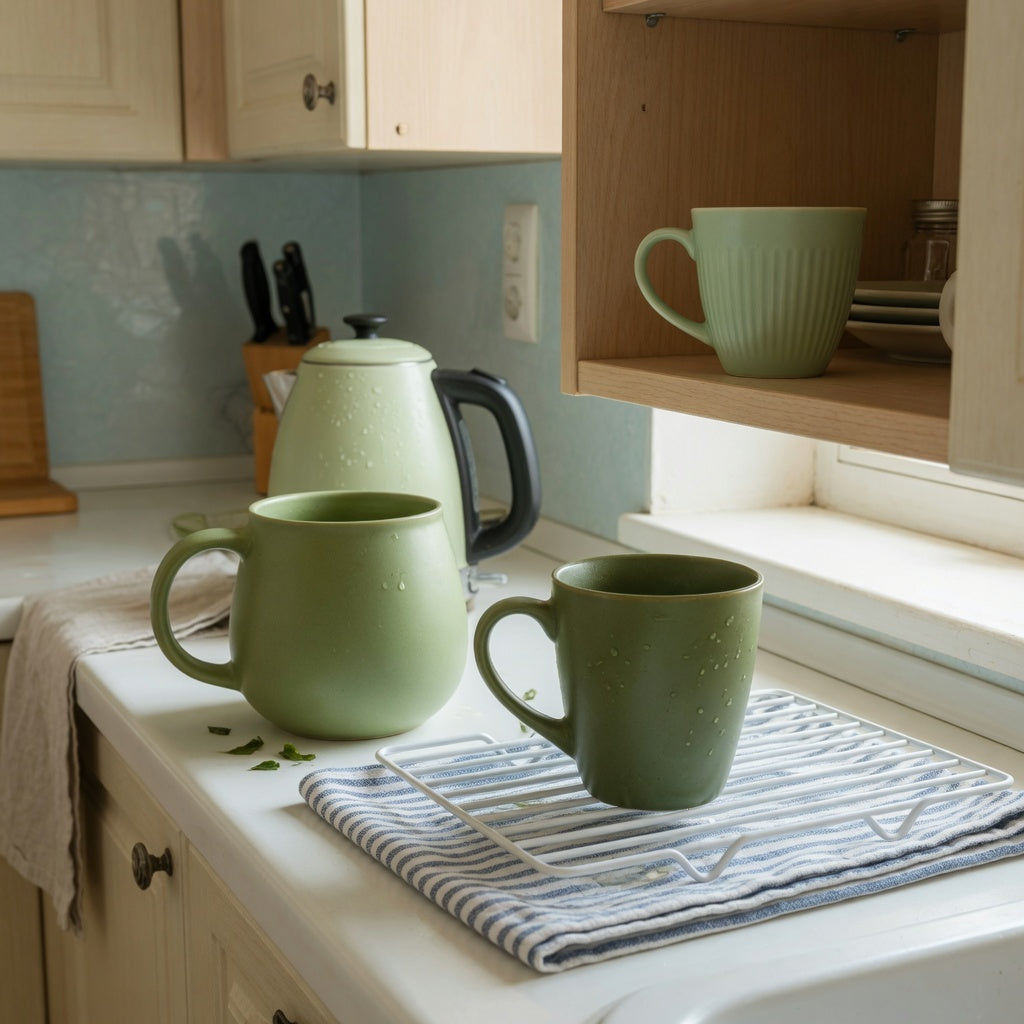
A mug rotation usually fails in three ordinary places: beside the kettle, in the drying rack, or under a low cabinet shelf. One cup is in use, one is waiting to be washed, and the latest purchase never returns to its assigned spot. At our store, we see shoppers care about design first, then discover that refill frequency and storage determine which mug is actually used. This green tea mug everyday mug rotation practical purchase checklist starts with that daily reality.
We are comparing only the facts available for these three options: the Retro is listed at 170 ml, the Pleated at 200 ml, and the Emerald at 270 ml. We also consider the visible shapes shown in their product photography. Capacity can help you estimate refill rhythm, but it does not establish outer dimensions, material, heat retention, brewing performance, origin, stacking ability, or care compatibility.
How should you use the green tea mug everyday mug rotation practical purchase checklist?
Watch your routine for two normal days before choosing. A busy workday and an ordinary evening reveal more than an idealized tea setup. When we help shoppers compare mugs, these are the details we ask them to record:
- Count refills correctly. Count each additional pour after the initial fill, stopping when the mug goes to the sink or drying rack.
- Identify the mug's home base. Note whether it spends most of its time on a kitchen counter, office desk, open shelf, or crowded cabinet.
- Measure the actual storage space. Record clear shelf height, shelf depth, and the width available for both the mug body and handle.
- Record the cleaning route. Note whether you normally hand-wash immediately, batch-wash later, or rely on a dishwasher. Care compatibility must be confirmed separately.
- Choose a drinking rhythm. Decide whether you prefer short, finished servings or one larger pour that needs fewer interruptions.
These checks prevent capacity from carrying more meaning than it should. A 170 ml listing establishes the smallest volume in this comparison, but it does not automatically prove the smallest outside dimensions. Likewise, 270 ml can reduce refill count only if you fill and drink more before returning to the kettle.
Which listed capacity matches your refill rhythm: 170 ml, 200 ml, or 270 ml?
The useful question is not which mug holds the most. It is which listed volume matches the amount you actually finish and the number of refills you tolerate.
| Reader situation | Why it may fit | Trade-off and next step |
|---|---|---|
| You prefer short pours and do not mind returning to the kettle. | The Retro's 170 ml capacity is the smallest listed option, so it aligns with a frequent-pour routine. | Expect more refills than with the other two capacities. Inspect the Retro 170 ml coffee and tea cup. |
| You want a middle option without moving straight to the largest capacity. | The Pleated holds 200 ml, which is 30 ml more than the Retro and 70 ml less than the Emerald. | It does not minimize refills or maximize volume. Compare the Pleated 200 ml coffee and tea cup. |
| You keep a mug near your desk and want fewer refill interruptions. | The Emerald's 270 ml capacity is the largest listed option, holding 100 ml more than the Retro. | There is more liquid to finish, and capacity alone cannot confirm shelf fit. Review the Emerald 270 ml coffee and tea mug. |
A listed capacity is a comparison value, not a required fill line. If you usually leave the last portion untouched, choosing 270 ml may add washing volume without reducing your kettle trips. If you refill a 170 ml cup immediately after every pour, the smaller size may create more interruptions than you want.
How will the visible shape work on a shelf, drying rack, or desk?
External geometry determines storage, and internal volume cannot stand in for measured dimensions. In the listing photography, the Retro appears lower and rounded, the Pleated has a visibly pleated exterior, and the Emerald presents a more upright silhouette. Those are visual observations, not dimensional or stacking guarantees.
- For a cabinet: measure the clear opening and include the handle area. Leave enough access to lift the mug without catching its rim on the shelf above.
- For a drying rack: compare the visible body and handle with your rack's tine spacing. A product photo can show profile, but it cannot guarantee a specific rack fit.
- For an office desk: check the open area beside your keyboard, notebook, and charging cables. Do not infer base dimensions or stability from capacity alone.
- For stacked storage: do not assume universal nesting. Check rim and body geometry, and avoid forcing mugs together when no stacking claim is provided.
The Pleated mug's contours are a visible design detail, but we do not turn that appearance into an unverified grip or cleaning claim. Choose the shape because it suits your space and style, then confirm dimensions on the current listing if exact clearance is a deciding factor.
Which mug fits short breaks, long desk sessions, or a shared kitchen?
A useful recommendation connects your routine to a reason for choosing, while also naming the compromise you accept.
- Short tea breaks: choose the 170 ml Retro cup if you finish smaller servings and enjoy separate trips to the kettle. It is not a good fit if frequent refilling already annoys you.
- A flexible middle slot: consider the 200 ml Pleated option if neither capacity extreme reflects your habit and the visible pleated design suits your shelf. Skip it if your main goal is either the fewest possible refills or the smallest listed volume.
- Longer desk sessions: check the 270 ml Emerald mug if a larger pour can reduce interruptions for the same total amount consumed. It is a poor match if you regularly leave tea unfinished or have not confirmed storage clearance.
- A shared kitchen with inconsistent storage: capacity may not settle the decision. Compare other visible profiles in our unique coffee mugs collection, then verify the dimensions and care details that matter to your household.
None of these verified facts establishes the mugs as insulated vessels, travel tumblers, or brewing systems. If you need a sealed lid, a capacity above 270 ml, or a product with a particular material or origin, a different style would serve you better.
Which care details must be confirmed for a mug used every day?
Daily rotation exposes care assumptions quickly. Dishwasher loading, microwave reheating, and repeated hand-washing are different workflows, but the verified information provided for this comparison does not include care guarantees. We will not promise compatibility with a dishwasher cycle or microwave based on appearance.
- Before purchase: read the current product page and any available care instructions for cleaning and reheating guidance.
- At unboxing: confirm that the item matches the ordered model, then inspect the rim, handle attachment, and base for visible transit damage before first use or gifting.
- For hand-washing: decide whether the visible profile, including the Pleated mug's contours, works with the sponge or brush you already use. This is a workflow check, not a cleaning-performance claim.
If dishwasher or microwave compatibility is mandatory and the current product information does not confirm it, pause the purchase until that point is resolved. An everyday mug should fit your real cleaning routine, not require an exception every night.
Which seven checks should you finish before adding a mug to cart?
- Count your actual refills across two normal days.
- Choose 170 ml, 200 ml, or 270 ml from that observed pattern.
- Measure the shelf, drying rack, and desk location the mug will use.
- Compare the visible body and handle shape with that space.
- Confirm current cleaning and reheating instructions instead of assuming them.
- Reject any option whose capacity trade-off already bothers you.
- Open the matching product page or compare another profile in the collection.
Keep the green tea mug everyday mug rotation practical purchase checklist beside the product photos as you compare. If capacity points to one mug but storage or care remains uncertain, treat the unknown as unresolved rather than filling it with a guess.
Frequently asked questions
How do I use the green tea mug everyday mug rotation practical purchase checklist?
Count how many times you refill before washing, then choose among the verified 170 ml, 200 ml, and 270 ml capacities. Measure the mug's intended storage location and compare the listing photos with that space. Confirm care instructions separately before ordering.
Is 170 ml too small for an everyday green tea mug?
It is too small if you dislike returning to the kettle or normally drink more before washing your mug. It can suit a shopper who prefers short, finished pours and accepts more frequent refills. The Retro is the 170 ml option in this comparison.
Should I choose a 200 ml or 270 ml mug for an office desk?
Choose 200 ml if you want the middle listed capacity and do not mind refilling sooner. Choose 270 ml if reducing refill interruptions matters more and you usually finish the larger amount. In either case, confirm the mug's external fit around your keyboard and storage area.
Can I put the Retro, Pleated, or Emerald mug in a dishwasher?
Dishwasher compatibility is not included in the verified facts used for this article, so we cannot promise it. Check the current product page, packaging, or included care instructions before using a dishwasher cycle. Do the same before microwave reheating.
Does mug capacity tell me whether it will fit or stack in my cabinet?
No. Capacity describes internal volume, while cabinet and stacking fit depend on outside height, width, handle projection, rim shape, and the mugs stored beside it. Measure your space and use current product dimensions where available rather than assuming fit from millilitres.
Count tomorrow's pours, measure the exact place the mug will live, and open the product that matches your refill pattern. If none clears both your storage and care checks, return to the unique coffee mugs collection and compare a different visible profile instead of forcing a capacity choice.
More from our blog
Read more
Ceramic Coffee Mugs With Large Handles: Everyday Mug Rotation Checklist
Compare cabinet clearance, finger room, capacity, care, and desk use across CoffeifyMug's large-handle ceramic mug styles before building a rotation that fits your actual week.
Read more
Dandelion Coffee Mug Everyday Mug Rotation Practical Purchase Checklist
A hands-on checklist for comparing 400 ml and 480 ml mugs by actual pour size, handle fit, cabinet space, care requirements, and everyday use.
Read more
Leave a comment
This site is protected by hCaptcha and the hCaptcha Privacy Policy and Terms of Service apply.