
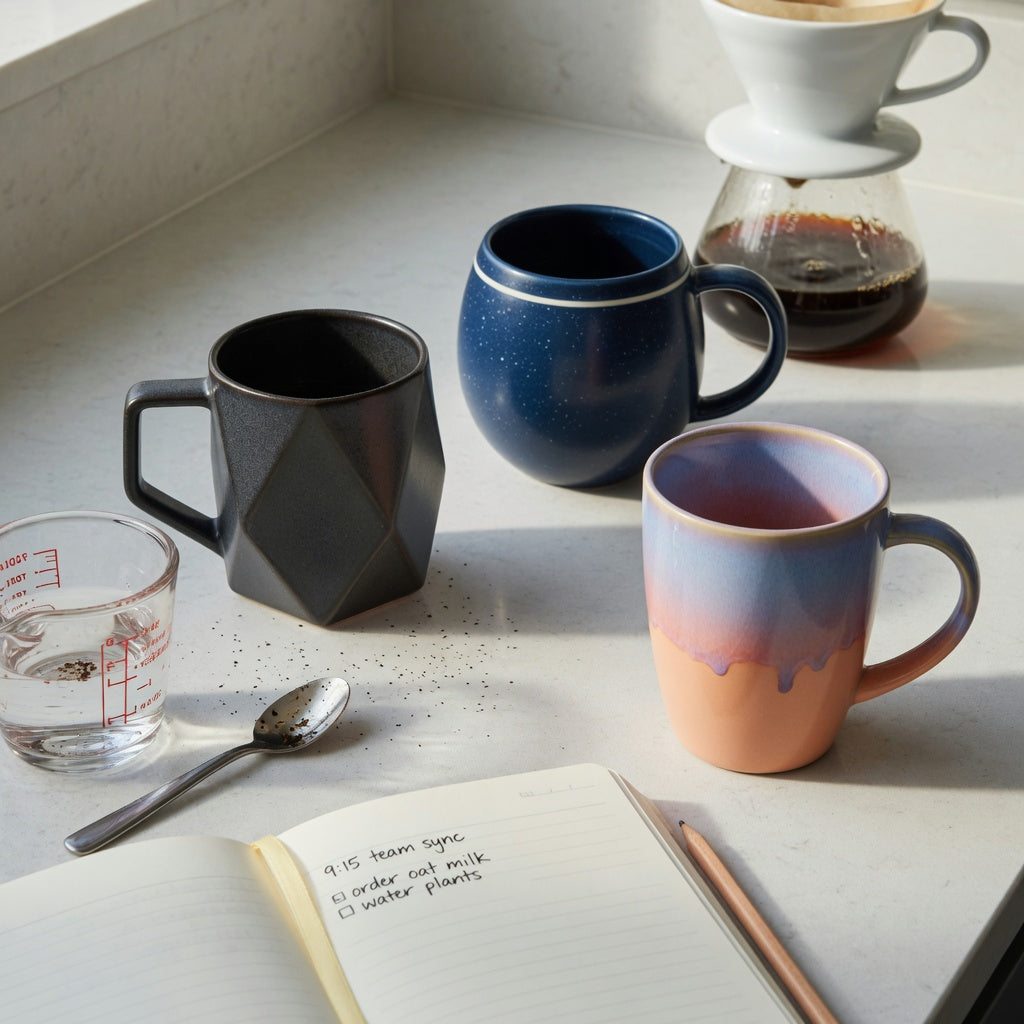
Geometric Coffee Mug Morning Routine Product Shortlist Guide: 3 Picks
Reading time: about 9 minutes
At 7:10 a.m., a mug can fail for an ordinary reason: your normal pour leaves no room for milk, the shape crowds the drying rack, or the cup is empty before you reach your desk. This geometric coffee mug morning routine product shortlist guide starts with those routine details, then narrows three current CoffeifyMug options by listed capacity, ceramic material, visible shape, and refill tolerance.
From handling and packing mugs in our store, we have learned that appearance gets a product onto a shopper's shortlist, but fit keeps it in daily rotation. We pay attention to the places where mugs actually cause friction: beside a full coffee maker, between office equipment, against dishwasher tines, and inside a cabinet already holding six other cups. The goal here is not to declare one universal winner. It is to remove the options that do not fit your morning.
Geometric coffee mug morning routine product shortlist guide: three filters
Before opening product pages, record three details from one normal morning. Use the drink you actually make, including milk, cream, foam, or extra water.
- Finished drink volume. Pour your completed drink into a measuring cup. If it measures 10 fl oz, a mug listed at 10 oz may not provide comfortable headroom for carrying. Capacity conventions can vary, so confirm the current listing rather than treating the number as a guaranteed fill line.
- Time from pour to last sip. A five-minute cup at the kitchen island creates different needs from a drink that sits beside a laptop for 35 minutes. Ceramic material matters, but wall thickness, starting temperature, and fill level also affect how long a drink stays warm.
- Refill tolerance. Decide whether your limit is zero refills, one planned top-up, or several smaller pours. A shape you enjoy may still be the wrong purchase if its listed capacity repeatedly sends you back to the coffee maker.
Use shape and color only after those filters. Visible planes can change how the body feels in your hand, while rounded forms provide a more continuous contact surface. Neither feature proves base stability, usable capacity, or heat performance. Check those points separately.
Which mug fits a stationary, one-pour kitchen routine?
Reader situation: You pour once, leave the mug beside the toaster or coffee maker, and finish the drink before moving to another room. You prefer a body with noticeable surface changes instead of a plain cylinder.
Why the Rhombus belongs on the shortlist: Its visible angular form gives the fingers distinct planes to recognize. In our hands, those changes make orientation easier to feel than on a completely smooth body. Choose it if that tactile quality matters and the current listed capacity covers your measured drink with carrying room.
Reasons to skip it: Angular high points may need more clearance from nearby mugs, plates, and dishwasher tines. It is also a weaker fit if you want a continuous curved palm rest or need mugs that stack tightly. Review the current capacity, base view, and form on the Rhombus coffee and tea mug product page before deciding.
Which form suits a walk from the brewer to an office desk?
Reader situation: Your first cup travels from the kitchen to a desk, reading chair, or window. You accept one refill and care more about a rounded hold than pronounced facets.
Why the Planet belongs on the shortlist: Its visible rounded geometry provides continuous contact around the body. That makes it the logical comparison for shoppers who dislike sharper transitions under the fingers. Confirm that the listed capacity fits your first pour and that the handle and overall width suit the space where you set it down.
Reasons to skip it: A rounded body offers fewer tactile reference points than an angular one. If tip resistance is your main concern, do not infer it from the product name or side profile; compare the base in the current photos. See the Planet coffee and tea mug for the listed material, capacity, and visible form.
Which option works as a visual morning cue or practical gift?
Reader situation: You enjoy seeing a distinctive mug on an open shelf, or you are buying for someone whose kitchen and desk already contain plain, solid-color cups.
Why The Gradient belongs on the shortlist: Its visible color transition is the clearest point of difference. During gift unboxings, that surface treatment is noticeable before the recipient checks capacity or care information. It can also provide an easy visual cue for a mug reserved for a particular drink or part of the day.
Reasons to skip it: A gradient does not establish heat retention, durability, or dishwasher compatibility. It is not the practical choice if surface appearance ranks below stackability, exact volume, or a documented care requirement. Check the current details and photographs for The Gradient coffee and tea mug rather than assuming the finish changes how the ceramic performs.
How do listed capacity, ceramic material, and shape trade off?
Material comparison is straightforward here because the three shortlisted options are ceramic. Ceramic can serve daily hot-drink routines well, but it can chip at the rim, base, handle joint, or a raised angular point if knocked against a faucet, plate, or hard countertop. Shape affects grip and storage; it should not be used as a shortcut for judging capacity or thermal performance.
| Option | Best starting scenario | Verify on the listing | Primary reason to skip |
|---|---|---|---|
| Rhombus | Stationary routine with a preference for angular grip cues | Listed capacity, base view, and rack clearance | You prefer smooth curves or compact stacking |
| Planet | Carrying the mug to a desk with one acceptable refill | Listed capacity, overall width, and base footprint | You want stronger tactile planes |
| The Gradient | Visual distinction, open shelving, or gifting | Listed capacity, care directions, and current finish photos | Appearance is secondary to utility |
A useful geometric coffee mug morning routine product shortlist guide should make it acceptable to reject all three. If every listed capacity is below your measured drink, or none fits your cabinet and care routine, browse the wider unique coffee mugs collection with the same three filters instead of forcing a poor match.
What should you check at unboxing and during the first wash?
We recommend doing the functional inspection before removing all gift packaging or placing the mug into a crowded wash cycle. Small issues are easier to spot on a clean, dry mug under direct light.
- Inspect the contact points. Check the rim, handle joints, base, and raised facets for a visible crack, sharp chip, or loose fragment. Do not continue using a visibly damaged mug.
- Test the base. Set the empty mug on a dry, level counter and press lightly near the rim from several directions. A grout line or warped tray can create false rocking, so use a genuinely flat surface.
- Follow the listed care directions. If the product page permits dishwasher use, leave enough rack space to stop the rim or angular body from striking plates and tines. If the care method is not stated, a soft sponge and non-abrasive wash is the cautious starting point.
- Avoid abrupt temperature changes. Let a hot ceramic mug cool before a cold rinse or a large addition of ice. Keeping separate mugs for immediate hot-to-iced drink changes reduces thermal-shock exposure.
Dry the foot ring before setting the mug on unfinished wood or paperwork. A coaster also catches the small amount of water that can remain under a freshly rinsed base.
Who should skip geometric ceramic for another mug style?
- Car commuters: Choose a lidded travel mug designed for a vehicle cup holder rather than an open ceramic mug.
- Small stacked cabinets: A straight-sided or purpose-made stackable mug may use the space more efficiently.
- Primarily iced-coffee drinkers: An insulated tumbler can manage condensation and long drink times better.
- Strict appliance requirements: If dishwasher or microwave compatibility is mandatory, choose only a listing that states the relevant care information clearly.
Visible geometry is a style and handling preference, not a reason to compromise on volume, storage, or safe care. A simpler mug is the better purchase when it fits more of your daily constraints.
A five-minute shortlist before checkout
- Measure the completed drink, not just the coffee portion.
- Allow headroom for milk, foam, and carrying.
- Set a maximum number of acceptable refills.
- Identify where the mug spends most of the morning.
- Measure usable cabinet height and nearby shelf clearance.
- Confirm material and care directions on the current product page.
Keep the Rhombus if angular grip cues solve a real preference. Keep the Planet if a rounded hold better matches the walk to your desk. Keep The Gradient if visible distinction matters for your shelf or gift recipient. Remove any option that fails the volume or care check, even if it is your favorite photograph.
Frequently asked questions
How do I use a geometric coffee mug morning routine product shortlist guide?
Measure one normal finished drink, record how long you take to finish it, and decide how many refills you will accept. Compare those answers with each product's current listed capacity before using shape as the deciding factor. This keeps the shortlist tied to your routine instead of appearance alone.
Which geometric mug is best if I hate refilling?
There is no responsible universal answer without comparing the current listed capacities with your measured pour. Choose the option that holds your finished drink with enough headroom to carry it comfortably. If none does, move to a larger non-geometric mug rather than accepting an unwanted refill.
Are the Rhombus, Planet, and Gradient mugs dishwasher safe?
Check the care instructions on each current product page because a shared ceramic material does not guarantee identical care. If dishwasher use is permitted, space the mug so its rim, handle, and raised surfaces cannot knock against other items during the cycle.
Can I switch from hot coffee to iced coffee in the same ceramic mug?
Avoid moving directly from a very hot drink to cold water or a large amount of ice. Let the ceramic cool first to reduce abrupt temperature stress. A separate insulated cup is usually more practical if hot-to-iced switching is part of every morning.
What should I do if none of the three mugs match my volume or cabinet?
Start with the CoffeifyMug unique mug collection and keep only listings whose current capacity covers your measured drink with headroom. Then compare grip, base, storage, and documented care. If no geometric option passes those checks, choose a straight-sided, stackable, or travel style that does.
More from our blog
Read more
Ceramic Coffee Mug With Handle: Morning Routine Purchase Checklist
Measure your finished drink, set your refill limit, then compare listed capacity, visible handle form, ceramic material, and vessel shape. This checklist also identifies details that product photos...
Read more
Minimalist Ceramic Mug Morning Routine Product Shortlist Guide
Compare round, pleated, and retro ceramic forms by your measured first-pour volume, time near the kettle, refill tolerance, visible shape, and handle preference. Each option includes a reason to ch...
Read more
Leave a comment
This site is protected by hCaptcha and the hCaptcha Privacy Policy and Terms of Service apply.