
Cappuccino Coffee Mug Home Coffee Station Product Shortlist Guide
Reading time: about 10 minutes
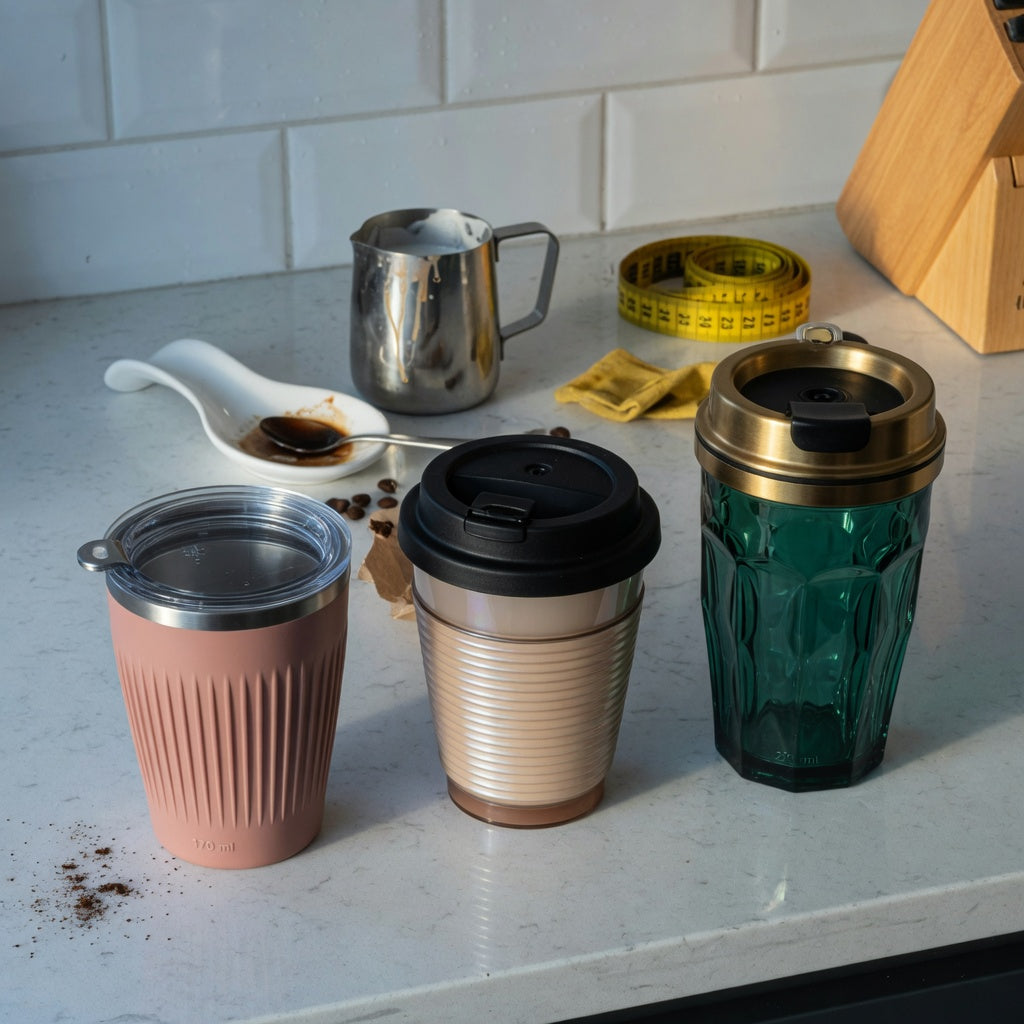
A milk pitcher, scale, spoon rest, and bean container can occupy the open counter beside a brewer before the cup has a place to land. The mug that looked right in a product photo may then miss the routine in one of two ways: its listed capacity is too close to your usual fill line, or its exterior size was never checked against the available space. This cappuccino coffee mug home coffee station product shortlist guide separates those questions and compares three verified catalog values: the Retro at 170 ml, the Pleated at 200 ml, and the Emerald at 270 ml.
In our store, we treat those capacities as a starting filter rather than proof of physical size or appliance fit. We are not claiming that any of these products was designed, tested, or certified for cappuccino. We also do not infer foam performance, heat retention, microwave or dishwasher safety, barista use, or clearance beneath a particular brewer. The useful comparison is narrower: your measured serving volume, the listed cup capacity, and the everyday station fit you can verify from current specifications.
Which size belongs in a cappuccino coffee mug home coffee station product shortlist guide?
Start with the cup already used most mornings. Before drinking, notice the usual fill line. Later, fill the clean cup with water to that same line and transfer the water to a graduated measuring jug. That gives you a more useful number than choosing according to the drink name, since households prepare milk coffee in different amounts.
Do not automatically match that measurement to an identical listed capacity. Leave whatever empty rim space you personally need to carry the drink from the station to a table or desk. If your usual fill line is close to a published capacity, the next listed size deserves consideration. We do not assume that a catalog capacity is the same as every shopper's preferred usable fill line.
| Option | Verified listed capacity | Reader situation | Reason to consider | Reason to skip |
|---|---|---|---|---|
| Retro | 170 ml | Your measured drink sits clearly below 170 ml | It is the lowest-capacity option in this three-product shortlist | Your drink approaches 170 ml or changes size often |
| Pleated | 200 ml | You need more room than 170 ml but do not need 270 ml | It adds 30 ml over the Retro | A 30 ml increase does not provide enough flexibility |
| Emerald | 270 ml | Your regular drink exceeds the practical range of the smaller choices | It adds 70 ml over the Pleated and 100 ml over the Retro | You intentionally make short drinks or have not confirmed exterior fit |
A coffee cup for cappuccino should earn its place through the routine you actually follow. The beverage label alone cannot tell you which of these three capacities is appropriate.
Why does a 170 ml label not prove a smaller counter footprint?
Capacity describes volume. It does not establish a cup's height, maximum width, base diameter, or handle reach. A lower-capacity vessel is therefore not automatically the shortest or narrowest choice. This distinction matters on a coffee station where a few centimeters can determine whether the cup interferes with a tray, cabinet, pitcher, or another stored item.
We ask shoppers to record four separate measurements rather than treating milliliters as a shortcut:
- Vertical clearance: Measure from the surface where the cup will rest to the lowest shelf, cabinet, or fixed appliance part above it.
- Usable width: Include the space needed by a handle if the selected cup has one, plus enough room to grasp it without moving another tool.
- Counter depth: Measure from the backsplash or wall to the front edge, allowing a sensible margin so the cup does not sit at the edge.
- Storage opening: Check the cabinet shelf, tray, or rack where the cup will live after the station is cleared.
Compare those numbers only with dimensions explicitly shown in the current product information. If a dimension needed for your setup is not stated, treat that part of the fit as unknown. Product photography can show proportions, but it is not a measuring tool and should not be used to promise clearance beneath a brewer.
Who should shortlist the 170 ml Retro?
The Retro has the lowest verified capacity in this group at 170 ml. It is the clearest candidate for someone who deliberately prepares a short drink and whose measured fill line sits comfortably below that number. The reason to choose it is serving-volume alignment, not an assumption that the outside of the cup must be smaller.
- Choose it when: Your daily serving is consistent, falls below 170 ml with your preferred rim space, and you do not need one cup to cover substantially larger guest drinks.
- Skip it when: Your fill line approaches 170 ml, you regularly add more milk after reaching the station, or you want one capacity for several different drink sizes.
- Next step: Review the current photos and available specifications on the Retro Coffee Tea Cup product page, then compare any stated exterior measurements with your station notes.
The 30 ml gap between the Retro and Pleated is meaningful only if your own serving measurement falls inside that gap. If it does not, style may decide between them, but capacity should not be used to manufacture a difference that your routine never notices.
Is the 200 ml Pleated enough of a step up?
At 200 ml, the Pleated occupies the middle position. It can make sense for a drink that needs more listed room than the Retro provides while remaining well below 270 ml. We often find that the middle option deserves the most scrutiny: 30 ml more than the Retro may solve a close capacity decision, but it is not a large jump.
- Choose it when: Your measured fill line rules out 170 ml, fits within 200 ml with the carrying space you prefer, and the station serves similar drink sizes most days.
- Skip it when: Your drink is already close to 200 ml, the household alternates between very short and much larger servings, or the modest increase over 170 ml does not resolve the issue.
- Next step: Open the Pleated Coffee Tea Cup product page and verify the current material, care information, photographs, and any dimensions provided there.
Do not infer grip, stackability, or cleaning performance from the Pleated name alone. Those are separate product questions and should be answered by current specifications or direct inspection, not by the capacity comparison.
When does the 270 ml Emerald make more sense?
The Emerald's verified 270 ml capacity gives it the largest allowance in this shortlist: 70 ml more than the Pleated and 100 ml more than the Retro. That makes it the relevant option when your measured drink cannot sit comfortably within 170 or 200 ml, or when you want more flexibility between weekday and guest servings.
- Choose it when: Your usual serving needs the larger listed capacity, you prefer more empty space below the rim, or one cup must accommodate more than one measured drink size.
- Skip it when: You consistently make a short drink, dislike unused volume, or are selecting it on the assumption that its exterior footprint matches either smaller-capacity option.
- Next step: Check the Emerald Coffee Tea Mug product page against your volume and station measurements before committing to the larger capacity.
A 270 ml label does not prove that the Emerald is taller or wider, just as it does not prove that it shares the same footprint as the other two. Exterior dimensions remain their own checkpoint.
Which material, care, and condition checks still matter?
Capacity does not answer material or care questions. If your search started with the phrase cappuccino cup ceramic, treat ceramic as a specification to verify on the current listing rather than a fact established by this shortlist. The same rule applies to surface finish, microwave use, dishwasher cleaning, and exposure to rapid temperature changes.
Before ordering, check these details on the current page:
- Material: Confirm the stated construction instead of identifying it from color, shine, texture, or a search result.
- Care directions: Look for explicit washing and appliance instructions. Do not run a first dishwasher cycle or place the cup in a microwave unless the current directions permit it.
- Exterior dimensions: Record height and widest measurement if provided. For an item with a handle or other projection, include that in the available station space.
- Included pieces: Verify exactly what the current product listing says is supplied rather than assuming accessories are part of the order.
At a gift unboxing or first kitchen setup, inspect the item under good light before putting it into service. Check the rim for chips or hairline damage, place the dry base on a clean flat counter to see whether it rocks, and inspect any handle attachment or projecting part from both sides. These checks do not imply a defect in a particular product; they are practical inspection points for drinkware that has traveled through delivery.
Should a two-person station use one size or mixed capacities?
One size works when both people prepare similar volumes and want similar rim space. If one person stops well below 170 ml while the other regularly needs more than 200 ml, buying two middle-capacity cups may satisfy neither routine. A mixed shortlist can be more practical: choose each capacity from a measured serving, then confirm that both exterior sizes fit the shared storage and counter area.
Gift buyers face a different problem because the recipient's fill line may be unknown. A 200 ml middle option is not automatically the safest gift. Look at a cup the recipient already uses, ask about their normal serving, or choose from current product information only after deciding how much uncertainty you are willing to accept. Style is a valid final filter, but it should follow capacity, dimensions, material, and care requirements.
A five-minute station audit before adding to cart
- Note the fill line in the cup used for an ordinary morning drink.
- Measure that line with water and a graduated jug rather than estimating by eye.
- Decide how much empty rim space you need for carrying the drink comfortably.
- Measure the station's maximum height, width, and depth, including the path used to pick up the cup.
- Check the current product page for material, care directions, included pieces, and any stated exterior dimensions.
- Write one reason to choose and one reason to skip the remaining option. If the skip reason affects daily use, remove it from the shortlist.
The value of a cappuccino coffee mug home coffee station product shortlist guide is that each option stays on the list for a stated reason. Retro 170 ml is the small-serving candidate, Pleated 200 ml is the measured middle step, and Emerald 270 ml is the larger-capacity choice. None earns an appliance-fit or care claim without separate evidence.
Frequently asked questions
Can a cappuccino coffee mug home coffee station product shortlist guide confirm clearance under my brewer?
No. This guide compares verified listed capacities and explains how to evaluate everyday cup fit, but it does not establish product dimensions or compatibility with a particular machine. Measure the available clearance and compare it only with current, explicitly stated product dimensions.
Is 170 ml enough for a cappuccino at home?
It can be enough if your own finished drink sits comfortably below 170 ml with the rim space you prefer. There is no serving assumption in this article that makes 170 ml right for every household. If your measured fill line approaches that number, compare the 200 ml and 270 ml options instead.
Does the 270 ml Emerald necessarily use more counter space?
Not necessarily. A larger volume does not by itself establish greater height, width, or base diameter. Confirm exterior measurements separately and do not rank station footprint from the capacity numbers alone.
Are these options confirmed as ceramic, microwave safe, or dishwasher safe?
Those details are not established by the verified facts used for this comparison, so we do not make those claims here. Read each current product listing and follow the care information supplied with the item. A product name, photograph, or search phrase is not a substitute for a stated material or care specification.
Where should I make the final comparison after measuring my drink?
Take your measured serving volume and station envelope to our unique coffee mugs collection, then open the three product pages side by side. Choose only the option whose listed capacity gives you the rim space you want and whose current specifications answer the fit and care questions that affect your setup. If a required specification is missing, confirm it before ordering rather than guessing.
More from our blog
Read more
Clay Pottery Coffee Mugs Replacement Purchase Product Shortlist Guide
Replace the mug that chipped, tipped, or no longer suited your routine. This practical shortlist compares three scenic options by physical fit, care requirements, daily setting, and reasons to skip.
Read more
Unique Christmas Coffee Mugs Gift Choice Product Shortlist Guide
Compare three distinctive coffee and tea mugs by recipient routine, seasonal style, cupboard space, and care expectations, with a clear reason to choose or skip each design.
Read more
Leave a comment
This site is protected by hCaptcha and the hCaptcha Privacy Policy and Terms of Service apply.