
Cacao Cup Size Decision Guide: 250 ml, 390 ml, or 400 ml?
Reading time: about 8 minutes
A cup that looks generous on a product page can feel undersized once your usual cacao is poured, stirred, and carried away from the kitchen counter. The reverse is frustrating too: a large cup occupies valuable desk space while a modest serving sits low inside it. This cacao cup size decision guide compares only the verified size facts for three current CoffeifyMug options.
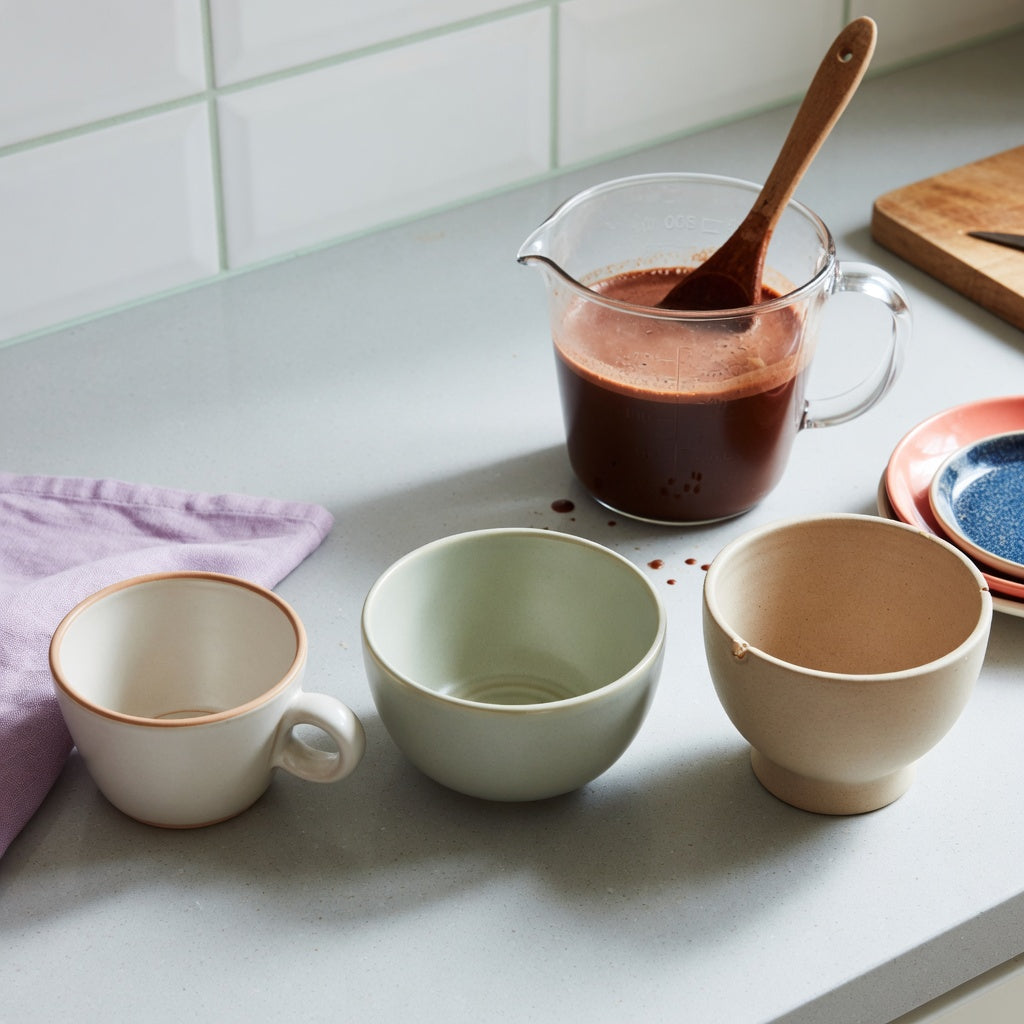
In our store, we start with the finished pour rather than an assumed serving standard. The current comparison is the Ball Handle at 250 ml with a listed 11.2 cm diameter, the Round at 390 ml, and the Spittoon at 400 ml. We treat all three as everyday drinkware. This article does not describe them as traditional, ritual, certified, or purpose-built cacao vessels.
Cacao cup size decision guide: what changes at each capacity?
There are two different size decisions hidden in this lineup. Moving from 250 ml to 390 ml adds 140 ml of listed capacity. Moving from 390 ml to 400 ml adds only 10 ml, so the Round-versus-Spittoon decision should rely heavily on visible opening, external form, and where the cup will be used or stored.
| Current option | Verified size fact | Situation it fits | Main limitation |
|---|---|---|---|
| Ball Handle | 250 ml and listed 11.2 cm diameter | Your finished pour and preferred headspace fit comfortably below 250 ml | Least room for extra liquid, foam, toppings, or ice |
| Round | 390 ml | Your pour outgrows the 250 ml option and you want a larger everyday cup | More cup and carrying weight than a modest serving may require |
| Spittoon | 400 ml | You use close to 400 ml or prefer its visible form and opening | Only 10 ml more listed capacity than the Round |
A listed capacity is a comparison figure, not an instruction to fill the cup to its rim. The usable amount depends on the freeboard you want for stirring, carrying, foam, or ice. We recommend measuring that working fill before choosing a size.
Is 250 ml enough after you leave room to stir?
The smaller option makes sense when your regular finished drink fits below 250 ml with the amount of headspace you prefer. Prepare cacao as you normally do, including the milk, water, or other liquid additions you actually use, then transfer it to a marked measuring jug. Do not rely on the volume of one ingredient because the finished pour is the number that must fit.
If that measured amount leaves comfortable room below 250 ml, the 250 ml Ball Handle cup is the direct option to inspect. It suits a contained solo serving, a kitchen counter where you do not want unused cup volume, or a gift recipient known to prefer smaller drinks. It is not a practical match for a recipe that already approaches 250 ml before foam, ice, or stirring room is considered.
The listed 11.2 cm diameter gives you one concrete measurement to compare against a shelf or countertop. Check how the product page labels that measurement before treating it as the internal opening, since overall diameter and usable rim opening are not automatically the same. A handle may also extend beyond a body measurement, so external fit deserves its own check.
Does the 390 ml Round solve the larger everyday pour?
The 390 ml Round cup is the practical step up if your measured drink cannot leave enough headspace in the 250 ml option. The 140 ml difference is substantial enough to accommodate a larger finished pour without pushing you all the way to a style selected mainly for its shape.
This size can make sense for carrying one larger drink from the kitchen to an office desk, but check the full footprint around keyboards, notebooks, cables, and the handle. More liquid also means more carrying weight, regardless of the cup's own weight. The Round is not the best fit for a consistently modest serving if cabinet room, desk clearance, or one-handed carrying is already tight.
Is the 400 ml Spittoon meaningfully larger than the Round?
By capacity alone, the difference is small. The 400 ml Spittoon cup provides only 10 ml more listed capacity than the 390 ml Round, so it should not be purchased with the expectation of a dramatically larger drink.
Choose it when your measured working fill benefits from the full 400 ml figure or when its visible shape and opening suit how you stir, serve, and display the drink. Compare product photos and any current external dimensions for shelf and dishwasher-rack fit. It is not the practical option if your only goal is a major capacity increase over the Round, and its product name should not be interpreted as a claim that it is a traditional or specialized cacao vessel.
How should visible opening, desk space, and ice affect the choice?
Capacity tells you how much volume is listed, but it does not show how a spoon moves inside the cup, how much surface is visible, or how the cup fits beside a laptop. This is why our cacao cup size decision guide does not rank the options by milliliters alone.
- For frequent stirring: Compare the visible opening and leave enough freeboard for the spoon to move without pushing liquid over the rim.
- For iced cacao: Measure the finished drink with the amount of ice you normally add. Ice occupies cup volume, so a liquid pour that fits 250 ml without ice may need a larger option once assembled.
- For an office desk: Check body width, handle reach, and clearance from the mouse, keyboard, charging cable, and papers. Capacity does not reveal the complete external footprint.
- For a kitchen shelf: Compare current external dimensions and shelf height rather than assuming the 250 ml option is smallest in every direction.
- For gifting: Match the recipient's known serving habit. If you do not know it, compare the visible forms in our unique coffee mugs collection instead of treating one capacity as a universal gift size.
We also avoid making heat-retention claims from the opening alone. Material, wall construction, starting temperature, room conditions, and the amount of liquid can all affect cooling. The verified size facts here do not support ranking one option as better insulated.
What should you inspect at unboxing and before a dishwasher cycle?
A size choice still has to work through regular use. Our team recommends checking physical condition, care directions, and storage fit as soon as a cup is unboxed, especially when it is intended as a gift.
- Inspect the rim: Look under good side lighting for chips, sharp spots, or hairline cracks. Do not use a damaged drinking rim.
- Check the handle joins: Examine both attachment points for cracks or separation before filling the cup with a hot drink.
- Test the base: Place the empty cup on a level counter and check for unexpected rocking that could make desk use awkward.
- Confirm care instructions: Do not infer microwave or dishwasher suitability from appearance. Follow the current material and care information on the relevant product page.
- Check dishwasher clearance: If the product's current instructions permit dishwasher use, position it so the rim and handle do not strike neighboring pieces or obstruct a spray arm.
- Avoid forced stacking: Do not stack cups whose shapes do not seat securely. Rim-to-base contact can create concentrated pressure and increase the chance of chipping.
Capacity alone cannot establish material, dishwasher compatibility, microwave compatibility, or thermal performance. Those details should be confirmed on the current product listing rather than assumed from cup shape or size.
A five-minute capacity check before ordering
Run through this sequence with your normal recipe and the product pages open:
- Prepare your usual cacao and measure the complete finished pour.
- Add the headspace you personally need for stirring, carrying, foam, toppings, or ice.
- Choose the Ball Handle only if that working fill sits comfortably within 250 ml.
- If you need more room, compare the 390 ml Round and 400 ml Spittoon by visible opening and external fit, not just their 10 ml capacity difference.
- Confirm current material, care directions, cabinet clearance, and dishwasher-rack space before ordering.
This method keeps the decision tied to the drink you actually make. Once you have the measurement, review the linked product that matches it or place the current options side by side in the unique coffee mugs collection.
Frequently asked questions
How do I use this cacao cup size decision guide for my usual recipe?
Measure the finished drink after adding the liquids you normally use, then decide how much room you want below the rim. Compare that working fill with the listed 250 ml, 390 ml, and 400 ml capacities. This avoids relying on an invented standard serving size.
Is the 250 ml Ball Handle too small if I add foam or ice?
It may be if the finished drink already approaches 250 ml before those additions. Foam, toppings, and ice all require space, so measure the assembled serving or allow your preferred headspace. Move to a larger option if the smaller cup would need to be filled uncomfortably close to the rim.
What is the practical capacity difference between the Round and Spittoon cups?
The Round is listed at 390 ml and the Spittoon at 400 ml, a difference of 10 ml. That small gap means visible opening, external shape, storage fit, and personal style should carry more weight than capacity alone. Neither should be treated as dramatically larger than the other.
Does the Ball Handle's listed 11.2 cm diameter mean the opening is 11.2 cm?
Not necessarily. The verified fact is a listed 11.2 cm diameter, but an overall diameter and an internal rim opening can be different measurements. Check the current product page wording and images before using that figure to judge spoon clearance.
Which current cacao cup size should I buy if I am still unsure?
Start by measuring one normal finished pour. Choose the Ball Handle if the drink and preferred headspace fit comfortably within 250 ml; otherwise compare the 390 ml Round and 400 ml Spittoon by form and opening. Use the current mug collection for the final side-by-side visual check.
More from our blog
Read more

Green Tea Mug Size Decision Guide: 170, 200, or 270 ml
Compare the Retro 170 ml, Pleated 200 ml, and Emerald 270 ml by refill preference and visible shape. See where each current size makes practical sense and where it does not.
Read more
Tall Ceramic Coffee Mugs Size Decision Guide: Small vs. Large
Compare smaller and larger tall ceramic mug capacities using your refill habits, shelf measurements, handle needs, and drink routine. This guide also shows how to verify current product details wit...
Read more
Leave a comment
This site is protected by hCaptcha and the hCaptcha Privacy Policy and Terms of Service apply.