



Brunch Coffee Mugs for Sideboard: What Buyers Compare
Reading time: about 14 minutes
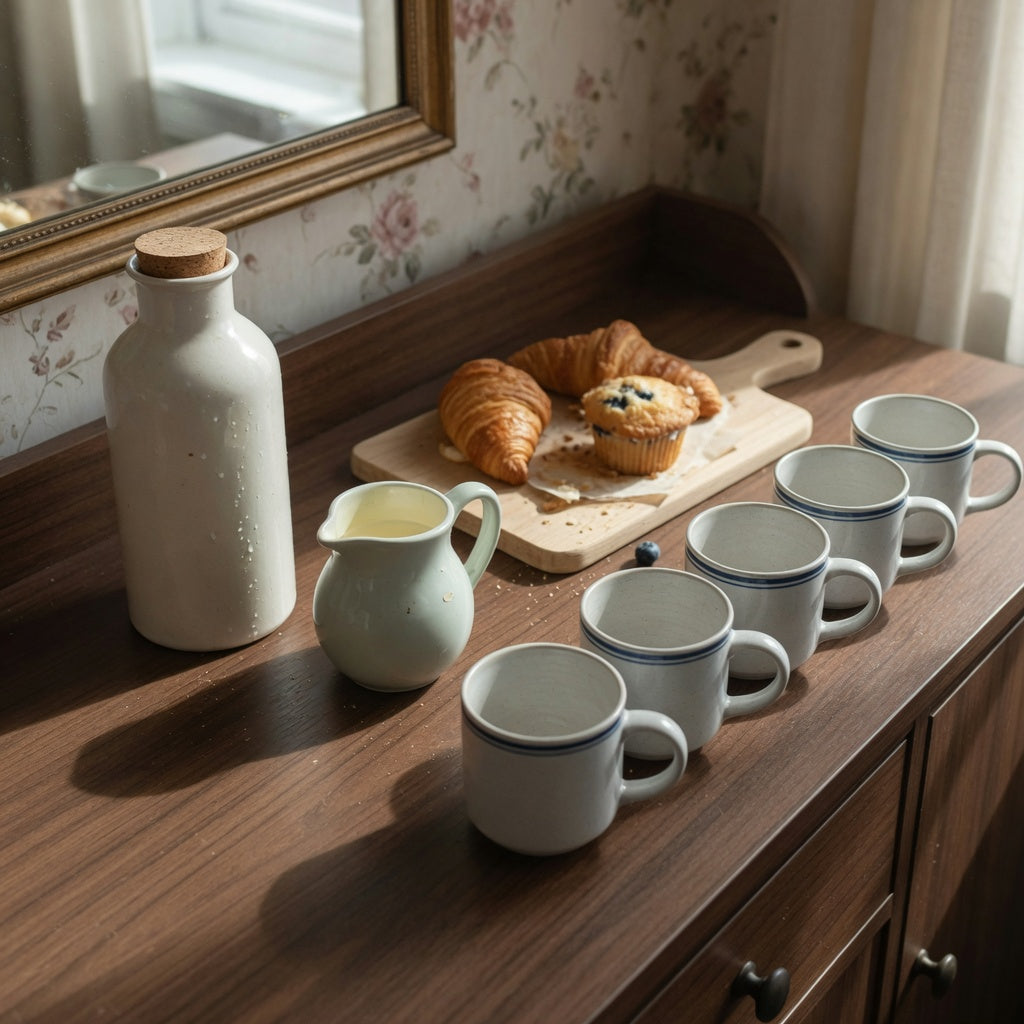
Four mugs, a carafe, cream, and a pastry board are enough to wreck a sideboard that looked calm an hour earlier. Two handles hang into the walkway. A tall cup covers the outlet. The slogan mug that looked sharp in the photo feels clumsy once it is full and someone has to carry it to the table. That is the job of brunch coffee mugs for sideboard use: take a hot pour, and still leave the buffet looking deliberate when people walk in. In our store, customer photos show the same miss. The print is chosen first. Shelf depth, handle swing, and how many cups stay out get settled after the box is already open.
A brunch station is not a cafe back bar, and it is not a closed kitchen cabinet. Food and drink share one top. Anything that lives there also meets dust, curious hands, and a later trip through the sink. A mug that only photographs well is the wrong buy.
Why brunch coffee mugs for sideboard have two jobs
Shoppers usually arrive with one of two pictures. One is a novelty ceramic with a brunch line or a breakfast illustration, sold on the slogan and a stated ounce size. The other is a styled buffet, where the mugs belong to the room and not only to the drink. Those problems are usually written up separately. On a real sideboard they are the same purchase.
A prop can live with a dusty well and an unknown glaze. A Sunday pour of coffee, tea, or a milky latte cannot. The interior surface, the stated capacity, and the maker's care notes matter more than the illustration. If the mug has to be both prop and pour, it has to clear both tests before it earns a permanent spot.
We would rather sell fewer mugs that survive the second brunch than a mixed pile that looks busy in a photo and fails once it is full. A printed theme is fine. It does not replace a food-contact surface you can stand behind, or a footprint that fits furniture you already own. Our team asks three questions before we point anyone at a sideboard mug: what drink goes in it, what clearance the buffet actually has, and whether the piece is for food or for display only.
Is an 8 oz cup or a larger brunch pour the better fit?
Capacity is the first number people ask for, and the first number that fails on a crowded buffet. A self-serve brunch usually means drip coffee, a milk-heavy latte, and tea. A smaller cup means more refills, and it usually clears a low shelf or a short cabinet. A larger mug, the 15 to 16 oz size shoppers compare for a leisurely pour, means fewer trips back to the carafe, but only if the sideboard, the cabinet, and the dishwasher can take it. Novelty brunch mugs are also marketed around 11 oz and 12 oz. None of those figures tells you the mug clears your shelf.
The 8 oz figure in regulatory writing is a category description, not a brunch recommendation. FDA ceramicware guidance treats cups and mugs as small hollowware commonly used for coffee or tea served above room temperature. They normally, but not exclusively, hold about 240 mL, or 8 fl oz, and they are made with a handle. A mug in that description has cylindrical sides. Use that as a definition of the category. Then read the ounces on the listing you are about to buy.
In our experience, the complaint that follows a brunch gift is rarely the print. It is the handle that will not clear the dishwasher rack, or the foot that creeps forward on a floating shelf every time someone reaches for sugar. On an open buffet, a wide rim lets heat off quickly. Some guests want that in a latte. Others want drip coffee that stays warm through a long conversation. A taller wall tips more easily if the foot is narrow and a sleeve or a pastry board nudges it.
Measure before you trust a size you saw in a product photo:
- Open height above the sideboard if a shelf, mirror, or window casing sits close.
- Interior height of the cabinet or drawer where the spare mugs will actually live.
- Dishwasher rack clearance, including the handle, not just the rim.
- Depth of the top, from the back edge to the overhang, so a handle does not become a hip-catcher in a hallway.
Stated capacity belongs on the current listing. Do not infer ounces from a lifestyle photo. The same rule applies on our own pages. The round coffee tea mug and the landscape tall coffee tea mug are different silhouettes, and the names are not measurements. Height, diameter, capacity, and how far the handle projects are facts to read on each listing. Start with the round listing when the top is already crowded and you hope the cup sits lower in the sightline, then confirm the published height and foot. Start with the landscape listing when the pour is the priority and there is open wall above the buffet, then confirm that height against the shelf and the cabinet. If you need several pieces that can read as one set, compare footprints in the unique coffee mugs collection before you commit to a print.
A large pour is a poor choice when the sideboard cabinet is short, the dishwasher rack is low, or children will carry full cups across a room. A tiny cup is a poor choice on a self-serve station, because guests hover at the carafe. Pick the volume for the drink you actually pour. Then reject any mug that fails the clearance test.
Should the mugs sit on the top, a shelf, or a hook?
The sideboard top is a work surface. Carafe, cream, sugar, napkins, and the mugs people are about to fill. It is a bad warehouse. Once the top is covered, there is nowhere to set a plate, and the coffee bar becomes a shelf you are afraid to touch.
Open shelves above the buffet can hold a short, edited row. Group by height and by a tight color story. Turn the handles the same direction so the line reads as one set. Leave gaps. A continuous wall of mismatched slogans looks like storage, not styling. Floating shelves also have a depth limit. If the mug foot is deeper than the shelf, it creeps forward every time someone reaches past it.
Hooks free the top, and they only work when three things are true. The mug hangs without the handle slipping. The hook is mounted into something solid and can carry the weight. The swing of the cup does not meet a head, a door, or the carafe. If a listing does not state weight, do not hang that mug until you know it. Heavy ceramic on a decorative hook is how a brunch station becomes a chip on the floor.
Closed storage inside the sideboard is where the rest of the set belongs. Guest mugs, seasonal prints, and anything you do not want coated in dust. If the station also has to look calm in the room, our notes on coffee mugs chosen for home decor cover the visual side. A desk station is a different constraint: less depth, more daily abuse, and almost no guest theater. The comparison of ceramic mugs for a desk coffee station helps when the buffet idea shrinks toward a corner of the counter.
How many mugs stay out, and how do you keep dust out?
Open display looks finished on day one. By the next weekend the wells have a gray film, especially near a window or a heat vent. Customers ask us how many mugs are reasonable. There is no universal household number. There is a split that keeps brunch coffee mugs for sideboard use actually usable, instead of turning the buffet into a cupboard nobody can reach.
- Two to four mugs within reach for the people drinking that morning.
- A small matching stack inside the cabinet for extra guests.
- Slogan or seasonal brunch mugs rotated in, then put away, instead of living on the shelf all year.
Upside down, the interior stays cleaner and the foot ring is what guests see. Pieces can scuff a printed exterior where they rub. Right side up, dust settles in the well and you wash before every pour. A cabinet door solves both. If you want the open look, keep the count low and wash that display set on a schedule, the way you would wash a bowl that sits out.
Matching mugs calm a buffet. A mixed novelty collection can work if you edit hard: similar height, one color family, handles aligned. Unedited, it reads as clutter, and clutter is what makes people dislike a coffee corner after a month. For a pair that will land on someone else's sideboard, the checks in our brunch gift pair comparison are the tighter brief. A gift pair does not have to solve storage for a family of six.
Open display is a bad home for a large everyday set, a worn interior, or any mug you are unwilling to wash before use. If dust bothers you, the sideboard is a serving moment, not a museum. If you plan to stack spares inside the cabinet, check whether the listing says the foot nests into the rim. Many mugs do not, and a forced stack chips the glaze at the lip.
What should you verify before hot coffee hits a printed mug?
A brunch illustration sits on the outside. The drink touches the inside. Those are different surfaces, and a cute exterior does not tell you how the glaze was formulated or fired.
FDA Compliance Policy Guide Sec. 545.450 sets an action level for lead in ceramic cups and mugs of 0.5 micrograms per milliliter of leaching solution in any one of six units tested. For cadmium, under CPG Sec. 545.400, the action level for small hollowware with a capacity under 1.1 liter is also 0.5 micrograms per milliliter in any one of six units. FDA evaluates these with methods that include ASTM C738, which extracts lead and cadmium from glazed ceramic surfaces using acetic acid. FDA states that lead can be extracted from some ceramic food-contact surfaces by food and can cause a wide variety of adverse health effects, including chronic lead poisoning with continued food use. The cadmium guidance notes that extractable cadmium from acid foods could cause chronic cadmium poisoning if that use continues.
Lead compounds have historically been used in glazes. If pottery is fired too cool, or without steady temperature control, the lead may not fully lock into the glaze and can leach into food. FDA has also said that ceramicware which shows extractable lead under the CPG Sec. 545.450 method should not be labeled lead free, and that such a label may be considered false or misleading. A marketing line is not the same thing as a passing test.
A 2017 pilot study looked at five ceramic mugs already known to contain lead. Lead measured in the coffee ranged from 0.2 to 8.6 micrograms per liter, and the amount tracked the cup more than the drink or the hold time. For one of the five mugs, the estimated daily dose exceeded California's 0.5 microgram per day Maximum Allowable Dose Level. Modeled blood lead levels in that study did not rise above the regulatory or guidance values the authors used. The shopping point is narrow. Mugs do not all behave the same, and a result from pieces already known to contain lead is not a blank assumption you can spread across every printed cup. Look for the maker's current test claims. Do not treat vintage or purely decorative ceramic as brunch drinkware.
We will not call a mug dishwasher safe or microwave safe unless the current listing says so in plain language. Surface prints can fade, craze, or lift across wash cycles even when the clay body is sound. If care instructions are missing, hand wash, skip the microwave, and do not read the silence as a yes. Cracked glaze, a gritty interior, or a piece sold only as decor is a display object. It is not the mug for hot coffee.
Round footprint or taller cup on a shallow buffet?
Match the silhouette to the furniture, then confirm the numbers on the page. The rows below are starting points, not measured promises about any single lot.
| Reader situation | Where to start | What to verify on the listing | A poor fit when |
|---|---|---|---|
| Shallow top already holding a carafe and food | Round coffee and tea mug | Height, diameter, capacity, handle projection, care notes | You need a very tall pour, or the listed foot looks narrow once you compare it with the height |
| Open wall above the buffet and a longer pour | Landscape tall coffee and tea mug | Overall height, foot width, capacity, cabinet and dishwasher clearance | A low floating shelf or a short sideboard cabinet is the only storage you have |
| Several pieces that need to read as one set | Unique coffee mug collection | Which listings share a color story and publish the same care limits | You grab unrelated prints and hope the sideboard edits itself |
If the current listing shows a lower, wider form, it usually fights a crowded top less, because the hand and the eye stay lower. Treat that as a shopping hypothesis, not a measurement. If the page shows a wide bowl on a small foot, it can still feel tippy, and you should pass. A taller cup suits a self-serve latte or a big drip coffee only when the vertical space is honestly free. It is a bad neighbor under a low picture light, or inside a cabinet with a fixed shelf a few inches down.
Neither shape is a good display-only piece you later decide to drink from. Neither one replaces a closed cabinet if the household owns more mugs than the buffet can stage. If the color or the handle on these two does not match the room, use the collection to compare other forms instead of forcing a mismatch onto the sideboard.
What to measure on the sideboard before checkout
- Name the drink: drip coffee, latte, or tea. Then read stated capacity on the listing.
- Measure top depth, open height, cabinet interior, and dishwasher rack, including the handle.
- Decide the home for each mug: in use on the top, a short row on a shelf, a hook, or closed storage.
- Cap the open display. Put the rest inside the sideboard so dust is not part of the place setting.
- Read care notes for the dishwasher and the microwave. If they are absent, do not invent a yes.
- Prefer food-contact ceramics with current maker guidance over vintage or decor-only pieces. Treat a lead-free claim as meaningful only when it matches how FDA uses that phrase.
- Check the color story. Similar heights and a short palette beat a pile of unrelated brunch slogans.
- If you are buying a pair as a gift, confirm both pieces share care limits so one is not hand-wash only while the other is not.
Start with the silhouette that matches the buffet, confirm every spec on the live product page, and keep the open count small enough that Sunday brunch still has room for the food.
Frequently asked questions
Can brunch coffee mugs for sideboard be used for hot coffee, or are they only decor?
Use them for hot drinks only when they are sold as food-contact ceramic and the current listing supports that use. A brunch print on the outside does not tell you how the interior glaze was fired, or whether lead or cadmium can leach. Decorative and vintage pieces belong on the shelf, not in the pour. If dishwasher or microwave guidance is missing, hand wash and do not microwave until the maker says otherwise.
Should mugs sit on the sideboard, on a shelf, or on hooks?
Keep the top for the carafe and the few mugs about to be filled. A short row on a shelf works if the heights match and you leave gaps. Hooks work only with a secure handle, a solid mount, and enough swing room. Everything else goes inside the sideboard. A crowded top is the fastest way to make a brunch station feel unfinished.
How do I stop dust collecting in mugs left on open display?
Leave fewer mugs out. Two to four for the morning pour is easier to wash than a full open shelf. Store the guest set behind a door. Upside-down display keeps the interior cleaner but shows the foot and can scuff prints. If dust builds within a week, the mugs are in the wrong place, not the wrong color.
Is a 15 or 16 oz mug better than a smaller cup for brunch?
It is better when you want fewer refills of drip coffee or a latte and you have measured the height. It is worse under a low shelf, in a short cabinet, or on a dishwasher rack that clips the handle. An 8 oz cup, the size FDA uses as a typical hollowware example, suits smaller pours and tighter clearances. Read the ounces on the listing rather than guessing from a photo.
Do matching mugs look better on a coffee bar than mixed novelty mugs?
On a sideboard, similar height and a tight color story almost always look calmer. Mixed brunch slogans can work if you edit them down to a short row and rotate the rest by season. An unedited collection reads as clutter, even when each mug was fun on its own. Buy the set you can stage, not the set that fills every hook.
When the measurements and the care notes line up, compare the round listing and the landscape listing against your buffet, or look through the wider set of unique coffee mugs before the sideboard fills with pieces you will only move aside.
Ready to pick your mug? Two ways to save on today's order:
Ordering 1–3 mugs? Get an extra 10% off your 1st order with code 10_OFF Apply 10% Off & Shop Wooden-Handle Mugs →
Gifting 4+ mugs? Buy 3, Get the 4th Free applies automatically at checkout (no code needed; offers do not stack) · Free standard shipping (Nov pre-Christmas delivery: 15–20 calendar days US) · Free replacement if chipped in transit.
Popular mug buying guides: Ceramic Tea Cups & Infuser Mugs · Ceramic Mugs with Lids Compared · Wooden-Handle Tea Infuser Mugs Compared · Christmas & Secret Santa Mugs 2026 · Espresso & Cortado Cups Guide · Cup & Saucer Gift Sets · All 25 Mugs Spec Table · Mug Size Guide · Shipping & Promo FAQ
FIRST ORDER 10% OFF (CODE: 10_OFF) · OR BUY 3, GET THE 4TH FREE


Read more
Pleated Coffee Tea Cup Ceramic Home Decor: What to Compare
Shoppers hunting a pleated coffee tea cup ceramic home decor piece often mix even porcelain folds with hand-pinched stoneware. We separate capacity, glaze wording, hot grip, and care so the cup mat...
Read more
Elk Moon Home Decor Mug: What Buyers Should Compare
An elk moon home decor mug can be a daily coffee cup or a shelf piece that should never hold a drink. We compare design type, capacity, print care, food-contact warnings, and gift timing so you can...
Read more
Leave a comment
This site is protected by hCaptcha and the hCaptcha Privacy Policy and Terms of Service apply.