

Big Latte Mug Capacity and Grip Guide: 400 vs 440 vs 480 ml
Reading time: about 10 minutes
A customer picks up The Rock from our shelf most weeks, wraps a hand around the handle, and asks whether a big latte mug at 480 ml is too much for one drink. The honest answer depends on what goes into it. A double shot with a modest stretch of steamed milk drinks very differently from the same mug filled near the rim. All three sizes in this comparison sit in our unique coffee mugs collection, so you can see the current range side by side.
What does 400, 440 or 480 ml mean for a big latte mug?
The FDA's compliance guide for ceramic hollowware does not set a latte-mug capacity. It describes cups and mugs as small ceramic hollowware commonly used for hot beverages that normally, though not exclusively, hold about 240 ml (8 fl oz) and are made with a handle. The same guidance treats anything under 1.1 liters as small hollowware, so every size here sits well above the everyday 240 ml mark.
U.S. fluid ounces convert at 29.5735 ml, the packaging factor given in NIST Handbook 130. Run our three listed capacities through that and you get:
| Listed capacity | Approx. U.S. fl oz | What that pour looks like |
|---|---|---|
| The Flow — 400 ml | ~13.5 fl oz | A 12 oz latte with a thin foam cap and a little headroom |
| Morning and Night — 440 ml | ~14.9 fl oz | A 12 to 14 oz drink with room to carry it without sloshing |
| The Rock — 480 ml | ~16.2 fl oz | A 16 oz iced latte, or a large hot drink filled short of the brim |
Notice that 480 ml is just over 16 fl oz, not exactly 16. If a recipe or pod machine is built around a 16 oz pour, that mug gives you a sliver of spare room rather than generous room. Add ice and the spare volume disappears fast.
Brim capacity versus the pour you can actually carry
Listed capacity is normally measured to the brim. Nobody drinks from the brim. Once you leave room for a foam cap and for the liquid to move while you walk, you are working with noticeably less than the number on the page.
A practical target is 1 to 1.5 cm of headroom below the rim. Applied to these three mugs, that lands roughly here:
- 400 ml — about 12 oz of usable volume, which is a clean 12 oz latte with a thin cap.
- 440 ml — about 13 oz usable, so a 12 oz drink sits comfortably or a 14 oz drink fits if you pour carefully.
- 480 ml — about 15 oz usable, which is where a 16 oz iced latte comes up short because ice displaces a surprising amount of liquid.
That last point catches people out. If you drink iced lattes by volume rather than by habit, a 480 ml mug is the smallest size here that behaves like a full-size iced glass.
How much handle room does a big latte mug need?
In our experience, handle complaints outnumber capacity complaints. A handle that looks generous in a product photo can still pinch because the opening narrows where it meets the mug wall. A slim handle can be fine on a light 400 ml mug and miserable on a full 480 ml one, especially if you carry it one-handed from the kitchen to a desk.
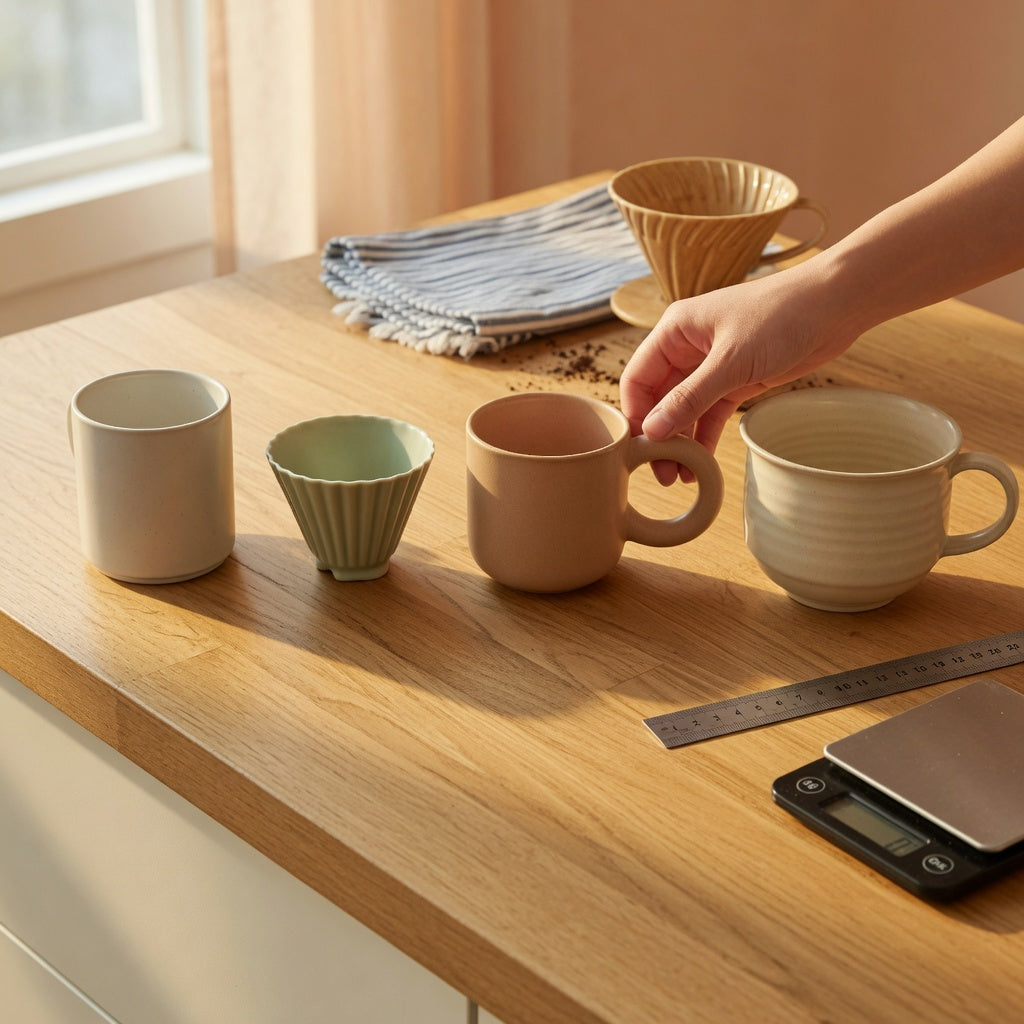
When you handle a mug in person, or judge one from listing photos, run through four checks:
- Finger count. Can two fingers pass through the opening without pressing against the ceramic?
- Thumb rest. Is there a flat or slightly flattened spot on top of the handle, or does your thumb slide?
- Knuckle clearance. With the mug full, does the handle push your knuckles into the mug wall?
- One-hand tilt. Can you tip the mug far enough to finish the last mouthful without re-gripping?
If you have small hands, the 400 ml The Flow is the lower-risk starting point because there is less liquid weight to manage. If a broad handle opening is non-negotiable, check the current listing photos and any published handle dimensions before you order. A capacity number will not tell you whether your knuckles clear.
Will it fit under the group head, on the shelf, or in a car cup holder?
A larger mug fails in three physical places far more often than it fails in the hand: under an espresso machine, under a cabinet, and inside a car cup holder.
Take three measurements before you commit:
- Drip tray to group head — with your scale already on the tray, not empty.
- Shelf or cabinet gap — measure the lowest shelf you would actually store it on, not the tallest.
- Cup holder diameter — if the mug is going in a car, the handle is usually what disqualifies it, not the base.
Shape matters as much as volume here. A wide, bowl-leaning cup is easier to pour latte art into because the surface is broader. A taller, straighter mug takes less horizontal counter space but may sit closer to a low group head. A partly filled wide mug also exposes more surface, which is worth thinking about if you sip slowly.
Which size fits how you actually drink?
The Flow 400 ml — for a 12 oz latte and a small kitchen
If your usual drink is a double shot with 200 to 250 ml of steamed milk, 400 ml leaves sensible headroom without turning the drink thin. It is also easier to tuck onto a crowded desk or a narrow apartment counter than the larger options. It is not the right pick if you routinely make 16 oz iced drinks or want a wide canvas for latte art.
Morning and Night 440 ml — for the undecided
At 440 ml, this is the middle size, and in practice that means it absorbs both jobs reasonably. A 12 oz hot latte fits with room; a moderately iced drink fits if you are not heavy-handed with ice. It is also the safer gift when you do not know the recipient's counter space, but it is still a compromise, so it does neither extreme perfectly.
See the Morning and Night 440 ml mug
The Rock 480 ml — for iced lattes and long mornings
480 ml earns its place when you want a full 16 oz iced latte, a long black coffee you sip for an hour, or a mug that doubles as a soup or cereal bowl on a lazy morning. Understand the trade: a 480 ml mug with a single shot and a small pour of milk produces a milkier, weaker-tasting drink, and it asks for more counter space than either of the others. It is the wrong mug for small hands or a cramped desk.
What does a full big latte mug weigh in your hand?
The liquid matters more than most shoppers expect. A millilitre of coffee and milk is close to a gram, so treat the liquid alone as roughly 400 g at 400 ml, 440 g at 440 ml, and 480 g at 480 ml. That is a bit over a pound before the mug's own weight is added, and a two-handed lift is normal at the top end.
This is where the size decision becomes physical rather than visual. If you carry a mug from kitchen to office desk every morning, or you drink standing up, the difference between 400 and 480 ml is the difference between a relaxed grip and a careful one.
Dishwasher, microwave, and reading a lead-free claim
Care guidance can vary by glaze and finish, so check the current listing for the specific mug you are buying. Do not assume that one mug's care instructions apply to its neighbours in the collection. If it will go through a dishwasher cycle or into a microwave daily, confirm that on the listing first.
On lead, the useful reference is the FDA's Compliance Policy Guide 545.450, which sets the lead action level for ceramic cups and mugs at 0.5 micrograms per millilitre of leaching solution, applied to any one of six units tested. Two things follow from that:
- A lead-free label is a claim, not a test report. A seller can print it without running a leach test.
- A test reference is worth more than an adjective. For a mug you use daily for years, look for a listing that points to testing against that guidance.
The FDA also notes that some ceramic foodware can leach lead from food-contact surfaces. That is a reason to buy from sellers who document their testing, not a reason to distrust ceramic generally.
When is a big latte mug the wrong buy?
Oversized is not universally better, and we would rather say so plainly:
- Small hands or grip issues. A full 480 ml mug is heavy and wide; 400 ml is the more forgiving choice.
- Single-shot drinkers. More volume means more milk relative to espresso, which dulls the coffee rather than showcasing it.
- Low group heads. Measure first — a tall mug plus a scale can exceed the clearance.
- Mostly tea. A partly filled 480 ml mug exposes a lot of liquid surface, and in our experience drinks cool faster that way than a smaller mug filled closer to the top.
- Cup holders and commutes. A handled ceramic mug is usually a desk mug, not a travel mug.
Frequently asked questions
Is 400 ml enough for a big latte mug?
For a 12 oz latte, yes — 400 ml is about 13.5 fl oz, which leaves roughly 12 oz of usable volume after a foam cap and headroom. It is only too small if you regularly make 16 oz iced drinks or want a wide bowl for latte art.
Will a 480 ml mug fit under my espresso machine?
We cannot answer that for your setup, and any seller who does is guessing. Measure the gap from the drip tray to the group head with your scale already in place, then compare it to the mug's listed height on the current product page.
How many ounces is 440 ml?
About 14.9 U.S. fluid ounces using the 29.5735 conversion factor. In practice that means a 12 oz drink sits comfortably and a 14 oz drink fits with careful pouring.
Do these mugs keep a latte hot for long?
We do not publish heat-retention figures for these mugs, so we will not invent them. Warming the mug with hot water before you pour is a practical step with any ceramic vessel.
Are these mugs dishwasher and microwave safe?
Check the current listing for the specific mug you are buying, since care guidance can vary by product rather than across the whole range. Do not assume that one mug's care instructions apply to its neighbours in the collection.
Pick your size in one pass
Run this checklist before you add to cart: your usual drink volume in ounces, converted at 29.5735 ml per fl oz; the headroom you want below the rim; the widest finger span you need through the handle; your group-head and shelf clearance; and whether the mug has to survive a commute.
If two sizes keep tying, take the smaller one — you can always pour slightly less, but you cannot shrink a mug that overwhelms your hand or your counter. Start with The Flow 400 ml for everyday lattes, step up to Morning and Night 440 ml for flexibility and gifting, and choose The Rock 480 ml only when the iced-drink or long-morning use case is genuinely yours. You can compare the full range in our unique coffee mugs collection.
More from our blog
Read more
Ceramic Mug Shapes: Handle Geometry and Daily Coffee Fit
How cylinder, belly, tapered, pleated, and handleless bodies change rim comfort, heat loss, hand fit, and shelf space — plus which of our 200 ml, 250 ml, and 400 ml shapes suits which drink, and wh...
Read more
14 oz Ceramic Coffee Mugs: 400 ml vs 440 ml Desk Mugs
A 14 oz label can mean 400 ml or 440 ml, and that gap changes headroom, handle balance, and how a desk mug feels. We compare the two capacities, material trade-offs, care checks, and which Coffeify...
Read more
Leave a comment
This site is protected by hCaptcha and the hCaptcha Privacy Policy and Terms of Service apply.