
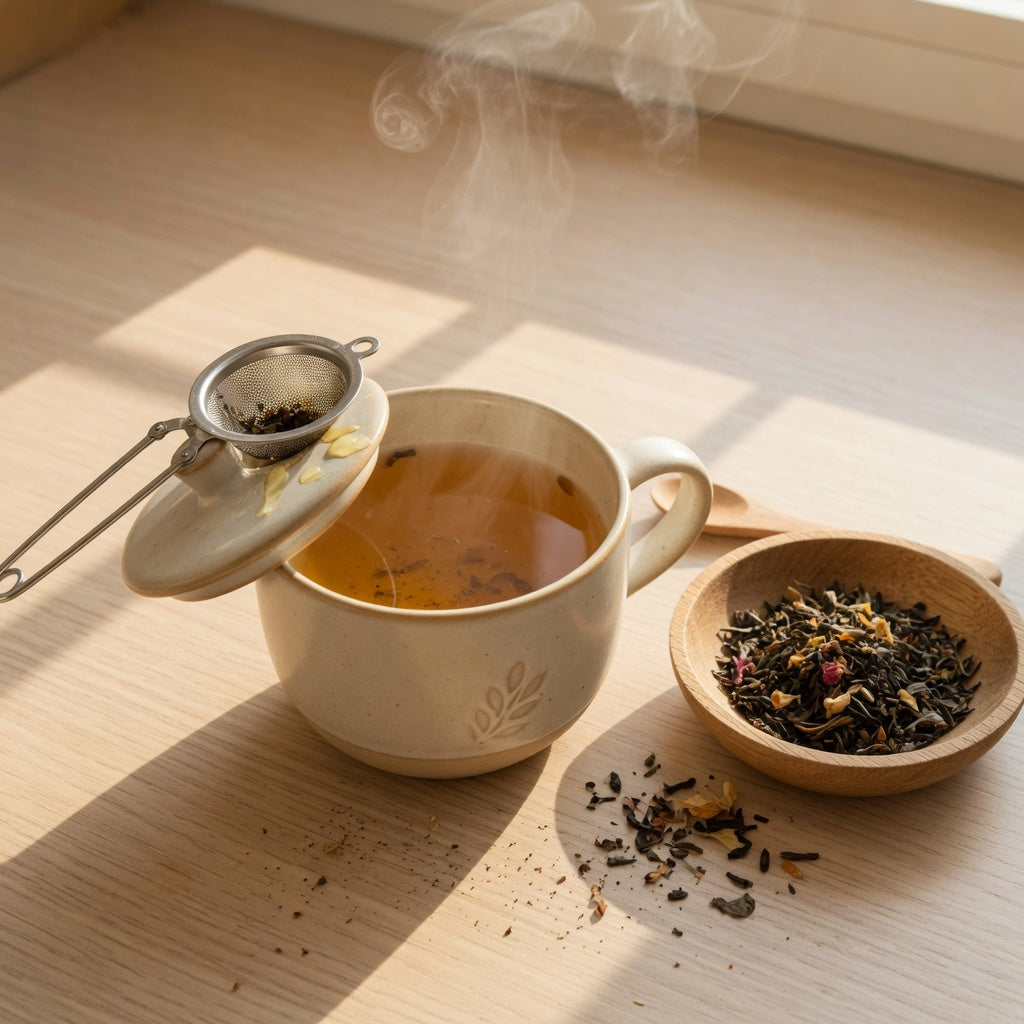
Best Mugs for Tea Drinkers: 7 Things Worth Comparing
Reading time: about 10 minutes
Roughly half of the tea mugs that leave our packing bench are second attempts. The first mug rarely broke — it cooled before the sitting ended, stained orange at the waterline, or pinched a knuckle every morning until it was demoted to the pen jar. Those repeat orders taught us something useful: the best mugs for tea drinkers aren't chosen by color preference. They're chosen across seven specific comparisons, and tea buyers weigh several of them differently than coffee buyers do.
What separates the best mugs for tea drinkers from an everyday coffee mug?
Any mug holds hot water. A tea mug earns its keep across a session rather than a sprint: smaller sips over a much longer sitting, constant checks on color as the leaves work, and often a second pour before the first is finished. That rhythm changes what matters. These are the seven comparisons we run through with customers at the counter:
- Material — how well it holds heat and whether it touches the flavor.
- Capacity and bowl shape — enough volume without a lukewarm second half.
- Interior color — your only honest read on strength.
- Infuser and lid setup — decisive for loose leaf, optional for bags.
- Handle fit and balance — judged full, never empty.
- Glaze safety — lead-free, food-contact claims you can actually verify.
- Care and stain behavior — dishwasher reality and tannin stains.
Porcelain, ceramic, glass, or insulated steel: which material suits your tea?
Material is where every trade-off lives. There is no single winner — each option gives something up:
| Material | Where it wins | Where it lets you down |
|---|---|---|
| Porcelain | Inert and non-porous, so it leaves delicate greens and whites untouched; light in the hand | Thin walls shed heat faster than stoneware; chips show quickly |
| Thick ceramic / stoneware | The best mug to keep tea hot through a long sitting; satisfying weight that warms your palms | Heavy when full; glaze quality varies a lot between makers |
| Borosilicate glass | You watch the steep happen; zero flavor transfer | Fragile, and it cools fastest of the four |
| Vacuum-insulated steel (ideally ceramic-lined) | Unmatched for commutes and desk days | No microwave; unlined steel can lend tea a metallic edge many drinkers notice |
In our store, thick ceramic wins for slow home rituals and porcelain for green and white tea drinkers who put flavor purity first. Glass suits people who brew visually — watching the leaves unfurl is part of the point — but nobody should hand a glass mug to a chronic table-edge knocker. If your tea mostly happens in the car, buy a dedicated insulated travel mug for tea instead of an open ceramic one. A full mug in a cupholder is a spill waiting to happen, and we'd rather say that than sell you the wrong tool.
A free upgrade most buyers skip: preheating
Whatever material you choose, swirl hot water in the mug and dump it before you pour. Thirty seconds of work buys noticeably more drinking time at temperature, and it costs nothing.
How much mug do you need — and what should the inside look like?
Size sounds simple until you've abandoned half a large mug at lukewarm temperature. The ground rules we use:
- 12 oz (about 350 ml) is the everyday sweet spot: most infuser baskets fit, a single strong steep fills it, and you finish it hot.
- 16 oz suits milky builder's tea and bulky herbal blends. Favor a narrower opening over a wide bowl so heat doesn't bleed off the surface. Full, a 16 oz ceramic tea mug carries just over a pound of liquid before you count the mug itself.
- 18 oz and up is grandpa-style territory — leaves go in, sink, and stay. Robust blacks and herbals handle the long contact; delicate greens turn bitter fast, so think twice before supersizing.
Interior color is the sleeper variable. A light or white interior lets you judge strength at a glance, which is how most tea drinkers decide when to pull the leaves. Dark interiors hide exactly what you're trying to see — though in fairness, they also hide tannin stains better. Choose which honesty you prefer: a light interior that shows both strength and staining, or a dark one that conceals both.
Loose leaf or tea bags: do you need a mug with an infuser and lid?
Loose-leaf drinkers shouldn't buy any mug before answering this one. Bag drinkers usually can.
- Choose a fine mesh infuser, not a steep basket with large holes. Finely cut blends slip straight through coarse mesh and leave sediment in the cup.
- A lid does double duty: it holds heat during the steep, then flips over as a rest for the wet infuser so your desk stays dry.
- Infuser systems mean more parts to wash, and some lids and baskets are hand-wash only. Read the care section on any listing before assuming dishwasher safety.
- Mostly bagged tea? A plain, wide, comfortable mug is the honest answer. Don't pay for hardware that will live in a drawer.
Will the handle fit your hand when the mug is full?
Handles are where our returns happen. A shape that looks sculptural in photos can pinch knuckles or feel tippy once filled, so judge every handle loaded, not empty:
- Knuckle clearance. Does the loop leave room for a full grip, or do your fingers ride the body?
- Balance when full. A mug that felt fine empty can pull forward at 16 ounces.
- Weight for the drinker. Smaller or arthritic hands notice every extra ounce by mid-mug. We haven't seen standardized ergonomic testing for handle designs, so in our experience the two-handed grip test — in the aisle or during your return window — beats any product photo.
A customer once told us she judges every mug with one question: can she cradle it in both palms during the second steep? Handles matter, but so does a body worth holding onto.
One defect mode worth knowing before you buy: handles crack where they join the body, usually after a knock or a cramped dishwasher rack. A hairline there will only travel. Pass on any mug with a visible join crack, at any price.
Lead-free glazes: what should you verify before you buy?
Glaze safety is the least glamorous comparison and the one we'd least want you to skip. The FDA sets an action level for extractable lead in ceramic cups and mugs at 0.5 µg per milliliter of leaching solution — a benchmark that exists precisely because small glazed hollowware used for hot drinks is a recognized exposure route. One pilot study measured lead leaching from some ceramic mugs into brewed tea at less than 0.2 up to 1.6 µg per liter. Small numbers. The direction is what matters: glaze quality is a safety feature, not a finish.
- Buy from listings that state lead-free, food-contact-safe glazes outright. Treat vintage and unbranded glazed mugs with suspicion, no matter how charming.
- Acidic brews stress compromised glazes hardest — a daily lemon tea raises the stakes on glaze quality.
- When a listing doesn't state food-contact safety, ask the seller directly. A seller who answers in specifics is telling you something; a seller who answers in evasions is too.
Tannin stains, crazing, and when to retire a mug
Tannin staining is normal, not dangerous — it's tea residue, not a defect. Most of it lifts with this routine:
- Make a paste of baking soda and a little water.
- Coat the stain and leave it overnight.
- Scrub gently and rinse. Stubborn marks usually yield to a diluted white vinegar soak after that.
Skip abrasive scrubbers on glossy glaze; they dull the finish and create micro-scratches that stain faster next time. Learn to recognize crazing — the fine crack lines that appear in a glaze after thermal shock, like pouring boiling water into a mug straight from a cold cupboard or a hot dishwasher. Crazing traps stains that never fully reverse. Once staining sits inside craze lines and won't lift, or the rim chips down to raw ceramic, retire the mug: exposed ceramic holds residue and is rough on the lip.
Dishwasher guidance varies more than buyers expect. Many plain glazed mugs tolerate a dishwasher for years; hand-decorated or metallic-finish pieces often don't. This is a per-listing fact, so verify it for the specific mug rather than assuming "ceramic" answers the question.
Which mug fits the way you actually drink tea?
Match the mug to the habit, not the reverse:
- The slow morning sipper wants a thick 12–14 oz ceramic mug with a light interior — hot brew, visible strength, no rush to finish.
- The desk or commute drinker needs a lid above everything else. If that leads you to ceramic-lined insulated steel instead of our shelves, that's the correct call, not a lost sale.
- The loose-leaf ritualist should hold out for a fine mesh infuser with a lid and at least 14 oz of headroom so the leaves can fully expand.
- The tea-and-coffee household is exactly who our Round Coffee Tea Mug is aimed at — round-bodied, and named for both drinks, which suits a cupboard shared by two beverages. What we won't do is quote its capacity, glaze finish, or dishwasher guidance from memory, because those details can change between production runs. Check the live listing, and message us if anything isn't spelled out. To be plain about its limits: if you need a built-in infuser and the listing doesn't show one, this isn't your loose-leaf mug.
- The gift buyer should weight character over specs. A mug that makes someone smile gets used more than a technically perfect one that doesn't. That's why most gift shoppers end up in our unique coffee mugs collection — tea drinkers browse it constantly, because in most households the mugs serve both drinks anyway.
A 60-second checklist before you order
- Material matches your tea and your pace: porcelain for delicate, thick ceramic for heat, glass for watching, insulated for travel.
- Capacity sits between 12 and 18 oz, in a shape that doesn't bleed heat off a wide surface.
- Interior is light enough to judge strength at a glance.
- Handle passes the full-mug grip test — knuckle clearance, balance, weight.
- Glaze is stated as lead-free and food-contact-safe.
- Care instructions match your sink reality, including every infuser part.
Run any shortlist through those six and you'll end up with a mug still in rotation two years from now — the real definition of the best mugs for tea drinkers, not a badge on a bestseller list.
Frequently asked questions
What size mug is best for tea?
Most tea drinkers are happiest between 12 and 18 oz. Twelve ounces fits a standard steep and gets finished while it's hot; 16–18 oz suits milky builder's tea or bulky herbal blends. If you sip slowly, a smaller mug refilled hot beats a large one that cools past the halfway mark.
Is porcelain or ceramic better for tea?
Neither is objectively better — they optimize for different things. Porcelain is non-porous and inert, ideal for delicate green and white teas where you don't want anything touching the flavor. Thick ceramic holds heat longer, which suits black tea and long sittings. Pick based on how fast you drink and how hot you like your refills.
What are the best mugs for tea drinkers who steep loose leaf?
Look for a mug of at least 14 oz with a fine mesh infuser and a lid that doubles as an infuser rest. Fine mesh keeps small leaf particles out of the cup, and the lid holds heat during the steep. Confirm on the listing that both parts are dishwasher-safe if you won't hand wash — infuser accessories vary more than the mugs themselves.
How do I remove tannin stains from a tea mug?
Make a paste of baking soda and water, coat the stain, and leave it overnight before scrubbing gently. Stubborn marks usually yield to a soak in diluted white vinegar. If staining sits inside crazing cracks and won't lift, the glaze is compromised and it's time to retire the mug.
Are ceramic mugs safe for hot tea?
Quality ceramic is one of the safest materials for hot drinks — inert, stable, and microwave-friendly in plain glazed form. The real safety question is the glaze: the FDA maintains an action level of 0.5 µg/ml for extractable lead in ceramic mugs, so buy from sellers who state lead-free, food-safe glazes, and retire any mug with a chipped rim or permanent craze staining.
Shortlist two or three candidates, run each through the checklist above, and pick the one that fits your hand and your routine. If plain white cylinders bore you as much as they bore us, start in our unique mug collection and let the design break the tie.
More from our blog
Read more

Shelf to Table Mug Styling: What to Compare Before You Buy
Use-first shelf to table mug styling keeps ceramic mugs visible on open shelves and moving onto the table, not stranded in a back row. Compare silhouettes, shelf zones, cleaning routines, and lead-...
Read more
Coffee Mug Gift Guide for Tea and Coffee Drinkers: What to Compare
Our working coffee mug gift guide for tea and coffee drinkers compares capacity, interior glaze, material, handle fit, and dishwasher durability — and names who should skip a dual-use mug entirely.
Read more
Leave a comment
This site is protected by hCaptcha and the hCaptcha Privacy Policy and Terms of Service apply.