
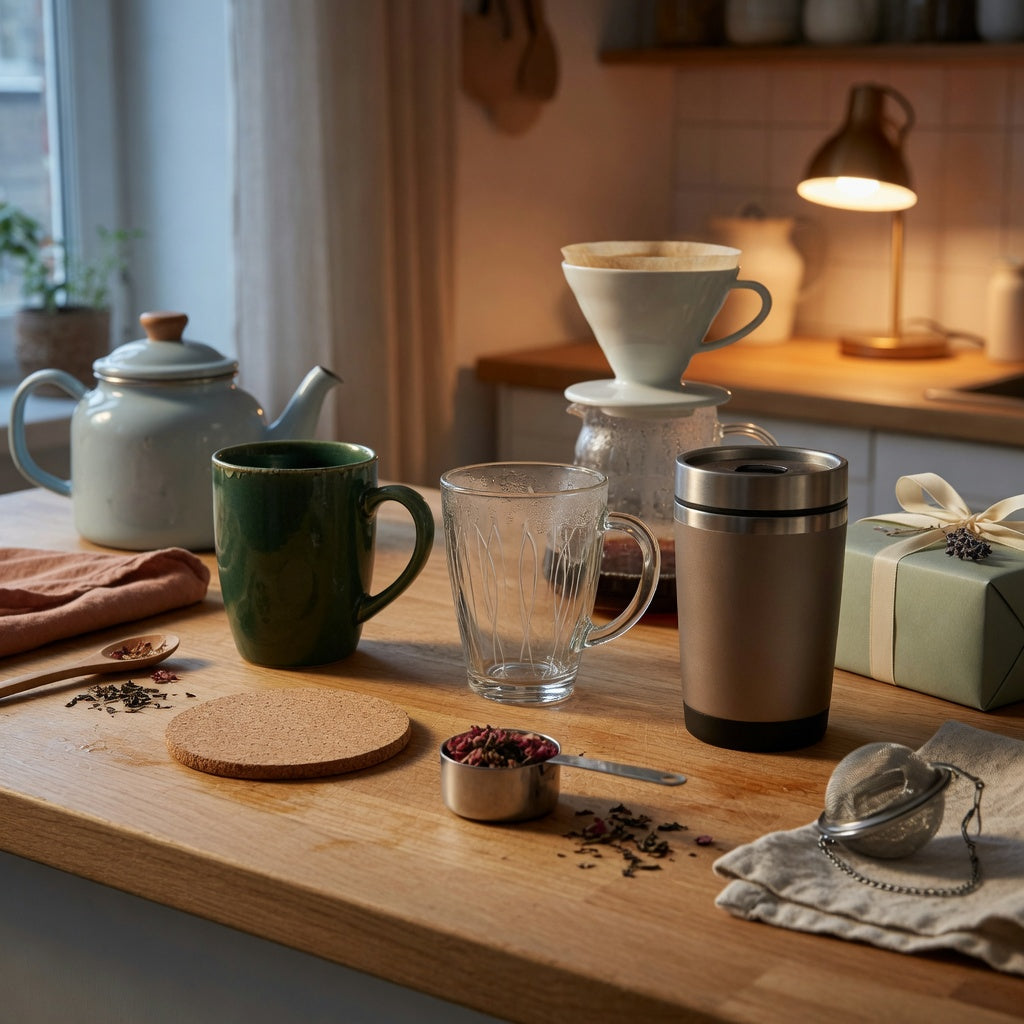
Best Mugs for Coffee and Tea Gifts: Size, Material, Care
Reading time: about 10 minutes
A mug can look perfect in a gift box and still be the cup nobody reaches for the next morning. The best mugs for coffee and tea gifts earn a place beside the kettle because they suit the recipient’s normal pour, grip, and sipping pace, not just the wrapping paper.
In our experience selling and handling this category, shoppers often compare color and artwork first. We reverse the order. Capacity, full-mug balance, handle clearance, rim profile, base stability, material, and care instructions are what people notice at 6:15 a.m. with coffee, in an office after lunch, and with tea before bed.
Which mug size fits both morning coffee and evening tea?
Start with the cup the recipient already uses. For a surprise gift, fill that cup with water to their normal drinking level and transfer the water to a measuring cup. This reveals their usable pour, which may be lower than a mug’s stated brim capacity.
A 12-ounce mug is a sensible candidate for many mixed coffee-and-tea routines, but it is not an automatic answer. Someone who adds milk needs headroom. A loose-leaf tea drinker may need space for a basket infuser, while a person brewing directly through a pour-over dripper needs a mug that fits beneath the brewer.
- Measure the normal fill: Compare the recipient’s actual pour rather than choosing from the words small or large.
- Allow working room: Milk, foam, tea bags, infusers, and the short walk from kettle to desk all require space above the liquid.
- Check equipment clearance: Compare the mug’s height and opening diameter with a coffee machine, dripper, or tea basket if the listing provides those measurements.
- Remember filled weight: A larger drink adds considerable weight before the vessel itself is counted. That matters for smaller hands, limited grip strength, and long desk sessions.
The supplied catalog identifies the Morning & Night Large Ceramic Coffee Mug as large and ceramic. That makes it a logical candidate for someone who already prefers a substantial ceramic format. The exact ounce capacity, dimensions, and empty weight are not confirmed by the catalog title, so verify those details on the current listing rather than estimating from a photo.
Will the handle, rim, and base feel right when the mug is full?
An empty mug can hide poor balance. When we handle a mug, we fill it with water before judging the grip because the added load can make a small handle pull forward or press the drinker’s knuckles against the body.
- Handle clearance: Find out whether the recipient uses a two-finger or three-finger grip. The loop should allow that grip without forcing the fingertips to pinch a full mug.
- Balance: Look at where the handle joins the body. A large body paired with a short loop may create more wrist torque, but a photo alone cannot confirm comfort. Listed weight and handle dimensions are more useful.
- Rim profile: A thin or tapered rim can feel precise, while a rounded, thicker rim can feel softer. Neither is universally better. The drinking edge should be smoothly glazed and free of chips or rough spots.
- Base and foot ring: A flat base matters on a desk crowded with a keyboard and notebook. An exposed foot ring can feel rough against wood, making a coaster a useful pairing.
Opening diameter affects more than appearance. A basket infuser must be easy to insert and remove, and a pour-over dripper needs enough rim to sit securely. If grip or geometry is the main concern, use our unique coffee mug collection to open several candidate listings, then prioritize pages with side views, top views, and actual measurements.
Inspect the delivered gift before wrapping it. Set it on a flat counter to check for rocking, run a fingertip around the clean, dry rim, and examine both handle joints for a visible hairline crack. These thirty-second checks catch the defects that matter far more than a minor variation in glaze color.
Ceramic, porcelain, glass, or insulated steel: which setting fits?
Stoneware and porcelain are both types of ceramic, although stores often list them separately because their typical weight, wall profile, and appearance differ. There is no honest universal heat-retention winner based on the material name alone. Opening size, wall thickness, fill level, room temperature, and the presence of a lid all affect how quickly a drink cools.
| Material label | Recipient and setting | Trade-off to check |
|---|---|---|
| Stoneware or glazed ceramic | A familiar home or office-desk ritual with a substantial feel | Can be heavy and breakable; weight, wall thickness, and appliance care vary by listing |
| Porcelain | Someone who prefers a visually lighter profile or a finer rim | Porcelain can be made thin, but it is not automatically lighter, tougher, or dishwasher-safe |
| Glass | A tea drinker who enjoys seeing brew color or a coffee drinker who likes visible layers | Single-wall glass may feel hot to hold; thermal-shock and appliance instructions require checking |
| Insulated stainless steel | A slow sipper, commuter, or outdoor drinker | Confirm lid security, leak-resistance wording, and gasket cleaning; metal must not go in a microwave |
All else being equal, a broad opening exposes more liquid surface than a narrow one and may allow faster cooling. A lid changes that equation. So does preheating the vessel. This is why a material label cannot replace the recipient’s real setting and pace.
A conventional ceramic mug is not the right brief for a bag commute unless the exact listing confirms a secure travel lid and suitable leak resistance. An insulated travel vessel has the opposite limitation: it may feel too utilitarian for someone who wants a sit-down mug they can reheat in a microwave.
The best mugs for coffee and tea gifts by sipping pace and setting
The drink matters, but the way a person drinks it often matters more. This scenario-first filter helps us avoid recommending a visually attractive mug that conflicts with the recipient’s daily routine.
- Slow desk sipper: Consider insulation, a lid, or a smaller mug that encourages fresh refills. A very large open vessel may leave the last portion cooler than they prefer.
- Quick morning coffee drinker: Favor enough usable capacity for one normal pour, a stable base, and a handle that remains comfortable under full weight.
- Loose-leaf tea drinker: Verify the opening diameter against their basket infuser and leave enough headroom to lift the basket without spilling.
- Coffee-with-milk drinker: Compare usable capacity after allowing space for milk or foam. Brim capacity is not the number they will actually drink.
- Shared kitchen or office: A broadly appealing single mug or matching set may work better than permanent personalization. Confirm dishwasher care if communal cleanup is part of the routine.
- Iced-drink or commute-only recipient: Choose a straw tumbler or purpose-built travel mug instead. A traditional gift mug may never leave the cabinet.
If the recipient keeps a mug on a counter or desk, has asked for a larger format, and prefers ceramic, the Morning & Night product page is the focused next place to compare because its confirmed catalog category matches those preferences. If you know the routine but not the person’s preferred shape or artwork, compare candidates in the broader unique mug collection instead.
Which care and food-contact details should a gift mug listing state?
The word ceramic does not establish dishwasher safety, microwave safety, or food-contact compliance. Those are separate listing-level claims. Glazes, printed decals, metallic details, and applied decorations can each change the care requirements.
- Dishwasher instructions: Check whether the whole mug is dishwasher-safe or whether the decoration requires hand washing.
- Microwave instructions: Do not assume ceramic means microwave-safe. Mugs with metallic decoration generally stay out of the microwave unless the manufacturer explicitly states otherwise.
- Thermal-shock guidance: Avoid moving a fridge-cold vessel directly to a boiling fill unless its maker confirms that use. Sudden temperature changes can stress ceramic and glass.
- Food-contact wording: Look for a clear statement covering the interior and drinking rim, not just a general claim about the decorative exterior.
- Testing documentation: For handmade, artisan, or imported pottery, ask what was tested and by whom. Country of origin alone does not prove or disprove safety.
For U.S. ceramicware, the FDA action level for lead leaching in cups and mugs is 0.5 µg/mL of leaching solution, with action based on any one of six units tested. FDA guidance describes testing extractable lead from glazed ceramic surfaces with ASTM C738 or equivalent AOAC methods. That regulatory threshold does not prove that a particular mug complies; product-level evidence must come from the seller or manufacturer.
Also watch for glaze condition over time. A fine network of lines in a glaze is called crazing. It can be an intentional finish or can develop with use, so appearance alone is not enough to diagnose a problem. If new lines appear alongside staining, a rim chip, or a body crack, stop using the mug and ask the maker for guidance.
For the Morning & Night mug, treat dishwasher, microwave, food-contact, and thermal-shock status as unconfirmed unless the current exact product page states each detail. Do not transfer care instructions from another ceramic mug that looks similar.
Should you give one mug, a pair, or a personalized piece?
- One distinctive mug: Best when you know the recipient’s taste or want to replace a chipped favorite. The risk is choosing a grip or capacity they dislike.
- A matching pair or set: Useful for couples, shared tea breaks, or frequent hosts. It requires more cupboard space and may be unnecessary for a one-person hot-drink routine.
- A personalized mug: Appropriate when the name, date, or phrase has lasting meaning. Confirm spelling and preview placement because personalization can restrict returns and make regifting awkward.
- An artisan piece: A strong option for someone who values handmade variation. Ask about food-contact testing, glaze care, and whether size differences are expected between pieces.
Keep presentation useful. Pair the mug with one coffee or tea the recipient already enjoys, rather than filling the box with accessories they may never use. Add a basket infuser only after confirming the opening diameter, and add a coaster if the mug’s foot could be rough against a wood desk.
What should you verify on the Morning & Night mug page?
Use the live Morning & Night mug listing as the final source before checkout. The catalog information available here confirms the product name and its large ceramic category, but it does not establish the remaining specifications.
- Exact capacity in ounces or milliliters, including whether it is brim or usable capacity
- Overall height, opening diameter, base width, and handle clearance
- Empty weight and enough photography to assess the intended grip
- Dishwasher and microwave instructions stated separately
- Food-contact language or available testing documentation
- What is included, such as one mug, a set, lid, spoon, or other accessory
- Current options, personalization terms, and return conditions
If a critical detail is absent, do not fill the gap with assumptions from the title, photos, or another seller’s similar-looking product. Choose a listing that gives you enough information to match the person who will use the mug.
Frequently asked questions
How do I compare the best mugs for coffee and tea gifts?
Start with the recipient’s normal serving size, sipping pace, grip, and drinking location. Then compare usable capacity, filled balance, handle clearance, rim profile, material, appliance care, and food-contact wording. Eliminate any mug that conflicts with a daily requirement, even if its design looks ideal.
Is a 12-ounce mug a good gift for both coffee and tea?
Twelve ounces can be a useful middle size for a mixed routine, especially if the recipient drinks moderate servings. It may be too small for a large morning coffee or larger than a slow tea drinker needs. Measure the person’s current normal pour and allow headroom for milk, foam, or an infuser.
Which mug material keeps coffee or tea hot the longest?
A lidded insulated vessel is generally designed for longer heat retention, but material alone does not settle the comparison. Wall thickness, opening size, fill volume, lid design, and room conditions also matter. For home ceramics, prioritize the preferred drinking feel and consider smaller fresh refills for a slow sipper.
Are ceramic mugs automatically dishwasher-safe and microwave-safe?
No. Dishwasher and microwave compatibility are separate product claims, even for ceramic, stoneware, and porcelain. Read the current care directions, and keep metal-decorated mugs out of the microwave unless the manufacturer explicitly approves that use.
Should I buy the Morning & Night mug or browse the collection?
If the recipient has asked for a larger ceramic format for a counter or desk routine, start with the Morning & Night mug and verify its capacity, dimensions, care, and safety details. If size, grip, or visual preference is uncertain, compare the unique coffee mugs collection and shortlist only listings that answer those same checks. Choose the page that gives you evidence, not just the most attractive thumbnail.
More from our blog
Read more

Gradient Coffee Mug Gift: Compare Size, Finish, and Care
Compare a gradient coffee mug gift by construction, capacity, handle comfort, food-contact information, appliance care, finish durability, and gift logistics. See when an open ceramic mug fits—and ...
Read more
Emerald Mug Gift Ideas: Compare Size, Material, Care, and Fit
Compare emerald mug gift ideas by material, usable size, handle comfort, care, and occasion. See what to verify before choosing a mug for a birthday, anniversary, desk, or kitchen.
Read more
Leave a comment
This site is protected by hCaptcha and the hCaptcha Privacy Policy and Terms of Service apply.