
Art coffee mugs morning routine practical purchase checklist: 7 checks
Reading time: about 9 minutes
At 7:05 a.m., the wrong mug shows itself quickly: your regular pour reaches the rim, the handle crowds your fingers, or the pictured design faces away once the cup lands beside your laptop. Our art coffee mugs morning routine practical purchase checklist starts with those ordinary failures. Morning timing, normal drink volume, and refill tolerance decide whether an art mug becomes the daily choice or stays at the back of the cupboard.
In our store, we compare these pieces only by what the listings and product photos support: ceramic material, stated capacity, visible shape, handle placement, and the pictured motif. We do not attach an artist, art movement, provenance, edition status, or production method that is not listed. That restraint matters because the artwork is a style choice; it does not turn a ceramic mug into an insulated cup, travel vessel, or higher-capacity option.
How long must your first cup last before the next refill?
Start with the clock, not the design. If you pour once before leaving home, your mug needs to hold the amount you normally finish in that window. If you work beside the kettle and enjoy smaller fresh pours, a lower listed capacity may be perfectly practical. The problem appears when a buyer likes the motif, guesses at volume, and discovers that the mug demands an unwanted refill before the first meeting.
- Measure your normal fill: fill your current mug with water to the level where your finished coffee or tea usually sits, including room for milk or foam.
- Check the amount: pour that water into a measuring jug and record the volume in the same unit used on the product listing.
- Allow usable headspace: if the listing does not say whether its capacity is measured to the brim or to a comfortable fill line, do not plan to use every last milliliter or ounce.
Then decide how much refill friction you accept. A shopper who wants one uninterrupted cup should prioritize a listed capacity that covers the measured pour. Someone who prefers two smaller servings can accept less volume, provided the mug is easy to carry back to the kitchen. For office use, also consider whether refilling means crossing the room, waiting for a shared machine, or leaving a call.
Which visible motif will you actually see from your seat?
For this comparison, art means the visible imagery shown on the current listings. It does not imply a named artist, a particular art movement, hand-painted production, limited-edition status, or a museum connection. Choose the scene you want to see, then verify that the mug's listed capacity and visible form still suit your routine.
| Morning situation | Why the visible design may fit | Product next step |
|---|---|---|
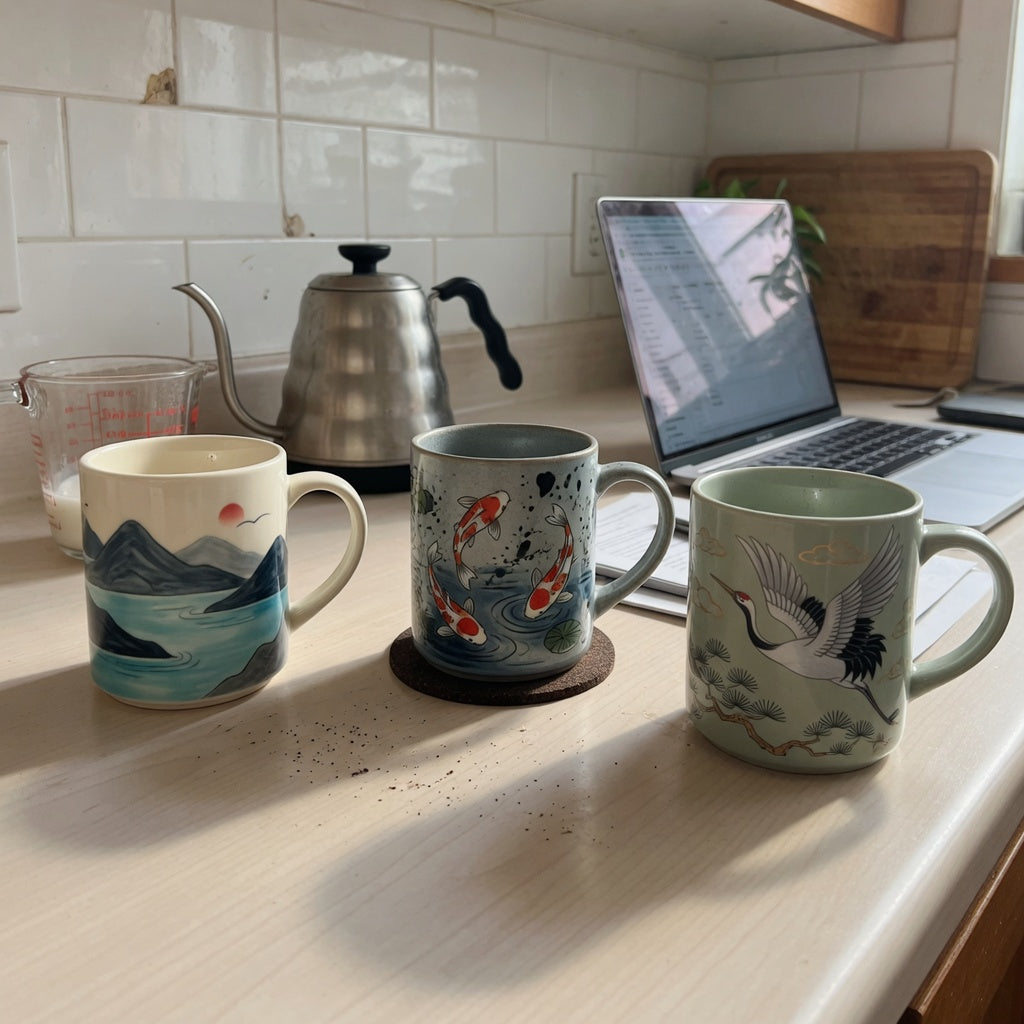
| The mug stays on an open kitchen counter, and you prefer scenic imagery. | The listing shows a mountain-and-sea motif. That landscape is the concrete reason to consider it, subject to the listed capacity and shape. | Review the photos and details for the Mountain Sea Coffee Tea Mug. |
| The mug sits beside a laptop, and a fish motif is the image you want in view. | The pictured koi provide a distinct visual focal point without requiring an unsupported story about origin or symbolism. | Compare the visible design, form, and listed capacity of the Koi Fish Coffee Tea Mug. |
| You prefer bird imagery and want the crane to be the main visual feature. | The listing-backed difference is the crane motif. Check its position relative to the handle from your preferred holding side. | Inspect the product images for The Crane Coffee Tea Mug. |
Handle orientation deserves a deliberate check. A photo taken from the right side does not prove that a left-handed user will see the same portion of the motif, and one front image does not prove that the design wraps around the body. Use every available product photo. If the opposite side is not shown, treat its appearance as unknown rather than assuming the main image repeats.
Will the handle, base, and rim work with a half-awake grip?
Product photos can show whether a body appears straight-sided or tapered and how the handle sits against it, but visual scale is not a substitute for measurements. If handle clearance, height, or base diameter is not listed, those details remain unknown. This matters for shoppers with larger hands, narrow desk shelves, small coasters, or crowded counters beside a kettle.
- Handle opening: look for enough visible clearance for your usual one-, two-, or three-finger grip, but do not infer an exact measurement from a styled image.
- Base footprint: compare the pictured base with the mug body and consider the stable space available beside your keyboard, brewer, or drying rack.
- Rim condition: at unboxing, run a fingertip carefully around the dry rim and inspect it for chips or rough spots before adding a hot drink.
- Handle joins: examine both points where the handle meets the body. A visible crack at either join is a reason not to use the mug.
When our team handles ceramic mugs, we also place each one on a flat, dry surface to check for obvious rocking. Gift recipients should do the same before the first pour. These simple checks catch practical problems that a motif comparison cannot.
Can your care routine suit a decorated ceramic mug?
The linked product listings present ceramic mugs, so ordinary ceramic care trade-offs apply: rims can chip after contact with heavier items, handles can be damaged by impact, and an exterior motif can be marked by abrasive cleaning. We do not assume dishwasher or microwave suitability unless the individual listing states it. Product-specific care instructions should take priority over general advice.
- Read the care line first: confirm any dishwasher or microwave statement on the exact product page rather than applying the instruction from another mug.
- Use a nonabrasive sponge: a soft sponge and regular dish soap are a conservative choice when the surface treatment is not fully described.
- Keep heavy items separate: do not let pans, cutlery, or other mugs strike the rim or handle in the sink or dishwasher.
- Avoid sudden temperature changes: do not move a very cold ceramic mug directly into extreme heat, or place a hot mug onto a cold or wet surface.
A decorated mug is a poor match for a shared office sink where dishes are regularly piled together. In that setting, a plain work mug that is inexpensive to replace may be the more sensible daily tool. Keep the art mug at home or at a desk where you control washing and storage.
Who should skip an art mug for the daily morning job?
Visible art adds personal style, not extra performance. A different mug category will serve you better if your non-negotiable is insulation, a sealed lid, rough-use durability, maximum stackability, or a volume larger than the stated capacities of these products.
- Choose an insulated travel mug for a commute, outdoor use, or a drink that must stay hot or cold for an extended period.
- Choose a larger plain mug if your measured serving exceeds the art mug's listed capacity and you strongly dislike refills.
- Choose a simple stackable set if several household members need interchangeable mugs in limited cupboard space.
- Choose a basic office mug if it will be left in a communal sink with metal cutlery and heavy cookware.
- Use a coaster for iced coffee at a desk; ceramic is not insulated, and exterior condensation can wet papers or electronics.
The right decision can be to skip the pictured mug. A design you enjoy will not compensate for the wrong capacity, an uncertain care routine, or a form that does not fit the available space.
Art coffee mugs morning routine practical purchase checklist: seven checks
Run this art coffee mugs morning routine practical purchase checklist against the listing rather than relying on the product name alone. A clear yes on the design is useful only after the functional questions are settled.
- Morning deadline: how long must the first cup last before you can conveniently refill it?
- Measured drink volume: does the stated capacity cover your actual coffee or tea plus milk, foam, or comfortable headspace?
- Refill tolerance: are you content with one or more extra trips to the kettle or coffee machine?
- Placement: does the visible body and base shape suit the counter, coaster, desk shelf, or cup space you use?
- Holding side: can you confirm that the preferred part of the motif faces you when the handle is in your usual hand?
- Care reality: will you follow the product's listed care instructions and protect the rim and handle from impact?
- Backup need: do you have another mug for commuting, long heat retention, rough use, or unusually large drinks?
If your functional answers are yes, use the visible motif to make the final choice: mountain-and-sea scenery, koi fish, or a crane. If the capacity, form, or care requirements remain uncertain, compare another listing rather than forcing the artwork into a routine it does not fit.
Frequently asked questions
What should an art coffee mugs morning routine practical purchase checklist include?
It should include your measured drink volume, required headspace, acceptable number of refills, mug placement, preferred holding hand, and realistic care routine. It should also separate listing-backed facts from assumptions about the artwork or production method. Use the seven checks above before choosing among motifs.
How much mug capacity should I allow for milk or foam?
Measure the final level you normally drink, not just the brewed coffee before additions. If a product page does not explain whether capacity is measured to the brim, leave a practical margin instead of planning to fill it completely. This also reduces spills while walking from the kitchen to a desk.
Are the Mountain Sea, Koi Fish, and Crane mugs identical in size?
Do not assume that similarly named ceramic mugs have identical capacity, dimensions, or form. Open each product page and compare the stated capacity and visible shape separately. The mountain-and-sea, koi, and crane imagery is the clear style difference supported by their listings.
Can these art coffee mugs go in a dishwasher or microwave?
Follow the care statement on the individual product listing. If dishwasher or microwave suitability is not stated, treat it as unknown rather than assuming that every ceramic mug has the same rating. Hand-washing with a soft, nonabrasive sponge is the conservative care option.
Which art coffee mug makes the most practical gift?
Start with the recipient's usual drink size and washing habits, then choose the visible motif they are most likely to enjoy. Mountain-and-sea imagery suits someone asking for a landscape scene, koi suits a shopper who wants fish imagery, and the crane option fits a preference for a bird motif. Inspect the rim, handle joins, and base during unboxing before the first use.
Take your measured pour and acceptable refill count to the three product pages first. If none clears every non-negotiable, browse our unique coffee mugs collection and keep listed capacity, visible form, ceramic material, and realistic care ahead of the picture.
More from our blog
Read more

Art Coffee Mugs Home Office Practical Purchase Checklist: Desk Fit
Compare art mugs by the details that affect a real home-office desk: visible motif, ceramic form, listed capacity, care information, and unboxing condition. This checklist maps mountain-sea, koi fi...
Read more
Art Coffee Mugs Morning Routine Product Shortlist Guide: 3 Picks
Use your actual first-pour volume, morning timing, and refill tolerance to compare the Mountain Sea, Koi Fish, and Crane ceramic mugs. Each option includes a clear reason to choose it, a reason to ...
Read more
Leave a comment
This site is protected by hCaptcha and the hCaptcha Privacy Policy and Terms of Service apply.