
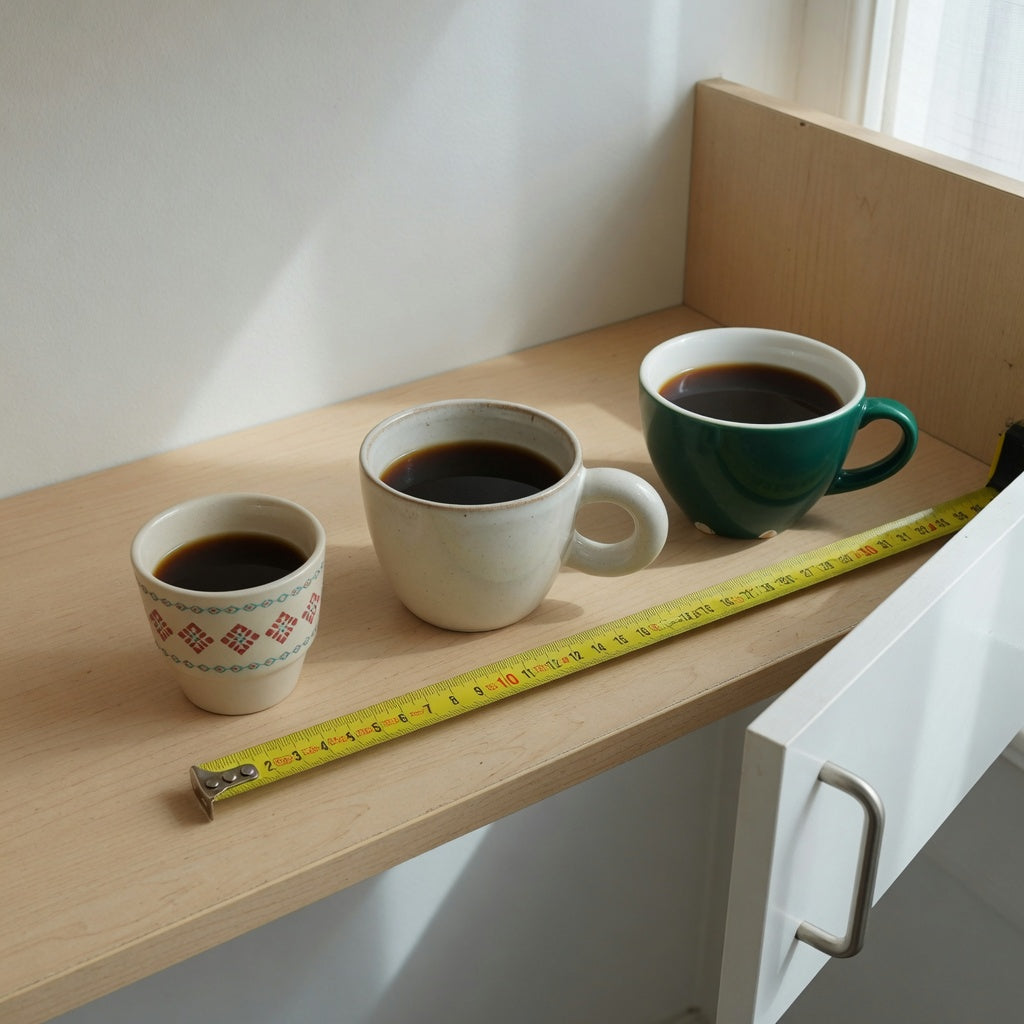
Piccolo Cup Storage Fit Guide: 170, 250 and 270 ml Compared
Reading time: about 10 minutes
The cabinet door closes until the last centimetre, then the cup handle catches the frame. On an office shelf, the same cup may fit front to back but leave too little room for the mug beside it. This piccolo cup storage fit guide starts with those ordinary fit problems because listed capacity does not reveal external height, body diameter, base diameter or total width including the handle.
At CoffeifyMug, we handle and pack compact drinkware sold in our store, and we use a practical sequence when checking storage fit: verify the published facts, examine the visible silhouette, then measure the space where the cup will actually live. For this comparison, the verified capacities are Retro at 170 ml, Ball Handle at 250 ml and Emerald at 270 ml. We do not have verified external height, width or depth measurements to publish for these products, so this guide will not turn visual estimates into invented centimetres.
These cups can be considered by shoppers looking for compact coffee or tea drinkware, but we are not presenting any of them as a certified piccolo cup. Their capacities also do not establish a fixed coffee-to-milk ratio, a barista standard or cafe provenance. The useful question here is simpler: which listed capacity and visible form suit your shelf, cabinet or desk?
Piccolo cup storage fit guide: which current shape is the safest starting point?
There is no honest way to guarantee the smallest external footprint from capacity alone. A 170 ml cup may be shorter, narrower or both, but wall thickness, handle geometry and body shape also affect the space it occupies. Use the following comparison to choose which product to measure first, not as a substitute for external dimensions.
| Current option | Verified capacity | Visible storage variable | Best starting situation | Main limitation |
|---|---|---|---|---|
| Retro coffee and tea cup | 170 ml | Upright retro-style body with a traditional side handle in the current listing imagery | Your usual drink fits 170 ml and you want to begin with the smallest listed capacity | The lower capacity does not prove that it has the smallest external width or height |
| Ball Handle coffee and tea mug | 250 ml | The rounded ball-style handle creates a clear outer projection to measure | You have an open shelf or desk with room around the handle and want more capacity than 170 ml | The handle can make close-packed rows or shallow closed cabinets less forgiving |
| Emerald coffee and tea mug | 270 ml | The listing photography presents a fuller form, while the capacity is the largest of these three | You value the larger listed pour and have reasonable clearance around each cup | It is not the logical first option when maximum storage density is the priority |
The practical distinction is between liquid capacity and storage envelope. Capacity tells you how much the cup is listed to hold. The storage envelope is the smallest imaginary box that contains the body, rim, base and furthest point of the handle. That second measurement determines whether the door closes and how many cups fit in one row.
Which shelf measurements prevent a door or handle collision?
A shelf can be deep internally but still have a restricted opening. Face frames, hinges and the inner surface of a closed door all reduce usable room. Before ordering, measure an existing cup that already fits comfortably and treat its outer dimensions as your maximum storage envelope.
- Usable depth: Measure from the cabinet back to the inner face of the closed door, not merely to the front edge of the shelf.
- Opening depth: Check whether a frame, hinge or raised shelf lip makes the cabinet entrance smaller than the space inside.
- Vertical clearance: Measure from the shelf surface to the lowest obstruction above it, including an under-shelf rail or door trim.
- Body-to-handle width: Measure from the opposite side of the cup body to the outermost point of its handle. This is especially relevant to the Ball Handle shape.
- Row allowance: Multiply the external width by the number of cups you plan to store, then leave enough finger room to remove one without knocking its neighbour.
- Stack height: Only include stacked storage if the cups sit together securely without placing unstable pressure on their rims.
A cup that passes the internal depth check can still fail at the opening if it must be tilted around a face frame. We also recommend checking the route from the counter to the shelf. High cabinets with narrow openings are awkward for a cup that needs to be turned sideways every time it is put away.
How much shelf space should you trade for 170, 250 or 270 ml?
The capacity differences are specific: the 250 ml Ball Handle lists 80 ml more than the 170 ml Retro, while the 270 ml Emerald lists 20 ml more than the Ball Handle and 100 ml more than the Retro. Those differences matter for daily use, but they do not translate directly into a predictable increase in external height or width.
- Choose 170 ml as your first comparison if your usual serving fits that volume and cabinet tolerance matters more than avoiding a refill. The Retro is not a good match for someone who routinely wants a drink larger than its listed capacity.
- Choose 250 ml as the middle capacity if 170 ml feels restrictive and you have checked the Ball Handle's outer projection. It suits a shopper who can give the handle room instead of forcing several cups into a tight row.
- Choose 270 ml for the largest listed pour if the extra 20 ml over the Ball Handle is useful and your storage is not already at its limit. The Emerald is a weaker choice for a narrow cubby or a cabinet where every cup must occupy the smallest possible envelope.
Remember that listed capacity is not necessarily the amount you will carry while walking to a desk. Many people leave headspace below the rim to reduce spills. Decide how much you actually pour before accepting a larger storage footprint purely for capacity you may not use.
How does the Ball Handle change a shallow cabinet or crowded desk?
The Ball Handle's defining feature is also its main storage variable. A rounded handle produces an outermost point that can meet a cabinet door, the cup beside it or the edge of a desk organiser. Rotating the handle sideways may reduce front-to-back demand, but that orientation uses more lateral shelf space.
For a single cup on an open office shelf, the projection may not be a problem at all. It becomes more significant when several mugs must line up evenly or when the cup sits near a keyboard, monitor stand or desk edge. If your storage depth is marginal, measure the full body-to-handle distance rather than judging the cup body alone.
This shape is not the cautious choice for an unmeasured, shallow cupboard. It is a more sensible candidate when the buyer specifically wants the 250 ml capacity and has open space around the handle.
Should these cups be stacked after washing?
Do not assume a cup is stackable because two pieces can physically sit together. Unless current product information explicitly describes a shape as stackable, plan for a single layer. Forced stacking can place the base of one cup against the rim or inner wall of another, creating unstable contact points.
- Let the rim, interior and foot dry completely before enclosed storage. Moisture can remain under the base even when the body looks dry.
- Do not build a tall stack if the handle causes the upper cup to lean or rotate.
- Leave enough removal space to lift a cup vertically instead of dragging its rim across the cup beside it.
- Use a clean, non-abrasive shelf liner if cups tend to slide when the cabinet is opened.
- Follow the current product care instructions for washing. Do not infer dishwasher suitability from appearance alone.
After a permitted dishwasher cycle, allow cups to cool and check recessed areas for trapped water before stacking or closing the cabinet. Common storage damage to rigid drinkware starts at contact points: rim-to-base knocks, surface scuffs and side impacts to a projecting handle. A single orderly row uses more shelf width, but it reduces those repeated contacts.
Which option fits a small kitchen, office desk or gift plan?
- Small kitchen with a tight upper cabinet: Start with the 170 ml Retro cup if that capacity suits the drink. Its smaller listed volume makes it the logical first comparison, but confirm the complete external envelope before treating it as a guaranteed fit.
- Office desk with open storage: Consider the 250 ml Ball Handle mug when you want the middle capacity and can keep the rounded handle clear of the desk edge and nearby equipment. It is not ideal for a narrow closed cubby.
- Open shelf and a larger regular pour: Compare the 270 ml Emerald mug. It fits the shopper who values the largest listed capacity here and is willing to allocate more storage tolerance instead of pursuing maximum density.
- Gift with unknown cabinet space: Avoid choosing by appearance alone. Ask about the recipient's usual drink volume and storage style, then compare additional silhouettes in our unique coffee mugs collection.
Gift unboxing and long-term use are different moments. A distinctive handle may make the strongest first impression, while a simpler outline can be easier to place in an already crowded kitchen. For a recipient with limited space, storage compatibility is part of the gift decision rather than an afterthought.
What can we verify, and what still needs measuring?
Our piccolo cup storage fit guide keeps the claim boundary clear. We can verify the three listed capacities and compare the visible product forms. The verified catalog facts supplied for this article do not include exact external height, body diameter, base diameter, handle projection or stacked height.
- The Retro is listed at 170 ml.
- The Ball Handle is listed at 250 ml and visibly uses a ball-style handle.
- The Emerald is listed at 270 ml, the largest capacity in this comparison.
- Capacity alone cannot prove which option is shortest, narrowest or easiest to stack.
- This article does not claim a certified piccolo designation, a prescribed milk-to-coffee ratio or professional barista testing.
If your cabinet has almost no spare clearance, none of these should be ordered on an assumption about exterior size. Use an existing cup as a fit template, check the current product listing and contact our store with your maximum measurements if an exact fit is essential.
A 60-second shelf test before ordering
- Measure the height, total width and total depth of a cup that already fits your shelf comfortably.
- Choose the lowest listed capacity that still accommodates the drink you normally prepare.
- Decide which direction the handle must face and measure clearance in that orientation.
- Plan a single row unless verified product information supports stable stacking.
- Check the current listing for external measurements and care details before completing the order.
Use those notes while comparing the three linked products. If none matches the capacity, handle shape or storage plan, move to the full unique coffee mug collection and evaluate each silhouette against the same measurements.
Frequently asked questions
How do I use this piccolo cup storage fit guide if exact dimensions are not listed?
Measure a cup that already fits and record its maximum height, depth and body-to-handle width. Treat those figures as your storage limit, then check the current product listing or ask our store for the measurements needed to compare. Do not estimate exterior size from capacity alone.
Is the 170 ml Retro guaranteed to use less shelf space than the 250 ml Ball Handle?
No. The Retro has the smallest listed capacity, so it is the sensible first option to investigate for a tight shelf. Wall thickness, body shape and handle projection still determine the final external footprint.
Will the Ball Handle mug fit behind a closed cabinet door?
It depends on the full depth of the mug in the orientation you plan to store it. Measure from the cabinet back to the inner face of the closed door, then account for the ball handle's outermost point. Rotating the handle may help with depth but will require more side-to-side space.
Can the 270 ml Emerald cups be stacked?
Do not assume stackability unless the current product information confirms it. Plan for a single row, especially if one cup rests on another's rim or sits at an angle. Fully dry every contact surface before storage.
Which cup should I compare first for a small office shelf?
Start with the Retro if 170 ml is enough for your usual drink and shelf space is the main constraint. Choose the Ball Handle only after allowing room for its projection, or the Emerald when 270 ml matters more than dense storage. Measure the shelf first, then open the relevant product page or compare other shapes in the collection.
More from our blog
Read more
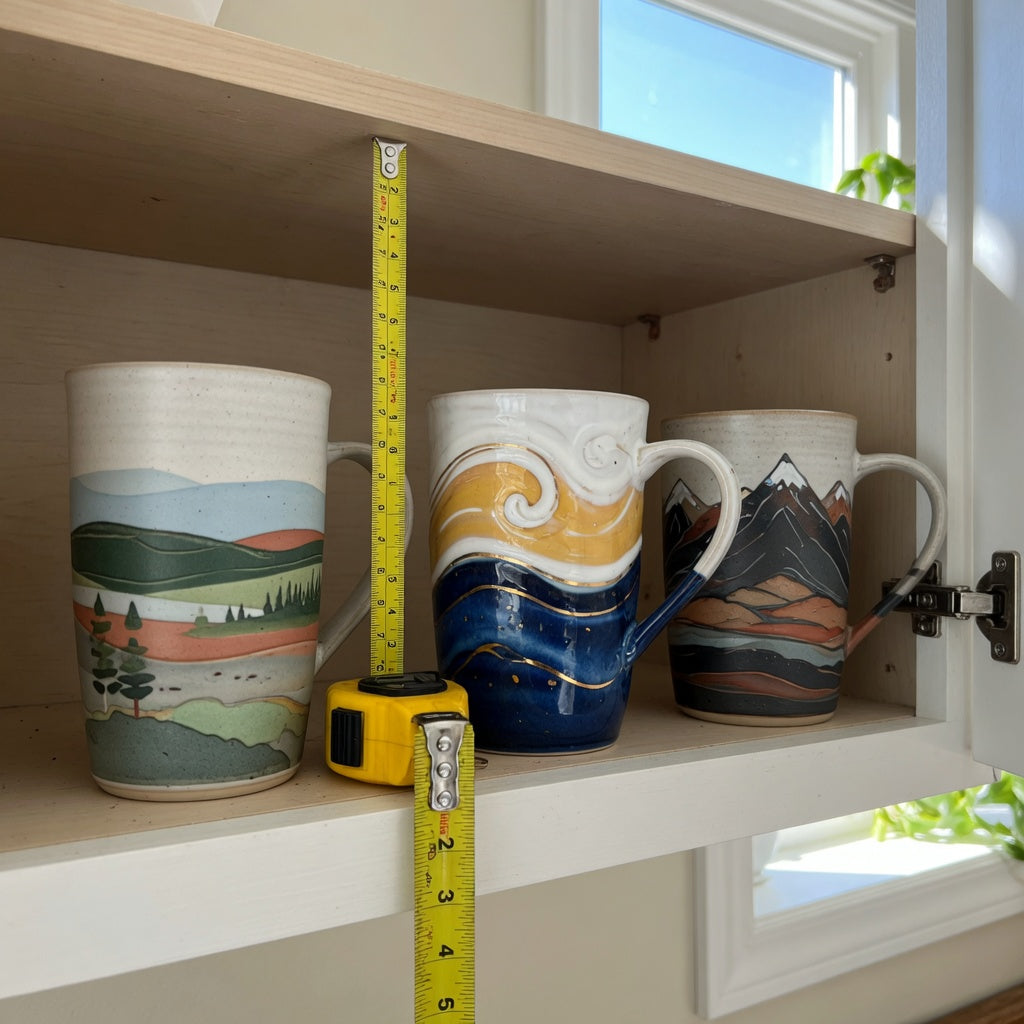
Tall Ceramic Coffee Mugs Storage Fit Guide: Shelf and Handle Fit
Compare CoffeifyMug's current tall ceramic mug shapes without guessing measurements. This guide explains how to check shelf height, cabinet depth, handle projection, display space, and gift fit bef...
Read more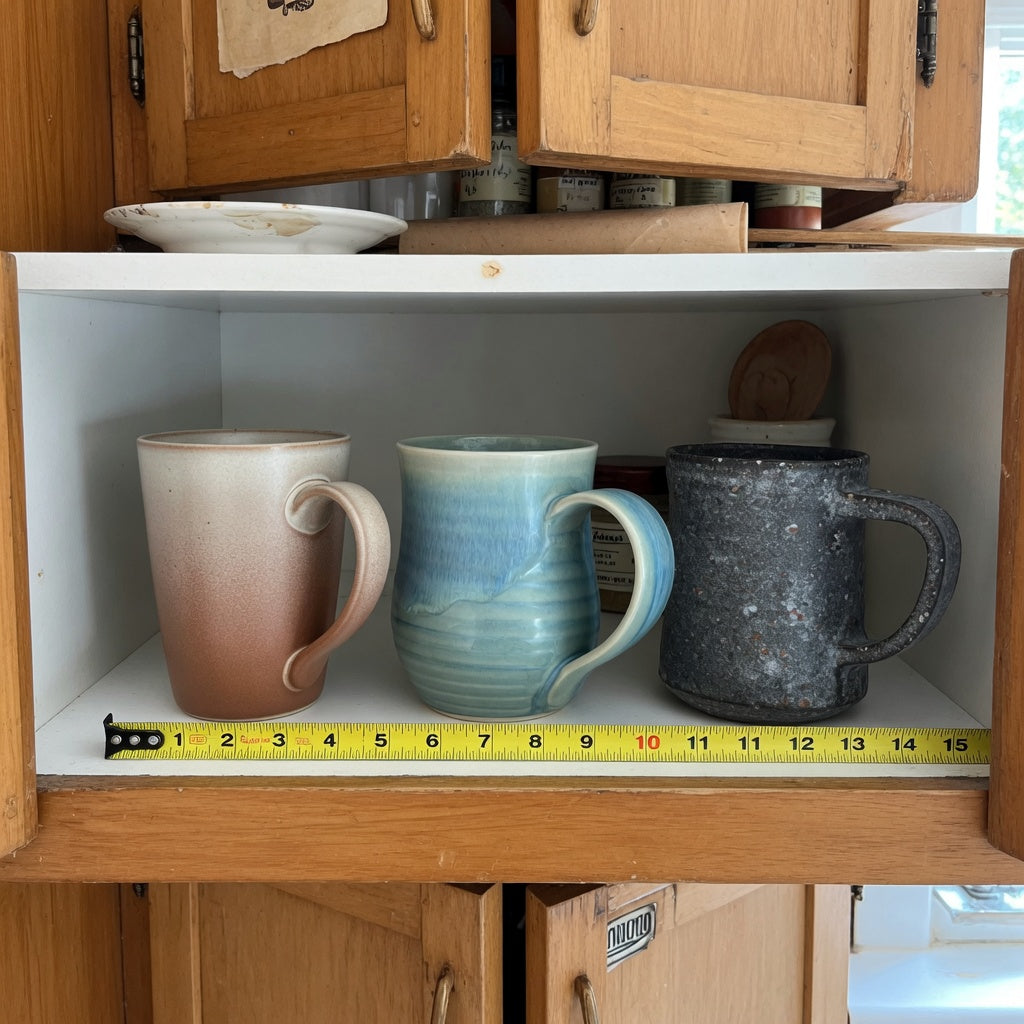
Apple Cider Mug Storage Fit Guide: 400 ml vs 480 ml
Compare the 400 ml Gradient and Flow with the 480 ml Rock using handle projection, shelf depth, cabinet clearance, and practical ceramic storage habits. Includes a no-guess measurement checklist.
Read more
Leave a comment
This site is protected by hCaptcha and the hCaptcha Privacy Policy and Terms of Service apply.