
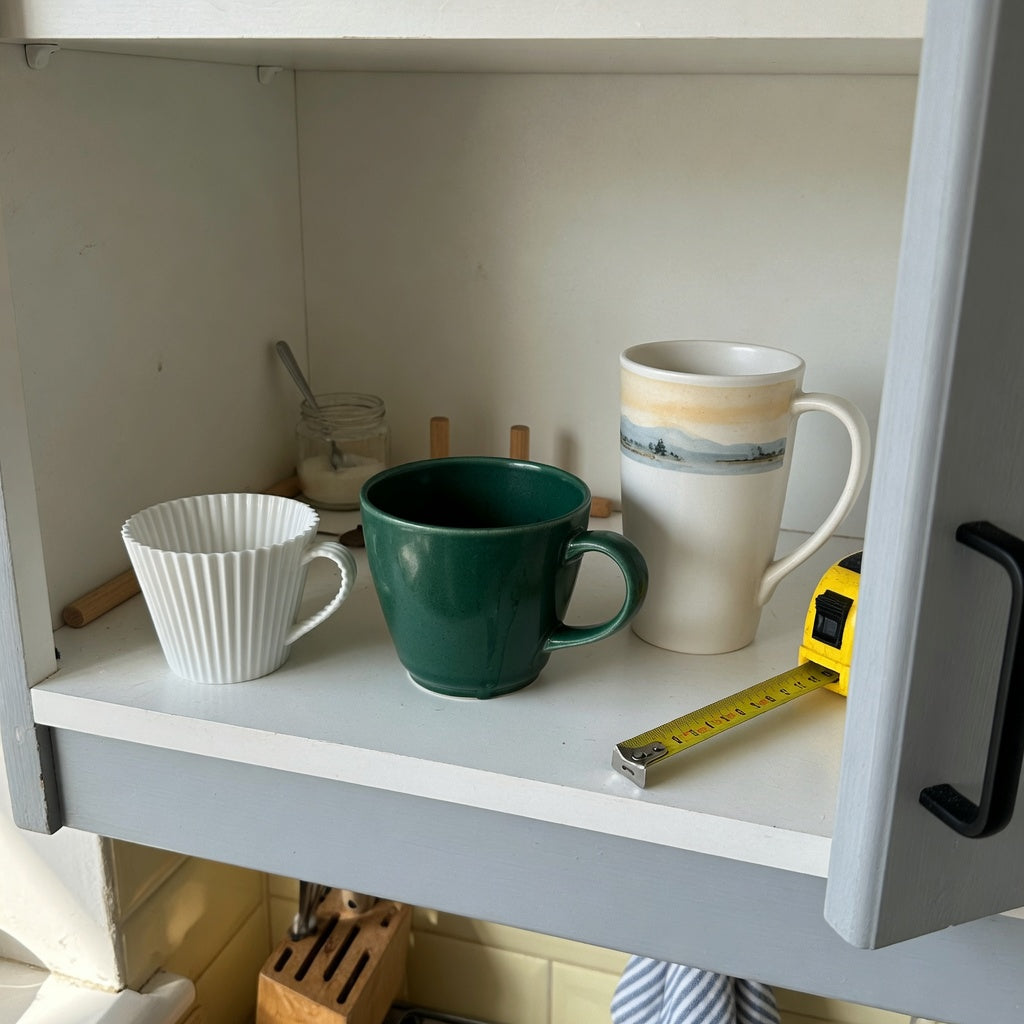
Americano Coffee Cup Storage Fit Guide: 3 Shapes Compared
Reading time: about 9 minutes
A cup can sit flat on a shelf and still stop the cabinet door from closing because its handle crosses the inner door line. Our americano coffee cup storage fit guide starts with that practical storage problem and compares the three current forms by visible shape, listed capacity, potential headroom, and the measurements shoppers need to confirm at home.
When we handle drinkware for orders, we look at the base, widest body point, rim, and outer handle edge as four separate contact points. The catalog facts we can stand behind here are the listed capacities: the Pleated coffee tea cup is 200 ml, the Emerald coffee tea mug is 270 ml, and the Landscape Tall coffee tea mug is 350 ml. We do not convert those capacity figures into unlisted heights, diameters, or handle widths.
That boundary matters. Capacity describes liquid volume, not the cup's exterior footprint. This comparison also does not claim compatibility with brewing equipment, dishwasher racks, hanging rails, or a universal Americano serving size.
Americano coffee cup storage fit guide: what changes by shape?
The three cups occupy different positions in the current range. Their listed capacities and visible forms help narrow a shortlist, but neither replaces measuring the shelf where the cup will live.
| Current cup | Verified capacity | Visible form to inspect | Storage question to answer |
|---|---|---|---|
| Pleated | 200 ml | Pleated outer wall and smaller-capacity form | Does the widest part of the body and handle clear the cabinet door and neighboring cups? |
| Emerald | 270 ml | Middle-capacity handled mug form | Is there enough side clearance to retrieve it without knocking the handle against another cup? |
| Landscape Tall | 350 ml | Visibly tall profile and largest listed capacity | Does the rim clear the shelf above, including any lip or support beneath that shelf? |
The Pleated is the first form to assess if a visibly lower-profile option and a 200 ml capacity suit your routine. The Emerald provides the middle listed capacity. The Landscape Tall gives the most listed volume, but its tall silhouette makes vertical clearance the first measurement to verify. None is automatically the best fit simply because it holds more or less liquid.
How do 200 ml, 270 ml, and 350 ml affect headroom?
Headroom is the empty space you intentionally leave between the drink and the rim. It makes a cup easier to carry from a kitchen counter to a desk and leaves room for additions, but the amount each shopper prefers varies. We do not assign one standard volume to an Americano or map these cups to machine presets.
- Pleated 200 ml: This is the smallest listed capacity. If your usual drink already approaches that volume, it may leave less practical headroom even if its visible form looks easier to store.
- Emerald 270 ml: It holds 70 ml more than the Pleated and 80 ml less than the Landscape Tall. That makes it the numerical midpoint of these three options.
- Landscape Tall 350 ml: This is the largest listed capacity. For the same measured pour, it offers the greatest potential headroom, provided its exterior height works in your storage space.
To check your own pour, fill your current cup with water to the level you normally use, then transfer that water to a measuring jug. Compare the result with 200 ml, 270 ml, and 350 ml while allowing the empty space you prefer below the rim. This gives you a personal volume reference without assuming that every Americano is prepared the same way.
How should you measure shelf depth and handle projection?
Handle projection is the part of the handle extending beyond the cup body. Overall storage width includes both the body and that outer handle edge. Measuring only the base can produce a false fit because the base may sit fully on the shelf while the handle meets a door, face frame, hinge, or adjacent mug.
- Measure usable height from the shelf surface to the lowest obstruction above it. Include shelf lips, brackets, and under-shelf rails.
- Measure usable depth from the back wall or rear obstruction to the inside face of the closed cabinet door. The wooden shelf board may be deeper than the space the door actually allows.
- Decide how the handle will face. A side-facing handle uses more lateral room, while a forward-facing handle may cross the door line.
- Measure an existing cup that fits well, from base to rim and across its widest body-and-handle span. Use it as a physical reference rather than assuming two cups with the same capacity have the same dimensions.
- Allow room to grip and lift the cup. An exact edge-to-edge fit can still be awkward if you must tilt the cup into neighboring drinkware every morning.
If no verified exterior dimensions are available for the cup you are considering, treat the product image and capacity as screening information only. Confirm current listing details before relying on a close cabinet fit.
Which cup should you shortlist for a cabinet, open shelf, or desk?
Closely spaced upper-cabinet shelves
If vertical room is your main constraint and a 200 ml capacity leaves enough headroom for your usual drink, start by reviewing the Pleated 200 ml cup. Its lower listed capacity and visible form make it a logical first comparison for a tight shelf. It is not a guaranteed fit, so check the widest body area and handle clearance as well as height.
Mixed kitchen and office storage
If the cup will move between a kitchen cabinet and an office desk, the Emerald 270 ml mug is the middle-capacity option to assess. It avoids the two capacity extremes in this three-product comparison. Measure the office shelf or cubby separately because an open desk shelf may have enough height but too little depth for a projecting handle.
Open shelving and a larger usual pour
If you have confirmed vertical clearance and want the largest listed capacity, review the Landscape Tall 350 ml mug. Its tall form is easier to accommodate on a genuinely open shelf or an uncrowded counter than beneath a low shelf board. It is not the practical choice for a low cabinet simply because the extra volume appeals to you.
Awkward spaces or gifts with unknown storage
A gift can look right at unboxing and still be inconvenient in the recipient's cupboard. If you do not know the available height and depth, the Emerald is the least extreme capacity choice, but it remains only a shortlist option. Browse the unique coffee mugs collection if you need another form or a listing with details better matched to an unusual shelf.
Why do stacking, cabinet doors, and care change the answer?
Storage is not finished once the cup fits. Daily retrieval, drying, and contact with neighboring pieces determine how practical the arrangement remains. In our experience handling this category, exposed rims and handles deserve the most space because repeated contact at those points can lead to chips or knocks during storage.
- Do not assume stackability: These verified facts do not establish that any of the three cups is designed to nest or stack. The Pleated exterior especially gives you a visible reason to inspect body contact rather than assuming one cup will settle securely inside another.
- Plan for single-layer storage: Until stackability is confirmed, storing cups upright in one layer avoids rim-to-base pressure and unstable handle contact.
- Leave retrieval space: A cup wedged between two others may fit on paper but require sideways pressure on its rim or handle each time you remove it.
- Dry before closing the cabinet: Let the cup drain and dry fully before enclosed storage. Follow the current product care information rather than inferring dishwasher suitability from the cup's shape.
- Check hanging systems separately: A rail or hook requires a verified handle opening and suitable balance. This guide does not provide enough evidence to recommend these cups for hanging storage.
If compact nesting, guaranteed hook fit, or exact commercial rack compatibility is essential, a purpose-specified cup with verified measurements would suit you better. These three should not be selected on capacity alone for those uses.
What should you verify before adding a cup to your cart?
- Record the usable shelf height, including any lip or bracket above the cup.
- Record the closed-door depth rather than measuring only the shelf board.
- Choose the handle orientation and check the resulting body-and-handle footprint.
- Measure your usual drink and decide how much visual headroom you prefer.
- Compare that pour with the listed 200 ml, 270 ml, and 350 ml capacities.
- Plan for upright, single-layer storage unless current product information confirms another arrangement.
- Recheck the selected product page for any current exterior dimensions or care details before ordering.
Use this americano coffee cup storage fit guide as a filter: first remove any capacity that does not suit your pour, then remove any visible form that conflicts with your measured space. The remaining product is a more defensible choice than one selected from capacity or appearance alone.
Frequently asked questions
Can the americano coffee cup storage fit guide guarantee cabinet clearance?
No. The guide compares verified capacities, visible shapes, and the storage variables you need to measure. A guarantee would require confirmed exterior height, widest body measurement, and total width including the handle for the exact cup.
Is the Pleated 200 ml cup guaranteed to fit a low shelf?
No. It has the smallest listed capacity of the three, but lower capacity does not prove a specific exterior height or handle width. Treat it as the first option to investigate when space is tight, then confirm the current product details against your shelf measurements.
Which cup offers the most headroom for the same Americano pour?
The Landscape Tall has the largest listed capacity at 350 ml, compared with 270 ml for the Emerald and 200 ml for the Pleated. For the same measured pour, it offers the most potential headroom. This does not establish a universal serving size or guarantee that its exterior height fits your cabinet.
Can I stack these cups to save cabinet space?
Do not assume that they are stackable unless the current product information specifically confirms it. Plan for upright, single-layer storage to limit rim, base, and handle contact. If nesting is essential, a cup designed and measured for stacking would be a better match.
Your next step is simple: measure usable shelf height and closed-door depth, check your normal pour volume, and then open the product page that best matches both constraints. If none of the three forms works on paper, compare other shapes in the CoffeifyMug collection before compromising on daily storage.
More from our blog
Read more
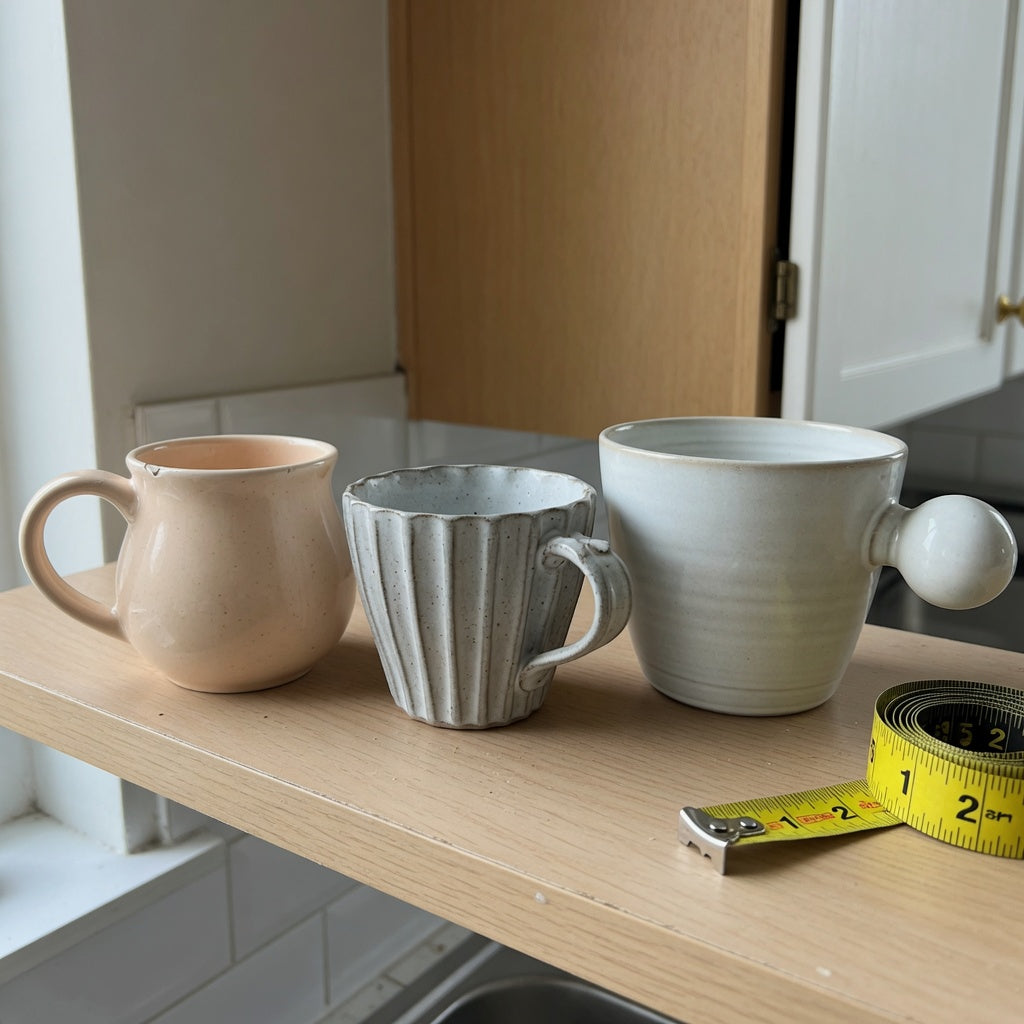
Ceramic Espresso Cup Storage Fit Guide for Shelves and Cabinets
Compare the verified capacities and visible forms of the Retro 170 ml, Pleated 200 ml, and Ball Handle 250 ml ceramic cups. This guide explains how to assess handles, shelf clearance, cabinet doors...
Read more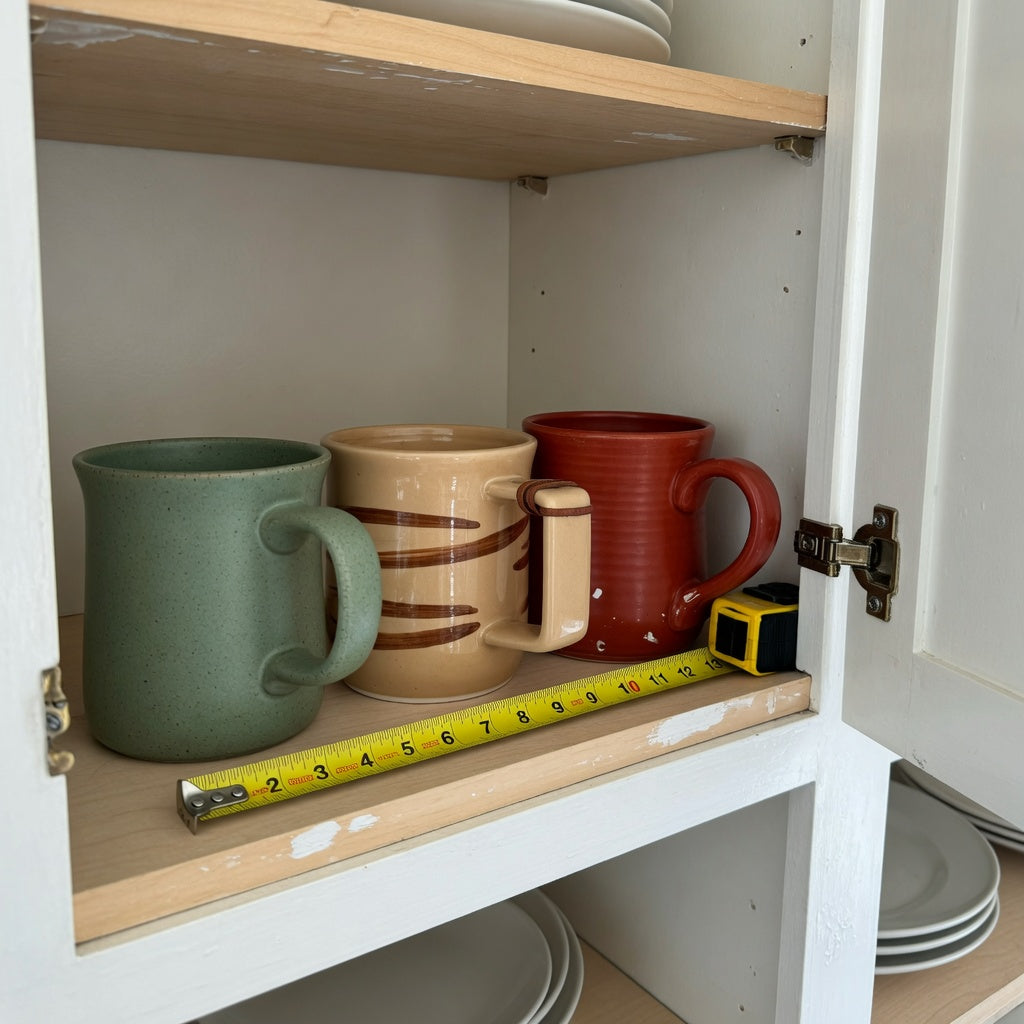
Hot Cocoa Mug Storage Fit Guide: 400 ml vs. 480 ml Shapes
This hot cocoa mug storage fit guide compares confirmed 480 ml and 400 ml capacities, then shows how to check handle projection, shelf depth, door clearance, and lift-out room.
Read more
Leave a comment
This site is protected by hCaptcha and the hCaptcha Privacy Policy and Terms of Service apply.