
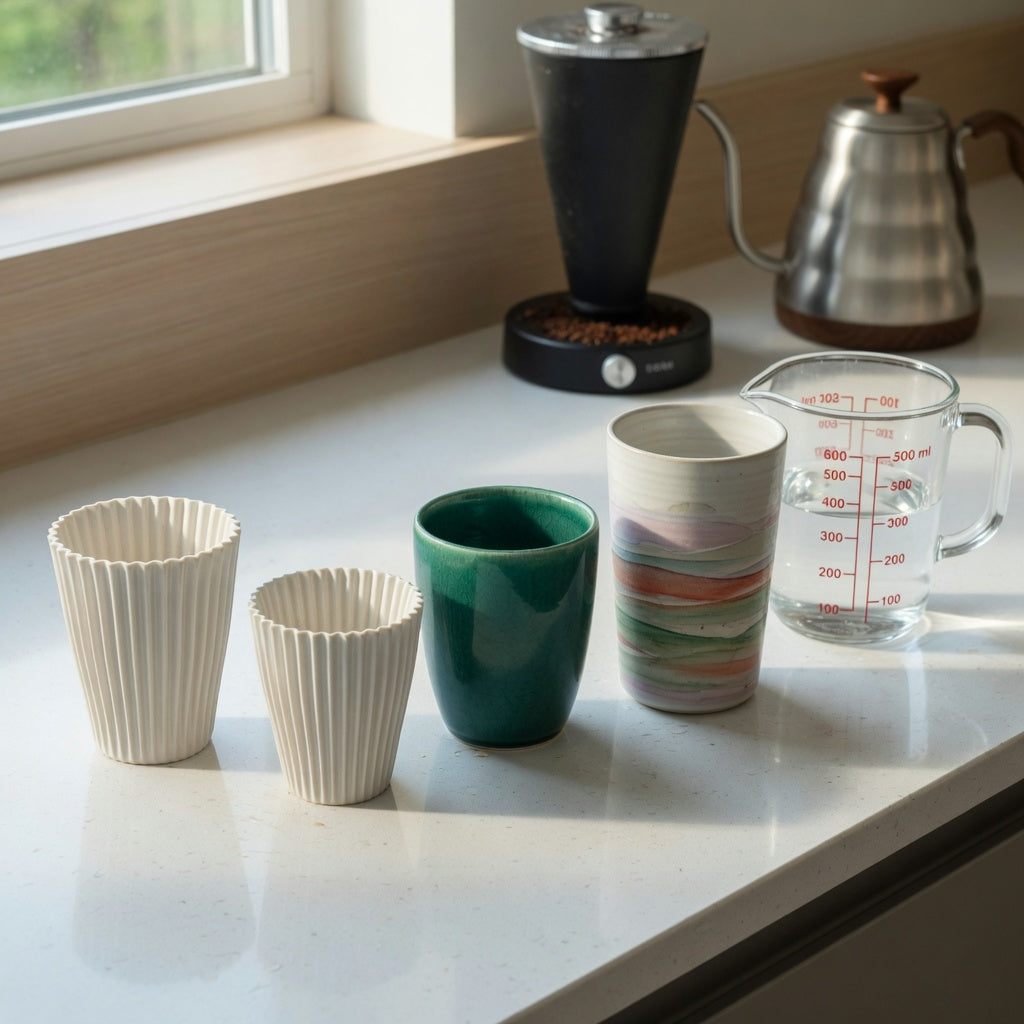
Americano Coffee Cup Home Coffee Station Product Shortlist Guide
Reading time: about 10 minutes
A measured 180 ml drink leaves a 20 ml difference against a 200 ml listed capacity, but a 90 ml difference against 270 ml. That simple subtraction is where our americano coffee cup home coffee station product shortlist guide starts. It is more useful than choosing from a styled counter photo because it ties the shortlist to your actual pour and the amount of unfilled capacity you prefer.
As the store team selling these products, we keep this comparison within the facts we can support: the Pleated is listed at 200 ml, the Emerald at 270 ml, and the Landscape Tall at 350 ml. We do not assign a universal Americano volume, treat listed capacity as a guaranteed comfortable fill line, or claim that any cup fits beneath a particular appliance. The useful decision is narrower: measure your finished drink, compare the three capacities, and then verify the physical and care details that matter in your kitchen.
How does the americano coffee cup home coffee station product shortlist guide work?
Start with the finished quantity you actually drink, not a recipe found online. Americano strength and total volume vary. Milk, extra water, and ice also change the space required, so measure the complete version that usually leaves your coffee station.
- Re-create your normal liquid quantities with cool water in a graduated measuring jug. This avoids transferring a hot drink just to take a measurement.
- Place the jug on a level counter and read the milliliter mark at eye level. Include the milk or additional water you normally add.
- Subtract that measured volume from 200 ml, 270 ml, and 350 ml. The result is the nominal capacity margin for each option.
- Decide how much margin feels appropriate for your routine. Carrying a cup to another room may lead you to prefer more margin than drinking beside the station.
- Verify external dimensions, material, and care instructions separately. Capacity alone cannot answer those questions.
If ice is part of your usual drink, run a separate cool-water rehearsal with the number of cubes you normally use. Ice displaces liquid, so a liquid-only measurement will not represent the finished fill level.
Listed capacity and usable headroom are different measurements
Headroom is the physical space between the drink surface and the rim. Nominal capacity margin is only the arithmetic difference between your measured drink and the listed capacity. We make that distinction because cup geometry and the method used to establish a listed capacity can affect where the liquid sits.
Nominal capacity margin = listed capacity minus your measured finished drink volume.
For example, a personal 180 ml recipe produces nominal margins of 20 ml in the Pleated, 90 ml in the Emerald, and 170 ml in the Landscape Tall. Those figures are exact subtraction from the verified listings. They are not recommended fill levels, promises about rim clearance, or evidence that 180 ml is a standard Americano.
Do not plan to fill a cup to its listed capacity simply because the numbers meet. If you dislike carrying liquid close to a rim, choose a larger nominal margin and confirm the result with the cup once received.
Three listed capacities for three different station routines
This table uses the same 180 ml example only to make the capacity differences visible. Replace that example with your own measured total before ordering.
| Product | Listed capacity | Margin with a 180 ml example | Reason to shortlist | Reason to skip |
|---|---|---|---|---|
| Pleated | 200 ml | 20 ml | Your measured drink is comfortably below 200 ml and you want the lowest listed capacity here | Your finished recipe comes close to 200 ml or changes often |
| Emerald | 270 ml | 90 ml | The 200 ml option leaves too little nominal margin, but 350 ml is more capacity than you need | Your drink plus preferred margin exceeds 270 ml |
| Landscape Tall | 350 ml | 170 ml | You make a larger drink or deliberately want the most nominal margin in this shortlist | The 270 ml option already covers your measured routine |
Pleated 200 ml: the lower-capacity option for a measured short pour
Choose the Pleated 200 ml coffee and tea cup when your completed recipe sits comfortably below 200 ml and you specifically want the lowest listed capacity among these three products. It makes the most sense for someone whose short black Americano is already measured and consistent, rather than someone estimating by eye each morning.
Skip it if your drink approaches 200 ml before milk, extra water, or ice is added. A listed capacity is not a target fill line, so a recipe that merely fits on paper may leave less physical headroom than you prefer. This is also a weak gift choice if you do not know the recipient's normal drink volume.
We would not call the Pleated compact based on capacity alone. A lower milliliter figure does not prove its exterior width, height, or shelf clearance. Use the current product-page information for those details instead of assuming that 200 ml guarantees a smaller footprint.
Emerald 270 ml: the middle step when 200 ml feels too close
The Emerald 270 ml coffee and tea mug adds 70 ml of listed capacity over the Pleated and sits 80 ml below the Landscape Tall. That makes it the logical middle candidate when your own arithmetic rules out 200 ml but does not justify moving directly to 350 ml.
Choose it for a measured routine that needs more nominal margin than the Pleated provides. For the earlier 180 ml example, the arithmetic difference is 90 ml, compared with 20 ml in the Pleated. That comparison does not promise 90 ml of comfortable physical headroom, but it clearly shows how much more listed capacity is available.
Skip the Emerald if your finished drink plus your chosen margin exceeds 270 ml. It is also unnecessary if a substantially smaller measured pour already leaves the margin you want in the Pleated. The middle capacity is useful only when it solves an actual volume problem.
Landscape Tall 350 ml: the largest margin in this three-cup shortlist
Shortlist the Landscape Tall 350 ml coffee and tea mug when your measured recipe or preferred nominal margin rules out both lower capacities. It offers 80 ml more listed capacity than the Emerald and 150 ml more than the Pleated.
This option is relevant for a longer drink or a recipe that includes additions, provided you measure the finished combination rather than guessing. It may also suit someone who carries the cup from a kitchen station to a nearby desk and deliberately wants more unfilled capacity.
Skip it if 270 ml already accommodates your drink and preferred margin. Extra listed capacity does not establish better heat retention, insulation, stability, or appliance compatibility. The word Tall is part of the product name, not a substitute for checking a published height before placing it beneath a shelf or brewing outlet.
Counter, shelf, and drying-rack checks capacity cannot answer
A coffee station has physical limits that milliliters do not describe. Before ordering, record the available width, depth, and height where the cup will sit. Include nearby cabinet doors, shelf edges, and the space needed to lift the cup without striking anything above it.
- Use any current external dimensions shown on the product page. If a dimension you need is not published, ask our store before treating the fit as confirmed.
- Compare the exterior measurements with the clear space on your counter, not with the capacity of a cup you already own.
- Check the drying area separately. A cup can fit its daytime position and still be awkward in a crowded rack or cabinet.
- Do not infer clearance beneath a coffee maker, brewer, or other appliance from the product name or listed capacity.
A useful low-cost check is to mark the published width and depth on paper and place that outline in the intended spot. For height, hold a ruler vertically at the same location. This catches conflicts with shelves and opening cabinet doors before appearance becomes the deciding factor.
Material, care, and unboxing details to verify before first use
Capacity cannot tell you what a cup is made from or which cleaning methods its finish can tolerate. Read the current material and care information on the relevant product page before ordering. Do not assume dishwasher or microwave suitability from appearance, and do not begin repeated dishwasher cycles unless the listed care guidance supports them.
Once the package arrives, inspect the cup under direct light before washing it. Look along the rim for chips, examine the body for visible hairline cracks, and set the dry cup on a flat counter to check for pronounced rocking. A chipped rim or visible crack is a reason not to use the cup. Photograph shipping damage and contact our store rather than testing a compromised item with a hot drink.
For a gift, complete that inspection before wrapping. Keep the original packing materials until you know the item arrived intact, then follow the published first-wash instructions. These steps are less exciting than choosing a finish, but they prevent a damaged or unsuitable piece from reaching a gift unboxing.
A practical shortlist in five decisions
- Measure the finished recipe. Include every liquid addition and run a separate displacement check for an iced version.
- Calculate the three margins. Subtract your volume from 200 ml, 270 ml, and 350 ml.
- Remove close calls. Eliminate any capacity that leaves less nominal margin than you are comfortable with.
- Check station fit. Verify current external dimensions against the counter, shelf, cabinet, and drying area.
- Confirm ownership details. Review material and care instructions before choosing a finish or placing the order.
This process may leave one cup, two cups, or none. None is a valid result. If your measured drink exceeds the shortlisted capacities, or if you need a specifically documented feature such as a lid or insulation, choose a different style whose listing explicitly supports that requirement.
Frequently asked questions
How should I use the americano coffee cup home coffee station product shortlist guide?
Measure your complete drink in milliliters, then subtract that volume from the listed capacities of 200 ml, 270 ml, and 350 ml. Keep the options that provide an acceptable nominal margin, and verify dimensions, material, and care details on their product pages before buying.
Is a 200 ml cup large enough for an Americano with milk?
It depends on your finished recipe, not on a universal Americano size. Measure the coffee, water, and milk together. If the total is 180 ml, the difference against the Pleated's listed capacity is only 20 ml, which may be less physical headroom than you want.
Should I choose the Emerald 270 ml or Landscape Tall 350 ml?
Choose the Emerald if 270 ml leaves your preferred nominal margin and the additional 80 ml offered by the Landscape Tall solves no specific problem. Choose the Landscape Tall if your measured recipe or desired margin exceeds what the Emerald can provide, then verify its external dimensions separately.
Will the Landscape Tall 350 ml fit under my coffee maker?
Listed capacity cannot confirm appliance clearance, and we do not make that compatibility claim here. Measure the available height, width, and depth around the intended position, then compare those numbers with current product dimensions or ask our store if a required measurement is unavailable.
Are these Americano cups dishwasher safe?
Do not infer dishwasher suitability from a cup's name, appearance, or capacity. Check the current care instructions on the individual product page before purchase and follow those instructions after unboxing.
Your next step: Run one cool-water measurement of your normal drink, write down the margin each capacity would leave, and remove the options that are too close. Then browse our unique coffee mugs collection and verify the current dimensions, material, and care details for the cup that remains on your shortlist.
More from our blog
Read more
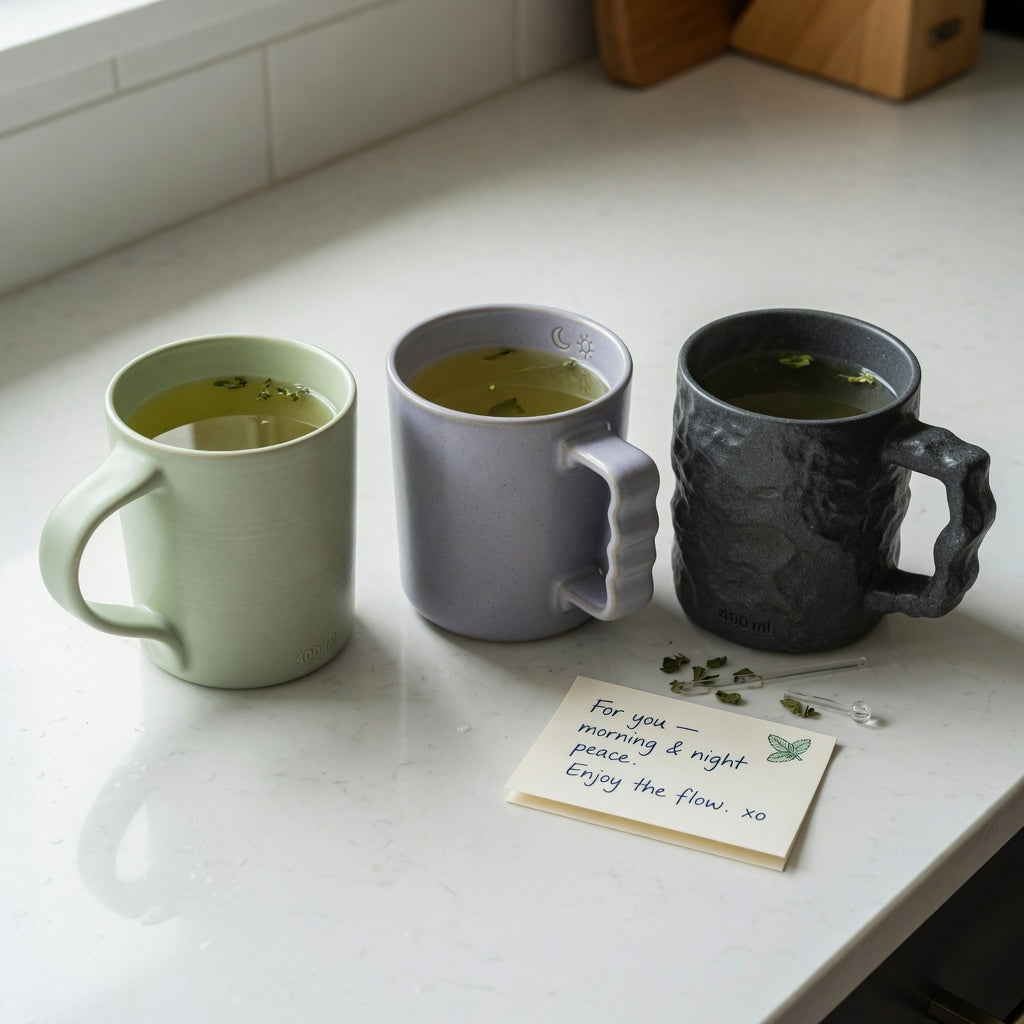
Peppermint Tea Mug Gift Choice Product Shortlist Guide
Compare three tea-ready mugs by 400, 440, and 480 ml capacities, recipient routines, and real handle feel. Each option includes a clear reason to choose it or remove it from your gift shortlist.
Read more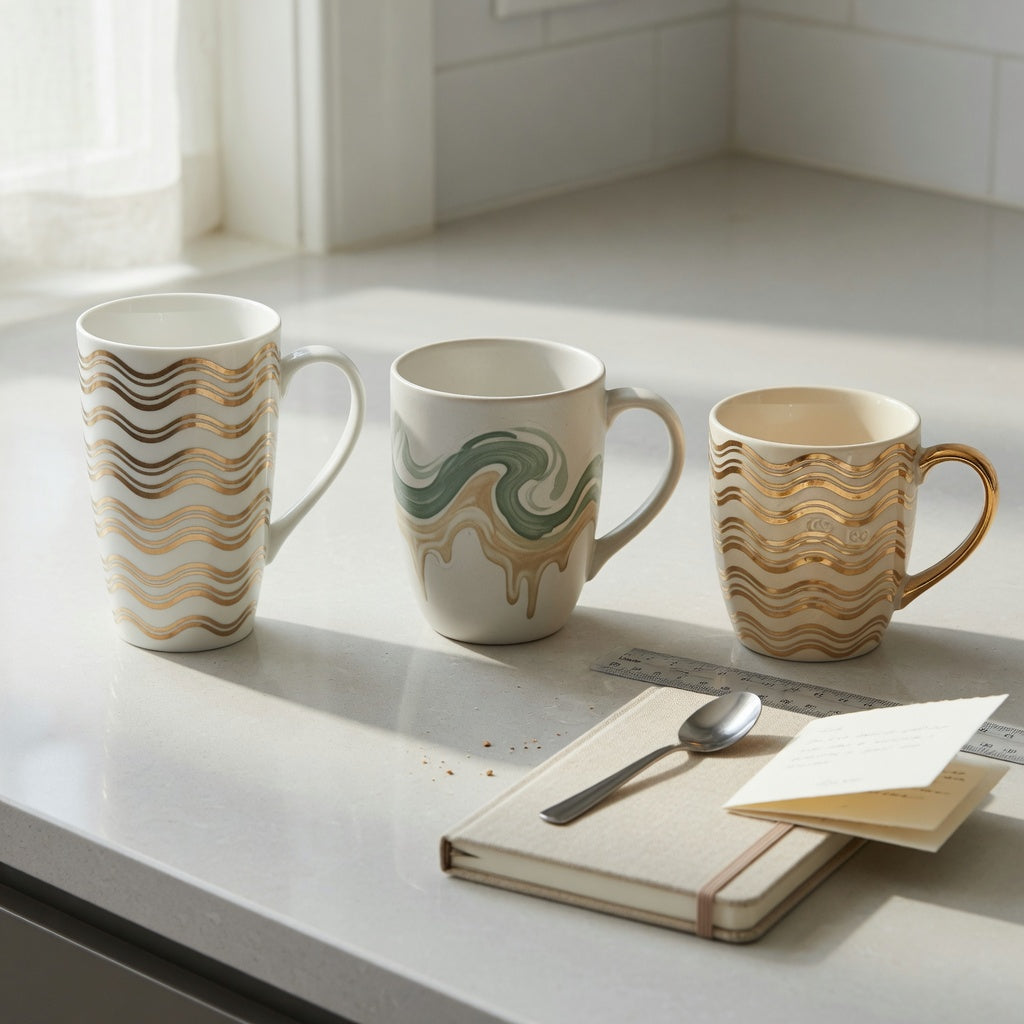
Large Decorative Coffee Mugs Gift Choice Product Shortlist Guide
Compare three decorative coffee-and-tea mugs by recipient routine, available space, visual preference, and verified care details. Each option includes a clear reason to choose it or leave it off th...
Read more
Leave a comment
This site is protected by hCaptcha and the hCaptcha Privacy Policy and Terms of Service apply.