
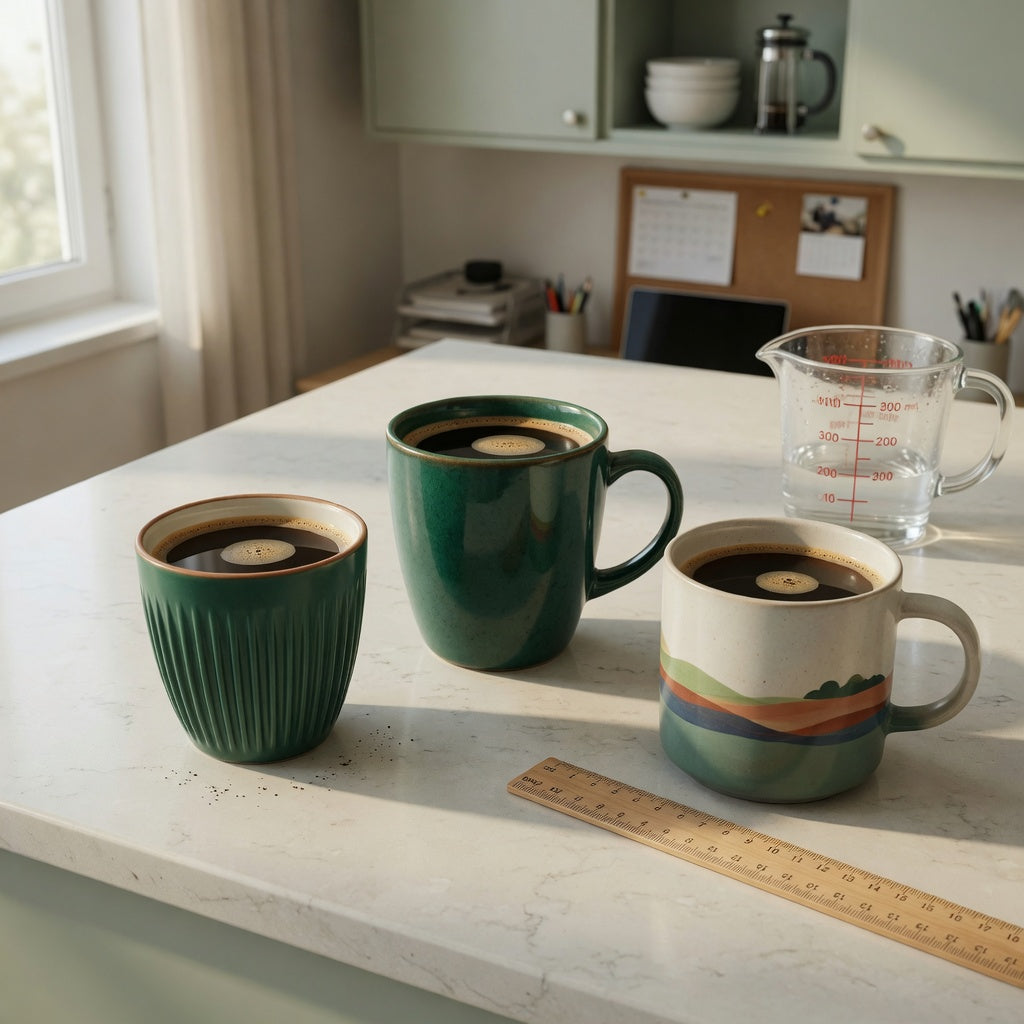
Americano Coffee Cup Buying Priorities: Capacity, Shape, Space
Reading time: about 10 minutes
A cup can look roomy in a product photo and become awkward at 8:15 a.m. Coffee sits close to the rim, the mug competes with a laptop, or the cabinet shelf is a few millimeters too low. The questions we hear while selling this category are rarely about one correct Americano recipe. They are about routine. In our store, americano coffee cup buying priorities start with the amount someone actually pours, followed by the headroom they want, the visible shape they prefer, and the space the cup must occupy.
We use three CoffeifyMug listings as clear comparison points: Pleated at 200 ml, Emerald at 270 ml, and Landscape Tall at 350 ml. Those are listed capacities, not universal Americano serving sizes or promised fill lines. Capacity also cannot establish external dimensions, equipment compatibility, material, or care requirements, so each of those details needs a separate check before purchase.
Which americano coffee cup buying priorities should come first?
Starting with appearance can lead to a cup that photographs well but does not suit the drink or the room. We recommend working through the decision in this order:
- Measure the completed drink. Include all the water and any milk, ice, or other additions you normally use.
- Choose a headroom margin. Someone who carries coffee from the kitchen to an office usually needs more unfilled space than someone who drinks at the counter.
- Inspect the visible shape. Look at height, width, handle position when present, and the way the cup will sit beside your usual objects.
- Confirm external space and care details. Compare dimensions when listed, and verify cleaning instructions rather than inferring them from the photo.
These variables are connected but not interchangeable. A lower listed capacity does not prove that a cup has the smallest external footprint. A tall silhouette does not reveal its exact height. Keeping those distinctions clear is one of the most useful americano coffee cup buying priorities because it prevents capacity from becoming a shortcut for every other decision.
How much headroom does your real pour need?
Headroom is the unfilled space between the liquid and the rim. It gives the surface room to move when the cup is lifted or carried. We cannot convert a listed capacity into guaranteed headroom because cup geometry and the way capacity is stated may vary, but you can make a practical comparison using your own pour.
- Fill your current cup with cold water to the same visual level as your finished Americano.
- Transfer that water to a graduated measuring jug and read the amount at eye level.
- Repeat the check on another day if your pours vary, then use the larger amount for planning.
- Compare that number with 200 ml, 270 ml, and 350 ml, leaving a margin rather than choosing a listed capacity equal to your drink.
For example, a hypothetical 180 ml pour creates a simple arithmetic difference of 20 ml against a 200 ml listing, 90 ml against 270 ml, and 170 ml against 350 ml. Those figures are planning margins, not promised usable headroom. They show why a cup close to your measured drink volume offers less tolerance for a generous pour or movement between rooms.
There is no headroom amount that suits every shopper. A cup that stays on a kitchen table can work with less margin. A cup moved past a keyboard, notebook, or open drawer benefits from more. Measure the completed drink rather than relying on the volume of one ingredient or an assumed Americano standard.
Which listed capacity matches your routine?
Short measured pours: Pleated at 200 ml
If your completed drink remains clearly below 200 ml and you would rather refill than use a higher-volume cup, start with the Pleated 200 ml coffee and tea cup. It has the lowest listed capacity of these three options, making it the logical first product to review for a short pour.
The limitation is straightforward: a drink close to 200 ml leaves little nominal margin. It is not a good fit for someone whose measured routine meets or exceeds that number, or who frequently adds more water after the first pour. The pleated appearance is a visible design feature, but it should not be treated as proof of a particular external footprint. Check the current product images and any listed dimensions before deciding it fits a tight shelf or desk.
Middle-volume pours: Emerald at 270 ml
If 200 ml sits too close to your measured amount but 350 ml is more capacity than you normally use, review the Emerald 270 ml coffee and tea mug. Its listed capacity occupies the middle position, so it can provide a larger planning margin than the Pleated for the same pour without moving directly to the highest-volume option.
This is not automatically the best desk mug or a universal standard size. A drink close to 270 ml will still leave a narrow nominal margin, and capacity alone does not confirm how much room the exterior requires. It suits the shopper whose measured volume falls between the other choices and who verifies the visible shape against the intended surface.
Larger pours: Landscape Tall at 350 ml
If your finished drink regularly needs more room than the 270 ml listing provides, the Landscape Tall 350 ml coffee and tea mug is the relevant next comparison. It has the highest listed capacity of the three and therefore offers the largest nominal difference at any identical pour volume.
The word Tall makes vertical space a specific buying check. This option is not a sensible default for a low cabinet shelf, a restricted storage area, or a short drink that leaves most of the cup unused. Its capacity also says nothing about insulation, spill resistance, lids, or coffee-machine clearance. Shoppers who need those functions should choose a product category that states them explicitly.
| Reader situation | Product to review | Listed capacity | Main limitation |
|---|---|---|---|
| Measured pour stays comfortably below 200 ml | Pleated | 200 ml | Limited nominal margin near 200 ml |
| Pour needs more room than 200 ml but not 350 ml | Emerald | 270 ml | External desk fit still needs verification |
| Larger measured pour or more desired headroom | Landscape Tall | 350 ml | Vertical storage space needs attention |
What can visible shape tell you before you buy?
Product photography is useful for comparing silhouettes, surface details, and proportions, but it is not a ruler. Tight image crops can make a 200 ml cup and a 350 ml mug appear similar in size. Capacity describes volume; it does not supply the exterior measurements needed for a cabinet or crowded work surface.
Before choosing by shape, measure these points on a cup that already fits your routine:
- External height: measure from the base to the rim and compare it with shelf or under-cabinet clearance.
- Widest point: include the handle when the design has one, especially for narrow cabinets and desk corners.
- Base contact area: check whether it sits fully on your usual coaster, tray, or stable section of the desk.
- Grip clearance: inspect the handle opening in the current images if finger and knuckle room matters to you.
Use dimensions from the current listing when they are provided. If a measurement you need is not shown, ask our store instead of estimating it from capacity. You can also browse our unique coffee mug collection to compare visible silhouettes before returning to the capacity that matches your measured pour.
How do desk, counter, and cabinet space change the choice?
The same cup can be easy to place on an open dining table and frustrating on a desk shared with a keyboard, charging cable, and notebook. We suggest measuring the actual zone where the cup spends most of its time, not the total size of the surface.
- Office desk: place your current cup beside the keyboard, then move the mouse and open a notebook. The remaining clear area is the practical limit.
- Kitchen counter: account for cupboard doors, appliances, and the route used to carry the filled cup away from the preparation area.
- Cabinet storage: measure shelf height, usable width, and door clearance. Landscape Tall particularly requires a height check because of its visible tall format.
- Drying area: consider rack or mat space only after confirming that the product's stated care instructions match your cleaning routine.
Do not automatically equate 200 ml with the smallest exterior or 350 ml with the widest. Different shapes can distribute internal volume in different ways. If external dimensions are essential and not listed, get that information before ordering.
What should gift buyers and daily-care users verify?
Gift shoppers often assume the middle capacity is the safest choice, but 270 ml is not universally right. Look at the recipient's current cup, ask how much they normally drink, and notice where they keep it. A 200 ml Pleated cup may suit a short-pour routine, while a 350 ml Landscape Tall may create a storage problem even if the recipient likes its appearance.
Capacity and shape also do not confirm material, microwave use, or dishwasher suitability. Read the current product care instructions before planning repeated dishwasher cycles. If a particular cleaning method is non-negotiable and the listing does not address it, contact us before buying or choose a style with explicit care guidance.
On delivery, a quick inspection can catch transit issues before the cup enters daily use:
- Check the rim and exterior for chips, hairline cracks, or other visible damage.
- Inspect the handle and its joins when the selected design includes one.
- Set the empty cup on a flat counter and confirm that it rests as expected.
- Keep the packaging until the item has been inspected against the listing.
An open coffee cup is also the wrong category for some routines. A commuter who needs a sealed lid, someone prioritizing insulation, or a buyer requiring confirmed machine clearance should select a style that states those functions and measurements directly.
Use this two-minute cart check
- Measure one normal completed drink in milliliters.
- Decide how much movement and spill margin your routine requires.
- Eliminate any listed capacity that falls below or too close to that amount.
- Measure the desk, counter, and cabinet area where the cup will be used and stored.
- Review the matching product page for visible shape, listed dimensions, and care guidance before adding it to the cart.
This sequence keeps americano coffee cup buying priorities tied to evidence from your own routine. The best current match is not automatically the largest or the most compact-looking option. It is the cup that accommodates the measured drink while leaving enough liquid margin and physical room.
Frequently asked questions
What are the main americano coffee cup buying priorities?
Start with your measured completed drink, then decide how much headroom you need. After that, compare visible shape, external dimensions when listed, available desk or cabinet space, and the product's care guidance. Do not use capacity as a substitute for those separate checks.
Is a 200 ml cup large enough for an Americano?
It can be if your completed drink stays clearly below 200 ml and leaves the margin you prefer. There is no universal Americano volume, so measure your actual pour. If it sits close to 200 ml, compare the 270 ml Emerald or 350 ml Landscape Tall instead.
How much headroom should I leave in an Americano cup?
There is no single correct amount. Leave more margin if you carry the cup between rooms or work around electronics, and less may be acceptable if the cup remains stationary. Compare your measured pour with the listed capacity, but treat the difference as a planning figure rather than guaranteed usable headroom.
Will the Landscape Tall mug fit under my coffee machine or in my cabinet?
The 350 ml listed capacity cannot answer that question. Measure the available vertical clearance and compare it with external dimensions on the current product page when provided. None of these cups should be assumed compatible with specific equipment based on capacity or photos alone.
Can I assume these coffee cups are dishwasher or microwave safe?
No. Capacity, product name, and visible shape do not establish care suitability. Check the current product instructions for the exact item, and ask our store before purchase if the cleaning or heating guidance you need is not stated.
Your next step: measure one normal pour and the space where the cup will live. Select the closest capacity that still leaves your preferred margin, then compare its silhouette with the broader CoffeifyMug unique coffee mug collection. Buy only after both the liquid headroom and the physical space check out.
More from our blog
Read more
Ceramic Cortado Cup Current Product Facts: 3 Sizes Compared
Compare the verified capacity details in our current compact-cup listings: Retro 170 ml, Pleated 200 ml, and Emerald 270 ml. See the nominal pour margin each size offers, who each option fits, and ...
Read more
Hot Toddy Mug Size Decision Guide: 400 ml or 480 ml?
Compare CoffeifyMug's current 400 ml and 480 ml ceramic options using your actual pour, preferred headspace, handle grip, storage space, and filled-mug comfort. This guide explains where The Gradie...
Read more
Leave a comment
This site is protected by hCaptcha and the hCaptcha Privacy Policy and Terms of Service apply.