

14 Oz Ceramic Coffee Mugs for Desk Use: Capacity, Footprint, Fit
Reading time: about 10 minutes
A 14 oz ceramic coffee mug for desk use has to survive a narrower set of conditions than the same mug at a kitchen table. On a desk, the base fights the coaster, the handle fights the mouse hand, and the fill line fights the ten minutes you spend away from it. We sell these mugs, pack them, and hear back when one does not fit, so the useful question is not whether 14 oz sounds right. It is whether the number on the listing matches the amount you will actually drink before the coffee goes cold.
Start with the conversion. The US fluid ounce is 29.57353 mL, so 14 fl oz is about 414 mL. That is roughly 1.75 times the about 240 mL (8 fl oz) mug the FDA uses as its typical example when it classifies cups and mugs as small ceramic hollowware. It is also far below the 1.1 liter threshold that would push a vessel into large hollowware, which matters later when we get to lead and cadmium limits.
The harder question is what the number measures. Many listings quote brim capacity, the volume if you fill the mug until it would spill. That is not what you carry. A mug needs headroom so coffee does not slosh over the rim on the walk from kitchen to desk, and a lid, if there is one, takes back part of the space it covers. A mug sold as 14 oz is often closer to a 12 oz pour in practice.
What does 14 oz actually pour once you leave headroom?
The conversion is the easy part. The fill line is where buyers get surprised. If a listing says 14 oz and you fill to the brim, you get 14 oz. If you leave a finger-width of space so the coffee does not crown over the rim, you get less. If there is a lid, the lid takes back some of the volume it covers. That is why two mugs with the same stated capacity can feel like different products at the desk.
This gap matters most for drip coffee and tea, where a small pour can go lukewarm before you finish it. A 14 oz ceramic coffee mug for desk use is a reasonable size for a long morning, but only if the stated ounces are a real pour and not a brim measurement. Ask which number the listing uses before you compare anything else.
For milk-heavy drinks, shoppers often look at 14 to 16 oz because a latte needs room for foam and a little settling. A straight 14 oz mug can work, but a mug that is actually 12 oz after headroom will feel tight for a large latte. Match the capacity to the drink, not to the number on the box.
Which 14 oz ceramic coffee mugs for desk use land closest to the number?
Our lineup is metric-first, so no label says 14 oz. Here is where the three current mugs land, using the capacities we publish:
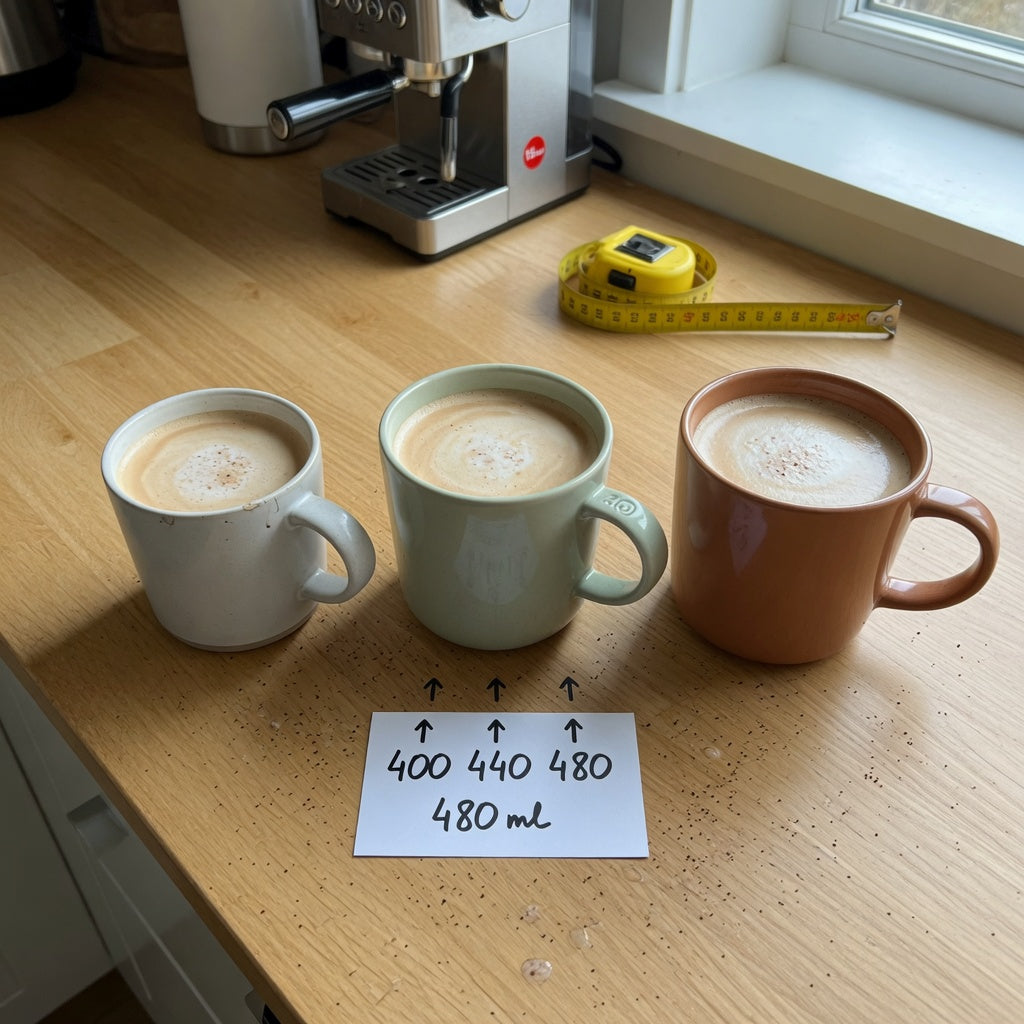
- The Flow — 400 mL (about 13.5 fl oz). This is the closest match if you want a desk mug near 14 oz without overshooting. It leaves a little room for headroom, so it is not the one to choose if you expect a full 14 oz before you take the first sip.
- Morning and Night — 440 mL (about 14.9 fl oz). This is the closest to a true 14 oz pour and suits a 14 to 15 oz habit. If you usually drink 10 oz and let the rest cool, it is more mug than you need.
- The Rock — 480 mL (about 16.2 fl oz). A 16 oz class mug, better for a long drip session than a small pour you want to finish while it is still hot. If you rarely drink 16 oz, it may be more mug than you need.
Capacity is only one axis. The unique coffee mugs collection shows the range together, which makes silhouette and handle differences easier to judge side by side. If you are deciding between two sizes, measure your desk first and pick the smaller one when you are unsure. A mug you fill completely beats a larger mug you leave half full.
How much desk footprint does a full mug really claim?
Footprint is not just base diameter. It is the base, plus the handle swell, plus the arc your hand needs to pick the mug up without knocking the mouse. Four measurements decide whether a mug works on your desk:
- Base diameter — does it sit on your coaster, or hang over the edge of it?
- Overall width including the handle — this is the number that collides with monitor stands and speaker feet, and it is often missing from listings.
- Height — check it against shelf clearance, a monitor riser, and the space under a single-serve brewer.
- Taper — a wide bottom resists tipping but eats desk space; a narrow foot is tidier but easier to clip.
If your desk is genuinely tight, a wide-bottom shape is usually the wrong call even though it feels stable in the hand. A straight-sided mug with a compact base is easier to live with beside a keyboard. We would rather answer a measurement question before you order than have you guess from a photo.
Will the handle clear your knuckles and your monitor?
A handle that looked generous in the photo can still be the wrong one at a desk. Two things go wrong. The opening is too small, so your knuckles press against a hot wall on a full mug. Or the handle is roomy but sticks out far enough to foul whatever sits beside it.
Judge a handle by opening width, not by how it looks. A chunky handle can have a small hole, and a slim one can be roomy. On a full mug, knuckles hitting the hot wall is a fit problem, not a design preference. The handle also adds overall width, which is the number that collides with a monitor stand, a speaker, or the mouse hand.
If knuckle clearance is your main worry, ask for the handle opening measurement before ordering. In our store, that is a better use of a question than guessing from a product photo.
Does a thicker ceramic body help or hurt at a desk?
Porcelain and stoneware are both ceramic; the difference is the clay body and firing. Porcelain is denser and typically thinner-walled, so it feels lighter in the hand and chips more readily at the rim. Stoneware is heavier and more forgiving of knocks. Double-wall ceramic adds an air gap for insulation and a cooler exterior. Ceramic-lined steel is a different product again: a metal shell with a ceramic coating, and because the shell is metal, verify the microwave claim on that exact listing.
Weight matters more on a desk than on a kitchen counter. A heavy stoneware mug at 14 oz is already substantial empty; filled, it becomes a two-hand carry for some people, and a two-hand carry next to a laptop is a spill waiting to happen. Empty weight and full weight are the specs we most wish every listing published.
Thicker walls hold heat a little longer, but the open top is still the biggest heat leak. If you sip slowly through a meeting, a smaller mug refilled more often often tastes better than a large mug you abandon. That is the honest trade-off of sizing up.
Which care claims survive metal trim and overglaze decals?
Care ratings are often written for a collection rather than a single piece. A metallic handle, gold rim, or overglaze decal on an otherwise identical body can remove microwave safety entirely. Read the care line on the exact product page you are buying, not the collection page above it. Check microwave, dishwasher, oven, broiler, and freezer separately, because they are not the same claim.
One caution worth repeating from public health guidance: California's Department of Public Health advises against microwaving or dishwashing dishes that contain or might contain lead, because heat and detergent can damage the glaze and increase leaching. Dishwashing a leaded piece can, in some cases, contaminate other dishes in the same load. That applies to ware that might contain lead, not to every ceramic mug, and it is one more argument for buying from a seller who will answer the question.
What do lead free and food safe actually promise on a 14 oz mug?
They promise less than most shoppers assume. FDA guidance for pottery sets an action level of 0.5 micrograms of lead per milliliter of leaching solution for cups and mugs, judged on any one of six units using ASTM C738 or the specified AOAC methods. Cadmium has its own 0.5 micrograms per milliliter action level for small hollowware. These are leach limits measured with an acid test, not guarantees of zero lead content.
FDA has documented imported traditional pottery labeled Lead Free that still released extractable lead, in some cases above those action levels. CDPH says you cannot tell by looking: plain white glazes are low concern, while damaged or chalky glaze, decoration sitting on top of the glaze, and bright color on the food-contact surface are higher concern. Coffee is acidic, which raises the chance of leaching compared with water.
CDPH separates lead-free ware, which contains no lead, from lead-safe ware, which may contain some lead but does not leach above California Proposition 65 levels. Separately, under 21 CFR 109.16, decorative ceramicware that looks food-suitable is treated as foodware unless it carries a required Not for Food Use warning or has a hole bored through the potential food-contact surface. A souvenir mug with no such marking and no testing statement is a question, not a bargain.
Desk-fit checklist before you add to cart
- Convert the stated capacity and decide whether it is brim or pour volume.
- Measure your coaster and the gap between keyboard and monitor.
- Check the height against your shelf, riser, or brewer clearance.
- Ask for handle opening width, not just handle style.
- Read the care line on the exact SKU for microwave, dishwasher, and oven.
- Confirm the material: solid ceramic, porcelain, double-wall ceramic, or ceramic-lined steel.
- Ask for a lead or cadmium test statement if the glaze is heavily decorated or the lip is painted.
Frequently asked questions
Is a 14 oz ceramic coffee mug for desk use too big for a standard desk?
Usually the capacity is not the problem; the handle and base decide it. A 14 fl oz mug is about 414 mL, or roughly 1.75 standard 8 oz cups. Measure the overall width including the handle and compare it with the gap between your keyboard and monitor before you buy.
How many cups of coffee does a 14 oz mug actually hold?
About 1.75 standard 8 oz cups if 14 oz is a real pour. If 14 oz is brim capacity, expect closer to 1.5 cups once you leave headroom, or slightly less on a lidded mug where the lid displaces volume.
Are 14 oz ceramic coffee mugs microwave safe?
Not automatically. Solid ceramic bodies often are, but metal handles, metallic rims, and some overglaze decals can make an otherwise identical mug unsafe in a microwave. Check the care instructions on the specific product page rather than the collection page.
What is the difference between lead-free and lead-safe ceramic mugs?
Lead-free means no lead is present. Lead-safe means the piece may contain some lead but does not leach above California Proposition 65 standards. FDA's 0.5 micrograms per milliliter action level for cups and mugs is a leach limit, so neither phrase substitutes for an actual test result.
Can I judge a mug's capacity from the product photo?
No. Scale cues in photos are unreliable, and a mug that looks large next to a notebook may be 12 oz. Compare the stated milliliters or fluid ounces, then convert before you buy. 14 fl oz is about 414 mL.
If you have measured your desk and settled on roughly 14 oz, start with Morning and Night at 440 mL for the closest pour, or The Flow at 400 mL if you would rather have headroom in the cup. If you need a larger desk mug for long drip sessions, look at The Rock at 480 mL. Either way, check the current listing for care details and glaze information before checkout, and browse the rest of the unique coffee mugs collection if neither silhouette suits the way your desk is arranged.
More from our blog
Read more
Big Latte Mug Capacity Guide: 400, 440, or 480 ml?
This big latte mug capacity guide compares 400 ml, 440 ml, and 480 ml mugs by refill pattern, handle comfort, desk footprint, and the daily routine each one suits.
Read more
Big Latte Mug for Small Coffee Setup: 400, 440 and 480 ml Compared
A 400 ml mug and a 480 ml mug solve different problems on a crowded counter. We compare usable fill, handle room, cabinet and machine clearance, and care labels — then map our three sizes to the se...
Read more
Leave a comment
This site is protected by hCaptcha and the hCaptcha Privacy Policy and Terms of Service apply.