
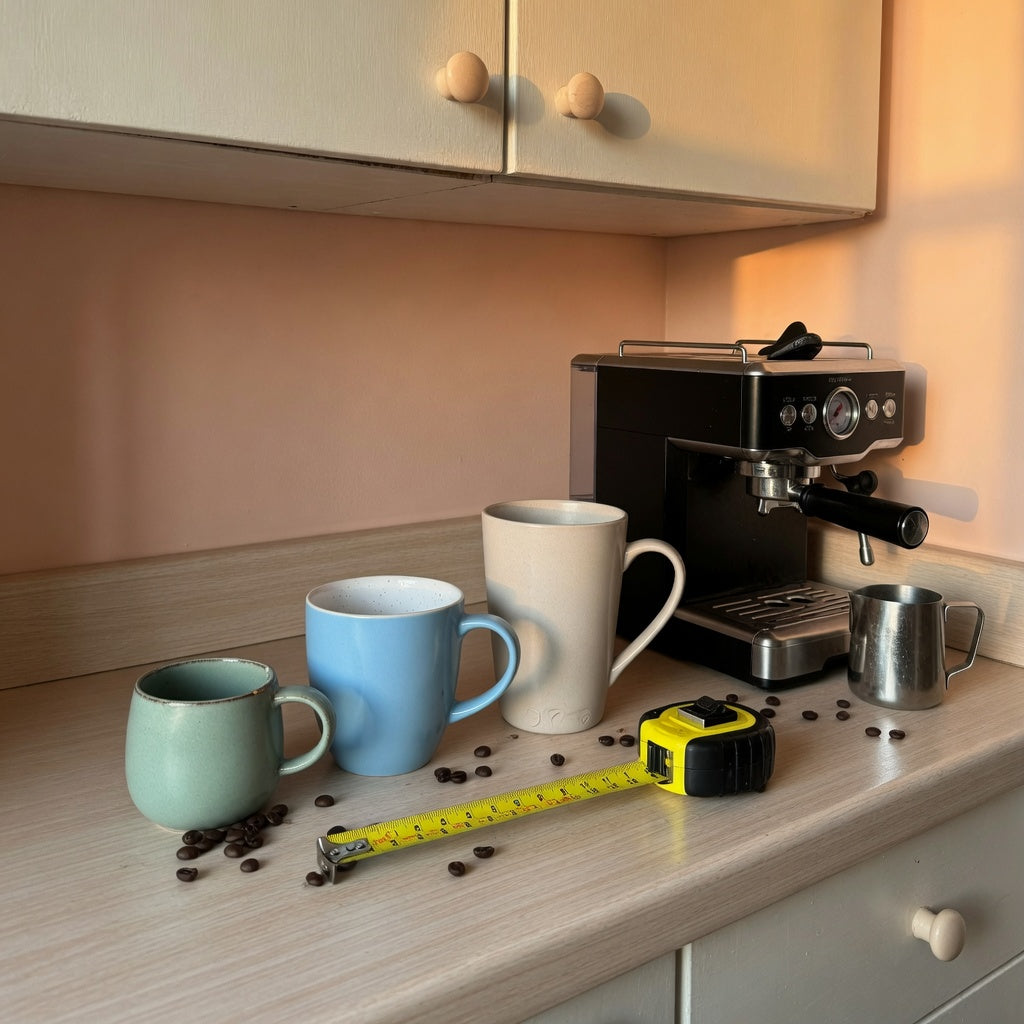
Big Latte Mug for Small Coffee Setup: 400, 440 and 480 ml Compared
Reading time: about 10 minutes
Line a 480 ml mug up next to a 300 ml café latte cup and the size gap is obvious. Put both in a product photo with nothing for scale and it disappears. That is the trap in every search for a big latte mug for small coffee setup: the cup described as a latte mug online might be a tight café-sized vessel, or it might be a tall mug that eats half your counter and barely clears the cabinet above it.
We sell ceramic mugs, we pack them for shipping, and we read what comes back after delivery. Almost none of those messages are about looks. They are about height, handle room, and how much of the listed capacity you can actually fill without wearing the drink.
Why the phrase "big latte mug" covers two different cups
Specialty café latte cups typically get listed around 300–355 ml. Tall retail mugs sold under the same name run well past that, into 400, 480 and 600 ml territory. There is no legal definition of a latte mug, so the label alone tells you almost nothing about the vessel in the box.
In a large kitchen you can absorb a bad fit — an oversized mug just moves to a different shelf. On a cramped counter it either works or it lives in the cupboard permanently. That is why we would rather you measure a gap before choosing a size than discover the problem on delivery day.
How much of a 400, 440 or 480 ml mug actually holds latte?
Listed capacity is normally measured to the brim. A brim-full mug is not one you can carry across a room, and it is not one you can set down while somebody jostles your elbow. A latte needs headspace: espresso first, then steamed milk, then a thin foam cap — and the foam needs somewhere to sit. A wide, shallow mug can look enormous while holding a modest drink, because so much of its volume sits in the top few millimetres.
Do the conversion yourself rather than trusting the rounded numbers on a listing. NIST Handbook 44 defines one U.S. fluid ounce as 29.57353 millilitres, so our three listed capacities work out to:
- The Flow, 400 ml — about 13.5 fl oz
- Morning and Night, 440 ml — about 14.9 fl oz
- The Rock, 480 ml — about 16.2 fl oz
Notice how close 400 and 440 ml land once converted: roughly 1.4 fl oz apart. That is a few sips, not a different drink. Choose between those two on shape and handle room, not on the number alone.
For baseline context, the FDA's compliance guide for ceramic hollowware describes cups and mugs as vessels that normally hold about 240 ml (8 fl oz) and have a handle. Everything in our range sits well above that, which is exactly why counter and cabinet maths start to matter here in a way they do not for a standard cup.
Wide bowl or tall cylinder — which shape survives a narrow counter?
Shape changes two things at once, and they pull in opposite directions.
A wide, bowl-shaped mouth gives poured milk room to spread, which is why latte art is generally easier in a wide cup than a narrow one. The cost is exposed surface area — a half-full wide mug sheds heat faster than a tall one holding the same volume, so the last third of the drink goes lukewarm.
A taller, narrower body usually takes up less base area for the same capacity and keeps a smaller drink warmer, but the pour window is tighter and the art is fussier. On a genuinely small setup the tall body tends to win, because footprint is the constraint you cannot negotiate and latte art is the skill you can practise.
The five measurements that decide whether a big latte mug fits your setup
Each of these takes under a minute. Each one has killed a purchase decision in our own experience, usually after the mug was already chosen.
- Group head to drip tray. Put your scale on the tray first, then measure the vertical gap. Allow extra for the portafilter spout. A mug that will not clear the group head becomes a tilted, hand-held pour.
- Cabinet or shelf clearance. Measure the gap above the exact spot the mug will live, not a general shelf height. Mugs get stored where they are used.
- Counter footprint. Trace the mug's base onto a sticky note and set that next to your grinder and kettle. A wide bowl can occupy more floor than three narrow cups stacked.
- Cup holder diameter, if the mug ever travels. Thick walls and wide bases are the usual reason a mug ends up riding on the passenger seat instead.
- Top-rack dishwasher height. Check clearance with the spray arm rotating. A mug that only fits on the bottom rack changes how you load the entire machine.
Which of our three sizes suits a small setup
We keep the range narrow on purpose — a wall of near-identical mugs helps nobody. Handle shape, empty weight, and care instructions are things you should confirm on the current product page rather than infer from a photo, so treat the table below as a capacity and use-case starting point.
| Mug | Listed capacity | Approx. fl oz | Where it fits |
|---|---|---|---|
| The Flow | 400 ml | ~13.5 | Tight counters, single-shot lattes with a moderate milk pour, anyone who wants a generous cup without a generous footprint |
| Morning and Night | 440 ml | ~14.9 | An everyday latte with proper room for a foam cap, and a mug that has to earn its shelf space with evening tea too |
| The Rock | 480 ml | ~16.2 | One large drink instead of two small ones, iced lattes, a desk where the mug stays put all morning |
If your counter is genuinely cramped, start with The Flow. Smaller listed capacity is the one figure you can bank on without measuring anything. If you already know your machine clears a taller mug, The Rock gives you the most working room and leaves headspace even on a full double. Morning and Night sits between them, which is either the sensible compromise or the mug that does neither job decisively — that depends entirely on how you drink.
If none of those three match your shelf, there are more shapes and finishes in our unique coffee mugs collection.
Handle room and the one-hand carry test
Handle comfort is the specification shoppers ask about least and complain about most. A handle that fits two fingers is fine on an empty mug and miserable on a full one.
Two checks before ordering. First, the opening: can your whole hand pass through, or only fingertips? Second, the carry: a wide, flat handle spreads load better than a thin loop, but it also projects further and can foul the cabinet door or the mug beside it.
Weight when full is the other half of the equation, and it is almost never printed. Fill a measuring jug to the listed capacity and lift it one-handed — that is the load you will be carrying, before the mug's own weight is added. If you have grip or wrist issues, a smaller listed capacity is the more comfortable answer no matter how good the handle looks in a photo.
Dishwasher, microwave, and what a "lead-free" label really covers
Ceramic is fired clay with a glaze, and glaze formulation is where the care questions actually live. "Dishwasher safe" and "microwave safe" are manufacturer statements about expected behaviour, not guarantees against every machine and every cycle. Repeated thermal shock — hot mug, cold rinse, hot drying cycle — is what eventually crazes a glaze, and a crazed glaze is where staining and stale odour begin. Hand wash anything with metallic trim or a hand-painted surface, and avoid dumping a hot mug into cold water.
On food-contact safety, the FDA's compliance guide for ceramic hollowware (CPG 545.450) sets a lead action level of 0.5 micrograms per millilitre of leaching solution, assessed on any one of six units tested, and the agency notes that some ceramic foodware can leach lead from food-contact surfaces. So when a listing says "lead-free," the useful follow-up is whether that refers to the glaze recipe or to a leach test against that action level. Those are not the same claim, and only one of them is a test result.
One more boundary: we do not publish insulation claims for our mugs. Treat any ceramic mug as a vessel, not a thermos. If heat retention is the priority, a vacuum-sealed travel mug is the right tool and a ceramic latte mug is the wrong one.
When a big latte mug is the wrong pick
A large mug fails in a few specific situations, and it is worth saying so plainly before you buy.
- Small drinks. A single espresso or a corto in a 480 ml mug looks lost and cools fast, because a wide surface with little liquid in it loses heat quickly.
- Fixed-ratio machines. If your machine dispenses a set volume, a bigger mug will not make a stronger drink — it makes a thinner one unless you pull a second shot.
- Tight cabinet stacks. Oversized mugs rarely stack, and they cannot share a shelf with smaller cups without wasting the height difference.
- Travel. Wide bases and thick walls are the classic cup-holder mismatch. Keep a separate travel mug for the car.
- Arthritis or a weak grip. A full 480 ml mug is a real load. A 400 ml mug with a roomy handle is the kinder daily choice.
If you drink 250–300 ml lattes and care more about art than volume, a smaller café-style cup is the better answer than anything on this page.
Frequently asked questions
Will a 480 ml mug actually hold a 16 oz latte?
480 ml converts to roughly 16.2 fl oz, but that figure is capacity to the brim. Leave headspace for the foam cap and for carrying, so a comfortable pour lands closer to 13–14 fl oz. If you routinely drink a full 16 oz, expect a fuller and riskier fill or step up in size.
Does a wide mug make latte art easier?
A wider surface gives the milk more room to spread, which many people find easier to pour into. It also flattens the crema layer faster and lets the drink cool sooner. Pick the shape that matches the drink you make most often, not the one you make best once a week.
How do I confirm a big latte mug for small coffee setup will clear my espresso machine?
Measure from the group head down to the drip tray with your scale already in place, then add a margin for the portafilter spout. If that number is tight, look at the 400 ml option first — a shorter body is more forgiving under a low group head, and listed capacity is the one figure you can rely on before delivery.
Which of your three mugs is best for a tiny kitchen?
The Flow at 400 ml, in most cases. It gives a genuinely generous latte cup while leaving the most counter and cabinet clearance, and it is the lightest full mug of the three to carry one-handed. Move up to Morning and Night or The Rock only after you have measured the space and confirmed the taller body fits.
Is a "lead-free" ceramic mug the same as a tested one?
No. "Lead-free" usually describes what the maker says went into the glaze; the FDA's 0.5 micrograms per millilitre action level is a leach result measured on finished ware. If food-contact safety decides your purchase, ask the seller which of the two they mean — a formulation claim and a test result are different things.
More from our blog
Read more

14 Oz Ceramic Coffee Mugs for Desk Use: Capacity, Footprint, Fit
A 14 oz ceramic coffee mug for desk use is not just a bigger cup. We break down real pour volume, footprint, handle clearance, care claims, and which CoffeifyMug sizes land closest.
Read more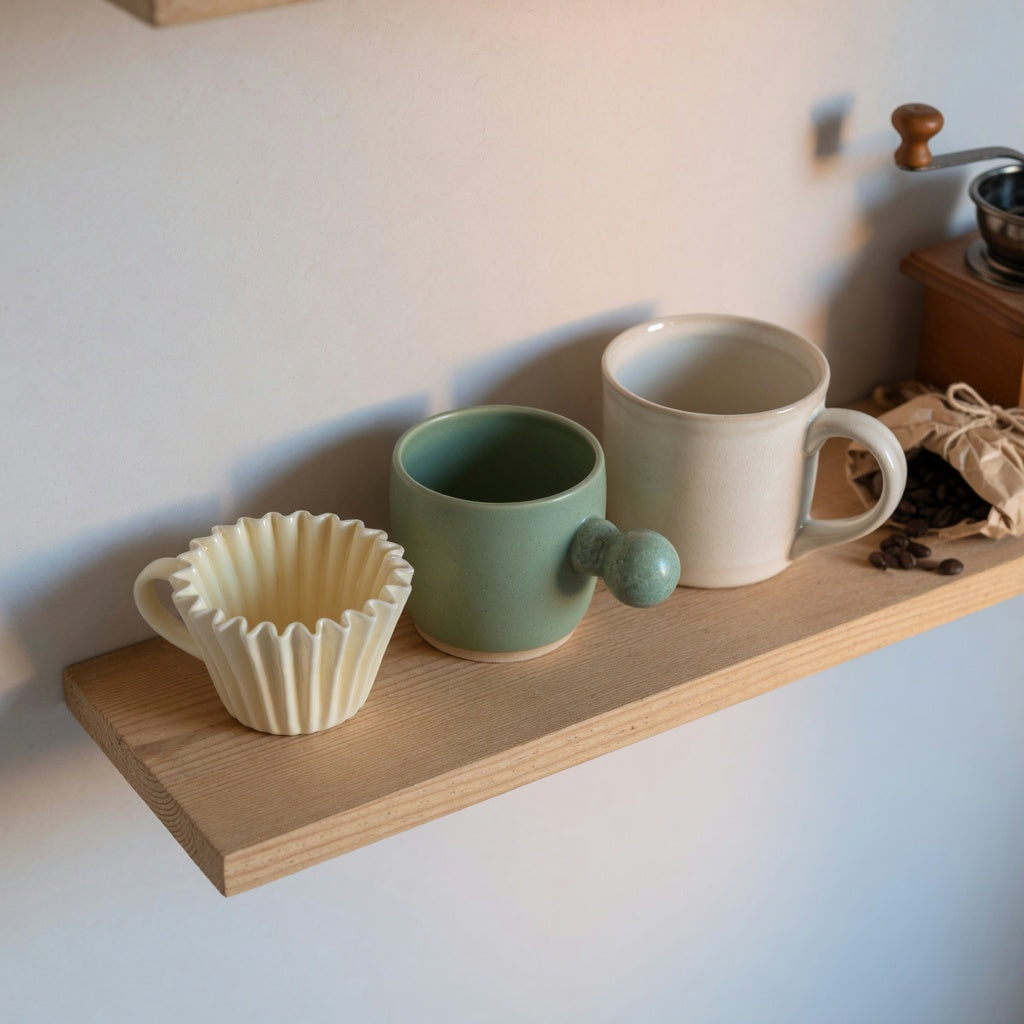
Ceramic Mug Shapes for Small Coffee Setup: What to Compare
Pleated, ball-handle and 400 ml forms behave very differently on a narrow shelf. A store-side guide to footprint, handle clearance and where each listed capacity lands in ounces — plus the details ...
Read more
Leave a comment
This site is protected by hCaptcha and the hCaptcha Privacy Policy and Terms of Service apply.