
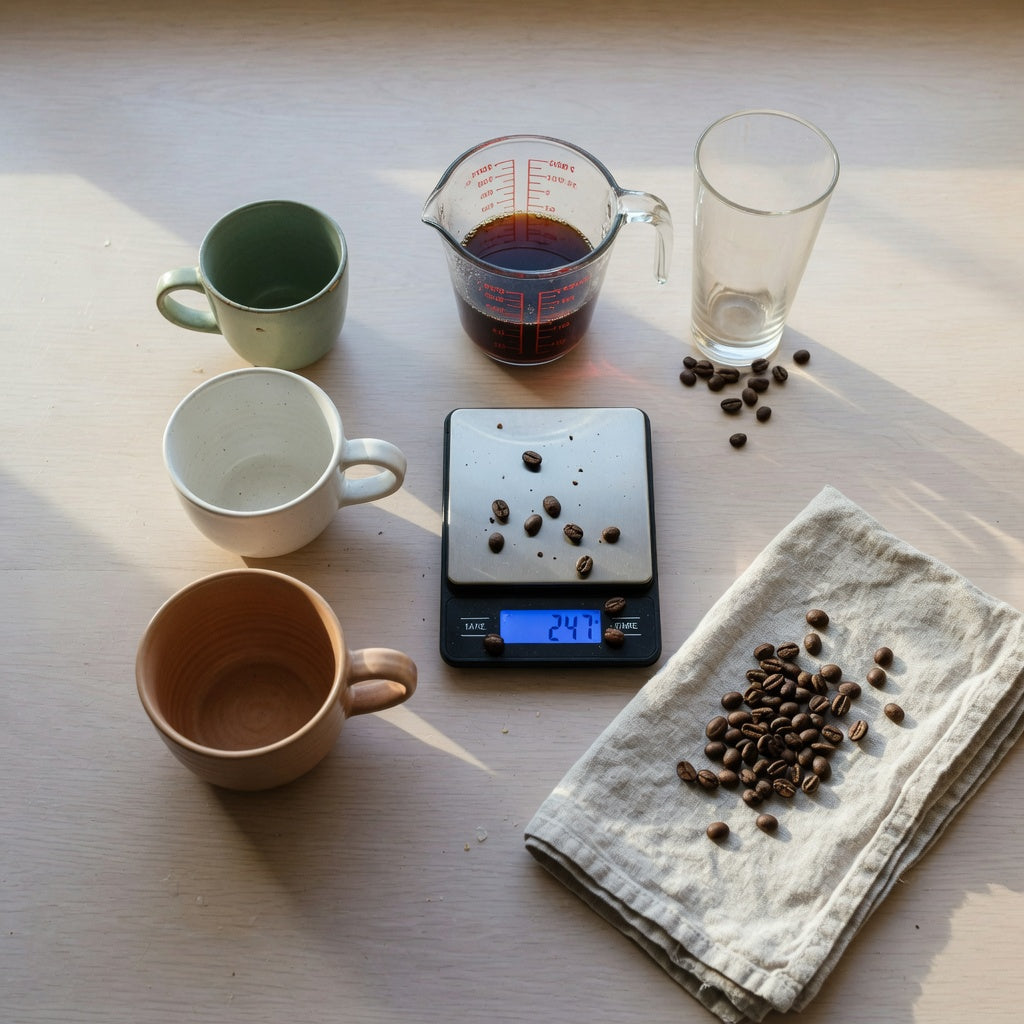
14 Oz Ceramic Coffee Mugs Capacity Guide: 400 vs 440 vs 480 ml
Reading time: about 11 minutes
Your single-serve brewer finishes its "large" cycle, you set the mug down at your desk, and the coffee line sits an inch below where the product photo suggested. Nothing is wrong with the mug. The 14 oz figure was measured to the rim, and you poured 10 oz. That gap between stated capacity and a real pour is the reason this 14 oz ceramic coffee mugs capacity guide exists.
We sell ceramic mugs and pack them for shipping, so we hear the follow-up messages a week after delivery: the mug is lovely, but is it too big for my pod brewer, does the handle clear my knuckles when it is full, and why does my tea go lukewarm before I finish it. Capacity answers the first question. The rest comes down to a few specs that most listings bury below the photos.
14 oz ceramic coffee mugs capacity guide: the milliliter math and the headroom problem
In U.S. fluid ounces, 14 fl oz is about 414 mL. NIST defines the U.S. fluid ounce as 29.57353 mL, so the conversion is straightforward arithmetic. It matters because ceramic mugs are usually specified in milliliters while shoppers search in ounces, and a 40 mL difference between two mugs is enough to change how full a cup looks on your counter.
Scale matters too. FDA compliance guidance describes a typical cup or mug as roughly 240 mL, or about 8 fl oz. A 14 oz mug is closer to two of those. When a listing says 14 oz, you are looking at a large everyday cup, not the diner-standard 8 oz mug.
- Brim capacity is the volume to the very lip. It is easy for a seller to measure and the least useful number for carrying a full mug across a kitchen.
- Comfortable fill leaves headroom so coffee does not slosh toward the handle side when you walk. On a handled ceramic mug with a curved inner wall, treat a 14 oz brim figure as roughly 12 to 13 oz of coffee you will actually enjoy.
- Lid displacement matters on any mug sold with a lid. Ask whether the stated capacity was measured with the lid seated or with the mug open, because a lid takes up room in the same body.
Which of our three current capacities fits your refill pattern?
Our current ceramic mugs sit at three capacities. They look interchangeable in a photo and feel very different when full.
| Mug | Stated capacity | Approximate U.S. pour | Best fit |
|---|---|---|---|
| The Flow Coffee & Tea Mug | 400 ml | ~13.5 fl oz | A 12 oz drip with a splash of milk, or a generous tea; the smallest of the three |
| Morning and Night Coffee & Tea Mug | 440 ml | ~14.9 fl oz | The closest match to a true 14 oz pour, with headroom left over |
| The Rock Coffee & Tea Mug | 480 ml | ~16.2 fl oz | Long black coffees, iced drinks with ice room, and anyone who dislikes refilling |
Read that table by serving routine, not by "bigger is better." If you brew 12 oz and add a splash of milk, The Flow at 400 ml gives you the closest thing to a full mug without a long empty stretch above the coffee line. If your brewer's large setting is 14 oz and you drink it black, Morning and Night at 440 ml is the natural match. If you make iced coffee, The Rock at 480 ml leaves room for cubes, but remember that ice displaces liquid: a 480 ml mug does not hand you 16 oz of coffee once the ice goes in.
You can see the three shapes side by side in our unique coffee mugs collection.
Is a 14 oz ceramic mug the same as a 14 oz ceramic-lined steel mug?
No, and the difference changes how the mug feels in your hand more than how much it holds. The word "ceramic" in a product name covers several constructions:
- Solid stoneware or porcelain is ceramic through the wall. Stoneware tends to be thicker and heavier; porcelain can be fired thinner and lighter for the same volume. Both hold heat in the body of the mug rather than only in the drink.
- Double-wall ceramic uses two ceramic walls with an air gap. The outside stays cooler to the touch, but the mug is heavier and the usable interior is smaller than the exterior suggests.
- Ceramic-lined steel is a vacuum-sealed metal body with a ceramic coating inside. It keeps drinks hot far longer than an open ceramic mug keeps them warm, but the lining is a coating, not a thrown wall, and it can stain or wear differently over years of use.
If a listing does not say which body you are buying, ask before ordering. On our product pages we state capacity in milliliters plainly, and the current care marks are the place to confirm everything else.
Drip, tea, or a milk-heavy latte: matching the pour to the mug
Desk coffee and refill habits
A 14 oz mug is a good desk mug only if you drink most of it before the coffee cools. It is a poor desk mug if you pour 8 oz and then answer email for 40 minutes, because the empty upper half is surface area working against you. If you routinely pour half a mug and reheat the rest, the smaller 400 ml Flow suits that habit better than pushing up to 480 ml.
Tea in the evening
Tea rewards extra room: a 440 ml or 480 ml mug leaves space for a bag, a spoon, and dilution if you steep strong. The trade-off is that a wide 16 oz mug cools a delicate green tea faster than a narrow cup. Fill it less than the brim and accept the stated number as a ceiling.
Lattes and iced drinks
Cafe milk drinks commonly land in the 12 to 16 oz range, which is why 14 oz is such a common search. A 440 ml mug takes a 12 oz latte with a little foam head; a 480 ml mug suits a 16 oz iced latte if you build it ice first, then coffee, then milk.
When a 14 oz ceramic mug is the wrong mug
We would rather point you elsewhere than sell you a mug that lives in the cabinet.
- You drink 6 to 8 oz. A large mug makes a small pour look lost and cools faster because of the air above the liquid.
- Your cabinet shelf is low. Measure exterior height, not capacity. A tall 480 ml body may not clear the shelf above it.
- Your brewer spout sits close to the drip tray. Check exterior height against that clearance before you buy; capacity tells you nothing about it.
- You want a commuter mug. A handled ceramic mug is not a travel mug. It may not fit a car cup holder, and ceramic can chip if it rolls around in a bag.
- You carry it one-handed up stairs. A full 480 ml mug is heavy. Check empty weight and handle opening before committing.
Handle opening, empty weight, and foot diameter: specs the capacity number hides
A mug can hold exactly the right amount and still be unpleasant to use. The handle opening decides whether your knuckles brush a hot wall on a full mug. The foot diameter decides whether it sits stable on a saucer or a narrow shelf. Empty weight decides whether you can lift it one-handed after a long pour.
We handle these mugs in our store, and the pattern repeats: buyers ask about capacity first and handle comfort second. A month later, the handle is what they mention. That is why we list exterior dimensions wherever we can rather than letting a photo do the work — a mug photographed next to a croissant will always look generous.
Lead, cadmium, and "food safe": how to read ceramic mug claims
Ceramic mugs are food-contact products, so safety language deserves more attention than the glaze photo. FDA sets an action level of 0.5 micrograms of lead per milliliter of leaching solution for cups and mugs, judged on any one of six units using methods such as ASTM C738. For cadmium, the action level for small hollowware is also 0.5 micrograms per milliliter. Those are leach limits under test, not a promise that every piece in a kiln behaves identically.
Two details separate a useful claim from a vague one. FDA has warned that some imported pottery labeled "lead free" still contained extractable lead above the applicable action levels. Separately, California's health department distinguishes lead-free tableware, which contains no lead, from lead-safe tableware, which may contain some lead but does not leach above Proposition 65 levels. You cannot tell which you have by looking at the glaze; decorative ware also has its own rule under 21 CFR 109.16, which treats food-looking ornamental pieces as food use unless they carry a "Not for Food Use" warning or are physically disabled for contact.
A small peer-reviewed pilot study of ceramic mugs measured lead in brewed coffee from 0.2 to 8.6 micrograms per liter and in tea from below 0.2 to 1.6 micrograms per liter, with results varying by mug. That does not mean your mug is unsafe. It means "within the legal limit" and "no detectable leaching" are different statements, and a test reference beats a decorative sticker.
Microwave and dishwasher: why two mugs of the same size behave differently
A gold handle, a metallic rim, or an overglaze decal can change the care instructions on a mug that otherwise looks like the same body. Metal trim is the obvious microwave problem; decals and metallic accents are often the fragile part in a dishwasher, where heat and detergent wear the decoration before the ceramic itself fails.
California's health department also advises against microwaving or dishwashing dishes that contain or might contain lead, because heating can speed leaching and repeated washing can damage a glaze. That guidance is about suspect ware, not about every ceramic mug — but it is a good reason to follow the exact care mark on the piece you own instead of generalizing from the shape. If our listing for a specific mug does not state microwave or dishwasher status, ask us before you buy.
A two-minute fit check before you order 400, 440, or 480 ml
- Measure your usual pour. Fill your current mug with water, pour it into a measuring cup, and note the ounces. That number beats any cafe comparison.
- Measure the cabinet shelf. Leave an inch above the rim so you are not scraping glaze every morning.
- Check the brewer. Set your current mug on the drip tray and look at the gap between the spout and the rim.
- Check the cup holder if it matters. Compare base diameter, not capacity.
- Decide whether you reheat. If you often microwave half a mug, choose the 400 ml Flow rather than the 480 ml Rock.
- Confirm care marks and any lead or cadmium test statement. If the listing is silent, ask the seller.
Pick the serving routine first and the capacity follows: The Flow 400 ml for smaller, hotter pours, Morning and Night 440 ml as the closest thing to a true 14 oz mug, and The Rock 480 ml for long drinks and refill avoiders. Browse all three in the unique coffee mugs collection and compare the stated milliliters against the pour you measured this morning.
Frequently asked questions
Is 14 oz the same as 400 ml?
No. 14 U.S. fluid ounces is about 414 mL. The Flow is 400 ml (~13.5 fl oz), Morning and Night is 440 ml (~14.9 fl oz), and The Rock is 480 ml (~16.2 fl oz). If you want a true 14 oz pour with headroom above it, 440 ml is the closer match.
Why does my 14 oz mug look half full after brewing?
Most likely your brewer's large setting is closer to 10 or 12 oz than 14 oz, and the mug's stated figure was measured to the rim. Measure your usual pour once with a measuring cup and you will stop guessing; a 400 ml mug often fits a 12 oz habit better.
Is a 14 oz ceramic mug big enough for a latte?
For a 12 oz latte with a little foam, yes. This 14 oz ceramic coffee mugs capacity guide treats 440 ml as the sweet spot for that drink, since it leaves headroom for foam without the drink looking stingy. A 16 oz iced latte needs the 480 ml body plus room for ice.
Can I microwave a ceramic mug with a gold handle?
Only if the care mark for that exact mug says it is microwave-safe. Metallic handles, rims, and decals are common reasons a ceramic body is excluded even when a plain version of the same shape is approved.
How do I check whether a ceramic mug is lead free?
Look for a test statement tied to FDA action levels or ASTM C738 testing, or a Proposition 65 statement, rather than the words alone. FDA has found pottery labeled lead free that still released extractable lead, and you cannot judge it by looking at the glaze.
More from our blog
Read more

Big Latte Mug Comparison: 400 ml, 440 ml or 480 ml?
Three mugs, three capacities, three different mornings. This big latte mug comparison separates brim capacity from the pour you actually get, then shows which of our current 400 ml, 440 ml and 480 ...
Read more
14 Oz Ceramic Coffee Mugs Comparison: Which Option Fits?
A 14 oz ceramic mug rarely pours a full 14 oz once you leave headroom for milk or a lid. We compare our current 400 ml, 440 ml, and 480 ml mugs by drink routine, handle fit, care questions, and the...
Read more
Leave a comment
This site is protected by hCaptcha and the hCaptcha Privacy Policy and Terms of Service apply.