
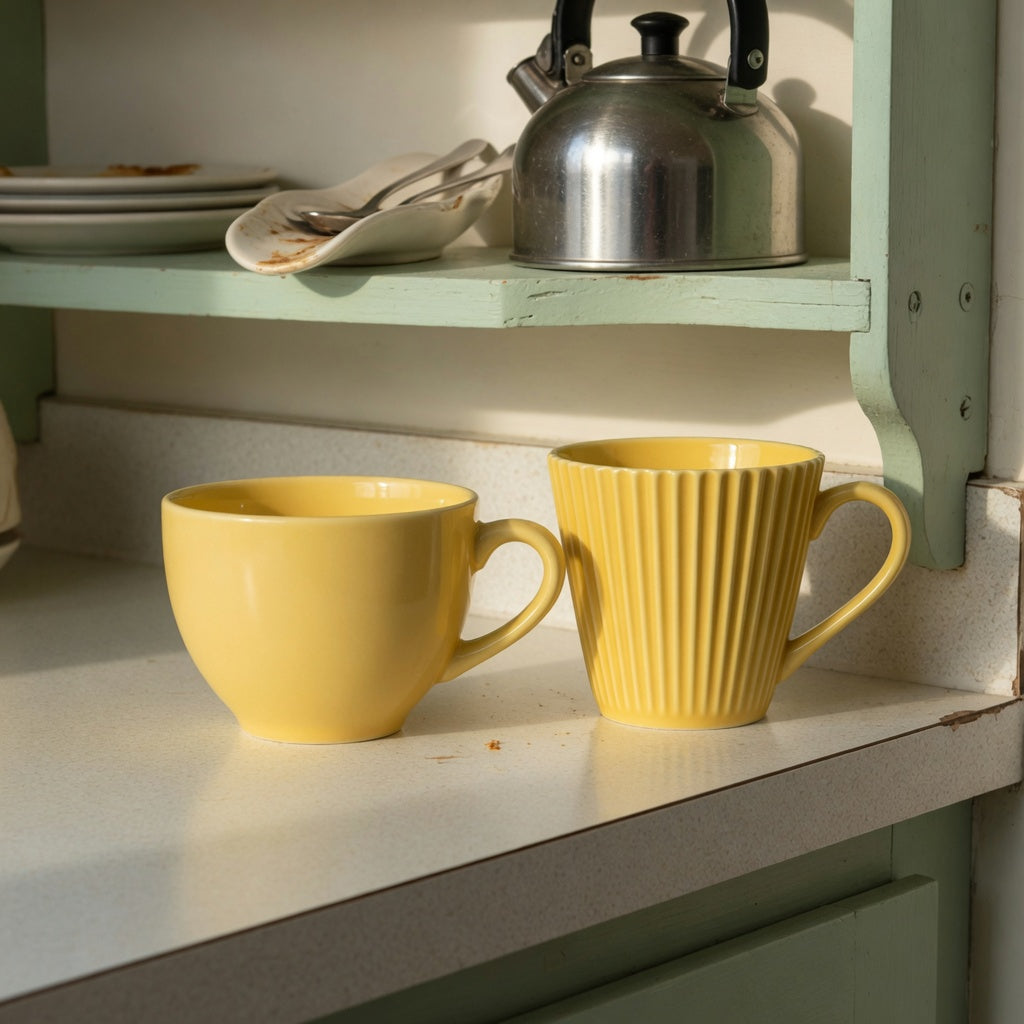
Yellow Ceramic Coffee Mug Compact Kitchen Practical Purchase Checklist
Reading time: about 10 minutes
A mug can fit on a counter and still fail the kitchen. The handle may meet a cabinet edge, the shelf may be too low to lift the cup cleanly, or the only open spot may be beside a wet drying rack. A shopper searching for a yellow ceramic coffee mug compact kitchen practical purchase checklist is usually trying to prevent that small but daily mismatch.
We handle ceramic coffee and tea cups in our store while packing orders, photographing shapes, and resetting display shelves. The questions we hear are practical: Is 170 ml enough? Will a textured surface be annoying beside the sink? Can the cup be stored without colliding with neighboring handles? Our current catalog gives shoppers two yellow options to compare: the Retro coffee tea cup listed at 170 ml and the Pleated coffee tea cup listed at 200 ml.
This comparison stays within those verified facts. We cover listed capacity, visible form, compact-use trade-offs, and current yellow-variant listings. We do not turn capacity into an invented height or diameter, and we do not promise microwave or dishwasher safety. In a small kitchen, knowing what still needs measuring is as valuable as knowing what the product listing confirms.
Which listed capacity fits the drink you actually pour?
Start with your normal serving rather than the color. Retro is listed at 170 ml; Pleated is listed at 200 ml. The 30 ml difference is modest, but it matters if your usual coffee or tea sits close to the smaller amount and you dislike topping up halfway through the drink.
Our practical check is easy to repeat at home: pour a normal serving into a measuring jug, then repeat it with your usual milk or sweetener. A serving comfortably below 170 ml points toward Retro. A serving that benefits from the additional 30 ml points toward Pleated. This is a volume comparison only; neither capacity tells you the cup's external height, width, or handling weight.
Both choices are a poor match for someone who routinely wants a large travel-style serving, a shared pour for two people, or a tall iced coffee built around substantial ice. Smaller listed capacity can help keep a single serving controlled, but it leaves less margin for overfilling on a narrow counter.
How do the Retro and Pleated forms change storage decisions?
Retro presents a smooth, rounded, classic form. Pleated uses visible vertical pleats, giving the ceramic a more textured appearance. Those are the form differences a shopper can assess from the listings and images. The verified facts do not provide numeric external dimensions, base diameter, handle projection, or weight, so neither model should be declared a guaranteed fit for a particular cabinet.
| Option | Listed capacity | Visible form | Compact-kitchen question | Yellow listing |
|---|---|---|---|---|
| Retro coffee tea cup | 170 ml | Smooth rounded form | Do you want the smaller listed serving and a quieter surface? | Yellow variant currently listed |
| Pleated coffee tea cup | 200 ml | Vertical pleated texture | Do you want 30 ml more and a more noticeable surface? | Yellow variant currently listed |
The smooth Retro has fewer recesses to wipe around after a splash. Pleated's ridges add tactile and visual interest, but they also create more surface transitions around which milk or sweetener can collect. If the listed 170 ml serving and simpler surface fit your routine, open the Retro coffee tea cup product page. If 200 ml and a more pronounced texture make more sense, review the Pleated coffee tea cup listing and confirm the yellow variant at order time.
What should your yellow ceramic coffee mug compact kitchen practical purchase checklist verify?
Use this sequence before checkout. It puts the measurements your kitchen owns beside the product facts the catalog supplies.
- Measure usable counter depth. Measure from the backsplash or wall to the front edge, then account for the kettle, grinder, spoon rest, and drying mat. On a counter around 12-14 inches deep, the usable zone can be much smaller than the overall depth.
- Measure the shelf opening. Record the clear height from the shelf surface to the underside above it. Open the cabinet door fully as well; a handle can need clearance at the front edge even if the cup body appears to fit. Do not infer this dimension from 170 ml or 200 ml.
- Check storage width and handle space. Mark the room available for the cup, its handle, and the neighboring mug. The verified facts here do not give a base diameter or handle projection, so use any external measurements on the live product page or ask for missing fit information.
- Match capacity to your measured serving. Choose Retro at the listed 170 ml for the smaller comparison point, or Pleated at the listed 200 ml if that additional volume is useful. Do not choose by yellow color alone.
- Decide how the form will be handled. The smooth rounded Retro has fewer surface grooves, while Pleated brings visible vertical texture. Think about wet hands, sink-side wiping, and how tightly other cups are stored.
- Check the live yellow variant. The catalog currently lists yellow for both named styles, but variant availability can change. Confirm the selected color on the product page rather than relying on a saved screenshot or an older gift guide.
- Set a no-fit rule. If you need more than 200 ml, a shared serving, or a particular appliance fit, stop treating these two cups as the default. Compare other listed styles in the unique coffee mugs collection, then check each option's own capacity, dimensions, and care information.
A useful result can be not yet. If one essential dimension is missing, asking before ordering is more practical than assuming a smaller capacity automatically means a compact physical shape.
Can 170 ml or 200 ml prove that a mug fits your cabinet?
No. Milliliters describe listed capacity, not external height, width, depth, handle clearance, or weight. A 170 ml cup is not automatically shorter or narrower than every 200 ml cup, so volume should never be used as a substitute for a physical fit check.
For a counter around 12-14 inches deep, measure the usable section after the backsplash, coffee machine, grinder, and drying mat take their space. On a low open shelf, measure the clear opening and leave room for the lift-out motion. Inside a cabinet, open the door and check whether the handle or rim meets the frame. These are layout checks, not product specifications.
Use any published external dimensions on the live product page to compare with your notes. If a needed dimension is absent, ask before ordering. We cannot confirm universal cabinet fit for Retro or Pleated because the external dimensions are not part of the verified facts used here and every kitchen layout differs.
What ceramic care checks matter after the unboxing?
Compact storage often means more contact between dishes, so inspect the cup before putting it into a crowded cabinet. Check the rim, handle join, foot ring, and visible surface for chips, hairline cracks, or finish marks. These are useful inspection points for any ceramic coffee cup; they are not a statement that either CoffeifyMug style has a known defect.
Our team treats care claims conservatively. The verified facts for this comparison do not establish microwave safety or dishwasher safety for Retro or Pleated. Do not use a dishwasher cycle as a compatibility test, and do not assume a yellow finish changes the care requirement. Follow the care information on the live listing or get confirmation before use.
Form affects the cleanup routine, too. Retro's smooth exterior has fewer recesses to wipe around after a spill. Pleated's vertical ridges are part of its character, but they create more surface transitions around which milk or sweetener can collect. Ceramic is not drop-proof, so a shelf that requires tight stacking or frequent knocking is a poor environment for either cup.
At an office desk, the same practical check applies: match the listed 170 ml or 200 ml to your serving, leave clear space around the cup for a keyboard and notebook, and choose a care routine you can actually follow.
Which compact-kitchen situation favors Retro, Pleated, or neither?
The recommendation changes with the job. Use these situations to turn the comparison into a concrete next step.
- Your normal coffee or tea serving is small and the shelf already looks busy. Retro's listed 170 ml capacity and smooth rounded form are the closer starting point for a restrained display. Review the Retro cup details and confirm external fit before ordering.
- You want the larger of the two listed servings. Pleated's listed 200 ml capacity is the direct comparison, and its vertical pleats give the yellow color a more noticeable surface. Review the Pleated cup details for the live yellow variant and any published fit or care information.
- You keep a mug beside the sink and value a quick wipe. Retro's smooth visible form gives you fewer grooves to work around. Choose it only after matching the 170 ml serving and confirming the product-page details; a smoother exterior does not establish dishwasher safety.
- You are gifting to a compact, mostly monochrome kitchen. Yellow can make a small cup easy to find and can act as an intentional accent. Choose the smooth Retro style for a classic look or compare the textured Pleated style if the recipient likes visible detail, then verify the live yellow variant.
- You need a large pour, a shared serving, or a particular appliance fit. Neither 170 ml nor 200 ml should be stretched into that job, and no appliance-fit claim is established here. Browse the full unique coffee mugs collection for another listed option, then repeat the capacity, dimension, and care checks for that product.
Frequently asked questions
What should a yellow ceramic coffee mug compact kitchen practical purchase checklist compare?
It should compare the verified facts that affect this decision: the Retro listing at 170 ml, the Pleated listing at 200 ml, each visible form, compact-use trade-offs, and the yellow variant shown on the current product pages. External dimensions, weight, stackability, and appliance compatibility are separate questions and should not be guessed from capacity.
Is 170 ml or 200 ml better for a compact kitchen coffee mug?
Choose 170 ml if your usual coffee or tea serving fits comfortably within the Retro listing and you prefer its smooth rounded form. Choose 200 ml if the Pleated listing better matches your serving and you want its vertical texture. Measure your actual drink rather than choosing by color.
How can I check if a yellow ceramic cup fits under my cabinet?
Measure the clear shelf height, usable depth, available width, and the space needed for the handle to pass the cabinet edge. Compare those measurements with the external dimensions shown on the live product page; the 170 ml and 200 ml capacity figures do not prove physical fit. If a needed dimension is missing, ask for it before ordering.
Are the Retro and Pleated yellow cups microwave-safe or dishwasher-safe?
Do not assume either claim from the ceramic material or the yellow finish. The verified facts for this comparison do not establish microwave or dishwasher safety, so follow the care instructions on the live listing or get confirmation before use.
Which yellow ceramic coffee cup is the better small-kitchen gift?
Retro is the simpler choice for someone who likes a smooth, rounded classic form and a listed 170 ml serving. Pleated suits a recipient who prefers visible texture and the listed 200 ml capacity. Check the current yellow variant and the recipient's shelf and serving constraints before selecting one.
Before checkout, write down your usable counter depth, shelf height, neighboring-handle space, and normal serving volume. Then open the Retro or Pleated product page, verify the yellow variant and care information, and use the unique coffee mugs collection only if neither listed capacity nor form fits the job. That is the practical next step for applying this yellow ceramic coffee mug compact kitchen practical purchase checklist to the kitchen you actually have.
More from our blog
Read more

Yellow Ceramic Coffee Mug Home Office Practical Purchase Checklist
Compare CoffeifyMug's yellow Retro (170 ml) and Pleated (200 ml) ceramic cups for desk space, meetings, break routines, care questions, and gifts. This checklist shows the trade-offs and when a dif...
Read more
A yellow ceramic coffee mug morning routine product shortlist guide
Match the listed 170 ml Retro and 200 ml Pleated yellow ceramic cups to your first-pour volume, refill tolerance, and counter space. We map each option to kitchen, office, and gifting scenarios, in...
Read more
Leave a comment
This site is protected by hCaptcha and the hCaptcha Privacy Policy and Terms of Service apply.