
Wooden Handle Tea Mug Comparison: 7 Checks Before You Buy
Reading time: about 9 minutes
A customer emailed us last spring with a photo of a wooden handle tea mug she had owned for about three months. The body was fine. The handle, though, had developed a faint wobble right where the wood met the glass — the exact spot we see fail first in this style of drinkware. Her question, “what should I have checked before buying?”, is the entire point of a wooden handle tea mug comparison.
Two mugs can look nearly identical in product photos and behave completely differently after a winter of daily brewing. The real differences hide in three places most listings bury in the fine print: the body material, the joint holding the handle, and the care the wood expects from you in return. We walk customers through all three at the counter in our store; here is that same walkthrough, written down.
What actually separates one wooden handle tea mug from another?
Strip away the styling and every mug in this category comes down to five variables. Score a candidate against them and you already know more than most listings tell you:
- Body material — borosilicate glass, soda-lime glass or ceramic, each with different heat behavior and weight in the hand.
- Handle attachment — screwed, pegged or glued, which predicts how the handle eventually fails.
- Capacity — a tea serving and a coffee serving are not the same size, and listings usually quote one number.
- Care demands — hand wash only, or a dishwasher claim; microwave yes or no.
- Wood finish — sealed, oiled or raw, which matters anywhere near hot liquids and your mouth.
These five also explain why prices vary so widely within one category — a spread you can see yourself across our unique coffee mugs collection, where wooden handle designs share shelf space with plain ceramic and double-wall glass.
Glass, soda-lime or ceramic: which body pairs best with a wooden handle?
The wood gets the attention, but the body decides how the mug performs. Three camps dominate:
| Body material | Heat behavior | Weight | Watch for |
|---|---|---|---|
| Borosilicate glass | Tolerates sudden temperature swings far better than standard glass; shows off tea color | Lightest of the three | Thin walls can chip if knocked against a sink or tap |
| Soda-lime glass | Everyday glass; more sensitive to a fast jump from cold to boiling | Light | Pre-warm the mug before pouring just-boiled water |
| Ceramic | Holds heat longest; best for slow sippers | Heaviest | Weight plus a dense wood handle changes the balance when you tilt to drink |
One nuance shoppers miss: capacity is usually measured to the brim. A mug listed at 350 ml pours closer to 300 ml once you leave rim room, and if a listing quotes only milliliters, dividing by roughly 30 gets you ounces. We have seen mugs returned over exactly this misunderstanding — the mug was never wrong, but the number on the box did not match the pour in the buyer's head.
How is the handle attached, and why does the joint decide the mug's lifespan?
Most buying guides skip this part. It is where these mugs succeed or fail. Three construction approaches dominate, and each fails differently:
| Attachment method | How it is built | How it tends to fail | Best suited to |
|---|---|---|---|
| Screwed metal collar | The wooden handle threads onto stainless hardware fixed to the body | Sturdiest for daily use, but the metal rules out microwave reheating | Daily coffee and tea drinkers who hand wash anyway |
| Pegged or tenon joint | A wooden peg slots into a hole in the body; no metal anywhere | Wood swells when it soaks and shrinks as it dries; repeated cycles turn a snug peg into a wobble | Lighter use and buyers who want an all-natural look |
| Adhesive-bonded collar | Glue joins the wood to a glass flange for the lightest silhouette | The weakest link if the mug sits in dishwater or runs through hot cycles | Occasional use, display shelves, careful owners |
In our store, wobble-at-the-collar is the single most common after-sales question about this style. That is why we give every customer the same advice: if a listing does not state the attachment method, ask before ordering. A seller who knows their product answers in one sentence.
Can a wooden handle tea mug go in the dishwasher or microwave?
The honest answer, from people who sell these daily: treat the dishwasher as a risk and the microwave as a case-by-case check.
Wood and dishwashers disagree. Prolonged heat and standing water make the fibers swell, then crack as they dry; once a hairline crack opens near the collar, the handle is on borrowed time. Repeated cycles also strip oil or lacquer finishes years faster than hand washing would. If nobody in your household will hand-dry a handle, this is the wrong category for you — plain ceramic or double-wall glass will cost less to replace and cause less friction.
Microwaves are simpler. Metal hardware means no. All-glass-and-wood designs without a collar are sometimes microwave-friendly, but we would not assume it from a photo and neither should you — check the listing for an explicit statement, and if it is silent, ask.
For daily care, the routine is short:
- Hand wash the body and keep the handle out of prolonged soaking.
- Towel-dry the wood immediately instead of leaving it upside down in a rack.
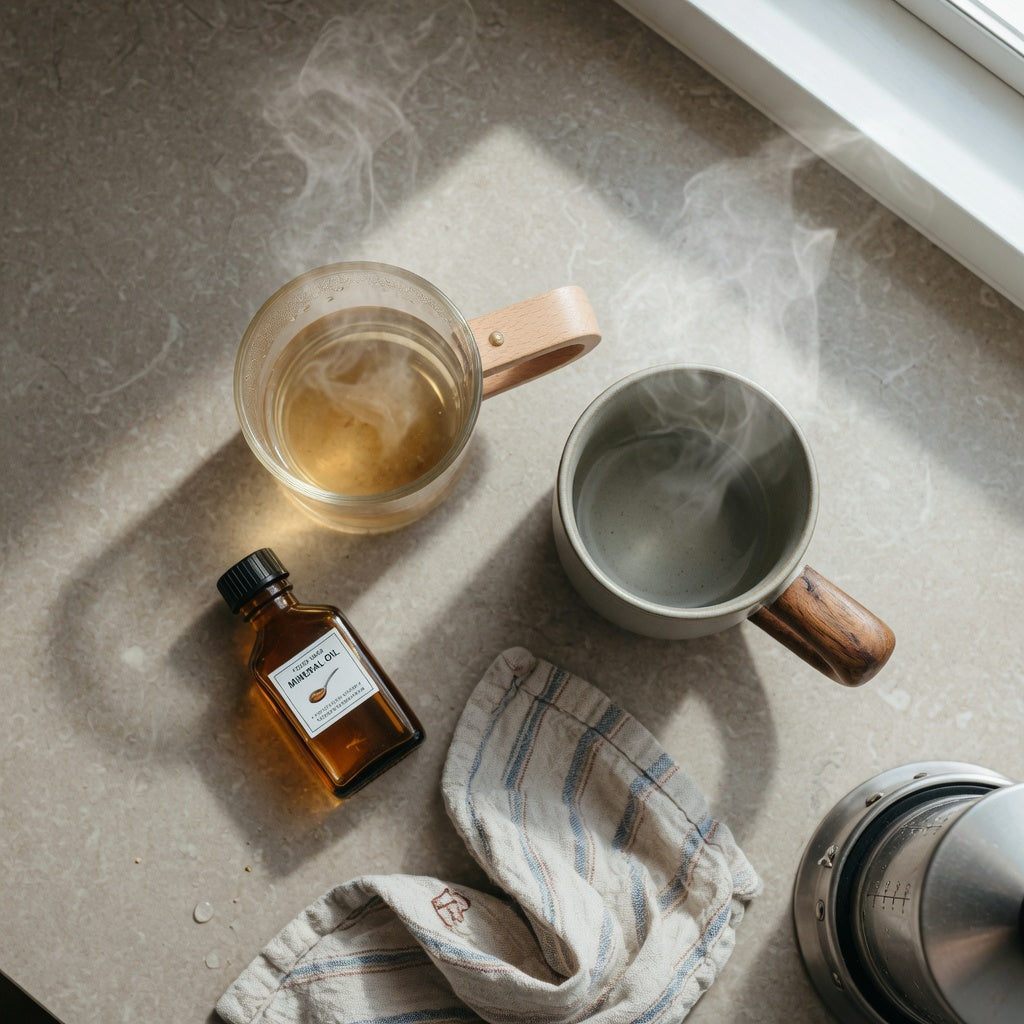
- Every month or two, rub a little food-safe mineral oil into the handle to keep the fibers sealed.
- Store it dry — a handle parked in a damp cupboard corner is a handle that eventually cracks.
Do wooden handles really stay cool through a long steep?
Mostly yes, with limits worth knowing. Wood conducts heat far more slowly than glass or ceramic, which is the reason this style exists: you can hold the mug through a long steep without a knitted sleeve. Three caveats from real use: the first stretch of wood nearest the body warms over a twenty-minute steep; a metal collar can get hot where it meets the glass; and the rim itself is always hot with just-boiled water, no matter what the handle is made from. Cool to the touch is a genuine advantage here, not an absolute one.
Which capacity fits your routine: tea pours or coffee refills?
Size is where tea and coffee drinkers split. Tea is usually poured smaller and hotter, roughly 200 to 300 ml (7 to 10 oz) per serving, often with a second steep to follow. Coffee drinkers tend to want 350 to 450 ml (12 to 15 oz) so a mug survives the first hour at a desk. Neither is wrong; buying a tea-sized mug for a large coffee habit is the mistake.
Weight matters as much as the milliliter number. A ceramic body with a dense hardwood handle carries noticeably more heft than a borosilicate body with the same handle, and that changes the tilt angle when you drink. If you sip with the handle pinched between two fingers — the way most people do at a desk — balance matters more than capacity suggests.
Is the Mountain Sea II the right wooden handle mug for your kitchen?
The mug we field the most questions about is our own Mountain Sea II coffee tea mug with wooden handle. It is aimed at readers who do not want to own two separate vessels: the listing positions it for both coffee and tea, and the design earns its keep on an open shelf.
Fit matters more than praise, so here is the honest mapping:
- Good fit: you hand wash dishes anyway, you drink coffee and tea in the same day, and you like drinkware with a visible design detail.
- Wrong fit: you need a dishwasher-proof daily mug for a busy household or for kids. Plain ceramic will serve you better and cost less to replace.
- Check before ordering: confirm the current listing for capacity in ml and oz, the body material, and whether the handle uses metal hardware, since that decides microwave use. We keep the product page updated; if a detail is not stated there, ask us before you buy.
For a deeper pre-purchase pass on this specific mug, our Mountain Sea II buying checklist walks through each verification step in order.
A seven-point wooden handle tea mug comparison checklist
Run this list against any two mugs — ours or anyone else's — and the better choice for your kitchen will be obvious in about five minutes:
- Confirm the body material on the listing: borosilicate, soda-lime or ceramic.
- Find the capacity in both ml and oz, and match it to tea pours or coffee refills.
- Identify the handle attachment method, or find a photo that shows the collar clearly.
- Check for metal hardware if microwave reheating is part of your routine.
- Read the care line: hand wash only, or a dishwasher claim you are willing to test.
- Ask what finish is on the wood and whether the listing calls it food-safe.
- Answer honestly: will someone in this house towel-dry the handle after every single wash?
Two of these checks — body material and capacity trade-offs — come up so often that we wrote a separate guide to the best mug for coffee and tea, covering materials, sizes and safety in more depth.
Shopping for someone else changes the calculus: packaging, presentation, and a style that suits the recipient's kitchen instead of yours. Our wooden handle tea mug gift guide covers the six checks that matter before a mug becomes a present. Otherwise, start with the Mountain Sea II listing above, or browse the full unique coffee mugs collection and shortlist two or three before you commit.
Frequently asked questions
Are wooden handle mugs safe for hot drinks?
Yes, in normal use. In most designs the wood never touches the liquid, so your drink only meets the glass or ceramic body. Two things to verify: that the finish on the wood is described as food-safe on the listing, and that the handle sits far enough below the rim that your lips never contact it. If either detail is unclear, ask the seller.
Can a wooden handle tea mug go in the dishwasher or the microwave?
Keep it out of the dishwasher: heat and standing water swell the wood fibers, and they crack as they dry. Microwave use depends on the hardware — any metal collar means no — so check the current listing for an explicit statement rather than trusting a photo.
How do I clean a tea mug with a wooden handle?
Hand wash the body in warm soapy water, keep the handle out of prolonged soaking, and towel-dry the wood right away instead of leaving it in a drying rack. Every month or two, work a little food-safe mineral oil into the handle to keep the fibers sealed.
Does a wooden handle actually keep the mug cool in your hand?
It helps, but it is not magic. Wood conducts heat far more slowly than glass or ceramic, so the handle stays comfortable through a normal steep. The wood nearest the body warms over longer sessions, a metal collar can get hot, and the drinking rim is always hot with freshly boiled water regardless of the handle.
What should a wooden handle tea mug comparison include that a regular mug review skips?
Three things: the handle attachment method, because it predicts the most common failure point; the wood care routine, because it changes your daily kitchen habits; and the body material pairing, because heat behavior and weight differ more between glass and ceramic than product photos suggest. A standard mug review rarely mentions any of the three.
Read more

Ceramic Planet Tea Mug: What Buyers Should Compare
A ceramic planet tea mug lives or dies on details most listings skip: how the galaxy art is fired on, whether metallic rims can handle a microwave, what glaze-safety testing actually proves, and wh...
Read more
Handbag Mug Comparison: 7 Checks Before You Buy or Gift One
A practical handbag mug comparison covering true capacity, ceramic versus resin materials, food-safe labeling, microwave and dishwasher limits, and the gift occasions a purse-shaped mug actually su...
Read more
Leave a comment
This site is protected by hCaptcha and the hCaptcha Privacy Policy and Terms of Service apply.