
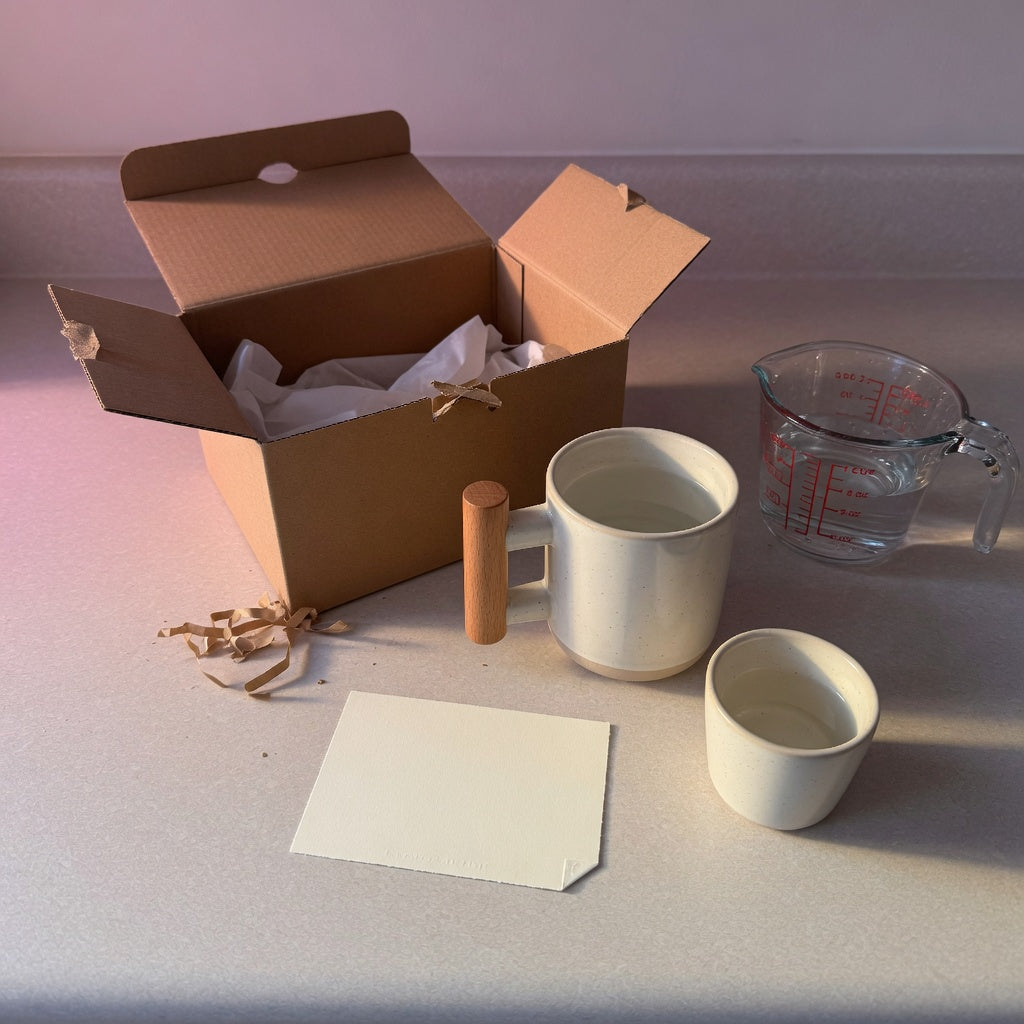
Wooden handle mug gift checklist: size, wash, and grip
Reading time: about 12 minutes
The mug looks finished on the kitchen counter. Wood handle, neat box, the recipient smiles. Two weeks later the message we actually get is about a handle that felt rough after a soapy soak, or a cup that went into an office microwave beside leftovers and came back too hot to trust. A wooden handle mug gift checklist is the short pass we want finished before the tape goes on the box.
In our store, these leave as housewarming gifts, desk gifts, and presents for people who finish their tea instead of letting it go cold. Weekday keepers are the ones whose size, washing rules, and grip were checked first, not the most ornate shape in the photo. When a buyer wants a wood-grip coffee and tea mug rather than a plain everyday cup, we point them to the Cloud coffee tea mug with a wooden handle. Treat the current listing as the spec sheet. If capacity, care, or how the handle is fastened is not written there, do not fill the gap from a photo or from a similar mug sold somewhere else.
If that shape is the wrong fit for how they drink, look through our unique coffee mugs and choose by habit, not by how the handle photographs.
Wooden handle mug gift checklist: start with the sink and the microwave
Before glaze color or engraving, write down three habits. We still ask for this when the giver says they already know the person.
- Dishwasher or hand wash. Does every mug in that kitchen ride the top rack, or is there already a hand-wash shelf for knives and wood boards?
- Microwave or kettle. Do they reheat a half cup at the office, or pour from a kettle and drink while it is hot?
- Real serving size. A morning mug, a small tea cup, or something closer to espresso?
Listings do not agree with each other. One wooden-handle mug is sold as dishwasher and microwave safe. A maker of a similar wood-accent cup says hand wash only and do not microwave. Nothing independent turns those two labels into one rule for the whole category. Match the recipient, then read the care line on the page you are buying. If that page is silent, take the cautious path: hand wash, and do not microwave, until the seller says otherwise in writing on this item.
This style is a poor gift for someone who runs every cup through the dishwasher and reheats coffee in whatever vessel is closest. A wood grip is not a stained ceramic handle. Water and a heated dry cycle treat it differently. If that is the household, skip the wood accent. Compare other coffee mugs and pick one whose current listing states both dishwasher and microwave safety, with no metallic paint or trim.
Wood handle, all-wood cup, or a boxed gift set?
Shoppers fold three products into one search. Care is not interchangeable, and a note written for the wrong type is how a good-looking gift becomes a fussy one. On the Cloud listing, confirm which of these you are actually holding before you write anything for the box.
| What you are holding | What touches the drink | Settle this on the listing | Who it suits |
|---|---|---|---|
| Ceramic or glass body with a wooden handle | Usually the glaze or glass, not the wood | Is the joint glued, pinned, or both, and is microwave use allowed? | A daily coffee or tea drinker who will hand wash a special mug |
| All-wood cup, sometimes lined | The wood or the lining is a food-contact surface | What is the lining, and can it hold hot coffee or tea? | Someone who wants a carved cup and will follow wood-cup care |
| Set with lid, spoon, or a lid used as a coaster | The cup, plus any metal on the lid | Are the extras actually included, and does metal change microwave use? | A presentation gift, only if the cup size is still useful after unboxing |
A wooden handle that never meets the drink is a different object from an all-wood interior. Retail food-code rules generally keep wood off food-contact surfaces. Hard maple, or another hard, close-grained wood, is a narrow exception for pieces such as cutting boards, salad bowls, and chopsticks. That exception is not a yes for every wooden drinking cup, and it does not automatically cover a handle that stays outside the liquid. The provision is about surfaces that touch food, not a household ban on wood grips. If the whole vessel is wood, ask what lines it and whether the maker rates it for hot coffee or tea. Do not wipe handle oil across an interior the listing never describes.
Is the pour near 8 fl oz, or too small for weekday coffee?
Photos lie about volume. A thick wall and a tall handle can make a small cup look like a diner mug. FDA guidance describes cups and mugs as small ceramic hollowware commonly used for coffee or tea above room temperature, normally about 240 mL (8 fl oz), and normally made with a handle. That figure describes the category the guidance has in mind. It is not the capacity of the Cloud mug, or of any other piece we sell, unless the listing prints its own ounces or milliliters.
- Around 240 mL (8 fl oz) is a modest everyday coffee or tea pour, not a large cafe mug.
- Well under that, think espresso, cortado, or a tasting cup. Fair as a gift only if the person drinks small.
- If the listing gives ounces or milliliters, convert them before you pay. If it gives neither, ask the seller. Generous is not a measurement.
In our experience, the too-small complaint shows up after the birthday, when the giver trusted the lifestyle photo. A useful gift is one they refill on a Wednesday, at a desk or beside the kettle. If you cannot find a number, ask before you pay.
Finger clearance when the mug is full and hot
Grip is where a wooden handle earns a place by the kettle or gets retired to a shelf. On our packing table, a wood grip often feels less harsh in the hand than a thin ceramic loop that has been sitting against a hot wall. That cooler feel is not the same as a comfortable hold once the mug is full. We check three things you can also check in the photos and the description.
- Finger room. We look for enough space that two or three fingers pass between the handle and the hot body without brushing the wall. A tight curve or a ball grip can look sculptural and then fight a full mug.
- Balance when full. A heavy wood grip on a light cup can tip. Set down one-handed, a full mug should sit without rocking. If the listing never mentions weight, stay skeptical of a chunky handle on a thin body.
- How the joint is made. The listing should say glued, pinned, or both. Buyers worry that a glued wooden handle loosens after hot drinks and washing. Those stories are common. We cannot point to a consumer standard that ranks glue against pins across brands. If the page never names the attachment, hesitate. Do not invent a joint the photo cannot prove.
Heat still reaches the hand along the rim and through the joint. A comfortable handle does not make a metallic rim safe, and it does not make an unlabeled cup microwave safe.
Lead, cadmium, and metallic coatings on the drinking surface
The drinking surface is the safety question. The wood grain on the handle is not. Under FDA pottery guidance (CPG 545.450), the action level for lead in ceramic cups and mugs is 0.5 µg/mL of leaching solution, applied to any one of six units, using ASTM C738 or a specified equivalent method. The cadmium action level for small ceramic hollowware is also 0.5 µg/mL of leaching solution in any one of six units. Small hollowware, in that cadmium guidance, means a capacity of less than 1.1 liters. FDA also says some ceramic foodwares leach lead from food-contact surfaces, and that continued food use can cause chronic lead poisoning. Those numbers are action levels for a leaching test. They are not proof that a decorative mug on a gift page was tested.
- Ceramicware that looks suitable for food is treated as meant for food unless it carries the conspicuous not-for-food-use labeling required by 21 CFR 109.16. A pretty glaze is not a decoration-only excuse.
- Ceramicware that still leaches lead under the test method should not be labeled Lead Free. Using that phrase when extractable lead is present may be false or misleading. The words on a product page are not a lab report.
- If you cannot find a food-use statement, do not buy the piece as a drinking mug.
Microwave use is a separate check. USDA says only cookware specially made for microwave ovens should be used, and that glass, ceramic, and plastics meant for that use are usually labeled. China with metallic paint or trim is not safe under that guidance. For an unlabeled utensil, USDA describes a one-minute high cycle beside a cup of water: if the utensil itself feels warm or hot, it is not microwave safe, because metal is in the material or the glaze. Do not run that test on a gift you are about to wrap. If the listing never says microwave safe, treat microwave use as unconfirmed.
Metallic coatings have already injured people in gift mugs. CPSC reported a recall of ceramic mugs with a metallic coating, sold in 2023 Starbucks-branded gift sets, that could overheat or break if microwaved or filled with extremely hot liquid, causing burn and laceration hazards. The recall covered about 440,500 mugs, with 12 reported overheating or breaking incidents and 10 injuries. A wooden handle does not cancel a metallic glaze. If the recipient reheats drinks, pass on metallic rims, metallic decals, and any cup the listing does not mark microwave safe.
The care card that should ride in the gift box
Unboxing is the easy part. The second week is when wood stays damp, a glue line softens, and someone runs the mug through a heated dry cycle just once. University of Minnesota Extension says wooden cutting boards may be damaged in a dishwasher and that wood may warp there. That caution is about boards, not glued mug handles, so it is not a lab result for this gift. It is still a reason not to assume a wood handle survives the same cycle as a plain ceramic mug, unless the maker of this exact mug says so.
A short card in the box beats a reminder they will forget by Friday. Copy only the lines the listing supports. This is the card we would rather see than a blank tissue wrap. Edit every line to the mug you actually bought:
Hand wash. Do not soak the handle, and do not leave the mug standing in a soapy basin. Dry the wood promptly, including the joint where it meets the body. Do not microwave unless this listing says the mug is microwave safe and you see no metallic paint or trim.
If the maker tells you to oil the handle, use only the finish they name. Where that finish is white mineral oil, oil that meets 21 CFR 172.878 may be used as a component of nonfood articles intended for food contact under 21 CFR 178.3620, subject to the limits in 21 CFR parts 170 through 189. Use of that oil in or on food itself is covered separately. None of that is permission to oil a drinking interior the seller never described.
Personalization needs the same restraint. Engraving and vinyl decals both show up on wooden-handle gifts. We have not seen a standards body publish how many hand washes a vinyl decal survives, so do not promise a sticker will look new next year. Engraving lasts longer and punishes a rush: confirm the spelling, confirm whether the cut is on the handle or the glaze, and ask for a proof before you pay.
Run the wooden handle mug gift checklist against the listing, not against the photo. Walk away, even if the picture is strong, when any of these are true:
- Dishwasher or microwave safety is asserted with no care detail you can read.
- The ceramic looks decorative and never says it is for food, and it lacks a clear not-for-food-use label.
- The handle attachment is unnamed.
- Capacity is missing, so you cannot tell a daily mug from an espresso cup.
- You cannot tell whether the wood touches the drink.
- There is metallic paint or trim, and the person reheats drinks.
Frequently asked questions
Can I put a mug with a wooden handle in the dishwasher or the microwave?
Only if the maker of that exact mug says so on the current listing, and only if you see no metallic paint or trim. A badge on a similar mug does not transfer. If the page is silent, hand wash, dry the wood, and do not microwave it. Someone who machine-washes and reheats everything will fight this gift.
What should a wooden handle mug gift checklist reject before checkout?
Reject unverified dishwasher or microwave claims, decorative ceramic with no food-use statement, a handle with no stated attachment, and a missing capacity. Also reject a metallic glaze if the person reheats drinks. Those are the failures that show up after the gift is opened, not the color of the wood.
Will a glued wooden handle come off after hot coffee and washing?
It can loosen if the joint stays wet or goes through a dishwasher, which is why buyers ask. There is no single consumer standard we can cite that ranks glued joints against pinned ones across brands. Read how this mug is fastened. If the listing does not say glued, pinned, or both, ask before you buy it as a daily mug.
Is an all-wood cup the same safety question as a mug with a wood handle?
No. On a ceramic or glass mug, the handle usually never touches the drink, so the food-contact surface is the glaze or the glass. An all-wood interior is a food-contact surface. Food-code limits on wood target that kind of contact, with only a narrow exception for hard, close-grained woods used as items such as boards, bowls, and chopsticks. Ask what lines the cup and whether the maker rates it for hot coffee or tea.
Should the gift include a lid, a spoon, and a care card?
A lid or spoon is a bonus only if this listing includes it and the cup is still the right size. Do not assume a coaster-lid is in the box because another gift set has one. A care card belongs with every wooden-handle gift: hand wash, dry the wood, no soaking, and no microwave unless that mug's label allows it. If you engrave, confirm the spelling first.
Set the listing next to the checklist before you buy
Open the product page beside this list. Confirm capacity in ounces or milliliters, confirm whether the wood is only a handle or a lined cup, confirm the joint, and confirm care in the seller's words. For the wood-grip coffee and tea mug we keep in front of buyers who want that style, start on the Cloud coffee and tea mug and buy only if those lines are still on the page today. If the recipient's habits do not match a hand-wash piece, go back through the rest of the mug collection and choose a mug the current listing marks for the way they wash and reheat.
More from our blog
Read more
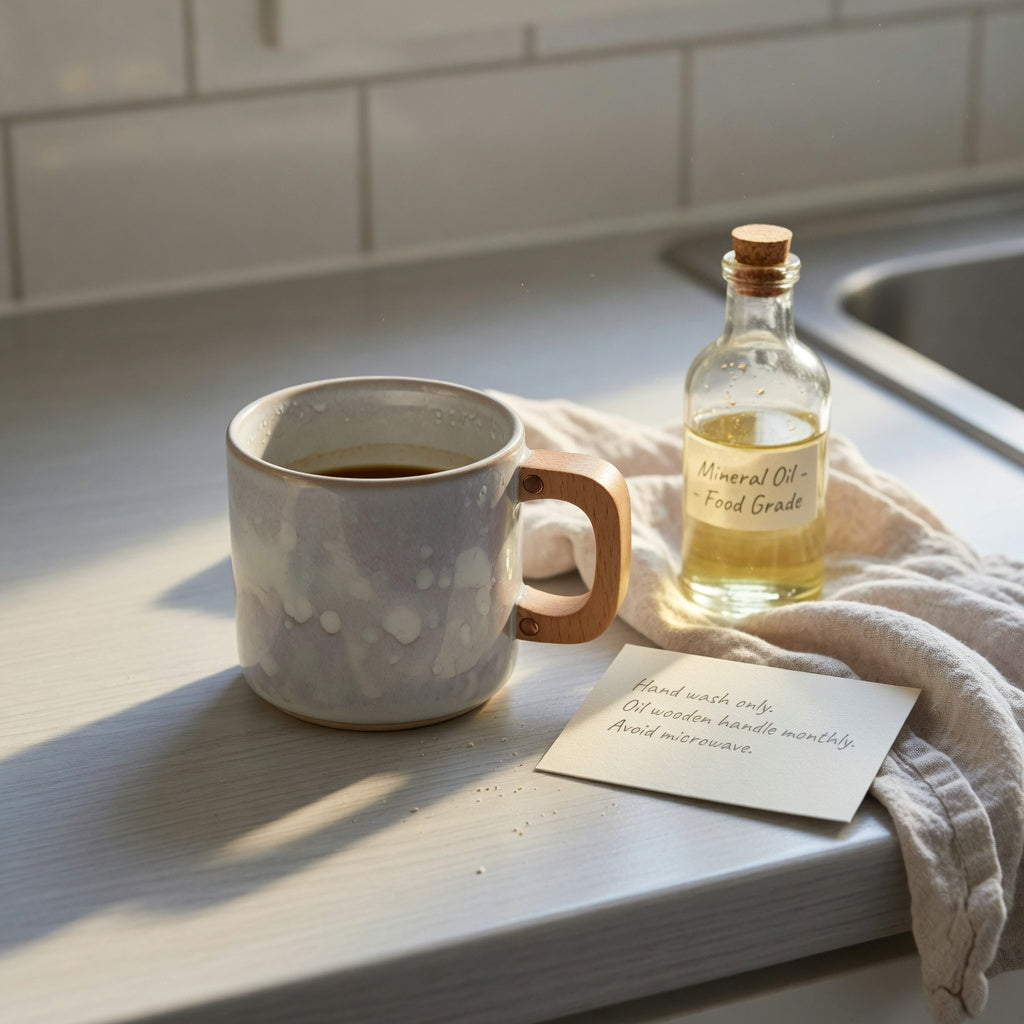
Cloud Ceramic Mug Wooden Handle Buying Checklist
Compare care text, wood species, glaze wear, and food-contact paperwork before a cloud-glaze photo decides the mug. This checklist flags dishwasher, microwave, and gift mismatches.
Read more
Yellow Ceramic Mug Gift: Shade, Size, and Form
A yellow ceramic mug gift works when the shade, the listed capacity, and the cup form match a short coffee or tea habit. We compare the 170 ml Retro and 200 ml Pleated yellow options, plus the care...
Read more
Leave a comment
This site is protected by hCaptcha and the hCaptcha Privacy Policy and Terms of Service apply.