
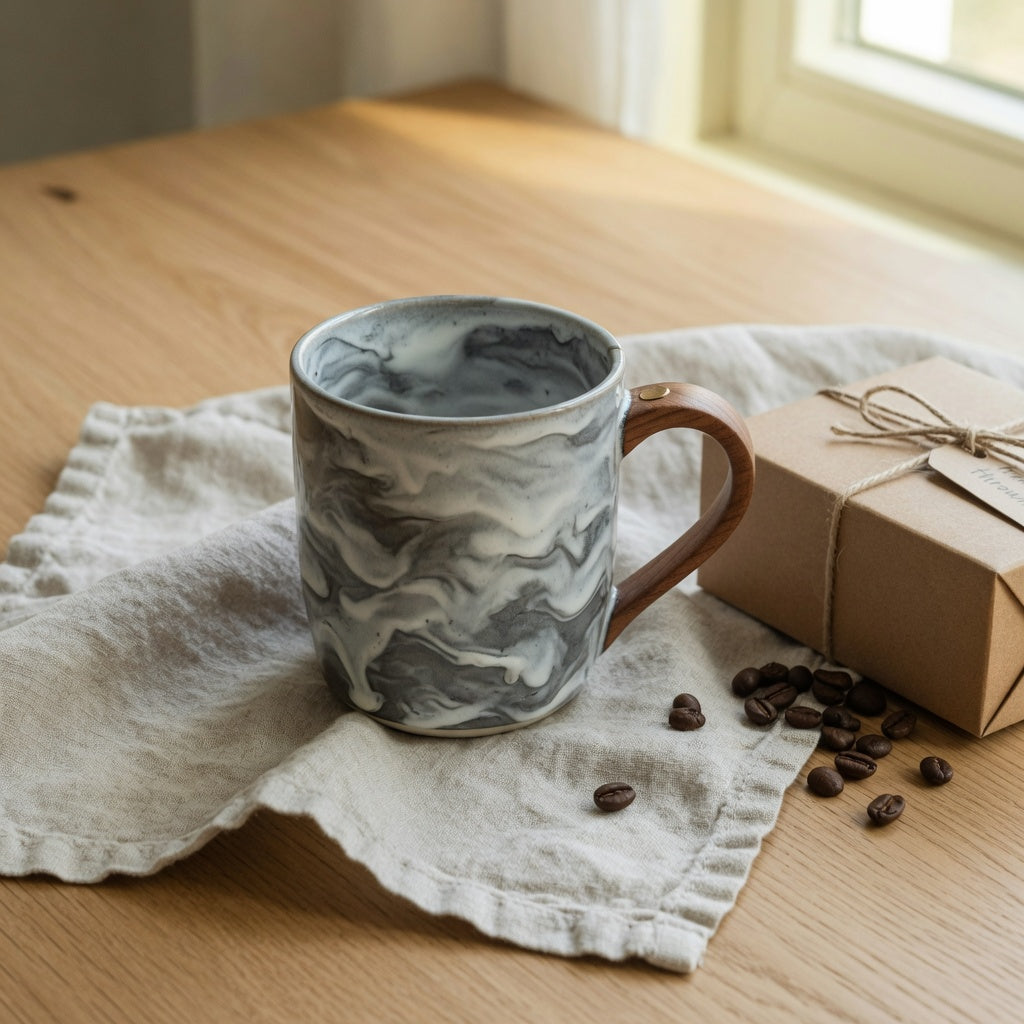
Wooden Handle Ceramic Cloud Mug Gift: What Buyers Should Compare
Reading time: about 9 minutes
The first email we get after a cloud mug ships is rarely about the glaze. It's about the handle — drying out, loosening, turning gray.
That question order tells you a lot about this category. A wooden handle ceramic cloud mug gift sells itself on looks: a poured gray-and-white glaze that pools differently on every single mug, paired with warm wood where a ceramic loop would normally sit. But the details that decide whether it becomes someone's daily cup or a cupboard ornament — capacity, handle join, care routine, packaging — never show up in a product photo. This is the comparison we walk through with gift buyers at CoffeifyMug, including the parts we'd rather say now than handle as a disappointed message later.
We stock and ship The Cloud Coffee Tea Mug Wooden Handle, and we hear weekly from customers weighing it against other styles. Below is the same checklist we run when a sample lands on our bench. If you'd rather compare silhouettes side by side first, start in our unique coffee mugs collection, then come back to the details.
What makes a wooden handle ceramic cloud mug gift different from an ordinary mug?
Two material choices set the style apart. First, the glaze: cloud-style mugs get a flowing gray, white and sometimes blue glaze applied so it drifts and pools as it fires, which is why no two come out identical. Second, the handle: instead of a shaped ceramic loop, a piece of natural wood — walnut and beech are the species you'll encounter most in this category — is fitted to the body, usually at two fixed points. The result is a tactile contrast, cool glassy ceramic against warm satin-finished wood, that people consistently mention when they pick one up at an unboxing.
Treat the marketing language loosely. "Japanese-style" and "Scandinavian-inspired" describe a look, not a verified origin or process. What you can actually verify on a listing: the glaze finish, the wood species, how the handle is attached, and the care instructions. Handmade glazing also means the mug that arrives will differ somewhat from the listing photo — a feature, but one worth mentioning to the recipient before they open the box.
Which capacity and weight suit the person you're buying for?
Mugs in this cloud-glaze style generally land somewhere in the 10–14 oz range, but the exact figure varies by maker and can shift between production runs, so read the listed volume rather than guessing from photos. Then match it to the drinker:
- Filter-coffee drinkers want headroom — a mug that takes a full 12 oz pour without sloshing on the walk from kitchen counter to desk.
- Tea drinkers often prefer a smaller body with a wider opening, which cools the brew faster and leaves room for milk.
- Older recipients or anyone with grip concerns feel the difference between a light and a heavy body once it's full. Loaded weight matters more than the number on a spec sheet.
Capacity is the first thing we tell buyers to confirm on The Cloud Coffee Tea Mug Wooden Handle listing before ordering — and if a spec you care about isn't stated clearly, message us and ask. That ten-second question prevents most of the size-related gift misses we see.
How is the wooden handle attached — and how do you spot a weak join?
The handle-to-ceramic join is the most common failure point in this entire category. Handles are typically bonded at two points, either over the glaze or onto unglazed pads, and a weak bond usually shows up as wobble within weeks of daily use. Three checks we run on every sample, in this order:
- The press test. Hold the mug by the body and push the handle gently sideways. There should be zero movement.
- The seam check. Look where wood meets ceramic. You want clean, even joints — not glue pooling, gaps or rough edges.
- The materials question. Ask what the handle is made of and how it's finished. Walnut runs darker and denser; beech is paler with a straighter, finer grain. The finish matters more than the species: a food-safe oil or seal tells you the maker designed the handle for daily washing.
One limitation we'd rather state than bury: we've never seen independent durability testing, six or twelve months in, on this style from any maker. Your best evidence is the arrival inspection plus the seller's written care guidance — which is also why the care section below matters as much as the spec sheet.
What do glaze and wood food-safety claims actually guarantee?
The glaze is the surface your recipient drinks from, so that claim deserves scrutiny. In the US, ceramic foodware falls under FDA compliance guidance that sets leaching limits for heavy metals — for mugs and cups, the lead limit is 0.5 micrograms per milliliter under Compliance Policy Guide Sec. 545.450. In practical terms, "food-safe glaze" should mean a properly fired glaze with a smooth, intact surface: no crazing, no pinholes, no rough patches.
The wood raises fair questions too. The FDA Food Code restricts wood as a food-contact surface to certain hard, close-grained species — the reason restaurant cutting boards are maple. On a handled mug like this, the wood sits at the side grip while the rim you drink from is glazed ceramic, but the useful questions remain: is the wood sealed, is that finish food-safe, and how is the join done? Ask the seller directly instead of reading tea leaves in product photos.
Is a hand-wash-only mug realistic for the recipient's daily routine?
Here's the trade-off we put first: mugs in this category are overwhelmingly hand-wash only, and most makers advise against the microwave. Heat, steam and detergent swell and dull wood, repeated soaking works at the join, and hard temperature swings stress both materials. None of that is a defect — it's the cost of the material — but it changes who the gift suits:
- Great match: someone who already hand-washes a favorite knife or a cast-iron pan, drinks a couple of cups a day at a desk or armchair, and enjoys objects that reward a little care.
- Wrong match: the household that dishwashes everything and microwaves every coffee. For them, we'd honestly steer you toward a straightforward dishwasher-safe stoneware mug — the gesture matters more than the style.
What the wooden handle does brilliantly is thermal: wood conducts heat far more slowly than ceramic, so the grip stays comfortable on a fresh, hot pour in a way a thin all-ceramic loop often doesn't. In our experience that means fewer burned-finger moments carrying coffee back to a desk — the everyday payoff for the extra care.
How do you care for the wooden handle so the gift lasts past the first month?
Care is simple, but it's non-negotiable. This is the routine we suggest sending along with the gift, on a card if possible:
- Hand wash in warm water with mild soap — quickly, and never left to soak.
- Towel-dry the handle immediately, and don't stand the mug in a sink of water.
- Once a month, rub a drop of food-safe mineral oil into the wood and wipe off the excess. This single habit prevents most of the drying and graying buyers report.
- Keep it out of the dishwasher, microwave and oven, and let the mug settle between iced and hot drinks rather than swinging between extremes.
- Pale or rough wood usually revives with another drop of oil. A joint that starts to move means stop using it and contact the seller.
Tea drinkers add one wrinkle: tannins can stain lighter glazes over months of use. It's cosmetic, not a flaw, but worth warning a careful recipient about before they discover it themselves.
Does the gift arrive ready to hand over? Packaging, cards and glaze surprises
The style has earned its gift reputation — housewarmings, weddings, coffee-lover birthdays, retirements, thank-yous — because it photographs beautifully and feels considered in the hand. Before ordering, confirm three things:
- Packaging. Does it ship boxed well enough to hand over directly, or should you plan to re-box it?
- A care card. Good makers include washing and oiling instructions. If the listing doesn't mention one, copy the routine above onto a card — it doubles as a personal touch.
- Glaze variation. Handmade cloud glazes mean the mug that arrives will differ somewhat from the photo. Tell the recipient in advance; surprises land better when they're announced.
Pairings that work in our experience: a bag of whole beans from a local roaster, a loose-leaf tea sampler, or a small pour-over dripper — a complete morning ritual in one box, all of it sized to a single mug.
Six comparisons to run before you checkout
| What to compare | Why it matters | How to check |
|---|---|---|
| Capacity and loaded weight | Matches the drinker's usual pour and grip strength | Listing specs, not photos |
| Wood species and finish | Walnut vs beech changes the look; the finish predicts upkeep | Product details, or ask the seller |
| Handle-to-ceramic join | The most common failure point in this style | Close-up photos, then the arrival press test |
| Care instructions | Hand-wash-only mugs fail fast in dishwasher households | Care section of the listing |
| Glaze food safety | The glaze is the drinking surface, and lead limits are regulated | Food-safety statements on the listing |
| Gift packaging | Determines whether it's handover-ready on arrival | Shipping details, or a quick message to the store |
Run those six checks and you can order with confidence. When you're ready, open The Cloud Coffee Tea Mug Wooden Handle and verify capacity, wood and care details on the current listing — message us about anything that isn't spelled out — or browse the unique coffee mugs collection to weigh this style against the alternatives before you commit.
Frequently asked questions
Can a ceramic mug with a wooden handle go in the microwave?
Most makers of this style advise against it, and our default is no: rapid microwave heating is hard on both the wood finish and some glazes. Treat hand-wash, no-microwave as the safe assumption for this category unless the listing for your specific mug states otherwise.
How do I keep the wooden handle from drying out or cracking?
Hand wash quickly, towel-dry right away, and never let the mug soak. Once a month, work a drop of food-safe mineral oil into the wood and wipe off the excess. That one habit prevents most of the drying and graying buyers report.
Is a wooden handle ceramic cloud mug gift suitable for tea as well as coffee?
Yes — the style is sold for both, and a cloud glaze suits a slow tea ritual as well as a morning pour-over. Capacity is the real decider: smaller bodies around 10 oz suit tea servings, while coffee drinkers usually want 12 oz or more. Confirm the listed volume on the product page before you order.
What's the first thing to check when the mug arrives?
The handle joint. Grip the body, press the handle gently side to side, and inspect the seam where wood meets ceramic for gaps or glue pooling. Check the glaze surface for crazing or chips too. If anything moves or looks wrong, contact the seller before gifting it.
More from our blog
Read more

Wooden Handle Tea Mug Gift Ideas: 6 Things Buyers Should Compare
Wooden handle tea mugs make memorable gifts, but the handle joint, body material, capacity, and hand-wash care decide whether the gift lasts. Here's what we check in our store before recommending o...
Read more
Coffee Mug Gift Ideas Wooden Handle: What Buyers Should Compare
Wooden-handle mugs make distinctive gifts when the grip stays cool, the joint stays tight, and the recipient will actually hand-wash. Here is the comparison our team walks shoppers through before c...
Read more
Leave a comment
This site is protected by hCaptcha and the hCaptcha Privacy Policy and Terms of Service apply.