
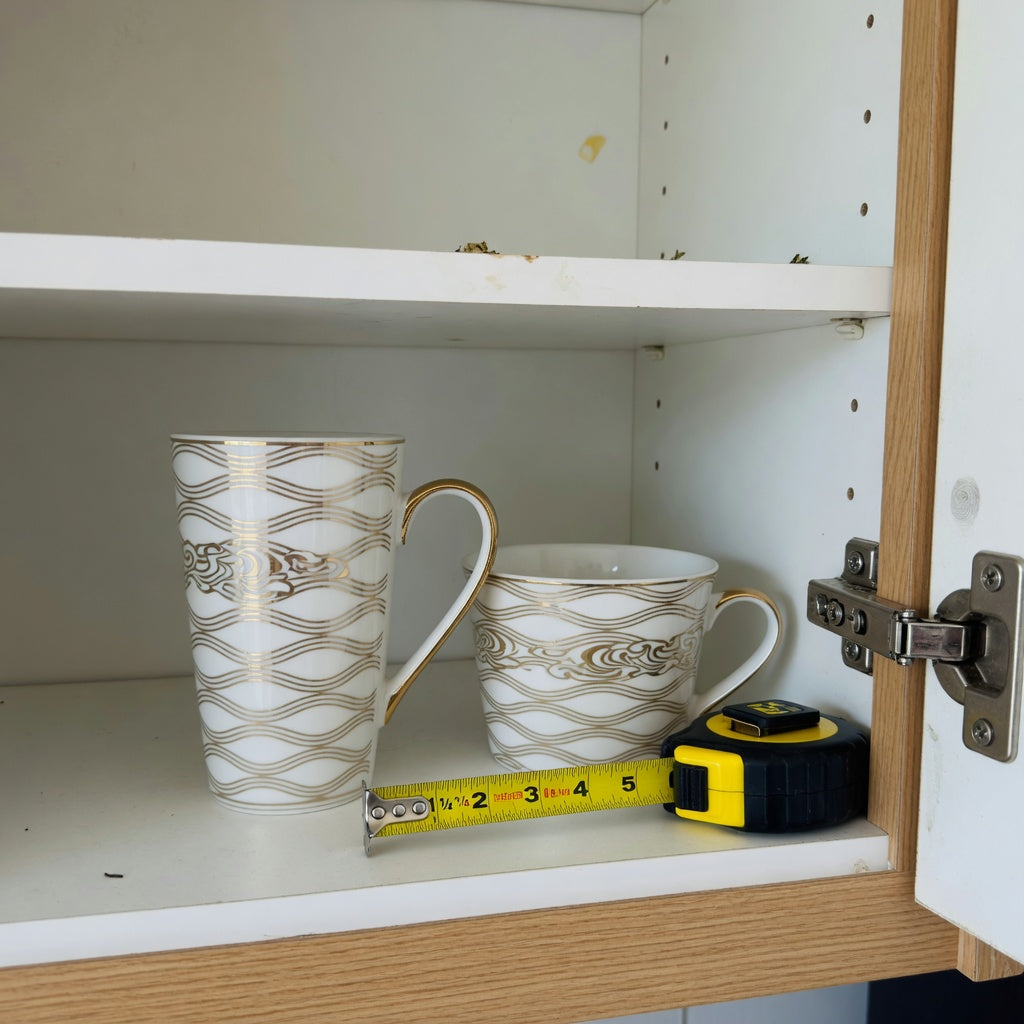
White and Gold Coffee Mug Storage Fit Guide: Tall vs Kio
Reading time: about 11 minutes
A mug can clear the shelf itself and still fail at the cabinet opening. The body catches under the face frame, the handle touches the closed door, or there is not enough room to lift the mug over a raised shelf edge. This white and gold coffee mug storage fit guide focuses on those practical failure points while comparing the two linked wave-pattern forms. The goal is simple: match the visible shape to the storage space you actually have without turning a product photo into an invented measurement.
In our store, we evaluate mug storage as a three-dimensional envelope rather than looking at body height alone. That envelope includes the highest point, the full width from the outside of the handle to the opposite side, the front-to-back footprint, and the temporary clearance needed to lift and tilt the mug during removal. The White Golden Waves Tall Coffee Tea Mug clearly signals a taller silhouette in its title and current presentation. The Golden Waves Kio Coffee Tea Mug presents a lower, more compact-looking form. That visible difference is useful, but it does not establish exact dimensions or capacity.
Listings and product presentations can change, and photography is not a scale drawing. We treat a dimension or capacity as confirmed only when it is stated on the live product page. If a listing does not provide handle-inclusive width or another measurement you need, use the shape comparison here to decide which option to investigate first, then test the available space with a similar mug you already own.
White and gold coffee mug storage fit guide: four clearances to record
Our team uses four separate measurements because each catches a different storage problem. Measure at the exact shelf position you intend to use. Cabinet interiors are not always uniform, especially near face frames, door hinges, shelf supports, and back panels.
| Storage variable | How to measure it | Problem it identifies |
|---|---|---|
| Clear height | Measure from the shelf surface to the lowest obstruction above it, including the cabinet opening. | A tall mug that fits inside the compartment but cannot pass through the opening. |
| Usable depth | Measure from the back panel to the inside of the closed door, not only to the shelf edge. | A body or handle that prevents the door from closing fully. |
| Overall width | Allow for the outside edge of the handle as well as the mug body. | Handles colliding in a row or pushing neighboring mugs out of alignment. |
| Insertion clearance | Check the path used to lift, tilt, and pull the mug over any shelf lip. | A mug that technically fits while stationary but is awkward to remove. |
Record these measurements in the same unit used on the live product listing. Do not substitute listed capacity for exterior size. Capacity describes how much the vessel is intended to hold; it does not tell you the handle projection, body diameter, or clearance needed at the cabinet opening.
Tall profile: how much vertical room does the cabinet opening need?
The Tall form is the first option to inspect if you have an open shelf, a high cabinet compartment, or a counter position with generous space beneath the upper cabinets. Its taller visible profile gives the white-and-gold wave design more vertical presence. That can make it the stronger display choice when the mug will remain in view instead of being packed into a short row of everyday drinkware.
The trade-off is access clearance. A tall mug needs enough room not only to stand but also to move upward before it can move forward. A fixed shelf lip, a lower face frame, or another mug placed directly in front can reduce that working space. We see this issue most often when someone measures the roomy interior of a cabinet but overlooks its smaller opening.
For a closed cabinet, measure clear height at both the opening and the back of the shelf. Use the smaller number. Then test the removal motion with a similarly tall item already in your kitchen. If you have to tilt that item sharply or scrape it under the frame, the Tall mug is not a practical choice for that position, even if its stationary height appears to fit.
This form is not the best starting point for low apartment shelves, compact office cabinets, or counters where small appliances already occupy the space beneath an upper cabinet. In those situations, inspect the Kio form first. If the Tall shape is the one you prefer visually, plan a higher compartment or open display position rather than relying on a tight fit.
Kio profile: does a lower-looking form solve a short shelf?
The Kio is the more logical first comparison for a cabinet with limited vertical room because its current visible form appears lower than the Tall option. That does not mean it will fit every small cabinet. Height is only one side of the storage envelope, and a lower body can still have a handle or body width that conflicts with neighboring mugs, hinges, or the cabinet door.
For an everyday kitchen row, the Kio form may be easier to place beneath a fixed shelf while leaving working room above it. This is useful when you reach for the mug frequently and do not want to angle it past the cabinet frame each time. It can also make sense for an office cupboard where shelf height is modest and mugs need to remain easy to identify and remove.
The limitation is shallow storage. Do not assume that a lower silhouette is automatically a smaller silhouette in every direction. Check the usable depth with the cabinet door closed, particularly if you plan to face every handle forward. If the shelf is narrow from front to back, turn your existing mug to the intended orientation and see where its handle sits relative to the door before choosing the Kio on height alone.
Listed capacity and visible shape answer different buying questions
A taller mug is not automatically the higher-capacity mug, and a lower mug is not automatically the smaller drink option. Interior taper, wall shape, base thickness, and the width of the vessel all affect capacity. Those details cannot be calculated reliably from a listing image.
If your priority is a longer coffee, tea with room for milk, or an iced drink, check the capacity stated on each live product page first. Then return to the storage measurements. A listed capacity can tell you which mug suits your usual pour, but only dimensions and visible form can help determine how it occupies a shelf.
- Generous vertical storage and a display-led choice: inspect the Tall listing first because its visible height suits open or high-clearance placement.
- Shorter cabinet compartment and frequent daily access: inspect the Kio listing first because its lower-looking form may leave more removal room.
- Shallow cabinet with a closing door: do not choose from height alone; overall depth and handle orientation become the deciding variables.
- Drink volume is non-negotiable: use the capacity shown on the live listing, if provided, before comparing storage fit.
Handle projection: the measurement most cabinet checks miss
Body diameter is not overall mug width. In our experience handling and arranging mugs, the handle is the part most likely to disrupt an otherwise tidy shelf plan. It can extend into the path of the cabinet door, overlap the next storage position, or leave too little room for a secure grip.
If handle-inclusive dimensions are available on a listing, use them. If they are not, make a practical test with a mug you already own. Place it at the intended shelf position, align the handle as you expect to store it, and close the door slowly. Check the door face, hinge hardware, neighboring handles, and the space your fingers need when lifting the mug.
- Start with every handle facing the same direction to see the maximum orderly row width.
- Try alternating handles only if the shelf has enough front-to-back depth for the offset.
- Leave usable grip space instead of pressing mug bodies tightly together.
- Remove the mug in one natural motion to test the insertion path, not only the stationary fit.
- Repeat the door test at the hinge side, where hardware can reduce usable space.
Alternating handles can improve row spacing, but it has a trade-off: the rear-facing handles may be harder to grip, and one mug can block another. For drinkware used several times a day, a slightly looser row is usually more workable than a tightly optimized arrangement that requires rearranging the shelf.
Open shelf, closed cabinet, or counter placement?
Open shelves remove the door and cabinet-opening constraints, making them more forgiving for the Tall form. They also keep the white-and-gold wave appearance visible. The cost is exposure to ordinary kitchen dust and the need to keep the display area orderly, so this setup makes the most sense for mugs that are used or cleaned regularly.
A closed cabinet favors the Kio form when vertical clearance is the main constraint, provided its complete footprint still fits. Check the door path and hinges before assigning a position. In mixed cabinetry, a practical arrangement is to place the Tall mug in the highest or open location and keep the Kio with frequently used mugs on a lower shelf.
Counter storage works only after checking the space above the mug. A tall piece may stand comfortably beneath a cabinet but remain difficult to lift if a coffee maker, kettle, or utensil container blocks the removal path. Place a similarly sized household item in the intended spot and repeat the motion you use during a normal morning, including reaching around nearby equipment.
If you need the highest possible mug density in a very small cabinet, neither decorative form should be assumed to solve that problem. A straighter shape or a product specifically described as stackable may suit the space better. The visual appeal of a distinctive silhouette comes with a real storage trade-off.
Stacking depends on base, rim, and interior geometry
Do not infer stackability from a front-facing product photo. Stable stacking depends on how the base meets the mug below, how much the interior tapers, where the rims make contact, and whether the handles interfere. A stack can look level from one angle while resting on a narrow contact point.
Unless a live listing specifically identifies a mug as stackable, plan to store the Tall and Kio forms upright in a single layer. This avoids building a cabinet plan around an unconfirmed feature. It also reduces the chance of unstable rim-to-base contact when another mug is removed from the row.
These forms are not ideal for a kitchen that requires every mug to stack vertically. If stacking is essential, compare other silhouettes and confirm that feature on the relevant listing before ordering. If you only need one or two decorative mugs, single-layer placement is the simpler and more accessible setup.
Two-minute fit check before adding a mug to your cart
Run this check with the cabinet door, shelf, and nearby drinkware in their normal positions. It is more reliable than comparing the mug to an isolated product image.
- Measure the lowest clear height at the cabinet opening and inside the compartment.
- Measure usable depth from the back panel to the closed door.
- Note shelf lips, face frames, supports, and hinge hardware.
- Decide where the handle will point and how much grip space you need.
- Check the live listing for stated capacity and dimensions without estimating missing figures from the photo.
- Choose the Tall form for measured vertical freedom or the Kio form as the first comparison for a shorter compartment.
- Use a similar mug or household object to rehearse the lift-and-remove motion.
This white and gold coffee mug storage fit guide should narrow the decision, not pretend that visible shape replaces measurements. The Tall and Kio forms can share the same white-and-gold style direction while serving different storage plans. The better option is the one that clears the opening, closes behind the cabinet door, and remains easy to reach during daily use.
Frequently asked questions
How do I use a white and gold coffee mug storage fit guide before ordering?
Measure clear height, usable depth, handle-inclusive width, and the path needed to remove the mug. Compare those figures with any dimensions stated on the live listing, then use the visible Tall or Kio profile to decide which product deserves the first fit check.
Is the Tall mug automatically higher-capacity than the Kio mug?
No. A taller exterior does not confirm a higher capacity because body width, interior taper, and base construction also affect volume. Use only the capacity stated on each live product page for that comparison.
Does the Kio mug automatically fit a closed cabinet better?
No, although its lower-looking profile makes it the more sensible first option for limited vertical clearance. You still need to verify shelf depth, overall width, handle orientation, hinge intrusion, and door closure.
Can the Tall and Kio mugs be stacked?
Do not plan on stacking unless the current product listing explicitly confirms that use. Stack stability depends on base, rim, interior, and handle geometry that cannot be verified from a front-facing image alone.
Which form is better for an open kitchen shelf?
The Tall form is the stronger first choice if you want a more vertically prominent silhouette and have unrestricted headroom. Choose the Kio if you prefer a lower visual line or need to place the mug beneath another shelf, then verify the remaining dimensions.
Your next step: measure one intended storage position and write down all four clearances before comparing the two product pages. If neither visible form matches that storage envelope, browse our unique coffee mugs collection and compare silhouettes from the shelf outward rather than choosing by decoration alone.
More from our blog
Read more
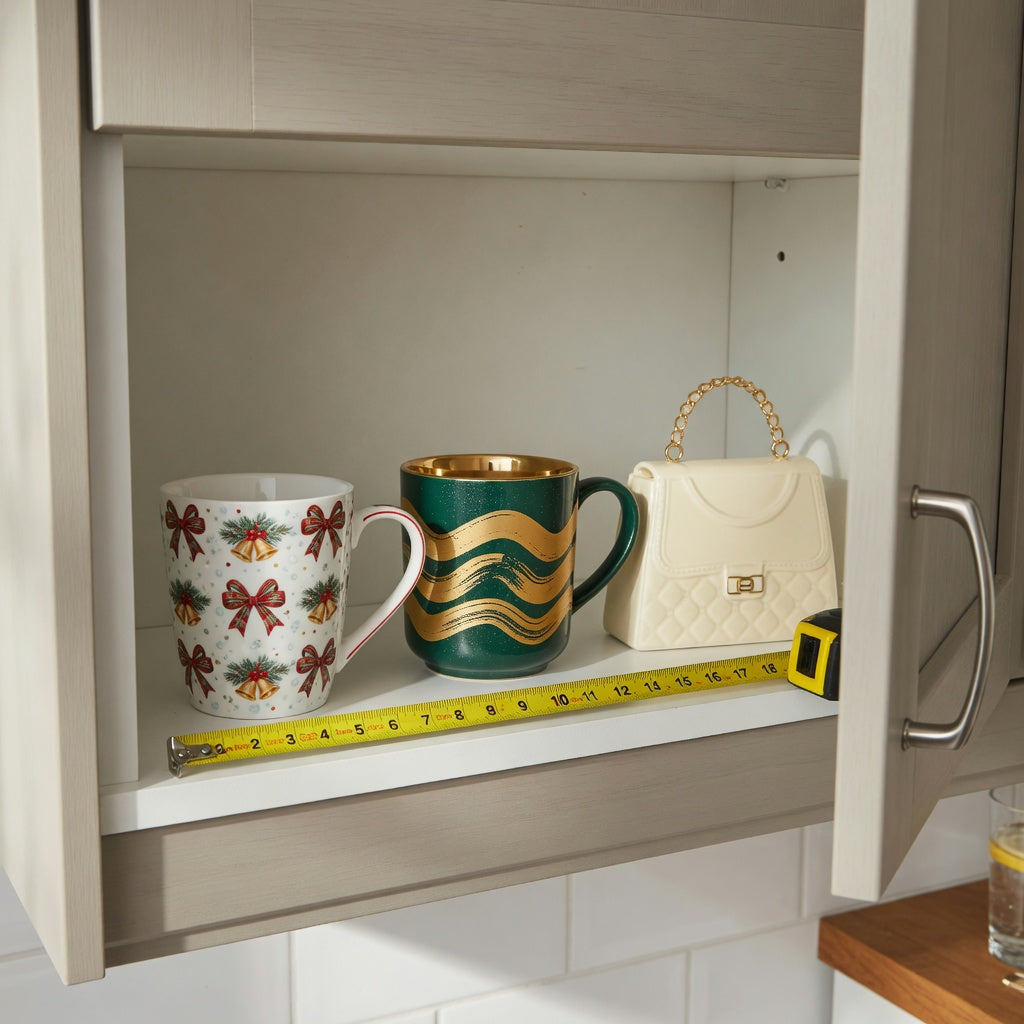
Unique Christmas Coffee Mugs Storage Fit Guide: Shelf Planning
Compare the visible forms of the Christmas Coffee Tea Mug, Golden Waves Kio, and Handbag mug against handle clearance, cabinet depth, shelf height, and display space. We separate confirmed product ...
Read more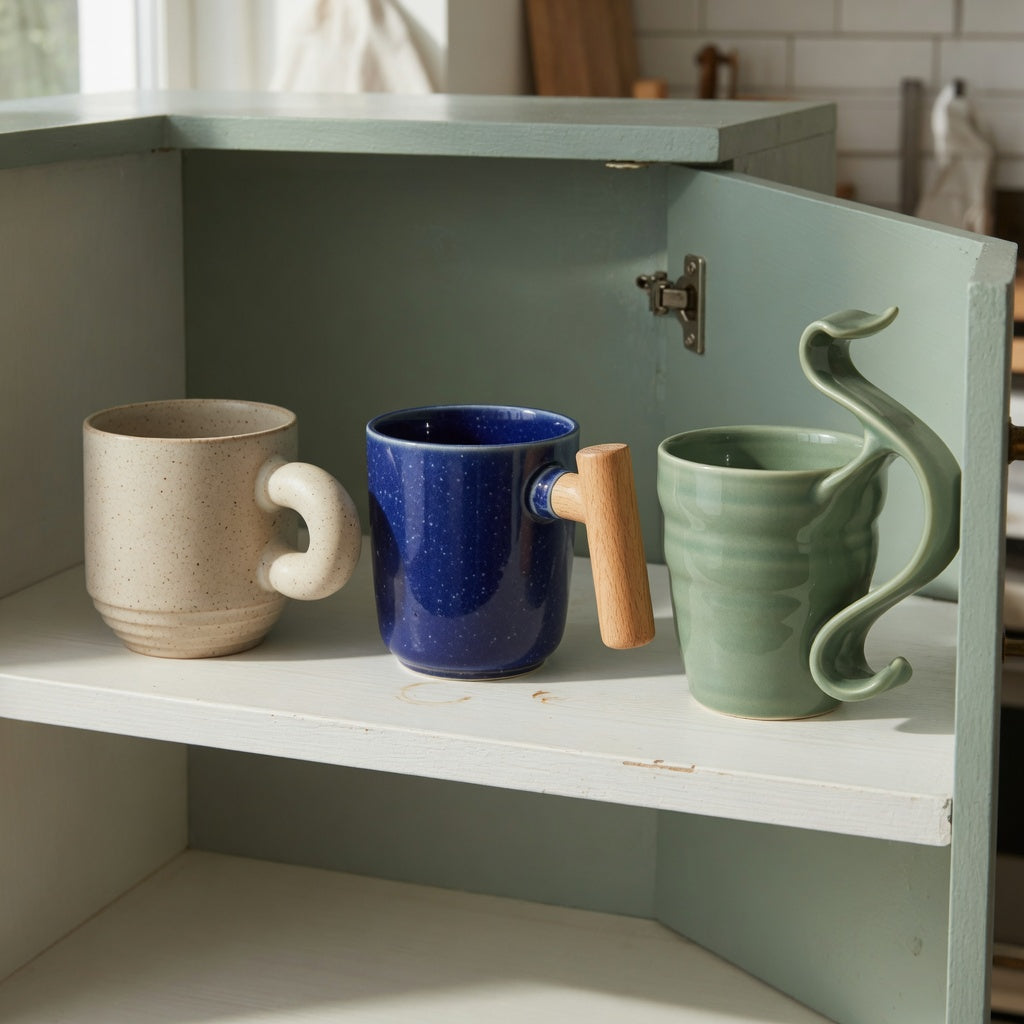
Ceramic Coffee Mugs With Large Handles Storage Fit Guide for Shelves
Compare the Ball-Handled, Mountain Sea II wooden-handle, and The Flow mug shapes by handle projection, shelf orientation, cabinet clearance, and daily access. Includes a practical measuring checkli...
Read more
Leave a comment
This site is protected by hCaptcha and the hCaptcha Privacy Policy and Terms of Service apply.