
What Size Mocha Mug Is Best For Everyday Use? 12–16 oz Guide
Reading time: about 10 minutes
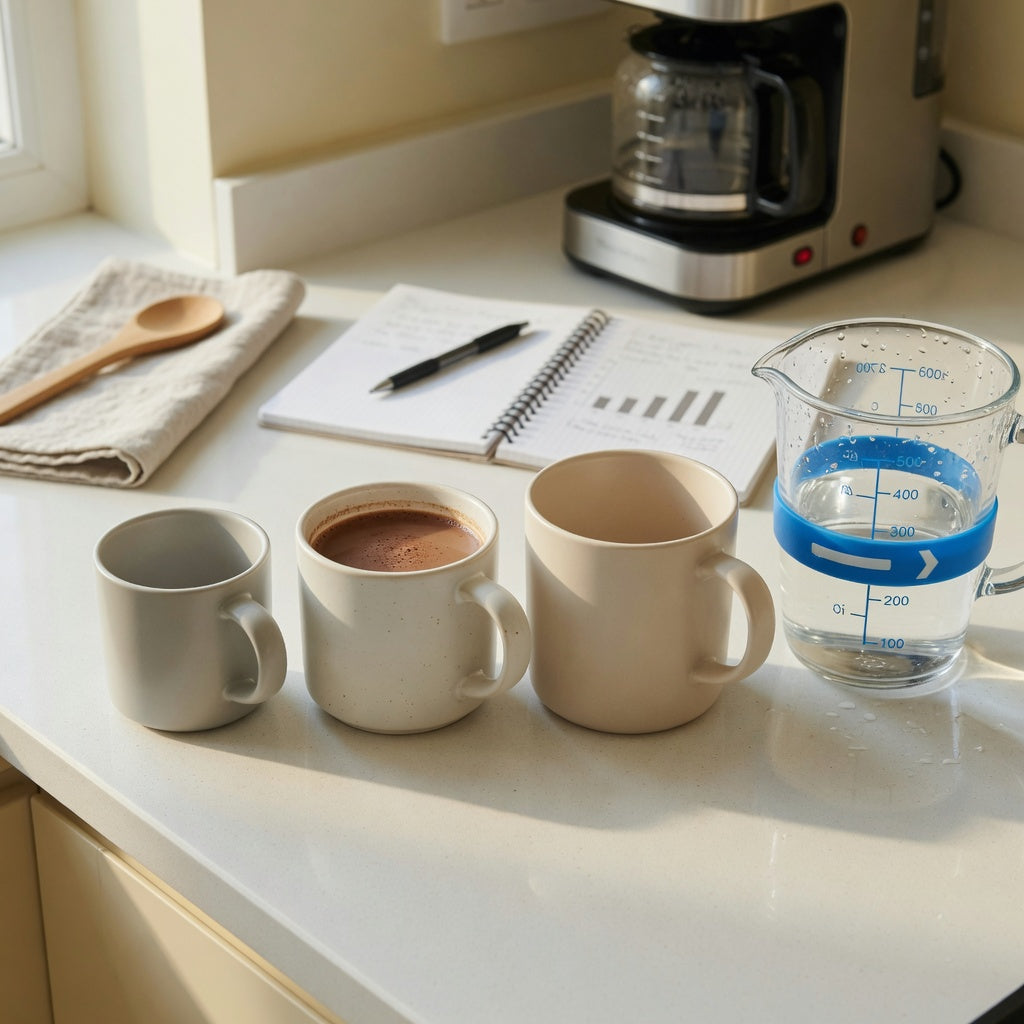
A mug can look generous while empty and become a brim-level balancing act after a coffee-and-cocoa drink is finished with milk or a topping. The spill usually happens on the short walk from the kitchen counter to the desk. That is why shoppers ask, What size mocha mug is best for everyday use? Our practical starting range is 12–16 oz, with the exact choice based on your finished pour and the headspace you want above it.
In our store, we assess daily fit by more than the capacity label. We set mugs on a flat counter, inspect the rim and handle, and think through the route from brewer to desk. There is no universal mocha-mug standard, and a listed capacity is not automatically a comfortable drinking capacity.
You can compare designs in our unique coffee mugs for everyday coffee and cocoa collection, but settle the size first. A mug that overflows, pinches the hand, or has no place in the cupboard rarely becomes the one reached for every morning.
What size mocha mug is best for everyday use: 12, 14, or 16 oz?
For most home routines, the useful answer sits between 12 and 16 oz. A 12 oz mug suits a modest finished drink, while a 16 oz mug is more forgiving if you add more milk, foam, a topping, or simply prefer to carry the cup with a lower fill line. The 14 oz area is the practical middle that avoids both extremes.
| Listed capacity | Approximate metric capacity | Best everyday situation | Main compromise |
|---|---|---|---|
| 12 oz | 355 ml | Smaller finished pour with few additions | Limited headspace once extra milk or a topping is added |
| 14 oz | 414 ml | Moderate coffee-and-cocoa drink with some carrying room | May still feel tight for a deliberately large drink |
| 16 oz | 473 ml | Larger pour or extra room below the rim | A small drink can look low in the mug |
| 18–20 oz | 532–591 ml | Intentionally large, long-format drink | More liquid to carry and a greater chance of machine or cabinet fit problems |
Choose near 12–14 oz if your current drink looks right in a standard mug and you rarely fill it to the lip. Move toward 14–16 oz if your normal pour reaches the rim, you add a topping, or you walk past a laptop and paperwork on the way to your desk. A larger capacity provides room; it does not mean you need to fill every milliliter.
This range is our practical merchandising guidance, not a formal drink standard. The best everyday size is the one that holds your finished drink below the rim without leaving so much empty space that the cup feels oversized.
How much headspace should a coffee-and-cocoa drink have?
Headspace is the gap between the finished drink and the rim. A practical starting point is roughly a half-inch of visible space, although the volume represented by that gap changes with the mug’s diameter and taper. A wide mug may hold more liquid in its top half-inch than a narrow one.
Capacity descriptions also vary. Some sellers measure close to the brim, while others may describe a more usable fill. If the listing does not explain its method, treat the capacity as a comparison number rather than a promise that every stated ounce is comfortable to drink from.
- Fill your current mug to the line you normally use and mark that height on the outside with removable tape.
- After the mug is empty and cool, refill it with water to the mark.
- Transfer that water to a measuring jug and record the result in milliliters or fluid ounces.
- Compare the measurement with the new mug’s listed capacity, allowing additional room below the rim.
For example, if your marked fill measures 360 ml, a 400 ml mug has 40 ml of nominal capacity above that amount. A 440 ml mug has 80 ml, and a 480 ml mug has 120 ml. Those differences are useful for comparison, but the actual visible headspace still depends on the mug’s shape and how its capacity was measured.
Our sizing rule: measure the entire finished drink, not only the coffee portion before milk, cocoa, or a topping is added.
Which 400, 440, or 480 ml CoffeifyMug fits your routine?
Our three relevant listings support coffee and cocoa use and sit close to the everyday 12–16 oz range. We are comparing them here by verified listed capacity only; shape, dimensions, handle clearance, material, and care instructions should be checked on the current product page before ordering.
| CoffeifyMug option | Listed capacity | Reader situation | Why it fits and where it does not |
|---|---|---|---|
| The Flow coffee and tea mug | 400 ml, about 13.5 oz | Your measured pour is modest and you prefer a higher-looking fill line | It is the smallest of the three, reducing unused volume. It offers the least spare capacity for a large topping or milk-heavy pour. |
| Morning and Night coffee and tea mug | 440 ml, about 14.9 oz | You are caught between a compact mug and a full 16 oz size | It provides 40 ml more listed capacity than The Flow and 40 ml less than The Rock. Very small drinks may still sit low, while unusually large ones may reach the rim. |
| The Rock coffee and tea mug | 480 ml, about 16.2 oz | Your drink needs deliberate headspace or your measured pour already fills a smaller cup | It has the most capacity of the three. A compact drink can look underfilled, and filling the available space means carrying more liquid. |
For a smaller daily pour: start with The Flow at 400 ml. For a middle-ground household or gift: Morning and Night at 440 ml is the most neutral capacity choice, though it cannot account for the recipient’s handle or style preference. For a larger drink or extra rim clearance: The Rock at 480 ml gives the most room.
If your usual pour measures close to the listed capacity of an option, move up rather than planning to drink at the lip. If your drink occupies only half of a 16 oz mug, move down so the cup feels proportionate to what you make.
Will a 16 oz mocha mug fit under your coffee machine?
Capacity cannot answer this question. A short, wide mug and a tall, narrow mug may hold the same amount while fitting very different spaces. Measure the machine with the drip tray in its normal position, then check four points:
- Vertical clearance: Measure from the tray to the lowest part of the spout or brew head.
- Removal room: Leave enough vertical space to lift and remove the mug without striking the rim against the spout.
- Tray footprint: Check that the base sits flat and that the handle does not force the mug off-center.
- Access after brewing: If you add anything after the coffee dispenses, make sure you can remove the cup without tilting a near-full drink.
Apply the same discipline to storage. Measure cabinet shelf height and usable width, including the handle rather than only the mug body. For the dishwasher, check upper-rack clearance, prong spacing, and the current product care instructions. Do not infer microwave or dishwasher suitability from the mug’s appearance; materials and decorative finishes can carry different care requirements.
On delivery, place the empty mug on a flat counter and inspect the rim, base, and handle joins. A chipped rim, a hairline crack near the handle, or a base that rocks noticeably should be addressed before the mug is used. This check matters even more if the mug will be wrapped as a gift and not opened again for several weeks.
Does the handle still work when the mug is full?
The difference between 400 and 480 ml is 80 ml. If both mugs are filled to capacity, the larger one carries more liquid, but capacity alone does not reveal the empty mug’s weight, wall thickness, balance, or handle geometry.
Use your current favorite mug as a template. Fill it to your normal line, note how many fingers you place through the handle, where your thumb rests, and whether your knuckles touch the mug wall. Then compare those preferences with any dimensions and side-view photos supplied on the new listing. If handle measurements are absent, do not assume a large-looking loop will feel large in hand.
At an office desk, extra headspace is often more useful than maximum drink volume. It gives you a safer margin around keyboards, notebooks, and charging cables. If a sealed lid, cup-holder fit, or leak resistance is essential, a standard open mug is the wrong format; use a travel vessel rather than solving a commute problem with more capacity.
Who should buy smaller than 12 oz or larger than 16 oz?
- Go below 12 oz if your measured finished drink is consistently small and you want a compact cup. This is not a good fit for generous additions or toppings.
- Stay within 12–16 oz if the mug will move between a kitchen counter, dining table, and office desk and you want a balance of fill height and carrying room.
- Go above 16 oz if your finished drink already approaches 16 oz before headspace is added. Accept the trade-offs of more liquid when filled, more storage space, and possible machine-clearance issues.
A 20 oz mug is not automatically a better everyday mug. It is a poor choice for someone who makes a modest drink, dislikes a low fill line, or has a tightly spaced cupboard. At the other end, a 12 oz mug is not useful if every pour finishes at the rim.
A 60-second capacity check before you order
- Measure your usual finished coffee-and-cocoa pour with water and a marked fill line.
- Allow visible room below the rim instead of matching the drink exactly to the listed capacity.
- Choose 400 ml for the most compact option, 440 ml for the middle, or 480 ml for the greatest capacity among these three products.
- Measure machine height with the drip tray installed.
- Check cabinet width and shelf height, including the handle.
- Compare handle clearance with a mug you already find comfortable.
- Read the current care instructions and inspect the mug before first use.
If your measurements point to roughly 13.5–16.2 oz, compare the three capacities in our unique coffee mug collection. Capacity should narrow the choice before color or design makes the final call.
Frequently asked questions
What size mocha mug is best for everyday use?
For most home routines, start within 12–16 oz. Choose the lower end for a modest finished pour and the upper end for a larger drink or more headspace. CoffeifyMug’s 400, 440, and 480 ml options equal approximately 13.5, 14.9, and 16.2 US fluid ounces.
Is a 12 oz or 16 oz mug better for a mocha with extra milk or a topping?
A 16 oz mug is more forgiving because it provides additional capacity below the rim. A 12 oz mug is better if your finished drink is small and you prefer the cup to look full. If both choices feel extreme, a 440 ml mug offers a practical middle by capacity.
Is a 400 ml mug large enough for an everyday mocha?
It can be, provided your entire finished pour sits comfortably below 400 ml. Measure your current drink rather than estimating from the coffee portion alone. If your marked fill is already close to 400 ml, choose 440 or 480 ml for headspace.
Will a 16 oz mocha mug fit under my coffee machine?
Not necessarily, because capacity does not determine height. Measure from the drip tray to the lowest point of the spout, then compare that number with the mug’s total height and the space required to lift it out. Never estimate machine fit from ounces alone.
Does listed mug capacity include room below the rim?
Do not assume it does. Capacity measurement methods can vary, and a quoted number may be close to a brim-full volume. Use the listing for comparison, measure your own finished pour, and preserve visible headspace for carrying and additions.
Your next step: mark and measure your current fill line, then choose the smallest listed capacity that preserves comfortable headspace for your usual drink. Recheck the current product dimensions and care instructions before placing the order.
More from our blog
Read more

350 ml Ceramic Tea Mug: Compare Size, Glaze, Handle and Care
Compare the details that decide daily comfort: real fill volume, handle clearance, glaze condition, infuser cleanup, care labels, and stability. We also explain when a larger or insulated mug is th...
Read more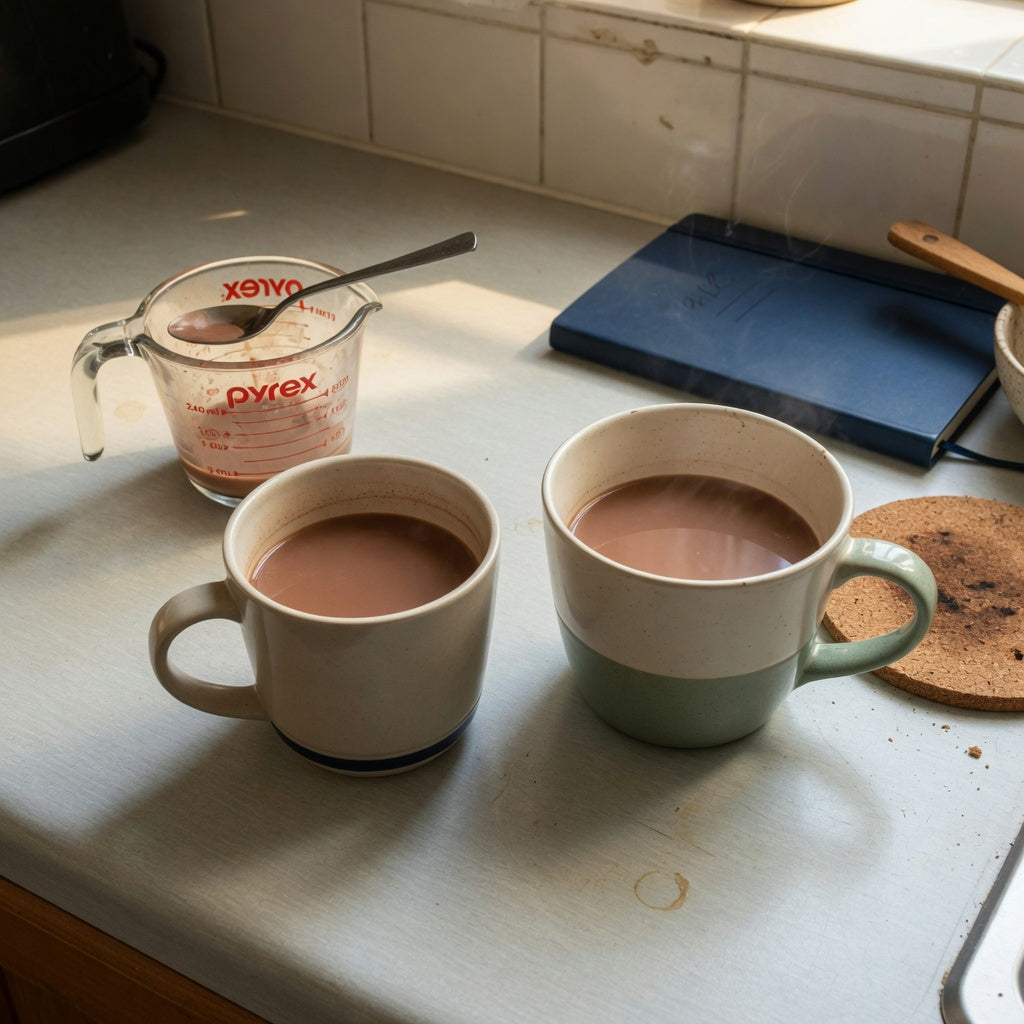
What size hot cocoa mug is best for everyday use?
An 8-ounce cocoa serving needs more than an 8-ounce vessel. Compare the 12–14-ounce everyday range with CoffeifyMug’s 400 ml and 480 ml options, including desk, cabinet, handle, and care trade-offs.
Read more
Leave a comment
This site is protected by hCaptcha and the hCaptcha Privacy Policy and Terms of Service apply.