
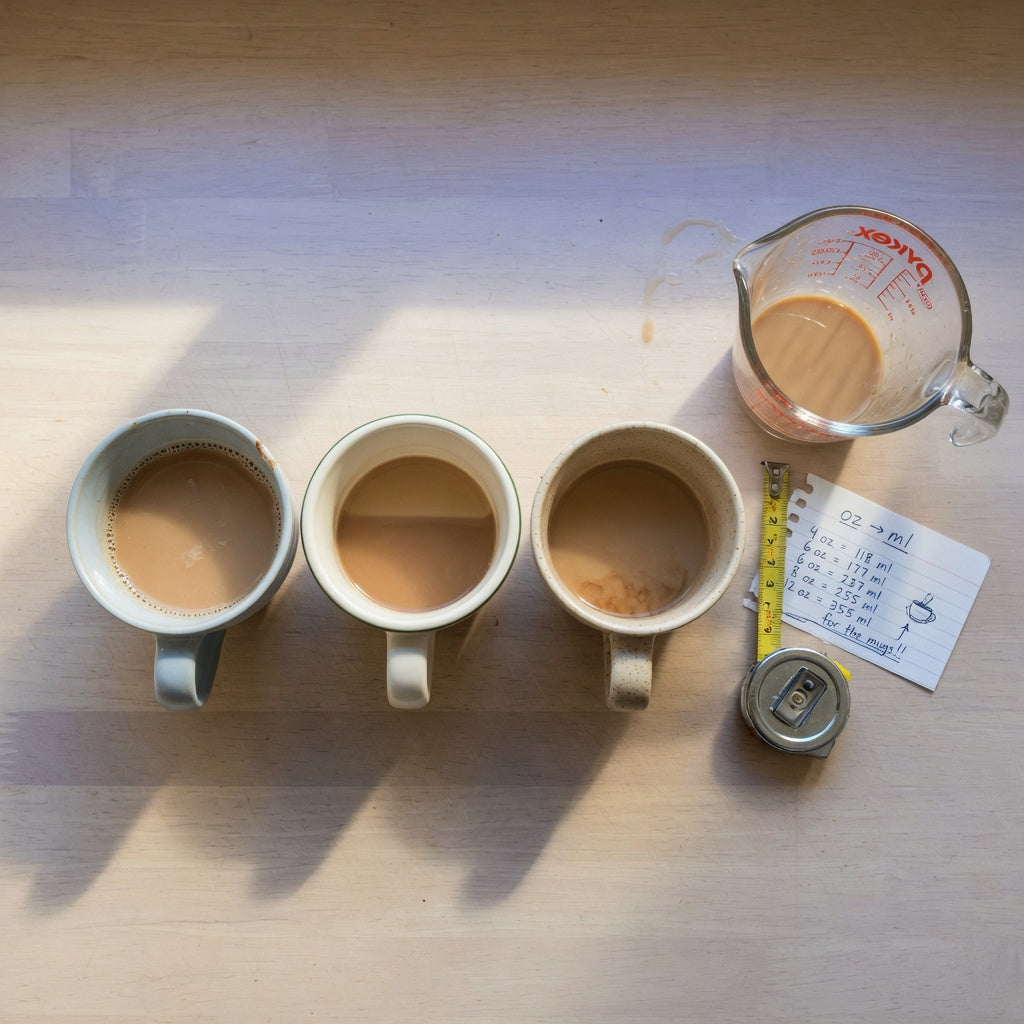
What Size Is a Cafe Au Lait Mug? Oz and ML Sizes Compared
Reading time: about 9 minutes
The question usually reaches us with a photo attached: a wide café cup, coffee lightened to tan, and one line underneath — “what size is a cafe au lait mug, and is this it?” The short answer: most hold between 8 and 16 ounces (roughly 240 to 475 ml), there is no single industry standard, and the category splits into two formats — the handled mug most people picture, and the handle-less French bowl known as a bol. Which number is right for you depends less on the label and more on how much milk you pour.
We pack and ship these mugs every week, and size is the detail that decides whether a purchase sticks. Too small and it reads like an ordinary coffee cup with a fancier name. Too large and it crowds the cabinet and turns a modest pour into a mostly-empty mug. Here is how to land on the right number before you order.
What size is a cafe au lait mug, and why is there no single standard?
The drink sets the size, and the drink itself has range. A cafe au lait is built on roughly equal parts strong brewed coffee and warmed milk, poured generously at breakfast — a bigger drink than a cappuccino by design, and looser in its proportions than a latte. Manufacturers interpret “generous” differently. European porcelain houses graduate their cafe au lait pieces across several milliliter sizes, then label them metric-first, which is exactly where American shoppers get lost.
When customers ask us what size works for daily home use, we give the same guidance: treat 8 oz as the practical floor, 12 oz as the comfortable middle, and 16 oz as the top of the everyday range. Past 16 oz you drift into soup-mug territory — fine if that is the goal, but it stops being a coffee decision.
Because so many listings print milliliters first, keep these conversions handy (1 US fluid ounce ≈ 29.6 ml):
- 8 oz ≈ 240 ml
- 10 oz ≈ 300 ml
- 12 oz ≈ 355 ml
- 14 oz ≈ 415 ml
- 16 oz ≈ 475 ml
How does a cafe au lait mug compare to espresso, cappuccino, and latte cups?
Buyers usually arrive at this question after mixing the categories up, so here is the side-by-side we sketch on notepads. Treat these as typical ranges across makers, not fixed rules:
| Vessel | Typical capacity | Typical shape | Best suited to |
|---|---|---|---|
| Espresso cup (demitasse) | 2–3 oz (60–90 ml) | Small, thick-walled, usually saucered | Straight espresso shots |
| Cappuccino cup | 5–6 oz (150–180 ml) | Wide and shallow | Equal-thirds espresso, milk, foam |
| Latte mug | 10–12 oz (300–355 ml) | Taller, narrower base | Steamed-milk drinks, latte art |
| Cafe au lait mug | 8–16 oz (240–475 ml) | Broad body, sturdy handle | Half brewed coffee, half milk |
| French bol (cafe au lait bowl) | Commonly 8–14 oz and up | Wide, shallow, no handle | Two-handed sipping, breakfast dunking |
The overlap with latte mugs is where shoppers hesitate, so let us be direct: a 12 oz cafe au lait mug and a 12 oz latte mug hold the same liquid. The difference is the drink underneath — brewed coffee plus milk versus espresso plus steamed milk — and the shape that suits each pour. If your habit is drip or French press coffee with a heavy splash of milk, the cafe au lait format is the honest match.
Handled mug or French bol: which one are you actually buying?
The bol deserves its own explanation, because product pages rarely spell it out. A bol is the wide, shallow, handle-less bowl long associated with French cafe au lait service, meant to be cradled in both hands at the breakfast table. The width is functional — the broad, open shape suits dunking a croissant — and the missing handle is the point. It is a seated, unhurried, both-hands vessel.
It also carries real trade-offs. No handle means no one-handed desk use. The wide footprint eats cabinet and dishwasher-rack space. And carrying a full bowl of hot coffee across a kitchen is a different risk than carrying a mug; we have heard that story from customers more than once.
Every mug in our lineup is a handled design, because most of our customers drink at a desk, on a commute, or one-handed while doing three other things. If the two-handed breakfast ritual is what you are after, a dedicated bol from a porcelain specialist is the truer purchase. That is a case where a different format genuinely fits better than anything we sell, and we would rather point you there than sell you the wrong shape.
Our 400, 440, and 480 ml mugs, converted to ounces
Our three current cafe au lait mugs sit deliberately in the middle-to-upper end of the range, with the milliliter-to-ounce math already done:
- The Flow — 400 ml, about 13.5 oz.
- Morning and Night — 440 ml, right around 15 oz.
- The Rock — 480 ml, just over 16 oz.
All three clear the 12 oz mark that separates an ordinary large coffee mug from a true cafe au lait mug. If you have been hunting specifically for 16 oz cafe au lait mugs, The Rock lands on that number. All three listings sit side by side in our unique coffee mugs collection, which is the fastest way to compare capacities before committing. Outside dimensions, weight, and care details vary by listing, so confirm those on the current product pages rather than guessing from photos. For a fuller head-to-head, our 400, 440, or 480 ml size decision guide covers which capacity suits refill drinkers versus one-pour-and-done mornings.
How much milk headroom does a cafe au lait mug actually need?
Printed capacity and usable capacity are different numbers, and almost every size comparison skips the distinction. Nobody fills a mug to the brim. That gap at the rim is what lets you carry the mug from counter to table without sloshing.
Our working rule after months of pouring from these daily: assume the usable pour is roughly 90 percent of the printed capacity, then subtract your milk.
Run the numbers for the classic half-and-half pour. A 400 ml mug takes about 360 ml comfortably — call it 6 oz of coffee plus 6 oz of milk with a sensible gap at the rim. Step up to 480 ml and you can pour milk-heavy ratios closer to one-third coffee, two-thirds milk without living dangerously. Mostly black coffee with a splash of milk? Even 400 ml behaves like a generously sized everyday mug.
Which size fits your cabinet, your desk, and your gift list?
Capacity only means something in context. Based on what we see reordered, gifted, and occasionally sent back, the mapping looks like this:
- One-person households and snug cabinets: The Flow at 400 ml is the smallest pour of the three. If you use a mug tree or stack mugs, compare the base and height on the listing against your shelf — measurements settle fit, photos do not.
- Shared cabinets where coffee and tea coexist: Morning and Night at 440 ml is the middle path — room for a proper au lait pour without overwhelming the tea drinker’s shelf.
- Milk-forward, refill-averse, big-breakfast drinkers: The Rock at 480 ml. The trade-off is footprint: more capacity generally means more shelf space, so measure shallow cabinets before ordering.
- Gift buyers: The Rock suits the “large coffee” person on your list; The Flow suits someone whose kitchen is already full. Confirm whether the listing is a single mug or a set — that detail trips up more gift orders than size does.
None of the three suits everyone. If your daily drink is a 5–6 oz cappuccino, any of these will dwarf it — a proper cappuccino cup is the better tool. And if you want the honest downsides of each size across a week of real use, our daily-use trade-offs guide walks through what to expect before you buy.
Which specs should you confirm on the listing before checkout?
We would rather answer questions before an order ships than after, so here is the checklist we give customers, in order:
- Care instructions. Dishwasher and microwave guidance varies by maker and material, and we do not generalize — read the care note on the exact listing you are buying.
- Outside dimensions and weight. Capacity tells you the pour; dimensions tell you whether it fits the shelf, the mug tree, and the dishwasher rack.
- Set count. One mug or four? Verify before a gift order ships, not after it arrives.
- Handle clearance. If the mug will share a shelf with taller pieces, make sure the handle has room to sit proud of the edge.
For small kitchens specifically, our compact-kitchen purchase checklist for all three sizes covers shelf depth, sink-drainer fit, and drying space in more detail.
Frequently asked questions
What size is a cafe au lait mug, and is there a standard?
No single standard exists. Most hold between 8 and 16 ounces (about 240 to 475 ml), with 12 to 16 oz the sweet spot for home use. Read the listed capacity in ml or oz rather than judging by photos — wide mugs photograph smaller than they pour.
How many ounces is a cafe au lait cup in real listings?
Listings vary by maker, but home sizes tend to cluster between 12 and 16 oz. Our three current mugs convert to about 13.5 oz (400 ml), roughly 15 oz (440 ml), and just over 16 oz (480 ml), so they sit toward the generous end of the category.
Is a cafe au lait mug the same as a latte mug?
Not quite. Capacities overlap — both commonly run 10 to 12 oz and up — but a cafe au lait is built on brewed coffee and milk, so its mug tends toward a broader body and a sturdier handle, while latte mugs run taller and narrower to suit steamed-milk drinks and latte art.
Can I use a large cafe au lait mug for cereal or oatmeal?
Plenty of customers do, and capacity decides it: a 480 ml mug like The Rock holds a standard bowl-sized portion, while 400 ml suits a smaller serving. Check the listing for the maker’s intended use and care guidance before it becomes your cereal bowl.
Are cafe au lait mugs dishwasher and microwave safe?
It depends on the maker and the material, and answers differ even within the category, so we do not generalize. Read the care note on the specific listing you are buying — and if a listing does not state it, ask the seller before checkout.
The 60-second size check before you order
- Convert the listed ml to oz so you know the pour you are actually buying.
- Choose handled mug or bol based on where you drink — desks and commutes favor handles.
- Match capacity to your milk ratio: more milk, more mug.
- Measure shelf depth, mug-tree rings, and dishwasher racks if your space runs snug.
- Confirm care instructions and set count on the current product page, not on old photos.
The short version: The Flow for smaller kitchens, Morning and Night for the everyday middle, The Rock for a full 16 oz pour. All three sit side by side in our unique coffee mugs collection so you can compare capacity, shape, and handle comfort in one place before you commit.
Read more
Wooden Handle Ceramic Mug Buying Checklist: What Buyers Should Compare
A shop-floor wooden handle ceramic mug buying checklist: how the handle attaches, glaze safety for hot drinks, brim-versus-usable capacity, wood finish, dishwasher and microwave reality, and the ho...
Read more
Ceramic Cafe Au Lait Mug: What to Compare (Size, Handle, Care)
A practical comparison guide to the ceramic cafe au lait mug: how 400, 440, and 480 ml pour differently, when a handled mug beats the traditional bowl, and which handle, glaze, and care details to ...
Read more
Leave a comment
This site is protected by hCaptcha and the hCaptcha Privacy Policy and Terms of Service apply.