
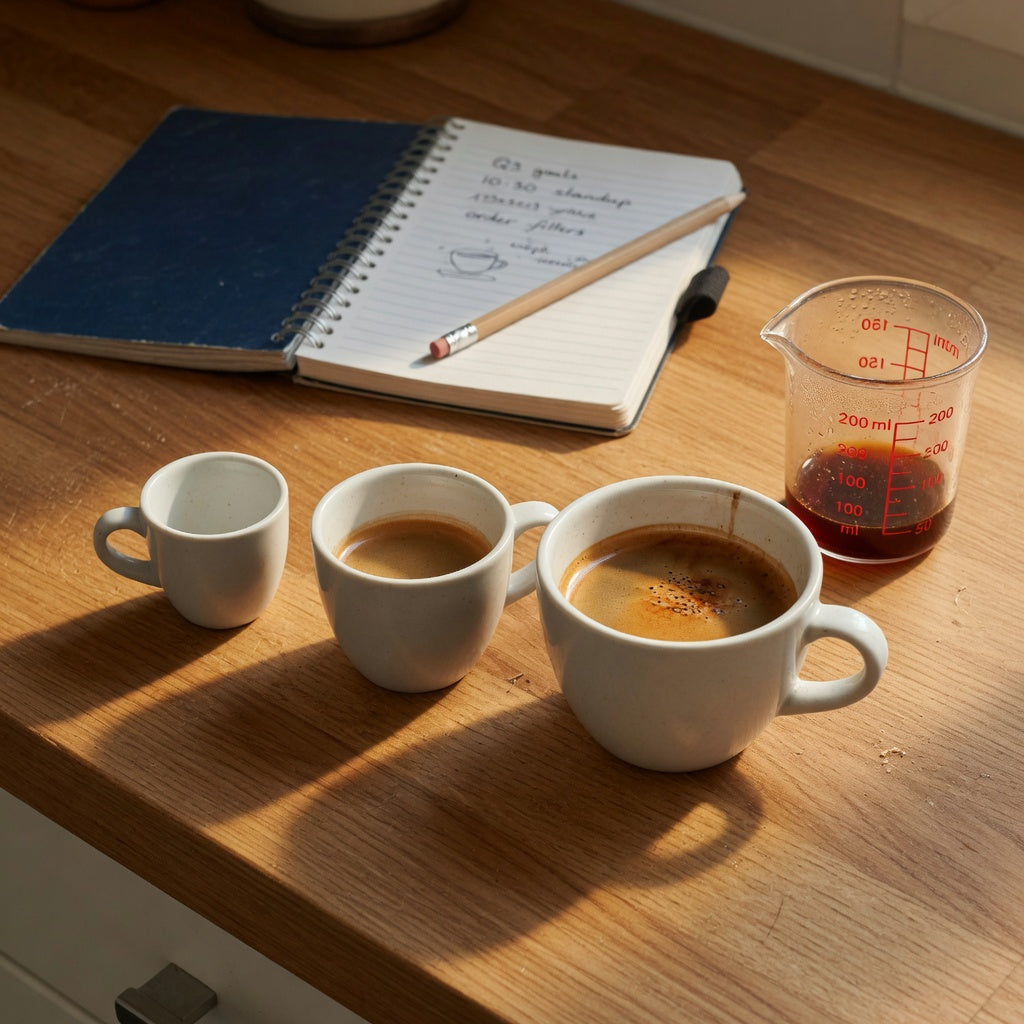
What Is a Lungo Coffee Cup Size? 170–270 ml Compared
Reading time: about 10 minutes
A small espresso cup can look perfectly placed under the spout until a longer pour climbs toward the rim. That near-spill is the practical reason shoppers type what is a lungo coffee cup size into search before buying a replacement.
The short answer is that a lungo cup should hold more than your measured finished drink. There is no single cup capacity that covers every recipe or machine setting. Traditional barista descriptions often place a lungo around 50–70 ml, programmed home pours may be around 110 ml, and some longer formats reach about 150 ml. Treat those figures as reference points, not universal serving standards or machine guarantees.
In our store, we use the facts we can verify: listed capacity and the headroom left after a measured pour. The three capacities compared here are the Retro 170 ml Coffee & Tea Cup, Pleated 200 ml Coffee & Tea Cup, and Emerald 270 ml Coffee & Tea Mug. You can also compare unique coffee mugs by style and listed capacity before narrowing the choice.
What is a lungo coffee cup size in milliliters?
Drink volume and cup capacity answer two different questions. Drink volume is the liquid your normal setting produces. Cup capacity is the total space listed for the vessel. Buying a cup with exactly the same number as your drink leaves no practical margin for crema, surface movement, or carrying it from the kitchen counter to a desk.
Use the final drink you actually consume as the starting number:
- Straight lungo: Measure the full extraction after the stream stops rather than relying only on the button name.
- Lungo with milk or added water: Measure the finished drink, including everything added after extraction.
- Iced version: Account for the space displaced by ice. A compact 170 ml cup can become crowded quickly even when the coffee portion is modest.
The useful answer to what is a lungo coffee cup size is therefore personal but measurable: it is a cup capacity larger than your normal finished pour, with enough unused rim for how you serve and carry it.
How much headroom do 170, 200, and 270 ml cups leave?
The table uses three example pours—60, 110, and 150 ml—to make the capacity differences visible. These are comparison values, not promises about what a machine will dispense. Mathematical headroom is simply the listed cup capacity minus the example drink volume.
| Listed cup | Listed capacity | Headroom after 60 ml | Headroom after 110 ml | Headroom after 150 ml |
|---|---|---|---|---|
| Retro | 170 ml | 110 ml | 60 ml | 20 ml |
| Pleated | 200 ml | 140 ml | 90 ml | 50 ml |
| Emerald | 270 ml | 210 ml | 160 ml | 120 ml |
These figures compare capacity only. They do not establish a comfortable fill line, account for the shape of the interior, or guarantee that a cup fits under a particular machine. A 20 ml remainder is mathematically positive, but it gives little margin if the crema rises or you need to carry the drink across a room.
Headroom also changes how the serving looks. A 60 ml lungo occupies a substantial share of a small espresso cup but sits low in a 270 ml mug. That visual difference is not a product defect. It is the trade-off between a compact presentation and spare capacity.
Which cup size fits a kitchen counter, office desk, or gift?
We match the three listed capacities to the shopper’s measured pour and routine. Someone drinking beside the machine can accept less spare rim than someone carrying a hot cup past a laptop, paperwork, or a crowded breakfast table.
170 ml: compact servings with a measured short-to-medium pour
The Retro’s listed 170 ml capacity leaves 110 ml above a 60 ml example pour and 60 ml above a 110 ml pour. That makes it the compact option for a straight lungo enjoyed at the counter or on a space-limited desk. A 150 ml pour leaves only 20 ml by subtraction, so this is not the forgiving choice for a long program, a substantial milk addition, or ice.
It is also not a breakfast-size refill mug or a travel cup. Capacity alone does not imply a lid, insulation, or compatibility with a vehicle holder. For gift unboxings, state the 170 ml capacity clearly so the recipient does not mistake a deliberately compact cup for a full-size everyday mug.
200 ml: a middle capacity with more carrying margin
The Pleated 200 ml Coffee & Tea Cup leaves 90 ml above a 110 ml example and 50 ml above a 150 ml example. It suits the shopper whose measured pour is too close to the top of a 170 ml cup but who does not want the drink sitting as low as it would in a 270 ml vessel.
This middle capacity is practical for carrying a programmed lungo from the kitchen to an office desk. It still is not automatically large enough for a milk-heavy recipe or a full portion of ice. Measure the complete drink rather than assuming that the extra 30 ml over the Retro covers every addition.
270 ml: the largest margin of the three listed options
The Emerald 270 ml Coffee & Tea Mug provides 160 ml of arithmetic headroom above a 110 ml example and 120 ml above a 150 ml example. Choose it if your measured setting runs long, you regularly add something after brewing, or you simply prefer more distance between the drink and the rim.
The trade-off is scale. A 50–70 ml traditional-style lungo will occupy a relatively small part of a 270 ml mug. If that low fill looks unfinished to you, the 170 or 200 ml listing will appear more proportional. The 270 ml capacity also does not make the mug a guaranteed latte, iced-coffee, or machine-compatible vessel; the final measured volume and external dimensions still matter.
Lungo, espresso, and Americano use water differently
The names are often treated as cup sizes, but they describe preparation more reliably than final volume. Two drinks can finish at similar milliliters while requiring different amounts of cup space once water, milk, or ice is added.
| Drink | How the water is used | Cup-buying implication |
|---|---|---|
| Espresso | A shorter espresso-style extraction | A compact demitasse may be enough; a 270 ml mug can look oversized. |
| Lungo | More water passes through the coffee during extraction | Measure the actual output because recipes and programmed settings vary. |
| Americano | Hot water is added after the espresso is extracted | Choose from the finished combined volume, which may exceed a compact lungo cup. |
A lungo is therefore not simply an Americano in a smaller cup. The water passes through the coffee during the longer extraction instead of being added afterward. For cup selection, however, the final milliliters still decide how much capacity and rim space you need.
How should you measure a home-machine lungo before buying?
A one-minute measurement is more useful than choosing from the name printed beside a button. Use the same coffee, setting, and additions you use on an ordinary morning.
- Use a heat-safe vessel marked in milliliters if it safely fits beneath the outlet. If it does not fit, brew into your normal cup and carefully transfer the drink for measurement.
- Run the setting without manually stopping it early. Read the volume at eye level after the stream has finished.
- If you normally add milk or water, add the usual amount and record the finished total. For an iced drink, test the complete serving rather than the coffee alone.
- Repeat the measurement on another normal serving. If the results differ, use the larger result for conservative capacity planning.
- Compare that number with 170, 200, and 270 ml. Favor more unused capacity if you carry the drink; less can work if you drink beside the machine and prefer a compact presentation.
There is no fixed headroom number that suits every person. The critical rule is not to match cup capacity exactly to drink volume. Crema and movement need room even if the subtraction looks perfect on paper.
Why does cup capacity not guarantee machine fit?
A 170 ml or 200 ml label describes volume, not external dimensions. Clearance under a spout depends on the cup’s height, rim width, base footprint, and the space around its handle. We have not used unverified dimensions in this comparison, so none of the three recommendations should be read as an equipment-fit promise.
Before ordering, check four physical points:
- The vertical distance from the drip tray to the outlet
- The available width around the cup position
- The base area supported by the drip tray
- The room needed to place and remove the handle comfortably
Compare those measurements with the information shown on the current product listing. If a dimension you need is not provided, ask before buying rather than assuming that a familiar milliliter capacity means familiar external proportions.
What should you inspect before the first pour or dishwasher cycle?
Capacity is only one part of receiving drinkware. Our practical unboxing check is simple and applies to cups generally; it is not a claim that any listed product has these defects.
- Run a fingertip near, but not forcefully across, the rim and look for a chip or rough damaged edge.
- Turn the empty cup under side light and check for a visible hairline crack.
- Place it on a level counter and confirm that the base sits steadily rather than rocking.
- Read the current product page or included care guidance before using a dishwasher, microwave, or hot-water preheating routine.
Do not infer care compatibility from color, shine, or a product photograph. Materials and surface finishes can require different treatment, and this guide only verifies the three listed capacities. If a care method is not stated, confirm it with the store before starting repeated dishwasher cycles.
For a gift, include the capacity in the note: 170 ml for compact servings, 200 ml for a middle option, or 270 ml for the most headroom of these three. That small detail sets the right expectation before the box is opened.
Frequently asked questions
What is a lungo coffee cup size in ml?
There is no single universal lungo cup size. Traditional barista descriptions often reference drinks around 50–70 ml, while programmed home pours may be around 110 ml and some longer formats around 150 ml. Measure your own finished drink and choose a cup with capacity left above it.
Is a 170 ml cup big enough for a lungo?
It can be if your measured pour leaves practical rim space. A 110 ml drink leaves 60 ml of mathematical headroom in a 170 ml cup, while a 150 ml drink leaves only 20 ml. Choose a larger capacity if you carry the cup, add milk or water, or regularly produce the longer example.
Should I buy a 200 ml or 270 ml cup for a lungo?
Choose 200 ml if you want a middle capacity that leaves 90 ml above a 110 ml example pour. Choose 270 ml if your finished drink runs longer or you prefer a larger safety margin. A short 60 ml serving will sit visibly lower in the 270 ml option, so presentation is part of the trade-off.
Is a lungo the same size as an Americano?
Not necessarily, and the preparation is different. A lungo sends more water through the coffee during extraction, while an Americano adds hot water after espresso is made. Measure the final beverage rather than choosing a cup from the drink name alone.
What should I do if my machine’s lungo volume varies?
Measure more than one normal serving and plan around the larger finished volume. Include any milk, water, or ice you usually add, then compare that total with the verified 170, 200, and 270 ml capacities. Your next step is to open the unique coffee mugs collection and choose the option that leaves useful rim space without making your everyday pour look lost.
More from our blog
Read more
The Cloud Coffee Tea Mug Wooden Handle: Compare Before Buying
Compare the confirmed 300 ml capacity, ceramic body, wooden-handle care, desk fit, and gift appeal of this cloud-shaped mug. This guide also flags unconfirmed specifications and explains when anoth...
Read more
What Size Cup for Americano Coffee? 200, 270 or 350 ml
Choose an Americano cup from the volume you actually pour, not the drink name alone. We compare CoffeifyMug's 200, 270 and 350 ml listings, calculate nominal headroom, and flag ice, desk use, care ...
Read more
Leave a comment
This site is protected by hCaptcha and the hCaptcha Privacy Policy and Terms of Service apply.