
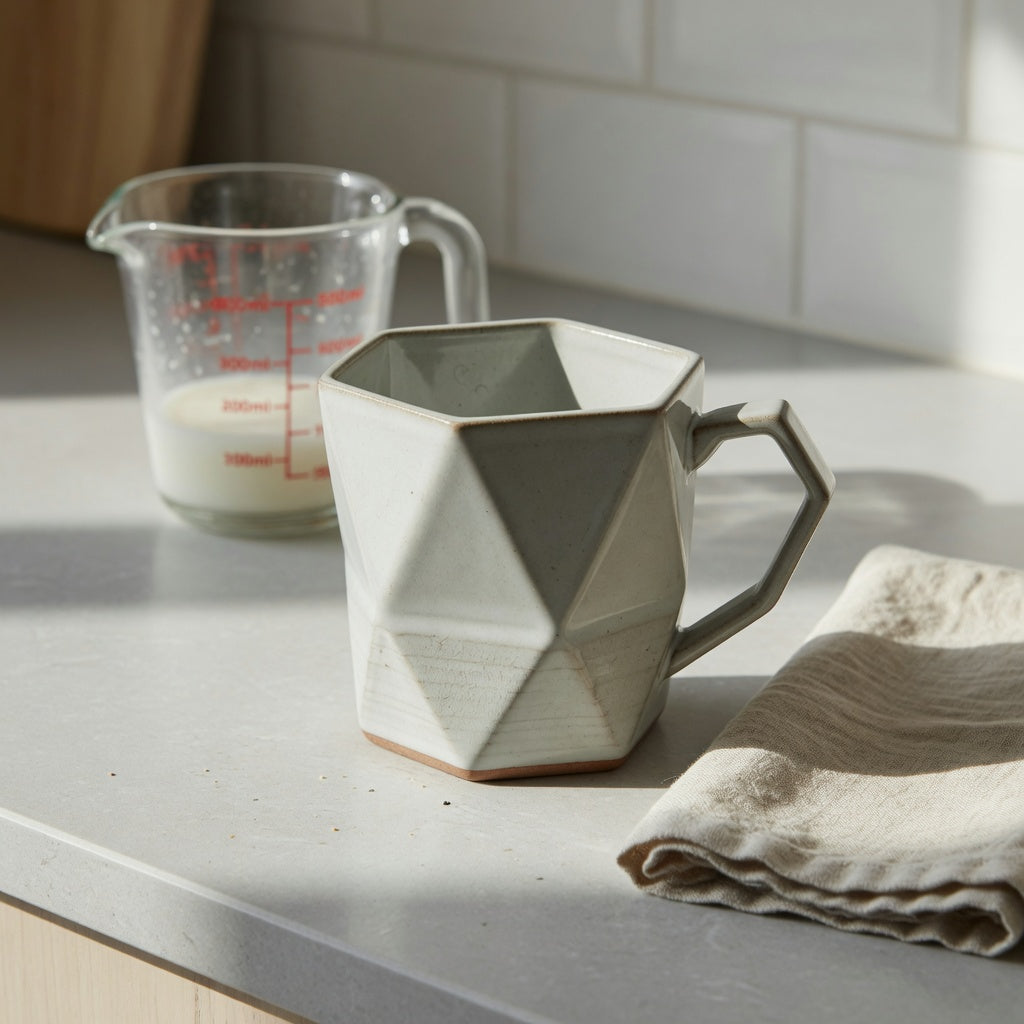
Unique Rhombus Ceramic Mug: 7 Checks Before Buying
Reading time: about 9 minutes
Set a faceted mug beside a laptop and it immediately looks more considered than a standard office cup. The real test starts after the coffee goes in. A unique rhombus ceramic mug must still feel balanced when full, leave enough room for your fingers, sit without rocking, and fit the amount you actually drink.
Those practical checks matter to us at CoffeifyMug because we sell and handle design-led drinkware, not just photograph it. Start by opening the current Rhombus Coffee Tea Mug listing and checking every stated size, material, and care detail. Keep our collection of unique coffee mugs open beside it so you can compare the angular profile with other shapes instead of deciding from one image.
Does a unique rhombus ceramic mug fit your normal pour?
Capacity is the easiest mismatch to prevent. Examples found across this design category are often compact, around 250 to 320 ml, but that range is not a specification for every rhombus mug or for the linked product. The live product listing is the source to use for its current details.
Also check what the stated capacity means. Brim capacity measures liquid nearly to the edge. Usable capacity leaves headspace for milk, foam, movement from the kitchen to a desk, or the displacement caused by ice. Two mugs with the same advertised volume can therefore feel different in daily use if one has a tapered interior or a narrower opening.
- Prepare the coffee or tea you normally drink, including milk.
- Pour it into a measuring jug and record the volume in millilitres.
- Check how much empty space you usually leave above the drink.
- Compare that amount with the capacity stated on the mug listing.
A compact geometric rhombus coffee mug can suit tea, a short coffee, or a milk drink made for one sitting. It is less convincing for a large filter coffee or an iced drink that needs room for cubes. If your measured pour exceeds the listing or leaves no practical headspace, compare other distinctive ceramic mug shapes and capacities before ordering.
How do handle clearance, rim geometry, and the foot affect daily use?
We inspect three contact points before getting distracted by glaze color: the handle, the drinking rim, and the foot. These are the areas your hand, mouth, and counter meet every day.
- Handle clearance: Look for the internal height and width, not only the outside silhouette. A narrow opening may support a two-finger pinch grip but frustrate someone who prefers three or four fingers through a broad D-shaped handle.
- Filled balance: An empty mug can feel comfortable while a full one pulls away from the hand. Handle position, wall weight, and liquid volume all affect that leverage.
- Rim finish: A faceted exterior does not require a sharp drinking edge. The lip should look even and smoothly glazed, without rough patches where you are likely to sip.
- Foot contact: A broad-looking body can still rock if its foot ring is uneven. On a level counter, press lightly at opposite points on the rim. Clean any debris from the foot and repeat before deciding the mug itself is uneven.
Photos can show finger clearance only approximately, especially when no hand or ruler appears for scale. If the listing omits handle dimensions and grip is a deciding factor, ask before buying. This is particularly relevant for larger hands, reduced grip strength, or anyone who finds a pinch grip tiring.
We have not seen dependable long-term comparison data proving that angular mugs are universally more or less comfortable than round mugs. Comfort is hand-specific. In our experience, the most useful question is not whether the shape is unusual, but whether its handle supports the way you already lift a full cup.
Which ceramic, glaze, and construction details deserve inspection?
Ceramic is an umbrella term, not a complete specification. A listing may identify the body as earthenware, stoneware, or porcelain, each made with different clay and firing choices. Do not infer a specific ceramic body, wall thickness, or durability rating when the seller only says ceramic.
Product photos should let you inspect more than the exterior pattern. Look closely at the interior, rim, handle joins, and foot:
- The food-contact interior should appear continuous and easy to reach with a sponge.
- The rim should be free of visible chips, sharp glaze ridges, or exposed damage.
- The two handle attachment points should not show a crack line or separation.
- An unglazed foot ring can be normal, but it should not be so rough that it scratches a desk or shelf.
- Angular corners need cupboard space because repeated contact with another mug or a stone sink can chip exposed points.
Glaze safety deserves factual restraint. The FDA guidance on lead-glazed traditional pottery explains that some glazes or decorations can contain lead and may leach when pottery is not manufactured and fired correctly. The agency also says commercially manufactured pottery intended for everyday use is much less likely to present this problem than antique, damaged, handmade, or brightly decorated traditional pottery from an uncertain source.
That does not make handmade ceramic automatically unsafe, and it does not make every factory mug automatically suitable for beverages. Confirm that the piece is sold for food and drink use, and rely on product-specific statements or seller documentation for any testing or certification claim. Appearance alone cannot establish those details.
Handmade character or matching-set consistency?
A shopper seeking unique drinkware may want visible variation. Another may want four mugs that line up evenly on an open shelf. Those goals point toward different production styles.
| Comparison point | Handmade or small-batch piece | Manufactured geometric mug |
|---|---|---|
| Shape | Minor differences in profile, rim, or handle placement can be part of the character | Dimensions and handle position are generally intended to repeat more consistently |
| Glaze | Pooling, tone, and surface pattern may vary between pieces | Color and finish are usually selected for a more uniform result |
| Buying a set | Best for shoppers comfortable with small differences | Often the more practical direction when close matching matters |
Neither label proves durability. Firing quality, wall design, glaze application, and handle construction still matter. For one visually distinctive desk cup or gift, review the current rhombus-shaped coffee and tea mug after confirming its listed details suit the recipient. For a coordinated cupboard, compare several options and verify that the pieces are intended to match.
Can it handle your microwave, dishwasher, and sink routine?
General material guidance and product-specific care instructions are not interchangeable. Iowa State University Extension guidance identifies ceramic as a non-reactive food-contact material and notes that ceramic can be used in microwaves and dishwashers. A particular mug may still have a glaze, decoration, metallic detail, or construction that requires different treatment, so follow its own listing or maker instructions.
Our practical care sequence for a sculptural ceramic mug is straightforward:
- Read the microwave and dishwasher statements before the first use. If either point is unstated, ask rather than assume.
- Wash with a soft sponge and non-abrasive cleaner. Inspect interior photos first: some faceted mugs have a rounded inner well, while others repeat the angular shape inside and need a smaller brush at the corners.
- If dishwasher use is approved, load the mug so its corners and handle cannot strike another item during the cycle.
- Do not microwave a piece with metallic-looking trim unless the maker expressly confirms the applicable care method.
- Avoid abrupt temperature changes, such as moving a very hot ceramic mug directly into cold water.
- Do not nest angular mugs unless they are designed for stacking. Contact between rims and exterior edges creates avoidable impact points.
Hand washing takes slightly longer if the interior has corners or the handle join is tight. That is a genuine trade-off. Shoppers who want a one-pass wash, unrestricted stacking, and no care-label checks may be happier with a plain, straight-sided everyday mug.
Who gets daily value from the shape, and who should skip it?
| Reader situation | Fit | Reason and next step |
|---|---|---|
| Tea or a moderate coffee at a desk | Potentially strong | The sculptural profile can work well for a seated drink. Check the current product page for capacity, handle, and care details before choosing it. |
| One design-led housewarming or office gift | Potentially strong | The shape feels more intentional than a generic promotional cup. Confirm the recipient's usual drink size and washing routine first. |
| Large iced coffee with plenty of cubes | Usually weak | Ice consumes usable volume, and a compact opening can be inconvenient. Compare larger or wider options in the mug collection. |
| Drink carried during a commute | Poor | An open ceramic cup does not replace a sealed travel vessel. Choose a purpose-built mug with a secure lid. |
| User needs a full-hand grip | Depends on handle dimensions | Skip any design with narrow clearance and compare a larger D-shaped handle instead. |
For gifting, picture the unboxing and the following Monday morning. A distinctive mug is a good present only if the recipient can comfortably hold it, fit it under their coffee equipment, and clean it using their normal routine. Style cannot repair a capacity or grip mismatch.
Seven checks to make before checkout
- Measure your normal prepared drink instead of estimating from your current mug.
- Distinguish listed brim capacity from the usable fill level you need.
- Check handle opening, finger clearance, and likely grip style.
- Inspect the rim, interior glaze, handle joins, and foot in close-up photos.
- Confirm the exact microwave and dishwasher instructions.
- Decide whether handmade variation or set consistency matters more.
- Allow shelf, sink, and dishwasher space for the angular exterior.
Frequently asked questions
Is a unique rhombus ceramic mug comfortable to hold every day?
It can be, but comfort depends on handle clearance, filled balance, and your preferred grip. A narrow handle may suit two fingers while feeling cramped to someone who uses a full-hand hold. Check dimensions or ask the seller if product photos do not provide enough scale.
What size rhombus mug works for coffee or tea?
Category examples often fall around 250 to 320 ml, which can suit tea, a short coffee, or a moderate milk drink. That range does not describe every product, so compare the current listed capacity with a measured serving from your own kitchen. Allow extra headspace for milk, foam, or carrying the mug to another room.
Can a rhombus ceramic mug go in the dishwasher?
Use the dishwasher only when the product's care instructions permit it. If approved, position the mug so its handle and angular edges cannot knock against another item. Hand washing is the more cautious option when care instructions are missing or the finish includes delicate decoration.
Is a handmade rhombus ceramic mug microwave safe?
Handmade construction alone does not answer that question. Microwave suitability depends on the clay body, glaze, firing, and decoration, so use the maker's explicit instructions. Do not assume a piece with metallic-looking trim is microwave compatible.
Is a geometric rhombus mug a good gift?
It is a sensible gift for someone who enjoys ceramic drinkware, takes modest drinks at home or a desk, and appreciates unusual forms. It is a weaker choice for a commuter, a large iced-coffee drinker, or someone who needs a broad handle. Check capacity and care requirements before treating appearance as proof of fit.
Measure one normal pour now, then compare it with the current Rhombus Coffee Tea Mug. If the capacity, grip, or care routine does not line up, return to the unique coffee mug collection and choose the shape that will still make sense after the first week of use.
More from our blog
Read more
What to Put in a Coffee Mug as a Birthday Gift: Practical Ideas
Build a filled birthday mug that feels personal rather than random. Match drink, self-care, hobby, or gift-card fillers to the recipient, then check fit, allergies, mug care, and wrapping before gi...
Read more
Ceramic Mug Wooden Handle Gift: 7 Checks Before Buying
Compare the wood-to-ceramic joint, usable capacity, handle clearance, glaze information, care requirements, and the recipient's daily routine before choosing a wooden-handle mug as a gift.
Read more
Leave a comment
This site is protected by hCaptcha and the hCaptcha Privacy Policy and Terms of Service apply.