
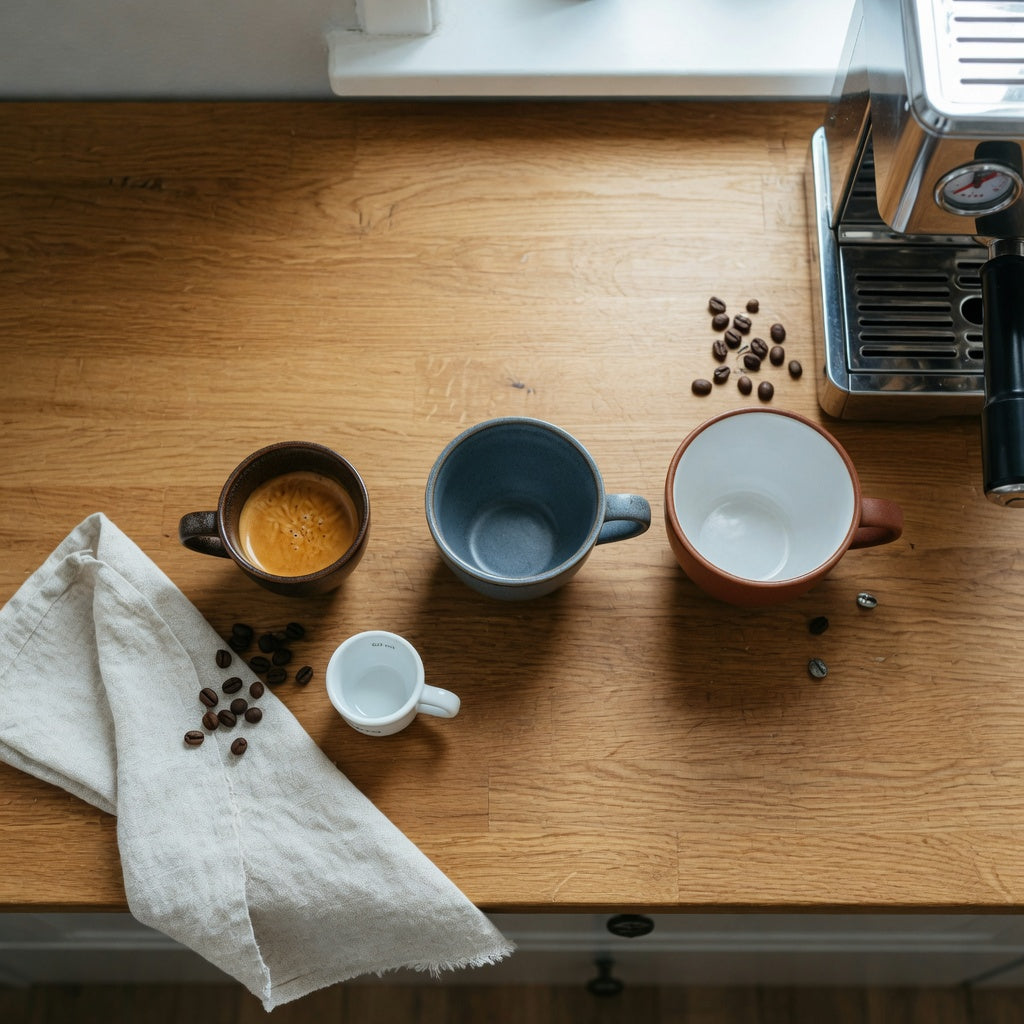
Unique Espresso Cups Everyday Mug Rotation Practical Purchase Checklist
Reading time: about 9 minutes
The cup that actually gets used every morning is rarely the prettiest one on the shelf. It is the one that slides under the group head without moving the drip tray and holds the drink someone really makes at 7 a.m. — usually a double shot with a splash of milk, not a 25 ml single. We handle these small ceramic cups daily, and the same three questions come back from customers: will it fit my machine, will it hold the coffee I actually pull, and is the glaze safe to drink from every day. So here is the unique espresso cups everyday mug rotation practical purchase checklist our team walks buyers through, in the order that rules a cup in or out.
What do 170 ml, 200 ml, and 250 ml actually hold?
Capacity is the number shoppers misread most. It is the volume to the brim, not the volume of coffee you should pour in. Those two figures sit far apart: a certified Italian espresso is around 25 ml, older specialty definitions put a single at 25–35 ml, and common cup-size guides land a demitasse near 60 ml. Practical buying advice usually settles on a 50–100 ml cup for a straight shot.
That gap explains why our cups sit at the larger end. They are sized for double-shot and cortado routines, not for strict 25 ml singles.
- Retro coffee cup, 170 ml — the double-shot-with-headroom pick. A standard double, crema included, lands around 50–60 ml, so you get visible space above the liquid instead of coffee sitting at the rim. Add a splash of steamed milk and it drinks like a piccolo. Pull a 25 ml single into it and the cup looks two-thirds empty — that is a sizing decision, not a defect.
- Pleated coffee cup, 200 ml — cortado territory, and the one-cup compromise. A double plus roughly equal milk fits with room to spare, so you can move from a short black to a small milk drink without swapping vessels mid-morning.
- Ball handle coffee mug, 250 ml — the largest, and the one for flat whites, longer milk drinks, or carrying coffee from kitchen to desk one-handed. If all you ever pull is a 30 ml shot, this is more vessel than you need.
If a strict demitasse look is the goal, be honest with yourself: none of these is it. A plain 60 ml white china cup will always look more "correct" beside a portafilter. The trade-off for a distinctive cup is that it generally holds more than a classic shot.
Does a dark or patterned interior make it harder to dial in a shot?
Crema is your feedback loop. It tells you whether the shot ran fast and pale or slow and dark, and whether the bubbles are fine or coarse. A white or clear interior shows all of that at a glance. A dark reactive glaze, a matte finish, or a metallic luster hides it — you taste a change in the coffee without seeing the cause, which slows down dialing in a new bag of beans.
The rim is the second thing your mouth notices. A thin, slightly flared rim delivers coffee cleanly; a thick rolled rim spreads liquid across more of your lip and reads softer and warmer. Irregular handmade rims are part of the charm, but check which side you naturally drink from, because an uneven rim can dribble at its low point.
Interior finishes differ from listing to listing, so do not assume. The unique coffee mugs collection is where we keep the patterned and shaped pieces, and each product page is the authority on its own glaze and rim — not a category photo. If the glaze color is not described, ask before ordering; a top-down image is the angle that shows the inside of the cup.
Will it clear the group head, the drip tray, and your shelf?
Decorative cup listings almost never publish group-head clearance, and that is the measurement that turns a beautiful cup into a shelf ornament. Run these five checks against your own machine and cupboard:
- Height to the rim. If you weigh shots with a scale under the cup, add the scale's thickness. A cup that fits bare may not fit with a scale on the tray.
- Outside base diameter. A wide base can overhang the drip tray grate or sit off-center under the spout.
- Handle angle. Straight-out handles collide with the body on compact machines; angled handles usually clear. Handleless cups solve it entirely but get hot to hold.
- Saucer footprint. A saucer adds roughly the width of a small plate to your shelf depth, which shallow open shelving will not take comfortably.
- Stackability. Straight-walled cups stack; one-off pottery generally does not. If six cups share one cupboard, that matters more than the glaze.
What does preheating and one dishwasher cycle actually change?
Thick ceramic walls hold heat well once they are warm and pull heat out of a cold shot quickly. That is why a 30-second fill with hot tap water before you pull does more for drink temperature than wall thickness alone. Skip it with a heavy cup and your first sip will be noticeably cooler than your last.
- Preheat the cup and, if you use one, the saucer. Hot tap water is enough; you do not need a dedicated warmer.
- Metal decoration means no microwave. Gold rims, platinum lusters, and metallic decals are the usual culprits. If the decoration catches the light like metal, keep it out of the microwave.
- Dry upside down. Unglazed foot rings trap water between base and shelf, which is how you get ring marks on wood and a musty cupboard.
- Do not stack glazed-on-glaze without a buffer, and never rest a rough foot ring on a decorated interior.
We do not publish a care claim we cannot back, so treat the care line on each product page as the authority for that specific cup. Where a listing is silent on dishwasher or microwave status, hand wash it and assume neither.
Is a brightly glazed or handmade cup safe for daily hot coffee?
This is the question buyers ask last and should ask first. The FDA is direct: lead in ceramic glazes and decorative decals can leach into food or drink if the pottery is not properly fired, and washing or boiling cannot remove lead from a piece that contains it. The agency also notes that some traditional pottery labeled "lead free" has still shown extractable lead at or above its action levels.
For cups and mugs, that action level is 0.5 µg/ml of leaching solution under CPG 545.450. Separately, 21 CFR 109.16 requires ceramicware that is decorative rather than food-safe to be marked "Not for Food Use" — or to have a hole through the food-contact surface — precisely because it can otherwise look perfectly usable.
A practical screen for any unique or imported cup:
- Ask for test results. A seller who handles this category should be able to say which standard the glaze was tested to. "Lead free" as a phrase on a page is not a test report.
- Treat the FDA's higher-risk list as a flag. That covers handmade pieces with a crude or irregular look from unknown makers, antiques, flea-market finds, damaged or worn glaze, and ware brightly decorated in orange, red, or yellow.
- Read the base. If it says "Not for Food Use," it is not a coffee cup, however good it looks on a shelf.
- Retire chipped or crazed interiors. Worn glaze is exactly the condition that makes leaching more likely.
What does the unique espresso cups everyday mug rotation practical purchase checklist look like in order?
The short version. Each step can rule a cup out before you reach the next, which is why the sequence matters more than the length:
- Decide your usual pour: single (25–35 ml), double (50–60 ml), or double plus milk.
- Match cup capacity with headroom, not to the brim.
- Confirm the interior actually shows crema — white, clear, or light.
- Measure group-head clearance, including any scale.
- Check base diameter against your drip tray.
- Choose a straight handle, an angled handle, or handleless.
- Confirm saucer footprint and stackability against your cupboard.
- Get glaze safety and care status in writing.
How many cups does a two-person rotation actually need?
Four is the number that works for most couples: two cups each per day, so one pair is always clean while the other dries. Six if you regularly make coffee for guests, or if you like a smaller cup on work mornings and a larger one at the weekend — which is where a 170 ml and a 250 ml side by side earn their shelf space.
A single statement cup is a different purchase from a set. One handmade cup is a personal ritual; four matching cups are logistics. For a household, matching capacity across the set matters more than matching pattern, because it keeps your dose predictable whichever cup comes out of the cupboard.
If the cup is headed for someone else's kitchen, buy from a listing that states what is actually in the box — cup only, or cup with saucer — and check the care line before you gift it. The rest of the unique coffee mugs we stock is worth browsing if you want to compare shapes side by side before committing.
Frequently asked questions
Is a 170 ml cup too big for a single espresso?
Yes, if you pull 25–35 ml singles. It is sized for a double shot with headroom, or a piccolo with a splash of milk. If singles are your default, buy a 50–100 ml cup and keep the 170 ml for doubles and short milk drinks.
Where should the unique espresso cups everyday mug rotation practical purchase checklist start?
With capacity, then machine fit. Capacity decides whether the cup suits the drink you actually make; group-head clearance and base diameter decide whether you can use it without moving the drip tray. Glaze and pattern come after those two, because a beautiful cup that does not fit stays in the cupboard.
Do I need to preheat a thick ceramic cup?
Yes. A quick fill with hot tap water for about half a minute warms the walls so they stop pulling heat out of the shot. It matters more with thick walls than with thin china, and it is the cheapest improvement to drink temperature you can make.
Do the Retro, Pleated, and Ball Handle cups come with saucers, and are they dishwasher safe?
That varies by listing, so check the what-is-included section and the care line on the specific product page rather than assuming. Where a listing does not state dishwasher or microwave status, hand wash it and keep it out of the microwave.
Is brightly glazed handmade pottery automatically unsafe?
No — plenty of handmade and brightly glazed ceramics are fired and tested correctly. But the FDA flags bright orange, red, and yellow decoration and irregular pieces from unknown makers as higher risk, and "lead free" labeling alone has not always held up in testing. Ask the seller for glaze test results before it becomes a daily cup.
More from our blog
Read more
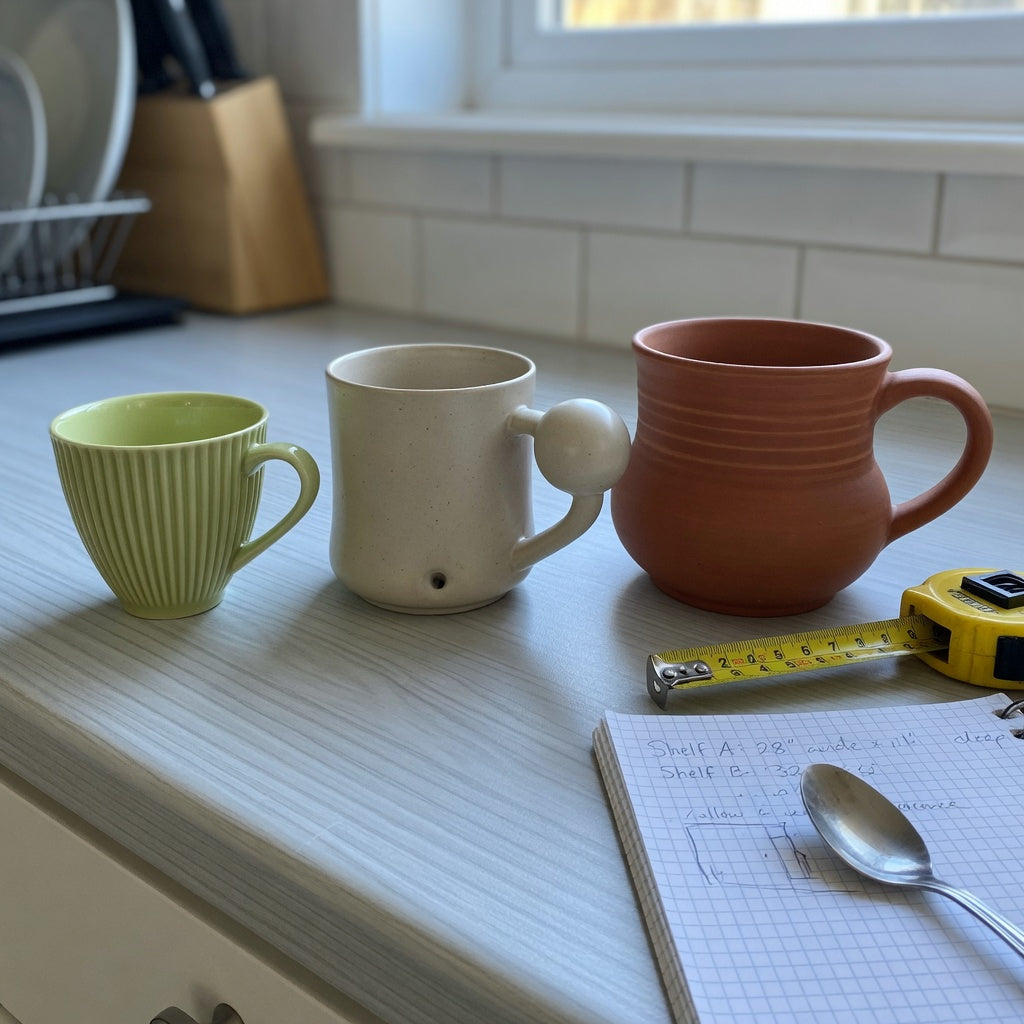
Ceramic Mug Shapes Everyday Mug Rotation Product Shortlist Guide
A working mug rotation gives every shape a job. Here is how listed capacity, handle geometry, rim feel, and shelf fit split a shortlist into a 200 ml pleated cup, a 250 ml ball-handle mug, and a 40...
Read more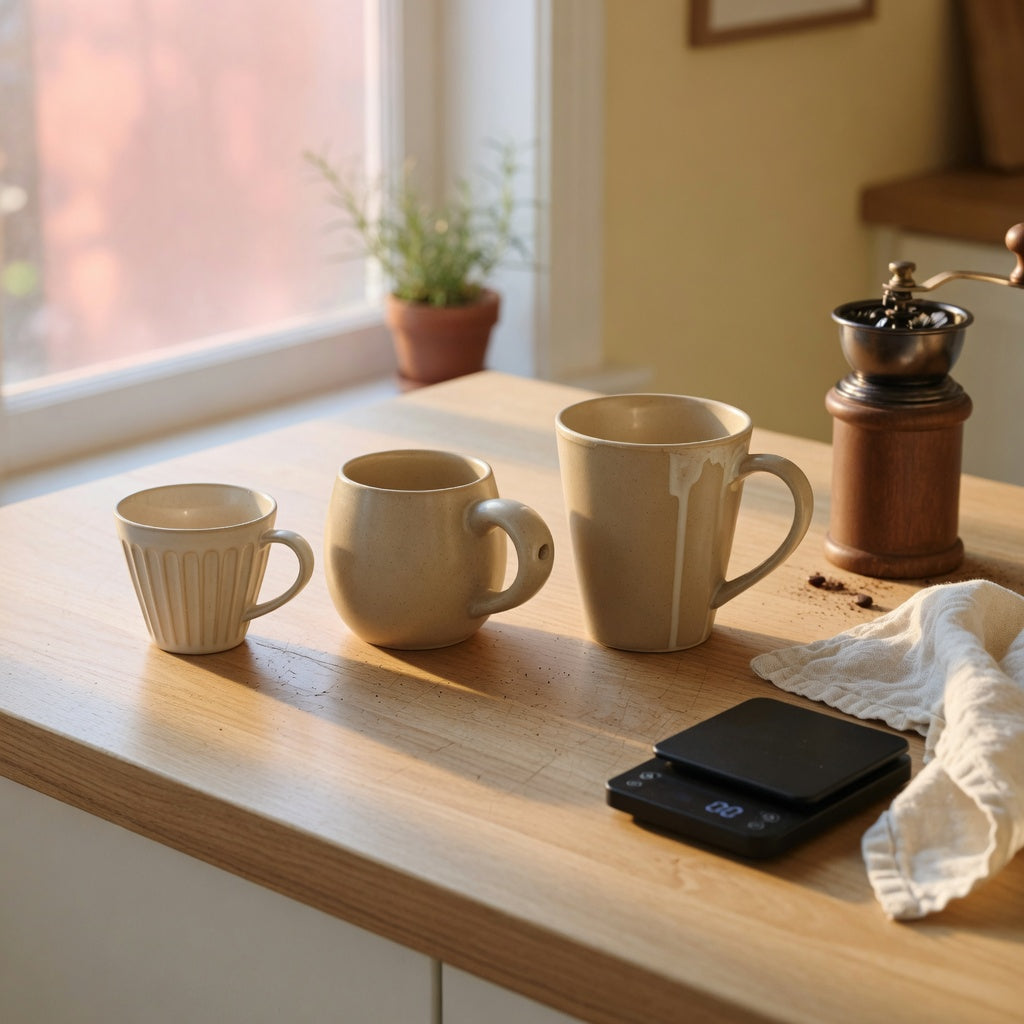
Ceramic Mug Shapes Home Coffee Station Product Shortlist Guide
Silhouette, handle geometry and listed capacity decide whether a ceramic mug earns permanent counter space. Three forms — 200 ml, 250 ml and 400 ml — with plain reasons to choose or skip each at yo...
Read more
Leave a comment
This site is protected by hCaptcha and the hCaptcha Privacy Policy and Terms of Service apply.