
Unique Design Coffee Mugs: Everyday Mug Rotation Buying Checklist
Reading time: about 9 minutes
The mug you reach for at 7:15 a.m. has to clear the cabinet door, fit beside the sugar jar, and return to the shelf after washing. A statement mug can look excellent in a product photo yet spend most of its life at the back of the cupboard because its footprint, care routine, or capacity does not suit the household. That repeated morning decision is the starting point for our unique design coffee mugs everyday mug rotation practical purchase checklist.
In our store, we handle design-led mugs as products that must earn a usable place, not just make a strong first impression during unboxing. The rotation guidance below is general. Product-specific comments are limited to the identities and information shown on the linked pages, while material, capacity, dimensions, microwave use, dishwasher use, and stackability should remain unknown unless the live listing confirms them.
Which mug deserves a daily, weekly, or display-first slot?
Start with frequency rather than design. A mug used every morning needs to work with your usual drink, washing habits, desk, and easiest cabinet position. A weekly mug can justify a more expressive look or a less convenient shelf slot because it is handled less often.
- Daily slot: Used roughly five to seven times per week. Confirm capacity, care instructions, grip clearance, and storage before prioritizing appearance.
- Weekly slot: Used one to four times per week. A stronger theme can be worthwhile if the mug still fits the shelf and drying area.
- Display or gift slot: Used occasionally or chosen for its visual identity. Storage and care still matter, especially if the recipient has a small kitchen or relies on a dishwasher.
If every mug in your cabinet must stack or occupy the same narrow footprint, a conventional cylindrical mug may be the better purchase. Unique designs make the most sense when the rotation has room for one deliberate accent.
What belongs on the unique design coffee mugs everyday mug rotation practical purchase checklist?
Use the unique design coffee mugs everyday mug rotation practical purchase checklist while standing at the actual cabinet, counter, or desk where the mug will live. Photos alone cannot tell you how a piece interacts with a shelf lip, neighboring handles, or a full coaster.
- Assign a realistic frequency: Decide how many days per week you expect to use the mug, rather than how often you hope to use it.
- Measure three storage limits: Record usable shelf height, available width, and depth before the cabinet door closes.
- Check the complete footprint: Compare the listed overall height, widest point including the handle or decorative elements, and base diameter with your measurements.
- Match capacity to the real drink: Use the listed ounces or milliliters. Allow room for milk, foam, tea infusers, or ice instead of comparing only the mug's exterior size.
- Read the care wording: Look for explicit dishwasher and microwave guidance. Do not infer either from the material name or product photograph.
- Decide whether stacking is required: Treat stackability as unconfirmed unless the listing shows or states it. Decorative mugs often work better in a single row.
- Test the destination: Check coaster size, keyboard clearance, drying-rack spacing, cabinet-door movement, and any tray the mug must share.
- Plan the arrival inspection: Before use, examine the rim, handle joins, base, finish, and decorative details under clear light.
A failed check does not automatically rule out the mug. It identifies the trade-off you are accepting, which is more useful than discovering it after the piece has joined a crowded shelf.
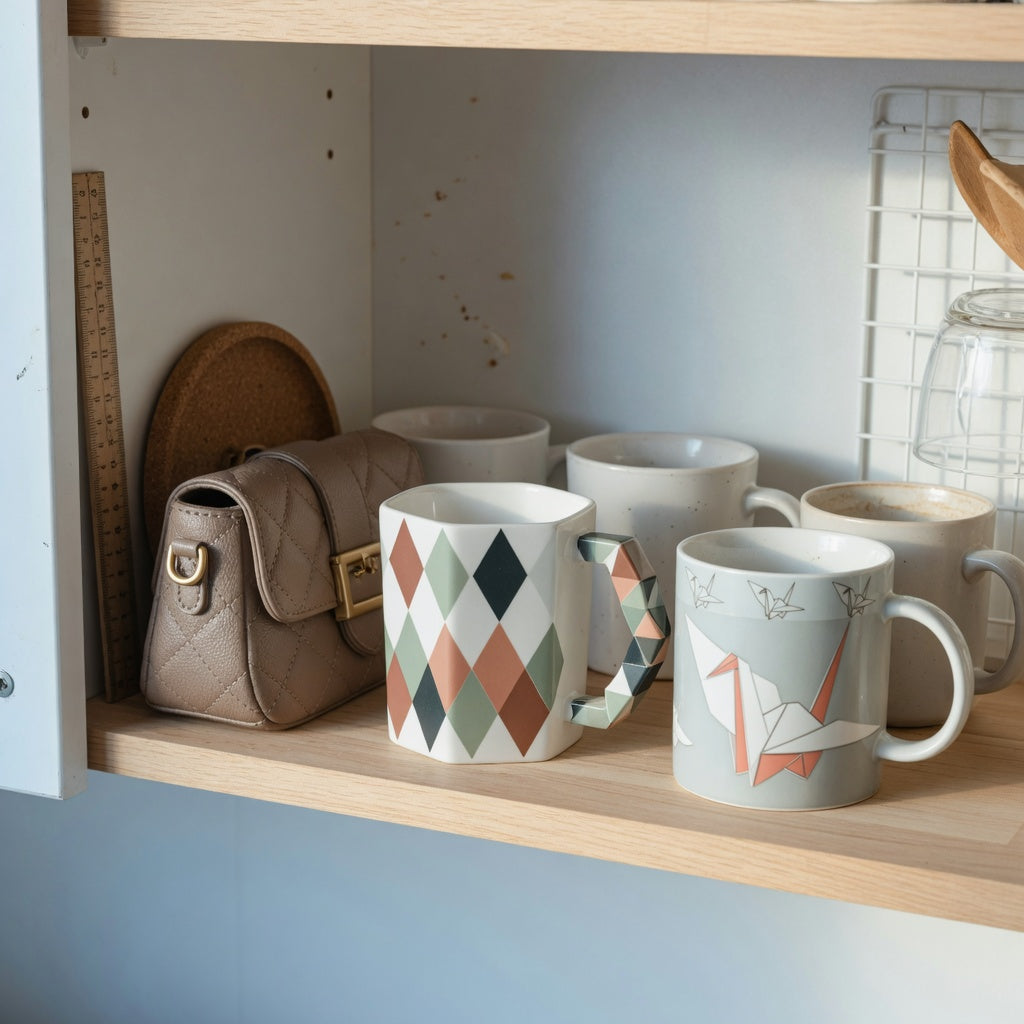
How do the Handbag, Rhombus, and Crane designs map to real routines?
These three products serve different style preferences. The table connects each visible design identity to a buyer situation, then points to the product detail that still needs verification before purchase.
| Reader situation | Why the design may fit | Product-page next step |
|---|---|---|
| You want a fashion-themed gift or a visible accent mug for an open shelf. | The Handbag Coffee Tea Mug has a clear theme, making it a logical statement piece rather than another neutral addition. | Confirm its listed material, capacity, full width, handle or decorative clearance, and care instructions. |
| You prefer geometric styling for an office desk or modern kitchen rotation. | The Rhombus Coffee Tea Mug is the direct match for a shopper choosing by geometric design language. | Compare the listed base and overall dimensions with your coaster, desk space, shelf, and drying area. |
| You are buying for someone who likes crane imagery or want a motif-led coffee or tea mug. | The Crane Coffee Tea Mug makes the motif central to the choice, which can suit a personal gift or quieter display setting. | Use the page images and description to check how the motif is applied, then verify dimensions and care guidance. |
If the theme matters more than choosing one of these three immediately, compare the wider unique coffee mugs collection. Keep your shelf measurements beside you so visual preference does not override practical fit.
What must the listing confirm about material, capacity, and care?
A product name establishes its design identity, but it does not establish every functional specification. We use five fields to separate confirmed information from assumptions:
| Field | What to verify | Why it affects the rotation |
|---|---|---|
| Material | Read the exact material stated on the page. Ceramic, glass, and metal should not be treated as equivalent. | Material affects weight, surface temperature, handling feel, and the care instructions you should expect. |
| Capacity | Look for ounces or milliliters rather than estimating from photographs. | Your usual coffee, tea, milk, foam, or ice must fit with enough headroom for carrying. |
| Dimensions | Prioritize overall height, widest width, and base diameter. | Those three measurements determine cabinet clearance, coaster fit, and the space left for neighboring mugs. |
| Care compatibility | Require explicit microwave-safe, dishwasher-safe, or hand-wash wording. | A daily mug that conflicts with your normal washing routine will quickly drop out of rotation. |
| Finish and detail | Check whether decoration appears printed, glazed, raised, or attached, then follow the listed care directions. | Detailed surfaces may require different handling, but appearance alone does not prove a durability or care claim. |
If a field central to your routine is missing, leave it marked as unknown. For example, unconfirmed dishwasher compatibility is a major limitation for a household that rarely hand-washes, while missing dimensions are a practical problem in a tightly fitted cabinet.
Will the mug work on an office desk, a crowded shelf, or as a gift?
- Office desk: Make sure the entire base fits on the coaster and that the handle clears the keyboard, monitor stand, and charging cables. For iced coffee, leave room for condensation on the coaster. A design mug is not a substitute for a sealed commuter tumbler unless the listing specifically supports that use.
- Crowded kitchen shelf: If dimensions are listed, make a quick paper footprint using the widest width and depth. Place it in the intended slot, close the cabinet door, and check the shelf above. Also look at where the mug will sit while drying.
- Gift unboxing: Match the design to the recipient, but also consider their preferred drink, available storage, and willingness to hand-wash. Someone who stacks every mug or uses only large servings may need a different style or capacity.
This scenario test is where many attractive mugs either earn a clear role or reveal that they are better suited to occasional use. Neither outcome is wrong. The mistake is buying a display-led design while expecting travel-mug utility.
What should you inspect before the first pour?
Unbox the mug over a clear counter and examine it before washing. In our experience handling this category, the highest-value inspection points are simple and easy to miss during an enthusiastic gift opening.
- Run a careful visual check around the rim for chips, rough spots, or sharp edges.
- Inspect both places where the handle meets the body for a visible hairline crack or separation.
- Set the empty mug on a dry, level counter and check for noticeable rocking at the base.
- Compare the finish and decorative details with the product page, noting any loose part, unexpected gap, or shipping damage.
Do not use a mug with a crack or sharp chip. Follow the product-page instructions before the first wash. If machine-wash compatibility is not stated, hand washing with mild dish soap and a non-abrasive sponge is the conservative choice rather than assuming it can handle repeated dishwasher cycles.
Which design earns the next open spot in your rotation?
- Choose the Handbag design when a fashion-led statement or themed gift is the priority and its verified dimensions fit the intended shelf.
- Choose the Rhombus design when geometric styling is the goal and its listed footprint works with the desk, coaster, or cabinet.
- Choose the Crane design when the motif suits the recipient or tea-and-coffee setting and the stated care requirements match the routine.
- Skip a statement design if the mug must fit a car cup holder, travel in a backpack, or stack tightly without the listing confirming those needs. A travel tumbler or conventional stackable mug is the more practical tool.
Frequently asked questions
How should I use the unique design coffee mugs everyday mug rotation practical purchase checklist?
Start by assigning the mug a weekly use frequency, then measure the intended storage space. Compare those measurements with the listed material, capacity, dimensions, and care instructions before choosing by design. Any missing specification should stay marked as unknown rather than being inferred from a photograph.
Which unique mug design is best for a small cabinet?
No Handbag, Rhombus, or Crane design can be declared the smallest from its name alone. Compare the listed overall height, widest width, and base diameter with your cabinet, including the shelf lip and space needed for the door to close. If dimensions are unavailable and the fit is tight, a simpler mug with confirmed measurements is the safer choice.
Can I put a unique design coffee mug in the dishwasher or microwave?
Only if the product page or care label explicitly says you can. Material alone does not confirm dishwasher or microwave compatibility, especially when decorative finishes or attached details may be present. If the care status is unclear, treat machine use as unconfirmed.
Are statement mugs practical for daily office coffee?
They can be if the capacity suits your drink, the base fits fully on a coaster, the handle clears nearby equipment, and the care routine works at the office. They are less suitable when you need a leak-resistant lid, car cup-holder fit, or something designed to travel in a bag.
What should I check before giving a unique mug as a gift?
Check the recipient's preferred drink size, storage space, care habits, and design taste. On arrival, inspect the rim, handle joins, base, finish, and packaging before wrapping it. A motif that feels personal is valuable only if the mug also fits the recipient's routine.
Take a ruler to the cabinet, record the available height, width, and depth, and decide how many weekly uses the new mug must earn. Then revisit the unique coffee mugs collection and buy only after the material, capacity, care instructions, and footprint match the rotation it will join.
More from our blog
Read more
Coffee Mug Gift Ideas for Him Everyday Mug Rotation Purchase Checklist
Use his real drink size, cabinet clearance, grip, washing habits, and design preferences to choose a gift mug that earns a place in his weekly rotation.
Read more
Large Decorative Coffee Mugs: Everyday Mug Rotation Purchase Checklist
Measure cabinet clearance, compare care instructions, assign each mug a daily role, and inspect it on arrival. This checklist separates product-page facts from details shoppers still need to confirm.
Read more
Leave a comment
This site is protected by hCaptcha and the hCaptcha Privacy Policy and Terms of Service apply.