
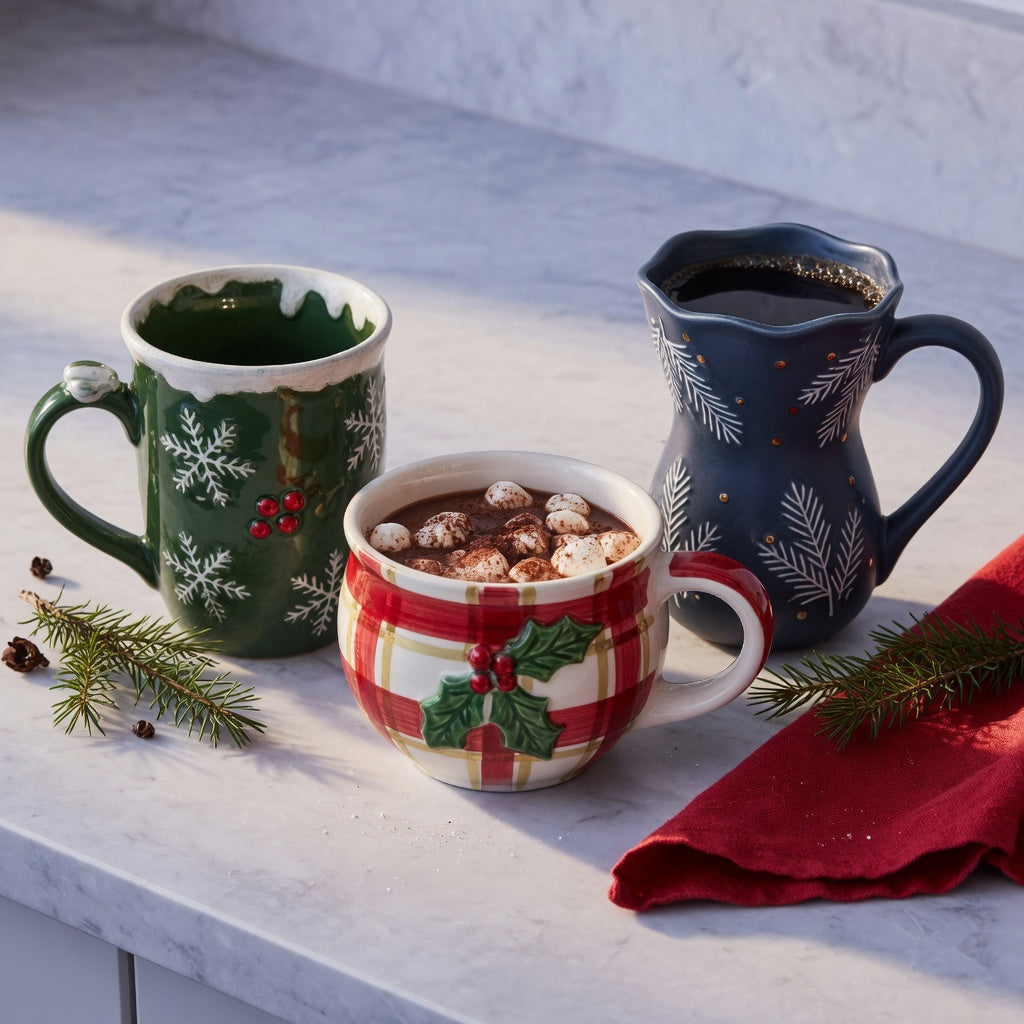
Unique Ceramic Christmas Coffee Mugs: A Practical Comparison
Reading time: about 10 minutes
A holiday mug can pass the photo test and fail at the first pour. The handle is too tight for two fingers, the rim feels rough, or whipped cream reaches the brim before a normal serving of cocoa is in the cup. We hear these concerns during seasonal comparisons in our store. The best unique ceramic Christmas coffee mugs earn their cabinet space as drinkware first, with the festive design added on top.
That means comparing more than the snowman, tree, or glaze color. Capacity, balance, food-contact information, decoration method, and care instructions decide whether a mug becomes a December favorite or stays in its box.
Why do unique ceramic Christmas coffee mugs feel different in hand?
Ceramic is a broad material label. A listing may refer to stoneware, porcelain, earthenware, or simply ceramic without identifying the clay body. Those terms do not automatically establish quality, but a specific material description gives you a better basis for comparing weight, finish, and care.
When we handle a ceramic mug, we inspect details that front-facing product photos often hide:
- Decoration placement: Ask whether the design is modeled into the form, protected beneath a clear glaze, or applied to the surface. A well-fired surface decoration can perform well, but it may require different care from relief work or underglaze imagery.
- Interior coverage: The drinking surface should look intentionally finished. If part of the interior is unglazed, the listing should explain that construction and its food-use care.
- Rim profile: A rounded rim usually feels forgiving during everyday use. A thin rim can feel precise, but it leaves less material to absorb a knock against the faucet.
- Foot ring: Turn the mug over in the product photos. A rough or uneven foot can scratch a desk, while an unstable base may rock once the mug is full.
- Handle joints: Look closely where the handle meets the body. Visible hairline cracks, gaps, or an abrupt narrow joint deserve clarification before purchase.
Glaze variation can make a mug visually distinctive, but variation alone does not prove that it is handmade. Likewise, a flat illustration is not automatically low quality. The useful question is how the decoration was applied and how the maker says to care for it.
For a shopper who wants an unmistakably seasonal cup for December coffee or tea, review the current photos and product details for the Christmas Coffee Tea Mug. Confirm the listed material, capacity, and care rather than relying on the product name alone. For a wider comparison of shapes and motifs, browse our unique coffee mug collection and compare the rim, base, and handle as carefully as the artwork.
Which capacity and handle suit coffee, cocoa, or an office desk?
Words such as large and oversized are not measurements. A tall tapered mug may hold less than a shorter mug with straighter walls. Before ordering, fill your current favorite cup to its normal drinking line, pour that water into a measuring jug, and use the result as your capacity reference.
- For drip coffee: Match the amount you actually pour, not the mug's brim capacity. Extra volume adds unnecessary weight if you prefer frequent refills.
- For hot cocoa: Allow about a finger's width of space below the rim for foam, marshmallows, or whipped cream.
- For an office desk: Favor a stable base and a handle that clears at least two fingers comfortably. Test the idea with a sweater cuff in mind, since narrow handles feel tighter in winter.
- For tea: A wide opening makes stirring and removing an infuser easier, but the larger exposed surface can let the drink cool sooner.
Wall thickness creates another trade-off. A substantial ceramic wall may feel reassuring and hold warmth well once heated, but it also makes a full mug heavier. Someone with limited grip strength may be happier with a lighter, balanced form and a roomy handle than with a dramatic sculptural cup.
What does food-safe mean for handmade and imported pottery?
A mug can look like drinkware without giving the buyer enough information about food use. Terms such as lead free, non-toxic, and food safe should not be treated as interchangeable marketing shortcuts. Ask what the claim covers and whether the seller can point to testing or a compliance statement.
The FDA pottery lead policy says regulatory action for cups and mugs may be considered if any one of six tested units exceeds 0.5 micrograms of extractable lead per milliliter of leaching solution under the specified laboratory method. That is a technical leach test, not something a buyer can confirm from color, country of origin, or a household swab.
Separate FDA guidance on imported traditional pottery notes that some pieces labeled lead free have still released extractable lead, with inadequate firing or cross-contamination identified as possible causes. This warning concerns some traditional pottery, not every imported ceramic mug.
Before using an unfamiliar handmade or imported piece for coffee, we recommend four checks:
- Confirm that the seller describes the mug as intended for food and beverage use.
- Ask what clay body and glaze are used, and whether lead or cadmium claims are supported by relevant testing.
- Read the base. A permanent statement that the piece is not for food use means it belongs on display, regardless of its cup-like shape.
- Avoid drinking from a piece with flaking decoration, an unknown craft coating on the interior, or a crack running through the body.
Food-contact suitability also does not establish microwave or dishwasher safety. Those are separate questions that should have separate answers.
Can the finish handle a microwave, dishwasher, and crowded cabinet?
Do not assume every ceramic mug belongs in every appliance. Metallic rims, luster decoration, and other metal-containing details should stay out of a microwave unless the manufacturer explicitly states otherwise. A color called gold is not proof that the finish contains metal, so use the listing's care instructions rather than guessing from a product name.
Dishwasher-safe and microwave-safe are also independent claims. A ceramic body may tolerate both while a surface decoration requires hand washing. Color-changing artwork, foil effects, and applied embellishments may have additional restrictions.
Our practical care routine for an unfamiliar holiday mug is simple:
- Read the care statement before the first use and check for separate microwave and dishwasher guidance.
- Hand-wash the first time with mild dish soap so you can inspect the rim, interior, and handle without dishwasher residue hiding a problem.
- Avoid a rapid temperature change, such as pouring boiling liquid into a mug that has just come in from a cold porch or garage.
- Do not force a relief-covered or irregular mug into a stack. Contact between projecting details and another ceramic rim creates obvious chip points.
- Recheck surface decoration and handle joints periodically. New cracks, flaking, or a loose handle are reasons to stop using the mug.
Fine crack lines limited to the glaze are commonly called crazing. They may collect visible coffee stains, and a new or worsening pattern is worth raising with the seller. Do not confuse deliberate crackle-glaze styling shown in a listing with an undisclosed crack through the mug body.
Handmade character, matching sets, or novelty form: which fits the recipient?
Handmade is a production description, not a guarantee of food safety, durability, or comfortable handling. Studio pottery may show small differences in rim shape, glaze flow, and handle placement. Those differences suit a collector who values individual pieces, but they are a poor match for someone expecting six identical place settings.
Country of origin should also be stated, not inferred from rustic styling, a seller's address, or a flag in a photograph. If local or USA production affects your decision, ask where the mug was formed, glazed, and fired. A design location and a manufacturing location are not necessarily the same.
We match the mug route to the recipient rather than declaring one style best for everyone:
- For a dedicated holiday-drinkware collector: The Christmas Coffee Tea Mug is the relevant place to check because the product itself is presented for the Christmas coffee-and-tea use case. Use the current listing to verify its exact specifications and care.
- For someone who wants a distinctive mug beyond December: Compare the current design and details of the Golden Waves Kio Coffee Tea Mug. Its product name is not limited to Christmas, making it a more logical listing to review for year-round gifting. Confirm whether its appearance and care suit the recipient.
- For a person who collects fashion-themed objects: Review the Handbag Coffee Tea Mug. A handbag motif can be a better personal match than a generic seasonal slogan, but it is not the sensible choice for someone who asked for a plain, stackable office cup.
- For an undecided shopper: Compare the current selection of unique coffee mugs by use case first, then choose the design. This keeps a striking shape from overshadowing practical needs.
A distinctive ceramic mug is not a strong gift for everyone. A commuter who needs a sealed lid, a household short on cabinet space, or a buyer building an exact matching set may be better served by a travel tumbler, a stackable mug, or coordinated dinnerware.
What should you inspect as soon as the box arrives?
We do not judge a mug only from the front. A quick counter inspection catches the problems most likely to matter during use or gifting:
- Compare the received color, shape, decoration, and included pieces with the current listing.
- Place the empty mug on a known flat counter and press lightly near different sides of the rim. A persistent rock may indicate an uneven base.
- Run a fingertip carefully around the drinking rim and foot. Check for sharp points, chips, or an abrasive base.
- Inspect the interior under bright light. A single tiny glaze pinhole may be cosmetic, but clusters, flaking, or exposed areas deserve clarification.
- Look at both handle attachments for cracks or separation. Then lift the empty mug by the handle to assess clearance and balance.
- Read the base markings and care information before washing or removing packaging needed for a return.
Expected glaze variation is different from damage. Compare variations with the listing description, but do not accept a sharp rim, a loose handle, or a structural crack as handmade character.
Frequently asked questions
Are unique ceramic Christmas coffee mugs usually microwave safe?
Some are, but ceramic material alone does not settle the question. The glaze, decal, metallic detail, or applied decoration can change the care requirement. Use the product's explicit microwave guidance, and keep any mug with unverified metal-containing accents out of the microwave.
How can I tell if a handmade Christmas mug is food-safe?
Confirm that the maker identifies it as intended for food and drink, then ask what supports any lead-free or food-safe claim. A permanent mark stating that the piece is not for food use overrides its mug-like appearance. Visual inspection cannot replace a laboratory leach test.
What capacity works best for a Christmas cocoa mug?
Measure the amount of cocoa you normally prepare and add headroom for toppings. A finger's width below the rim is a practical target for marshmallows or whipped cream. Use a stated fluid-ounce or milliliter capacity rather than judging from exterior height.
Can I put a gold-accent ceramic mug in the dishwasher?
Only follow the dishwasher if the maker's care instructions allow it. Metallic luster and other surface accents may require hand washing, while a gold-colored glaze may have different care. The appearance or color name does not identify the finish reliably.
Is a handmade holiday mug better than a mass-produced mug?
Neither method is automatically better. Handmade pottery offers individual variation, while production mugs are often the more logical route for matched sets and easier replacement. Food-use information, stable construction, comfortable handling, and clear care instructions matter in both cases.
Run this eight-point check before adding a mug to the cart
| Buyer check | What a useful listing should tell you |
|---|---|
| Material | The ceramic or clay-body description, not only a style label |
| Capacity | A numeric fluid-ounce or milliliter measurement |
| Food use | A clear statement that the mug is intended for beverages |
| Handle | Photos that show clearance, attachment points, and balance |
| Decoration | Enough detail to distinguish relief, glaze, decal, or special finish |
| Appliance care | Separate microwave and dishwasher guidance |
| Origin | A specific manufacturing statement if provenance matters to you |
| Storage | A shape that suits your shelf, cabinet, or display space |
Your next step: measure the capacity of the mug you already use, decide whether the gift needs to be overtly Christmas-themed or useful all year, and then compare CoffeifyMug's unique mug options against this checklist. A mug that cannot answer the practical questions does not become a better buy because the artwork is festive.
More from our blog
Read more
Ceramic Piccolo Cup: Compare Size, Heat, and Daily Care
A practical comparison of 3 to 4 oz piccolo sizing and CoffeifyMug's 170, 250, and 270 ml options. Learn how headspace, ceramic thickness, handles, glaze safety, and care affect daily use.
Read more
Ceramic Chai Mug: Compare Size, Comfort, Glaze, and Care
Choosing a ceramic chai mug is a capacity-and-comfort decision. Compare 400 ml, 440 ml, and 480 ml options, handleless versus handled forms, food-contact glaze, care, and the right fit for home, of...
Read more
Leave a comment
This site is protected by hCaptcha and the hCaptcha Privacy Policy and Terms of Service apply.