
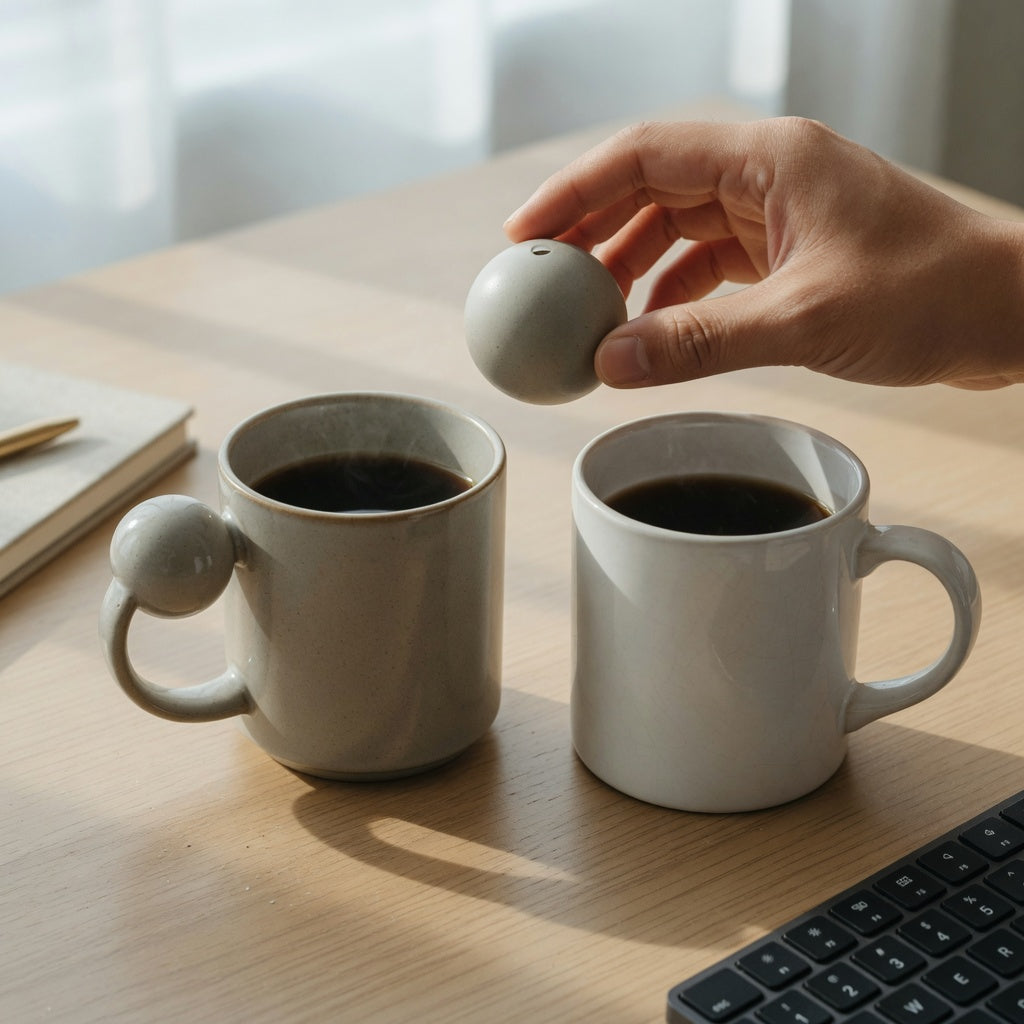
Unique Ball Handle Coffee Mug: Compare Grip, Size and Care
Reading time: about 10 minutes
On our product-review table, a ball-handle mug gets filled with room-temperature water before anyone discusses glaze color. Empty, the sphere feels playful. Filled, it answers the real buying question: can you control a unique ball handle coffee mug with a pinch grip, or do you immediately support the base with your other hand?
At CoffeifyMug, we treat the handle as functional geometry rather than decoration. Use the current Ball Handled Coffee Tea Mug listing to confirm any stated material, capacity, dimensions, variants, and care directions. If the sphere is not the only shape you are considering, compare it with our collection of unique coffee mugs before deciding.
We have not found standardized independent grip, heat-transfer, or long-term durability testing that establishes ball handles as universally more ergonomic than loops. That makes your normal serving size, carrying habit, and cleaning routine more useful than a broad comfort claim.
What changes when the handle is a ball instead of a loop?
A standard loop provides an opening for one or more fingers. A true ball handle provides a solid rounded grip point, so the thumb and fingertips pinch or cup the sphere. Some mugs place a decorative bead on an otherwise open loop; that hybrid still handles more like a conventional mug.
- Grip path: A loop supports the mug through hooked fingers. A sphere places more of the control between the thumb and fingertips.
- Finger clearance: With no tunnel to separate your hand from the vessel, your fingertips may sit closer to the cup wall. The side profile should show that spacing clearly.
- Attachment position: The height of the sphere and its connecting shank affects where you apply lifting force. Compare its position with the cup rim and base rather than viewing the handle alone.
- Handle projection: A prominent sphere may occupy extra room beside a keyboard, in a cupboard, or on a drying rack. Exact dimensions are more reliable than an angled product photo.
If you routinely hook two fingers through a handle while carrying coffee from the kitchen to another room, a loop will probably suit that habit better. A ball is easier to accept when the mug remains on a table or desk and you set it down between sips.
How should a unique ball handle coffee mug feel when full?
The useful test is not how the empty mug feels for five seconds. Beverage volume adds load, while the location of the ball changes leverage. A short serving used at a breakfast table can be manageable in a pinch grip even if the same handle would feel demanding with a larger, longer-held drink.
- Measure your normal pour. Fill your current mug as usual, then transfer that amount to a kitchen measuring cup. Compare the result with the capacity stated on the listing.
- Distinguish brim capacity from a comfortable fill. If the listing does not explain how capacity was measured, allow for the headroom you normally leave to prevent spills.
- Try a rough pinch-grip proxy. Over a counter, fill your existing mug with room-temperature water and pinch the outer curve of its handle instead of threading fingers through. Keep your other hand underneath. It will not duplicate a sphere, but it reveals whether that hand position feels natural.
- Study the side view. Note whether the ball sits near the upper, middle, or lower part of the vessel and whether your fingers appear likely to contact the body.
- Picture the whole routine. Include the walk to your desk, the space beside your mouse, the cupboard shelf, and the washing method—not only the first sip.
Needing a second hand under the base is not automatically a flaw. It is only a mismatch if you expected effortless one-handed carrying. Buyers who enjoy a two-handed, stationary coffee ritual may find that support completely natural.
Ceramic, glass, or rotating ball: which build fits your routine?
Ball-handle listings can describe fixed ceramic or glass grips as well as rotating or fidget-style mechanisms. These constructions should not be treated as interchangeable.
| Handle construction | Reader situation | Details to verify | Main trade-off |
|---|---|---|---|
| Fixed ceramic ball | Desk or table use with a sculptural ceramic finish | Glaze coverage, sphere-to-shank transition, shank-to-body join, capacity, and care | Distinctive solid grip without a finger opening |
| Fixed glass ball | A shopper who wants the beverage visible through the vessel | Exact glass description, hot-drink guidance, attachment construction, and appliance directions | Transparency does not prove heat resistance or microwave safety |
| Rotating or fidget ball | Stationary novelty or tactile desk use | Mechanism, component materials, cleaning access, and whether movement is intentional | Extra seams or moving parts require more care; durability is uncertain unless documented |
| Standard loop | Frequent one-handed carrying or a preferred full-finger grip | Opening height, opening width, wall clearance, and attachment joins | More familiar handling but less of the sculptural ball-handle look |
Do not use the material name as a shortcut for care or heat performance. The specific listing must provide those answers. Shoppers narrowing the choice to ceramic can also read our guide on how to choose a ball handle ceramic coffee mug for a closer look at grip and construction terminology.
Which measurements and photos expose a poor fit before checkout?
Front-facing photos sell the shape, but side and underside views answer more practical questions. Perspective can make the sphere appear larger or closer to the cup than it really is, so prioritize stated measurements whenever they are available.
- Capacity wording: Check how much the mug holds and whether the figure represents a brim fill or a practical serving.
- Body height and rim diameter: These affect cupboard clearance, drinking feel, and compatibility with a saucer you already own.
- Ball diameter and outward projection: These indicate how much contact area the grip offers and how much desk or shelf space it needs.
- Handle clearance: A clear side view should help you judge whether your fingertips will press against the vessel.
- Empty weight: If stated, add it to the weight of your usual drink mentally rather than assessing the empty cup alone.
- Join close-ups: Look for an uninterrupted transition at the ball, shank, and mug body rather than relying only on a distant lifestyle photo.
Office shoppers should compare the full handle projection with the gap beside a keyboard or monitor stand. Kitchen shoppers should check cupboard and drying-rack space. If measurements or care details are absent, treat the fit as uncertain rather than filling in the gaps from appearance.
Dishwasher, microwave, and glaze checks for sculpted handles
Ceramic construction alone does not establish dishwasher or microwave compatibility. Follow the directions on the exact product page, particularly if the design includes decoration, mixed materials, or a moving part.
Dishwasher care around the ball and shank
Use a dishwasher only when the listing permits it. Position the mug so the sphere is not wedged against a rack tine or another cup. If the handle creates a recessed underside, check for standing water after the cycle; for hand-washing, use a non-abrasive sponge and a soft, narrow brush around the join, then let that area drain fully.
Microwave directions for fixed and moving handles
A fixed ceramic appearance is not enough to confirm microwave use. Metallic decoration, mixed-material parts, or a rotating assembly require explicit guidance from the seller. If the construction or care wording is unclear, skipping the microwave is the conservative choice.
Glaze and food-contact surfaces
Inspect the interior and drinking rim for chips, cracks, rough patches, or incomplete-looking coverage before use. The FDA guidance on lead-glazed traditional pottery explains that lead may be present in glazes or decorations on some traditional pottery and can leach into food or drink if the pottery is not manufactured properly. That is a general category warning, not a claim about the product linked here; rely on current product information for its food-contact details.
Who gets daily value from a ball handle—and who should skip it?
We like this shape for the right routine, but we also recommend a conventional handle when the sphere conflicts with how someone actually drinks.
- Stationary desk or breakfast-table drinker: A ball can fit if you like a tactile pinch grip and the stated capacity matches your serving. Review the photos, description, and care wording on the current ball-handled mug product page.
- Style-focused gift recipient: The sculpted handle gives the gift an obvious visual feature. It is a better match for someone who enjoys unusual drinkware than for a person who specifically asked for a large, familiar loop.
- Frequent one-handed carrier: If you walk with a full mug or rely on fingers hooked through the opening, compare other unique coffee mug shapes and prioritize a loop with adequate clearance.
- Commuter or car user: Choose a purpose-built travel mug if you need a sealed lid, splash control, or cup-holder compatibility. A decorative ball grip does not replace those features.
- Buyer seeking a fidget mechanism: Select only a listing that explicitly describes the ball as rotating or movable. Do not force a fixed ceramic sphere or infer movement from a photo.
A two-handed hold can suit a slow coffee at home, while the same mug may be frustrating during a busy morning. The shape is not good for every buyer, and a standard loop remains the more practical choice for anyone who dislikes sustained thumb-and-fingertip pressure.
What should you inspect during unboxing and the first pour?
Our team checks the sculpted handle first because it is both the focal point and a load-bearing area. Use bright, angled light and inspect the mug before adding a hot drink.
- Look at the sphere, connecting shank, rim, and interior for chips, visible hairlines, or rough areas.
- Set the empty mug on a dry, flat counter and check whether the base sits steadily without rocking.
- Compare the physical shape and any included care information with the current listing.
- Wash the mug exactly as directed, paying attention to the underside of the ball and the attachment join.
- Make the first balance check with room-temperature water at your normal serving level, over a counter, before using a hot beverage.
If you find a crack, sharp chip, or damaged food-contact surface, stop before use and contact the seller according to the applicable policy. A cosmetic variation and a structural defect are not the same; the ball-to-body connection deserves particular scrutiny.
Frequently asked questions
What makes a unique ball handle coffee mug different from a standard mug?
A standard mug has an opening that lets fingers hook through the handle. A true ball handle uses a solid sphere as the primary grip, encouraging a pinch or cupped hold. A mug with a bead attached to an open loop is a hybrid rather than the same design.
What is the little ball on a ceramic mug handle for?
On a fixed ball-handle mug, the sphere is the grip and may also serve as a visual feature. On a rotating design, it may provide intentional tactile movement. Check the listing before turning it, and never force a ball that is not described as movable.
Can I put a ceramic ball handle mug in the dishwasher or microwave?
Only if the specific product instructions permit those uses. Ceramic by itself does not confirm appliance safety, especially if the mug has decoration or a moving assembly. If the care wording is silent, hand-washing and avoiding the microwave are the cautious choices.
Is a ball handle comfortable with a full cup of coffee?
It can be comfortable for a stationary drinker who likes a thumb-and-fingertip grip, but there is no universal answer. A larger serving creates more load, so buyers who prefer prolonged one-handed carrying may be happier with a loop. Compare the listed capacity, empty weight if provided, and side-view handle position.
Is a ball handle mug a good gift?
It suits someone who enjoys sculptural or unusual drinkware and usually drinks at a desk or table. It is a weaker choice for a commuter or anyone who asked for a large full-finger handle. Include the care information with the gift so the recipient does not have to guess about cleaning or microwave use.
Your next step is to write down three things: your usual pour, your preferred one- or two-handed hold, and the most care you are willing to give the mug. If all three match the current ball-handled mug listing, review its photos and details before checkout; if one does not, compare other unique coffee mugs instead of buying the sphere on looks alone.
More from our blog
Read more
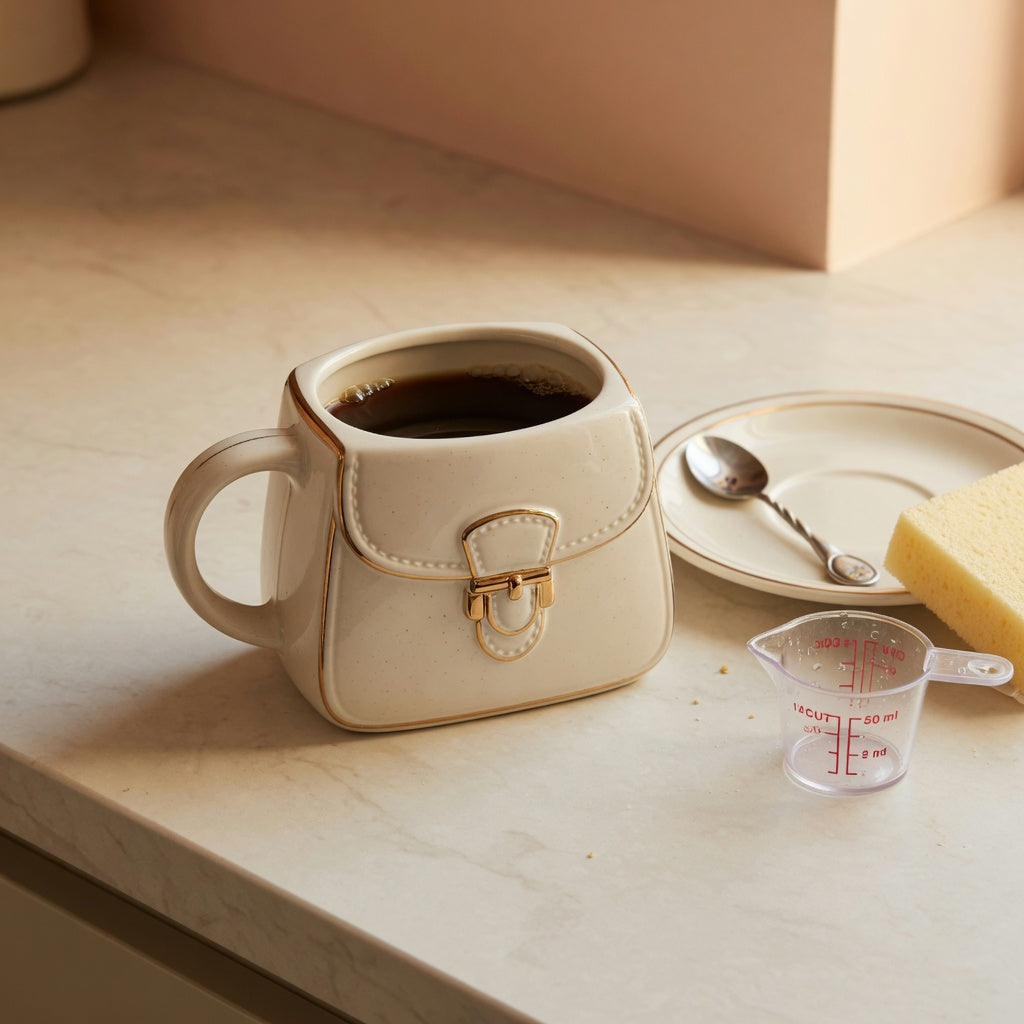
Ceramic Handbag Mug: Compare Size, Trim, Care, and Fit
Compare usable capacity, handle comfort, metallic-trim care, glaze and hot-drink checks, shipping protection, and gift fit before buying. We also flag who should choose a simpler everyday mug instead.
Read more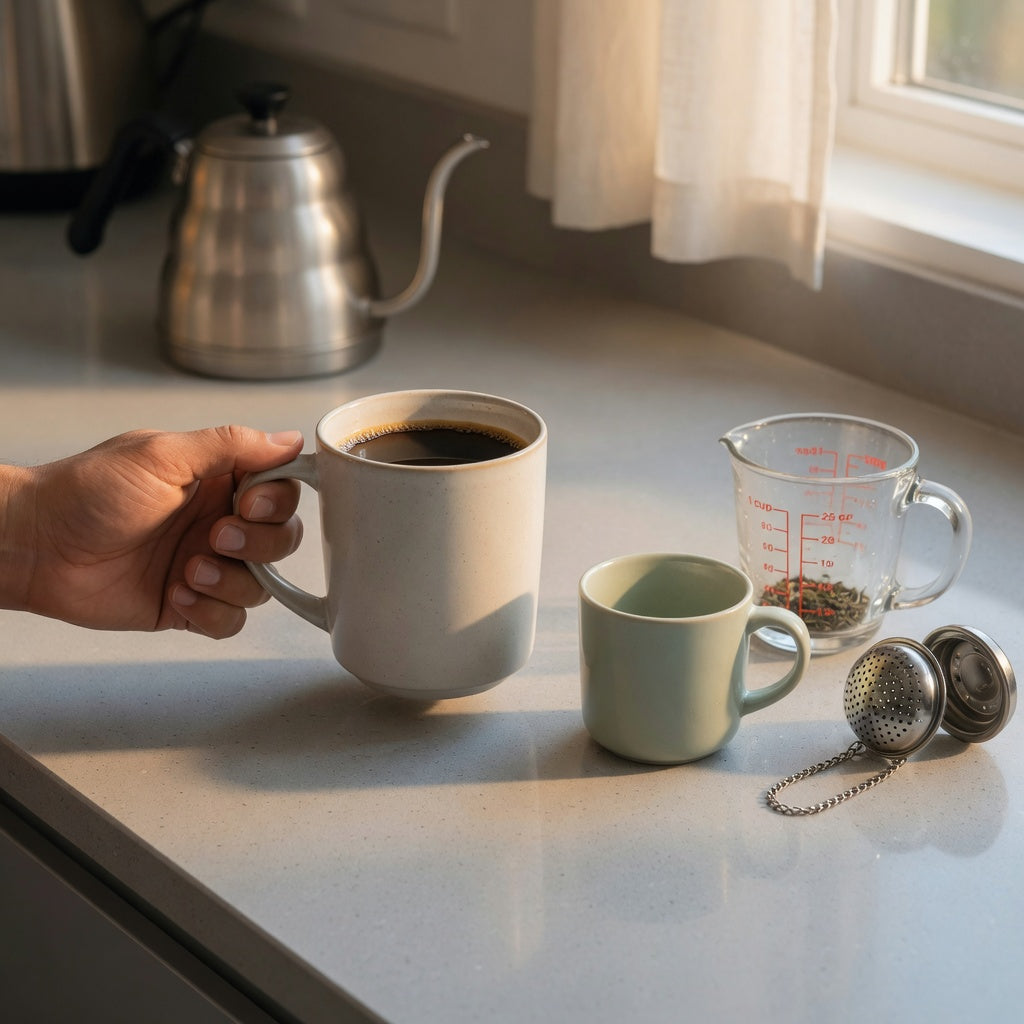
Large Ceramic Mug for Coffee and Tea: 7 Checks Before Buying
Compare usable capacity, full-mug weight, handle clearance, shape, heat loss, glaze safety, and care. We also explain when a smaller mug or insulated tumbler is the better buy.
Read more
Leave a comment
This site is protected by hCaptcha and the hCaptcha Privacy Policy and Terms of Service apply.