
Two Tone Ceramic Coffee Mugs First Time Buyer Product Shortlist Guide
Reading time: about 9 minutes
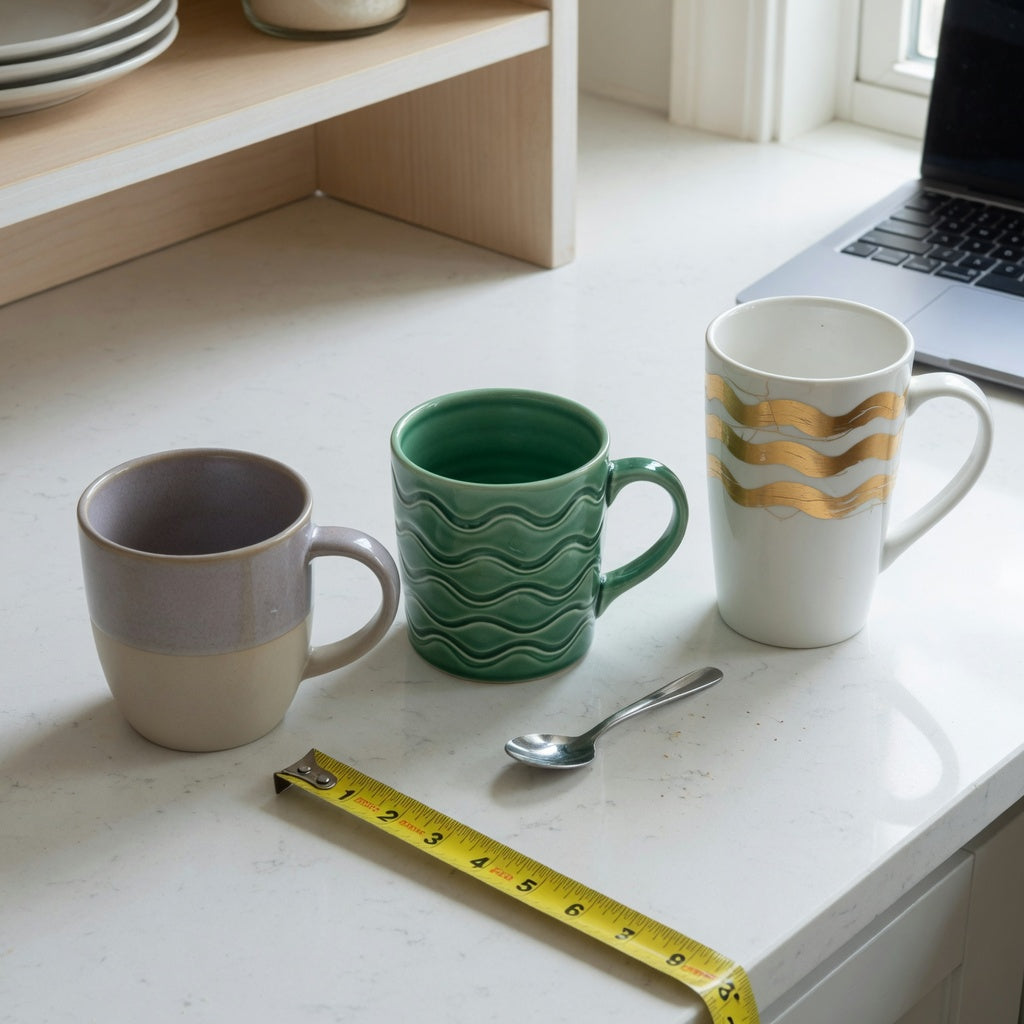
Three mug tabs are open on a phone beside a crowded kitchen cabinet: a gradient design, green waves, and a tall white-and-golden option. The finish is easy to compare. Daily fit is not. Our two tone ceramic coffee mugs first time buyer product shortlist guide separates facts shown on a listing from assumptions about capacity, grip, care, and storage.
In our store, shoppers often settle on a color before asking the questions that determine whether a mug will actually earn a place on the desk or kitchen counter. Our team uses the same practical checks while handling ceramic for photography and packing: inspect the rim, look closely at both handle joins, check the foot ring, and view the glaze under side light. Those checks do not fill gaps in a product listing. If a page does not state a measurement or care instruction, we treat it as unknown.
Your two tone ceramic coffee mugs first time buyer product shortlist guide: what earns a place?
A mug should make the shortlist only after it passes the requirements that matter to your routine. Start with the listing text rather than estimating from a styled photo.
- Stated capacity: Look for ounces or milliliters. A tall mug is not automatically a higher-capacity mug, and exterior height does not tell you how much room remains after adding milk, foam, or ice.
- External dimensions: Overall height, rim diameter, widest body diameter, and base diameter affect cabinet clearance, dishwasher-rack fit, and how much desk space the mug uses.
- Handle opening and projection: Interior handle height and width determine whether your preferred one-, two-, or three-finger grip is comfortable. Handle projection also matters on a narrow shelf or beside a laptop.
- Empty weight: Ceramic can feel substantial before a drink is added. If the listing does not state weight, do not assume a tall or wide-looking mug will be comfortable for someone with limited grip strength.
- Finish description: Confirm whether a gradient or wave is flat decoration, a change in glaze color, or a raised surface. The design name alone may not answer that question.
- Care instructions: Look for explicit dishwasher and microwave guidance. Never infer appliance compatibility from the word ceramic or from the appearance of a golden-colored detail.
- Current photos and policies: Review close views of the rim, interior, handle joins, and base. Read the current return terms before using or washing a gift purchase.
For a useful size reference, measure a mug you already enjoy. Record its height, base diameter, and handle projection. To estimate your preferred capacity, fill that mug with water to your normal coffee or tea level and transfer the water to a marked measuring cup. This gives you a real benchmark instead of an abstract number.
Which of the three finishes fits your desk, kitchen, or gift plan?
The product names and visible page presentation support three style-level distinctions: gradient coloring, green waves, and white-and-golden waves with a tall profile. Those names do not prove capacity, weight, finish texture, metallic content, or appliance compatibility. Confirm those details on the relevant page before ordering.
| Option | Reader situation | Reason to choose | Reason to skip or pause |
|---|---|---|---|
| The Gradient Coffee Tea Mug | A desk or neutral kitchen where you prefer a color transition to a repeated motif. | The product name identifies a gradient treatment, making it the clearest starting point for someone who wants the two-tone effect without a named wave pattern. | Skip it if you want sharply defined graphics. Pause if the listing does not confirm the capacity, dimensions, weight, or care instructions your routine requires. |
| Green Waves Coffee Tea Mug | A kitchen with green dishware, plants, or other established green accents. | The green wave description gives you a specific color and motif to coordinate with items you already own. | Skip it for a strictly monochrome mug set or a gift recipient whose color preferences are unknown. Verify whether the waves are flat or textured if surface feel matters. |
| White Golden Waves Tall Coffee Tea Mug | A shopper who wants a visibly taller silhouette and has measured vertical storage space. | The title explicitly identifies a tall profile plus white and golden wave styling. It is the most direct candidate of the three when height is part of the visual brief. | Skip it if your shelf or dishwasher rack has limited height. Do not assume that tall means higher capacity or that golden describes a microwave-safe finish. |
Do not force a winner if every option leaves a critical requirement unconfirmed. A shopper who needs a different profile, finish, or level of listing detail should compare the broader unique coffee mug collection and apply the same filters.
What should you inspect around the glaze, rim, handle, and base?
Good product photos should let you examine more than the front-facing design. These are the ceramic condition points we pay attention to when a mug is handled, packed, or checked after delivery:
- Rim: Look for chips, rough areas, or an interrupted glaze line where your lips will touch the mug.
- Handle joins: Inspect the upper and lower attachment points for a hairline crack that is separate from the intended decoration.
- Glaze surface: Pinholing appears as small pits. Glaze crawling leaves an unintended bare patch. Crazing appears as a fine network of lines in the glaze and should not be confused with an intentional crackle finish disclosed by the seller.
- Interior: The food-contact surface should appear continuous and free of visible chips or unexplained bare spots.
- Foot ring: An unglazed foot can be normal, but it should look even. After delivery, place the empty mug on a flat counter and check for obvious rocking.
A crisp boundary between two colors is not automatically a defect, and a blended gradient is not evidence of uneven firing by itself. The intended finish should be described or shown consistently. If close photos are unavailable, keep glaze condition in the unknown column rather than assuming either perfect quality or a problem.
How do dishwasher, microwave, and cabinet limits affect the choice?
Care and storage can eliminate an attractive mug quickly. Run each finalist through these real-use checks before letting color make the final decision.
- Dishwasher cycles: Use a dishwasher only when the product page explicitly allows it. Check that the mug can sit without its rim or handle knocking against another item, especially if the profile is tall.
- Microwave use: Look for a direct microwave statement. The word golden in a product title does not establish whether the effect contains metal, and it does not establish microwave compatibility.
- Temperature changes: General ceramic care favors gradual temperature changes. Avoid taking a very cold mug directly into high heat unless the product instructions specifically permit that use.
- Cabinet clearance: Measure from the shelf surface to the underside of the shelf above it. Include the handle if mugs are stored sideways or closely spaced.
- Office placement: Compare base diameter and handle projection with the clear area beside your keyboard, notebook, or monitor stand. A mug that fits the cabinet may still crowd a compact desk.
- Iced coffee and tea: Confirm usable capacity rather than relying on exterior height. Ice occupies volume, and a drink that fits without ice may sit too close to the rim once cubes and milk are added.
For gifts, care uncertainty matters even more. A recipient may use a dishwasher or microwave by habit. If the listing does not provide clear instructions, either ask before purchasing or choose a simpler finish with documented care guidance.
When is ceramic the wrong material for the job?
Two-tone ceramic makes sense for a home counter, tea tray, or office desk where the mug can be handled with ordinary care. It is not the strongest choice for every routine.
- Daily commuting: Choose a lidded insulated travel mug if the drink will ride in a work bag or vehicle cup holder.
- Outdoor and high-impact use: A durable non-ceramic mug is more practical around concrete patios, workshops, or settings where drops are likely.
- Very limited storage: Look for a measured, stackable set if mugs must fit a precise shelf footprint.
- Limited hand strength: Choose an option with a stated empty weight and handle dimensions instead of estimating comfort from photos.
- Visible drink layers: Clear glass may suit someone who wants to see tea color or layered coffee rather than make the exterior finish the visual focus.
Changing material or profile is not settling for less. It is the correct decision when durability, a lid, low weight, or exact stacking matters more than the two-tone ceramic finish.
Can you reduce the shortlist in five minutes?
The useful part of a two tone ceramic coffee mugs first time buyer product shortlist guide is the discipline to leave an unknown blank. Do not turn a product title or photo into an unsupported specification.
- Open the three product pages side by side and write down only confirmed capacity, dimensions, weight, finish description, and care instructions.
- Measure your current favorite mug and the intended shelf, dishwasher rack, or desk space.
- Remove any option that fails a non-negotiable requirement such as height, microwave compatibility, or handle fit.
- Match the remaining designs to the scenario: gradient for a color transition, green waves for a defined green motif, or the tall white-and-golden design when a taller silhouette is wanted.
- For an untested shape, consider starting with one mug rather than committing to a full coordinated set before checking the grip and storage fit.
- If none of the three survives the filter, return to the collection and compare other profiles instead of relaxing a requirement that affects daily use.
Frequently asked questions
What should a two tone ceramic coffee mugs first time buyer product shortlist guide verify?
Verify capacity, overall dimensions, empty weight, handle opening, finish description, and care instructions. Then compare those facts with a mug and storage space you already use. Any unstated detail should remain an unknown until the seller confirms it.
Does a tall ceramic coffee mug always hold more coffee?
No. A tall exterior can have a narrow body, thick walls, or a raised interior base, so height alone does not establish capacity. Use the stated ounces or milliliters to judge room for coffee, tea, milk, foam, or ice.
Can a white and golden waves mug go in a dishwasher or microwave?
Only follow dishwasher or microwave use that the product page explicitly confirms. Golden may describe color rather than material, but the name alone cannot tell you whether the finish contains a metallic component or needs special care.
Should a first-time buyer order one ceramic mug or a matching set?
One mug is the lower-risk starting point when handle comfort, weight, dimensions, or care are still unfamiliar. A set can make sense when those specifications are confirmed and matching tableware is the main goal.
What should I inspect when a ceramic mug arrives?
Check the rim, interior glaze, both handle joins, and foot ring before washing or using it. Place it on a flat counter to check for obvious rocking, and look under side light for chips, hairline cracks, pinholes, or unintended bare glaze patches.
Before checkout, keep only the options with confirmed answers for your drink size, storage space, grip, and care routine. Compare the three linked product pages first; if none meets all four requirements, use the CoffeifyMug unique coffee mugs collection to find a better-matched profile.
More from our blog
Read more

Unique Coffee Mugs for Gifts: First-Time Buyer Practical Checklist
Compare CoffeifyMug's Handbag, Rhombus, and Crane designs against the recipient's drink size, cabinet or desk space, grip, cleanup routine, and gifting expectations. Missing listing details stay ma...
Read more
Peppermint Tea Mug First Time Buyer Product Shortlist Guide
Compare The Flow 400 ml, Morning and Night 440 ml, and The Rock 480 ml by capacity and handle-comfort evidence. See what to verify, what remains unknown, and when to skip each option.
Read more
Leave a comment
This site is protected by hCaptcha and the hCaptcha Privacy Policy and Terms of Service apply.