
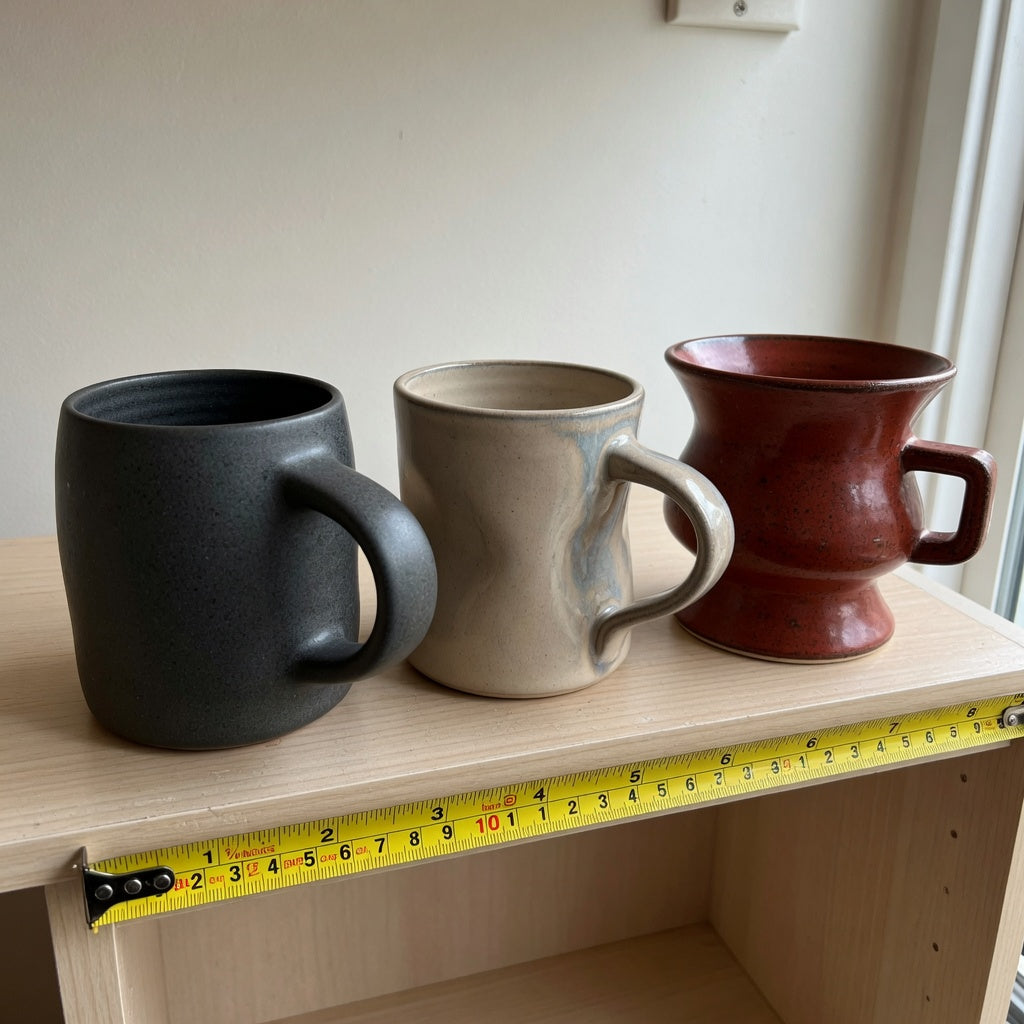
Thick Ceramic Coffee Mugs Storage Fit Guide: Shelf Needs
Reading time: about 9 minutes
A mug can clear the shelf opening and still prevent the cabinet door from closing. The handle, not the body, is often the frontmost point. We see this issue while handling and packing substantial ceramic pieces, especially when a shopper has measured height but not the mug's full outline. This thick ceramic coffee mugs storage fit guide focuses on that practical gap.
Below, we compare the visible forms of three current CoffeifyMug designs and explain how to check your own cabinet, open shelf, office hutch, or coffee station. We do not estimate measurements from photographs. If a live product page lists dimensions, use those figures as the source of truth; if it does not, contact our store before ordering for a tight space.
Use the thick ceramic coffee mugs storage fit guide to measure five variables
A single height measurement cannot tell you if a mug will fit. At our packing bench, we look at the whole silhouette: the base, the widest part of the body, the rim, and the outer edge of the handle. Those points affect different parts of a cabinet.
- Usable shelf depth: Measure from the back wall to the inside plane of the closed door, not merely to the front edge of the cabinet frame. A shelf lip, hinge, or door insert can reduce the usable space.
- Vertical clearance: Measure from the shelf surface to the shelf or cabinet structure above it. Include any raised lip beneath an adjustable shelf.
- Body footprint: Check the mug at its widest point rather than measuring only the base. A flared rim or pronounced shoulder may be wider than the foot.
- Full handle span: Measure from the side of the body opposite the handle to the handle's outermost edge. This is more useful than measuring handle projection alone when planning side-by-side storage.
- Grab space: Leave enough room to put fingers around the handle without dragging the next mug forward. A row may technically fit while still being frustrating to use every morning.
If dimensions are available on the listing, draw a top-view rectangle on paper or mark it with removable tape on the shelf. This simple mock-up reveals conflicts with hinges and doors that are easy to miss on a product screen.
How do The Rock, The Flow, and Spittoon use shelf space differently?
The current designs have visibly different outlines. Product photography can help you compare proportions, but it cannot establish exact scale because camera distance and angle vary. Our comparison therefore separates visible form from the dimensions that must be confirmed on each live listing.
| Current design | Visible form to compare | Storage situation to test | Trade-off to remember |
|---|---|---|---|
| The Rock Coffee Tea Mug | The listing images present an upright, substantial-looking body with a conventional side handle. | Start here if your cabinet bay suits a more vertical mug silhouette and you want a straightforward reference point. | An upright body does not guarantee the smallest total footprint. The handle can still determine cabinet depth and side spacing. |
| The Flow Coffee Tea Mug | The visible outline uses softer, more continuous curves through the body and handle. | Consider it for an open shelf, coffee station, or office desk where a flowing outline suits the surrounding objects. | A curved profile may look less bulky, but appearance alone does not prove that it occupies less shelf space. |
| Spittoon Coffee Tea Mug | The product images show a lower, broader, spittoon-inspired silhouette with a more pronounced shoulder. | Shortlist it for an open display or a shelf with generous side room, subject to the current listed dimensions. | The broader-looking lower form deserves extra attention in a narrow cabinet or a tightly packed row. |
These are visual comparison points, not substitute measurements. If none of the three forms clearly suits your available space, open the unique coffee mugs collection and compare each listing against the same five variables. Using one method across the collection produces a more useful comparison than choosing from a single front-facing image.
Which shape suits a shallow cabinet or crowded office shelf?
For a shallow closed cabinet, start with depth and door clearance. Place the mug with its handle facing left or right rather than toward the door. This often reduces front-to-back demand, although a broad body can still reach the door plane. The Rock provides a more conventional upright visual reference, while The Flow's curves should be checked at their widest point.
For a narrow cabinet where several mugs must sit side by side, body width and handle orientation work together. Alternating handles left and right may save usable row space, but it can make the middle mugs harder to grab. The Spittoon's visibly broader lower profile warrants a careful width check before it becomes part of a tightly matched set.
A low shelf creates a different problem. The Spittoon may appear shorter in photographs, but perspective can be misleading, so confirm any listed height instead of relying on the image. The same rule applies to The Rock and The Flow.
On an office desk or hutch, access often matters more than maximum storage density. Leave the handle exposed enough to pick up the mug without moving a monitor stand, notebook, or neighboring cup. For a shared office shelf, also consider whether different handle directions will be convenient for both left-handed and right-handed users.
How much handle and door clearance is enough?
There is no honest universal clearance number. Cabinet hinges, shelf lips, door panels, and the size of the user's hand all change the answer. A practical fit means the door closes without touching the mug and the mug can be removed without scraping another ceramic surface.
We use a current mug as a physical reference when helping shoppers think through a tight setup:
- Place your existing mug where the new one will live.
- Turn its handle toward the door, then left and right, and close the door slowly in each position.
- Measure the remaining space at the closest point.
- Compare the existing mug's full body-and-handle span with any dimensions shown on the candidate product page.
- Check the removal path, not just the resting position. A mug may fit on the shelf but catch the shelf above when tilted forward.
This check is especially useful before buying a gift. A substantial ceramic mug can make a strong impression during unboxing, but the recipient still needs a practical place to keep it. For a compact kitchen or dorm cabinet, one distinctive mug may be a better gift than a larger matching group.
Can thick ceramic mugs be stacked or stored rim down?
Stackability is a designed feature, not an automatic property of ceramic. Unless a product listing specifically states or demonstrates that a mug is stackable, plan to give it an individual footprint. We would not infer secure nesting from a front-facing photograph.
If you test two ceramic mugs together, the lower mug should support the upper mug without rocking. The upper base should not grind against a finished rim, and the handles should not act as levers that pull the stack off center. Repeated ceramic-on-ceramic contact can mark a finish or chip an exposed edge, so a wobbly stack is not worth the saved shelf space.
Storing a mug rim down keeps dust out, but the rim then carries the load and may contact grit on the shelf. Use a clean, dry surface and avoid sliding the mug. If you store mugs upright, allow them to dry fully before placing them in an enclosed cabinet.
Dishwasher fit is also separate from dishwasher-safe status. Follow the care wording on the live product page rather than assuming a care method. A thick or sculptural mug may occupy more rack space even if its care instructions permit dishwasher use, and its handle should not knock against adjacent ceramic during a cycle.
Which current mug should you shortlist for your storage setup?
- Regular closed cabinet with a conventional mug slot: Review The Rock's current listing. Its upright visual form makes it a logical starting point, but confirm the full handle span and usable cabinet depth.
- Open shelf or desk where the outline stays visible: Compare The Flow's curved profile. It suits a shopper prioritizing a softer visual shape, provided the widest body and handle points fit the available area.
- Open display with more side room: Inspect the Spittoon mug photographs and listing details. Its broader-looking, lower silhouette can make sense as a single statement piece, but it is the form to scrutinize most closely in a narrow row.
- Mixed household needs or a gift recipient with unknown storage: Compare the full selection of unique coffee mug shapes rather than forcing one of these three into an uncertain space.
The key is to match the reader's situation to the design, not to declare one shape universally better. A mug that works well alone on an open shelf may be inconvenient in a six-mug cabinet row. A form that looks compact from the front may project farther once its handle faces the door.
When is thick ceramic the wrong storage choice?
Thick ceramic is not the strongest match if every mug must nest in one narrow vertical stack, if you regularly lift drinkware from a high shelf and want the lowest possible weight, or if the cabinet is designed around slim cups. A purpose-built stackable mug or a thinner, lighter cup will usually suit those constraints better.
These designs are also not substitutes for sealed travel drinkware. If the mug must fit a vehicle cup holder, travel in a bag, or use a locking lid, choose a product designed for that job. A sculptural ceramic mug makes more sense on a stable kitchen counter, dining table, or office desk.
For a very tight cabinet, buying a single statement mug can be more practical than ordering a full matching row. In our experience, storage satisfaction depends as much on retrieval and daily handling as it does on fitting the pieces onto the shelf once.
Frequently asked questions
What should a thick ceramic coffee mugs storage fit guide tell me before I buy?
It should tell you to compare usable shelf depth, vertical clearance, the widest body point, full handle span, and removal space. It should also distinguish visible shape observations from verified dimensions shown on the live product listing.
Which needs the most shelf space: The Rock, The Flow, or Spittoon?
The Spittoon appears broader and lower in its product images, so give its horizontal footprint extra scrutiny. The Rock looks more upright, and The Flow has a more curved outline, but exact space requirements depend on current listed dimensions and handle orientation.
Can I stack The Rock, The Flow, or Spittoon mugs?
Do not assume any of these designs will stack securely unless the relevant product page expressly states or shows that feature. For storage planning, allow one stable shelf footprint per mug. If two mugs wobble, scrape at the rim, or place weight on a handle, store them separately.
How do I measure cabinet depth for a mug with a projecting handle?
Measure from the back wall to the inside plane of the closed door, accounting for hinges and any raised shelf lip. Then measure the candidate mug's full span from the body edge opposite the handle to the handle's outer edge, using listed product dimensions when available.
What should I do if the product page does not show every measurement I need?
Do not estimate scale from photography alone. Record your shelf's depth, height, and available width, then contact our store about the specific mug or start with the current unique coffee mugs collection to compare visible forms and available listing details.
More from our blog
Read more
Tall Ceramic Coffee Mugs Current Product Facts: Size and Shape
Compare the Landscape, White Golden Waves, and Mountain tall ceramic mug listings using only facts shoppers can verify. We separate visible shape and handle details from unconfirmed capacity, dimen...
Read more
Oversized Ceramic Coffee Mugs Current Product Facts Compared
Compare the listed 400 ml, 440 ml, and 480 ml capacities, body shapes, finishes, practical trade-offs, and unconfirmed details for three CoffeifyMug ceramic mugs.
Read more
Leave a comment
This site is protected by hCaptcha and the hCaptcha Privacy Policy and Terms of Service apply.