
Thick Ceramic Coffee Mugs Shared Household Product Shortlist Guide
Reading time: about 9 minutes
At 7:15 a.m., one mug is beside the kettle, another has disappeared to a home office desk, and the person making tea cannot find a cup that feels right in hand. Our thick ceramic coffee mugs shared household product shortlist guide starts with that ordinary problem: people sharing a cabinet often want different shapes, serving sizes, visual styles, and cleanup routines.
We handle and sell mugs for exactly this kind of kitchen. In our experience, the practical choice is rarely the design that appeals to everyone in the same way. It is the mug whose user, storage spot, and daily job are clear. The shortlist below treats The Rock, The Flow, and Spittoon as separate candidates, not as a coordinated set, and keeps product-specific observations separate from general ceramic buying guidance.
Which shared-household disagreement should the mug solve?
Start with the recurring friction rather than an abstract preference for thick ceramic. A substantial mug can feel reassuring to one person and cumbersome to another. A distinctive shape can prevent mix-ups, but it may also take more cabinet room than a plain cylindrical cup.
- Ownership: One person carries a mug between the kitchen and a desk, while someone else keeps reaching for it.
- Drink routine: A slow coffee drinker, a frequent refiller, and a tea drinker may not agree on opening size or serving volume.
- Grip: The handle and full-mug weight matter more than the empty mug's appearance, particularly for smaller hands or reduced grip strength.
- Storage: Height, base footprint, and total width including the handle determine whether a mug actually fits the available shelf.
- Cleanup: A mug intended for daily dishwasher cycles needs care instructions that explicitly support that routine.
Choose the strongest household requirement and let it eliminate unsuitable options. That produces a more useful shortlist than trying to find one mug that is equally appealing to every person.
Our thick ceramic coffee mugs shared household product shortlist guide by scenario
Each recommendation below maps a household situation to a first product page to inspect. We do not infer unlisted capacity, weight, microwave compatibility, dishwasher safety, or heat-retention time from a product name or photograph. Confirm those details in the current product description before purchasing.
The Rock: for a clearly personal, statement-making mug
Choose it when: One household member wants a recognizable mug with the rock-inspired visual identity shown on the The Rock Coffee Tea Mug product page. A design that is easy to identify can reduce accidental swapping between the kitchen, dining table, and work desk.
Skip it when: The household prefers quiet, conventional drinkware or needs mugs that visually blend with an existing collection. Also remove it from the shortlist if the dimensions, handle opening, care directions, or listed material do not suit the intended user. The name does not establish impact resistance or a specific temperature-retention result.
The Flow: for a mug intended to stay in shared rotation
Choose it when: Coffee and tea drinkers both need to accept the same candidate, and the flow-themed profile shown on the The Flow Coffee Tea Mug product page suits both people. This is the page to open first when household agreement matters more than assigning a strongly novelty-led mug to one owner.
Skip it when: The main problem is immediate visual separation between two people's mugs. Check the page rather than assuming that a tea infuser, lid, or oversized ice cube will fit the opening. If compatibility with an accessory is essential and no measurement is listed, ask before ordering.
Spittoon: for unmistakable visual separation
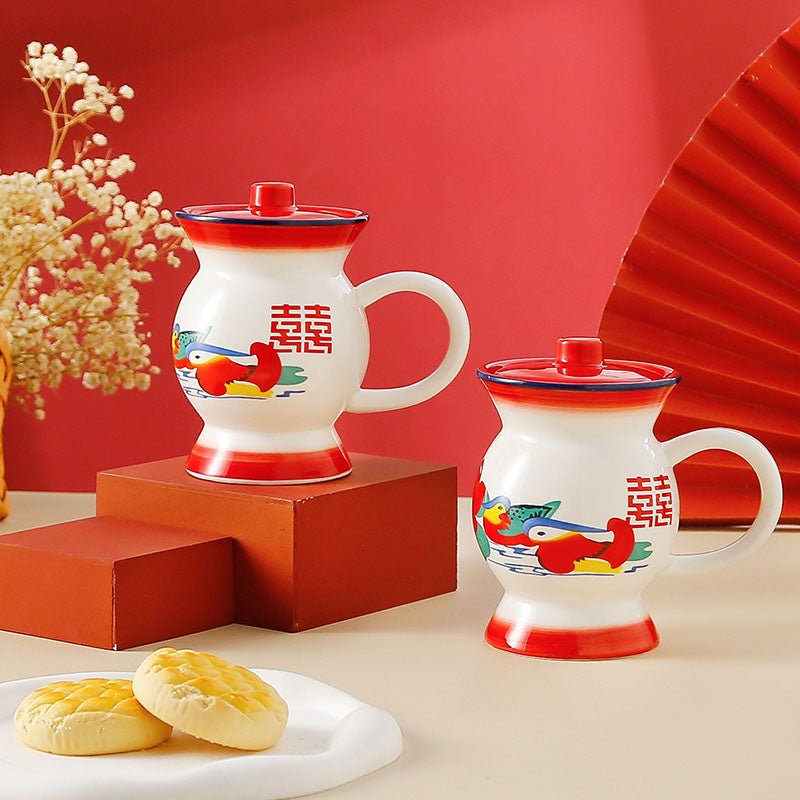
Choose it when: Two people repeatedly confuse their mugs, or the intended owner actively prefers unconventional drinkware. The spittoon-inspired presentation of the Spittoon Coffee Tea Mug gives the household a clear visual marker without relying only on color.
Skip it when: The mug is for a recipient who favors minimalist tableware, or it must look restrained during video calls and formal meals. A novelty-led shape is also not automatically easier to clean. Inspect the product photos, interior profile, dimensions, and care text before treating its distinctive appearance as a practical advantage.
If all three miss the household's preferred look, use the unique coffee mugs collection to compare other visual directions. Keep the same scenario filter in place so the collection does not turn a three-option decision into an unfocused browse.
Cabinet height, handle clearance, and full-mug weight
General buying guidance: The checks in this section apply to ceramic mugs broadly; they are not unlisted specifications for The Rock, The Flow, or Spittoon. Ceramic is also an umbrella term. Do not assume a mug is stoneware, porcelain, or earthenware unless its product page identifies the body material.
- Measure usable shelf height: Use the lowest point beneath the shelf above, then compare it with the mug's listed height.
- Check total width: Body diameter alone is not enough. Include the handle and leave room so neighboring mugs do not knock together.
- Consider the base: A broad footprint can improve how settled a mug feels on a counter, but it also consumes more shelf and dishwasher-rack space.
- Estimate filled weight: Every 100 mL of a water-based drink adds roughly 100 g to the mug's empty weight. A 300 mL serving therefore adds about 300 g before accounting for the ceramic body.
If a required measurement or weight is not shown, do not estimate it from a styled photograph. Camera angle and surrounding props can make a mug look smaller or larger than it is.
Coffee, tea, and iced drinks create different shortlists
A thick ceramic body is not an insulated travel mug. Cooling depends on fill volume, the mug's starting temperature, the exposed surface area, room conditions, and whether the drink has a lid. We do not promise a specific heat-retention time based on wall thickness alone.
- For slow coffee: A substantial ceramic mug may provide the feel the drinker wants, but someone focused mainly on keeping coffee hot for hours may be better served by a lidded insulated mug.
- For loose-leaf tea: Compare the opening with the user's infuser and verify microwave suitability if reheating is part of the routine.
- For iced coffee: Check listed capacity and opening size against the usual ice cubes or straw. Thick ceramic does not replace a sealed tumbler for commuting or spill control.
- For rapid refills: Prioritize comfortable lifting and easy rinsing rather than assuming the thickest-looking option is automatically best.
Pre-warming a room-temperature ceramic mug with warm water can reduce the initial temperature drop of a hot drink, but the product's care instructions still take priority. Do not move ceramic directly from a cold refrigerator into extreme heat.
Dishwasher cycles, thermal shock, and ceramic defect checks
Shared mugs often fail through routine handling rather than dramatic accidents. They knock against another cup in the dishwasher, acquire a rim chip in the sink, or develop a hairline crack near the handle joint. We check these areas because a glossy glaze can make small damage easy to miss.
- Read the product-specific care instructions before the first wash. Do not infer dishwasher or microwave safety from the word ceramic.
- If care guidance is unclear, use warm water, mild dish soap, and a nonabrasive sponge until the correct instructions are confirmed.
- Avoid abrupt temperature changes. Do not pour boiling liquid into a refrigerator-cold mug or place a very hot mug on a cold, wet surface.
- If dishwasher use is explicitly allowed, leave enough rack clearance to prevent the rim and handle from striking nearby dishes during the cycle.
- Inspect the rim, body, base, and handle connection after a hard knock. Stop using a mug with a structural crack, unstable handle, or sharp chip.
Fine lines limited to the glaze may be crazing rather than a crack through the ceramic body, but unexpected changes still deserve inspection. During a gift unboxing, check the rim and handle before removing packaging or washing the mug, and report any transit damage promptly.
Should two people choose matching mugs or distinct designs?
A shared household does not need matching drinkware to function well. Similar mugs create a coordinated table, while visibly different designs make ownership easier to remember. The three links in this article lead to separate product pages, so review the quantity, variant selection, and current cart details rather than assuming they form a bundle.
Our store rule is simple: match each mug to the routine first, then decide whether the mugs should match each other.
This thick ceramic coffee mugs shared household product shortlist guide is most useful as an elimination tool. If one person dislikes novelty, remove Spittoon. If both users reject The Rock's visual direction, remove it. If The Flow cannot meet a required measurement or care condition, remove it even if both people like the photographs.
A ten-minute cabinet-and-routine check before checkout
- Name the primary user and the drink most often served.
- Measure maximum shelf height, usable depth, and available width beside neighboring mugs.
- Open the three product pages and record only the currently listed material, dimensions, capacity, care instructions, and quantity.
- Eliminate any option that conflicts with the user's grip, accessory, microwave, dishwasher, or storage requirements.
- Choose by visual preference only after the practical requirements are satisfied.
- If no candidate remains, return to the unique mug collection with the same measurements and skip rules.
Frequently asked questions
Which thick ceramic mug should a shared household compare first?
Use this thick ceramic coffee mugs shared household product shortlist guide by starting with the household's most frequent disagreement. Compare The Rock first for a rock-inspired personal statement, The Flow when both users need to accept the same visual direction, or Spittoon when unmistakable identification matters most.
Are The Rock, The Flow, and Spittoon sold as one set?
They are presented here as three separate product-page candidates, not as a set recommendation. Check the quantity, available variants, and cart description on each current listing before ordering.
Can I assume a thick ceramic mug is dishwasher and microwave safe?
No. Ceramic material alone does not confirm appliance compatibility, and decorative finishes can have different care requirements. Follow the exact instructions shown on the selected product page.
Is a thick ceramic mug always better at keeping coffee hot?
No. Wall thickness can affect thermal behavior, but fill volume, starting temperature, opening size, room conditions, and lids also change how quickly a drink cools. Choose an insulated lidded mug instead if extended heat retention is the primary requirement.
What should we check immediately before ordering?
Open The Rock, The Flow, and Spittoon in separate tabs, then write down the current dimensions, capacity, material, care instructions, and quantity for each. Eliminate anything that misses the cabinet, grip, drink, or cleanup requirements; if none remains, compare the full unique coffee mugs collection using that same checklist.
More from our blog
Read more

Ceramic Espresso Cup Weekend Coffee Practical Purchase Checklist
Compare the 170 ml Retro, 200 ml Pleated, and 250 ml Ball Handle ceramic cups by actual pour size, visible form, machine and cabinet fit, and care unknowns. This checklist also explains when a trad...
Read more
Coffee Mug Gift Idea Weekend Coffee Practical Purchase Checklist
Use a real-world checklist to compare ceramic mug capacity, handle fit, cupboard clearance, care instructions, and artwork for slower weekend coffee routines. Includes scenario-based guidance for t...
Read more
Leave a comment
This site is protected by hCaptcha and the hCaptcha Privacy Policy and Terms of Service apply.