
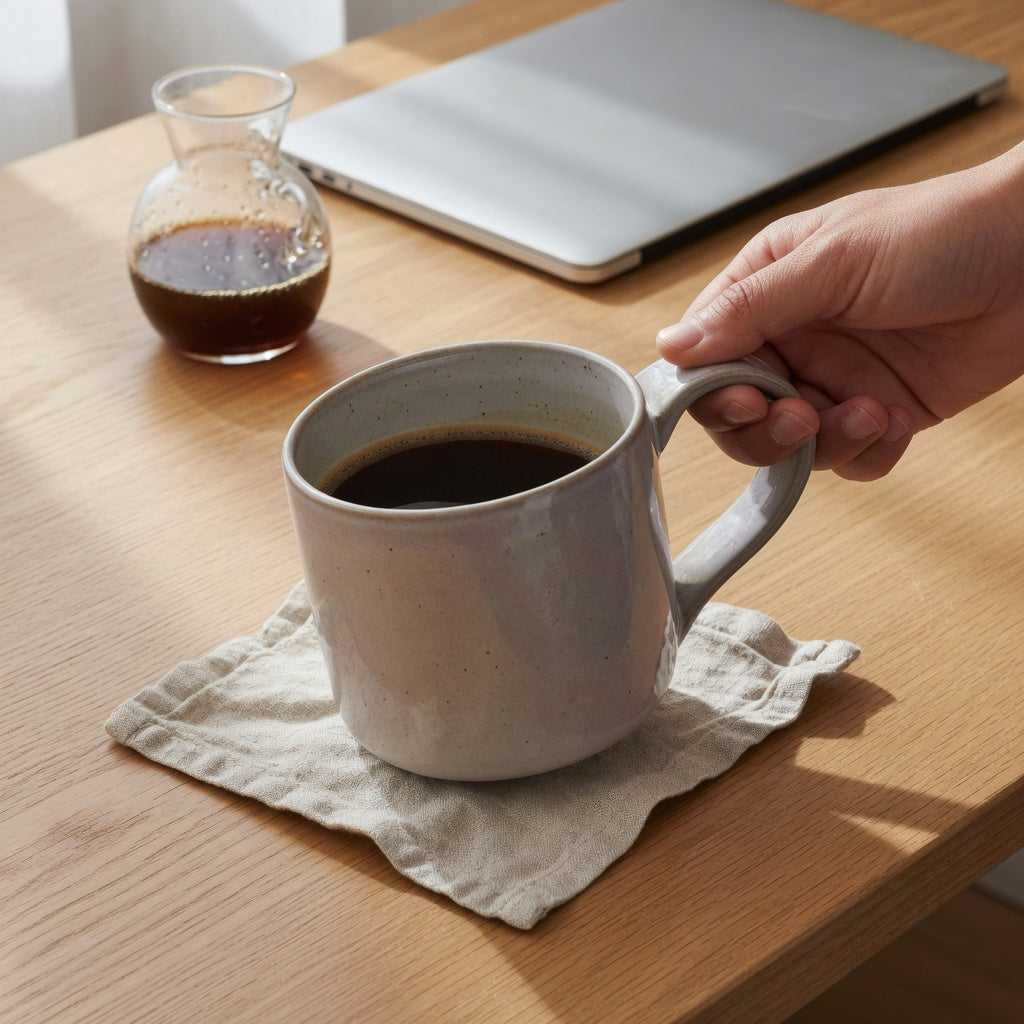
The Flow Mug Ceramic Coffee Tea: 7 Checks Before Buying
Reading time: about 9 minutes
A mug can feel balanced while empty and surprisingly demanding once a 350 ml drink is inside it. On a crowded desk, the handle must clear your fingers, the base must stay planted beside a charging cable, and the rim needs enough headspace for the walk from kettle to chair. Those are the practical reasons shoppers compare the flow mug ceramic coffee tea instead of choosing from a styled product photo alone.
In our store, we assess sculptural mugs as drinkware first and display pieces second. The live listing for The Flow Large Ceramic Coffee Mug identifies it as a 400 ml ceramic mug intended for coffee, tea, and cocoa. Those are the product facts we can stand behind here. Exact weight, dimensions, glaze documentation, and microwave or dishwasher instructions should come from the current listing, not from assumptions about ceramic. If the silhouette is still undecided, compare our unique coffee mugs by capacity and grip before narrowing the choice by color.
Is 400 ml enough for milk, tea infusers, or ice?
A listed capacity of 400 ml is roughly 13.5 US fluid ounces. That sounds generous, but nominal capacity and comfortable working volume are not the same. Filling a mug to the rim leaves no margin for milk, foam, an infuser, ice cubes, or the small movements that cause spills.
| Your usual serving | Theoretical space left | Practical reading |
|---|---|---|
| 250 ml tea | 150 ml | Room for an infuser and easy carrying |
| 300 ml coffee plus 50 ml milk | 50 ml | A full serving with modest headspace |
| 350 ml long coffee | 50 ml | Generous, but carry it steadily |
| 400 ml measured drink | None on paper | Choose a larger mug if you need working headspace |
These figures are simple arithmetic based on the listed capacity, not a measured fill line. Rim shape, foam, ice, and normal manufacturing variation can change the usable amount. Ice is especially easy to overlook: a 400 ml iced coffee recipe needs space for both liquid and cubes.
If your normal drink lands between 300 and 350 ml, the 400 ml Flow mug is sensibly matched on capacity. A 200 ml tea may feel lost in it, while a full 400 ml pour will sit too close to the edge. Buyers who regularly make 16-ounce or larger drinks should choose a larger format rather than treating the rim as extra capacity.
How does the flow mug ceramic coffee tea shape work on a real desk?
A 350 ml coffee or tea contributes roughly 350 grams before the ceramic body is counted. That is why an elegant handle can feel very different when the mug is full. We do not have an independently verified weight or handle-clearance measurement to add here, so use the live product information and photos rather than assuming the mug will feel light.
- Finger clearance: An elongated handle opening may suit a two-finger grip but not a full-hand grip. If hand comfort is a priority, look for measurements or ask before ordering.
- Handle leverage: More distance between your hand and the mug body can make a full mug feel heavier. It also places twisting force on the two points where the handle meets the body.
- Base contact: Judge the foot that touches the desk, not the widest curve of the mug. A small contact area can be less forgiving beside cables, notebooks, and uneven coasters.
- Rim and handedness: Check whether the rim, handle, or decoration is asymmetrical. Left-handed use may feel different if the form has a preferred drinking side.
Our practical arrival check uses cool water before the first hot drink. Fill the mug to your normal level, hold it for 30 seconds, walk a few steps, and set it beside the mouse pad or on the kitchen counter. This quickly reveals whether the handle twists, the rim feels too open, or the base needs a larger coaster.
This is tableware, not sealed travel gear. An open ceramic mug is a poor match for a backpack, car cup holder, or commute where a lid and impact resistance matter.
What should you verify about glaze, food contact, and care labels?
Ceramic is a broad material term. It does not identify the exact clay body, firing temperature, porosity, or glaze formulation. Stoneware belongs to the ceramic family, but shoppers should not assume a product is stoneware unless the current listing uses that term.
Food-contact claims also need more than a smooth finish. The FDA action level for extractable lead from cups and mugs is 0.5 µg/mL in a 4% acetic acid leaching solution. That is a regulatory action level used for vessels that frequently hold acidic hot drinks; it is not a product certification that can be inferred from appearance.
We do not have an independent laboratory report for the exact Flow mug glaze to cite in this article, so we will not turn a general FDA rule into a product-specific lead-free or cadmium-free claim. That restraint does not mean a mug is unsafe. It means safety assurances should come from the exact listing or documentation for the exact product.
- Match any dishwasher or microwave statement on the listing with the mark on the mug base. If the two conflict, contact our store before use.
- Keep metallic rims, luster, or foil decoration out of the microwave unless the maker explicitly approves microwave use.
- Inspect the beverage well on arrival. A chip, glaze skip, or unusual network of fine cracks inside the mug deserves a question before the first drink.
- An unglazed foot ring is common on ceramic ware. Dry it fully before placing the mug on wood or another moisture-sensitive surface.
Dishwasher cycles, tea film, and rim chips: where does wear start?
The wear patterns our team sees across large ceramic mugs are usually mechanical: a rim taps the faucet, a sculptural handle catches a dishwasher tine, or two mugs strike each other in a crowded cupboard. Tea and coffee film are cosmetic at first, but aggressive scrubbing can turn a small cleaning issue into a dulled glaze.
- Follow the listed care method. If dishwasher use is not stated, hand-wash with warm water, mild dish soap, and a soft cloth or sponge.
- Give the handle room. If dishwasher use is approved, position the mug so the handle cannot hook around a rack tine and the rim cannot knock another piece during the cycle.
- Avoid thermal shock. Do not move a chilled mug directly to boiling liquid or place a very hot mug on a cold, wet surface.
- Treat stains gently. Start with repeated mild washing. Avoid steel wool and harsh scouring powder, and check the care guidance before using any abrasive paste on matte or textured glaze.
- Store it without rim pressure. Do not force one ceramic mug inside another. Inspect the rim and both handle joints after any hard impact.
For a more detailed maintenance routine, read our care guide for The Flow Large Ceramic Coffee Mug. The small habits matter most: rack spacing, gentle cleaning, and keeping the handle away from cupboard collisions.
Who is The Flow mug for—and who should choose another style?
No independent heat-retention test for this exact mug was available for this guide, so we do not promise a temperature or duration. An open ceramic mug suits a seated drink; a vacuum-insulated vessel with a lid is the better tool for keeping a drink hot through a long meeting.
- Home coffee, tea, or cocoa between 250 and 350 ml: The 400 ml sculptural ceramic mug fits this routine because it leaves some carrying room while still feeling substantial.
- A stationary office desk: It can work if the handle suits your grip and the base fits your clear desk space. Use a coaster for iced coffee because open, uninsulated ceramic may collect condensation.
- A design-focused gift: The flowing form creates a stronger gift-unboxing moment than a plain cylinder. Confirm that the recipient actually uses ceramic mugs and will follow the stated care method.
- Short servings or reduced grip strength: A smaller mug with a compact handle may be easier to lift. Compare other unique ceramic mug shapes instead of choosing sculpture at the expense of comfort.
- Commuting, camping, or hour-long heat retention: Choose a lidded, impact-resistant, insulated product. The Flow mug is not designed to replace travel drinkware.
The flow mug ceramic coffee tea design is strongest for a buyer who wants a generous stationary mug and treats its sculptural form as part of everyday tableware. It is a weaker fit for anyone who needs minimum weight, a sealed lid, maximum impact resistance, or a full 400 ml serving with spill room.
Frequently asked questions
Is the flow mug ceramic coffee tea design practical for everyday use?
Yes, it can be practical for stationary coffee, tea, or cocoa at a kitchen table or desk. The listed 400 ml capacity suits generous servings, provided you leave headspace and the handle fits your grip. It is not a travel mug or an insulated container.
Is a 400 ml ceramic mug large enough for coffee with milk?
It is large enough for many milk-based home servings. For example, 300 ml of coffee plus 50 ml of milk leaves about 50 ml below the nominal capacity. If your finished drink measures 400 ml before foam, choose a larger mug.
How can I tell if The Flow mug is microwave or dishwasher safe?
Use the care statement on the current product listing and check the mark on the mug base. Ceramic material alone does not prove either type of compatibility. If no clear instruction is provided, do not assume microwave or dishwasher use.
Can a ceramic mug leach lead or cadmium into coffee or tea?
Some improperly formulated or fired glazes can release metals, which is why food-contact ceramic ware is assessed through leaching tests rather than appearance. The FDA action level for extractable lead from cups and mugs is 0.5 µg/mL in 4% acetic acid. For any exact mug, rely on product-specific statements or testing documentation rather than a visual check.
How do I prevent stains and chips on a large ceramic mug?
Wash with mild soap and a non-scratch sponge, avoid sudden temperature changes, and keep the rim and handle clear of other dishes. Do not nest mugs tightly or let a sculptural handle catch around a dishwasher tine. Dry an unglazed foot before setting it on wood.
Seven live-listing checks before you add the mug to cart
- Confirm that 400 ml matches your finished drink, not just the amount of coffee before milk or ice.
- Allow working headspace instead of planning to fill the mug to its nominal limit.
- Check available handle dimensions, finger clearance, and left-handed orientation.
- Inspect the rim shape and the base contact area in uncropped photos.
- Read the exact microwave and dishwasher instructions.
- Review any food-contact and glaze statements without assuming a certification.
- Choose ceramic only if stationary use, breakability, and open-cup heat performance suit your routine.
If all seven checks fit, review the current The Flow Large Ceramic Coffee Mug listing before ordering. If capacity, grip, or care still gives you pause, compare the unique coffee mug collection until the shape and your daily routine agree.
More from our blog
Read more

Great Mountain Coffee Mug: Size, Care, and Design Checks
A scenic mug has to fit more than the mood. Compare usable capacity, brewer clearance, handle geometry, artwork method, care wording, and gift fit before choosing a mountain ceramic mug.
Read more
Golden Waves Kio Mug: Compare Finish, Care, Size, and Fit
Compare the Golden Waves Kio Mug by the details that affect daily use: decoration type, microwave and dishwasher wording, usable pour, handle clearance, and wear points. We also explain who will be...
Read more
Leave a comment
This site is protected by hCaptcha and the hCaptcha Privacy Policy and Terms of Service apply.