



Tall Ceramic Latte Mug: What to Compare Before Buying
Reading time: about 8 minutes
In our store, the tall mugs sit at eye level, and that is where most hands go first. A shopper wraps both hands around one, sets it back on the counter, and asks the question we hear most often: is this too much mug for one latte? Fair question. No rule fixes a height or capacity for a tall ceramic latte mug; the FDA's own cup-and-mug example is about 240 ml, roughly 8 fl oz, while mugs sold under that label often run from the mid-teens to about 20 fl oz. That gap is why we compare measurements rather than adjectives.
Why 'Tall' Doesn't Mean One Size on a Tall Ceramic Latte Mug
Tall is a silhouette, not a standard. In our store we keep a steel ruler on the packing bench because shoppers routinely ask for height after they have read an ounce figure. Two mugs can both look tall and still differ by two inches and six ounces. Ask for two numbers: listed capacity and physical height. If only ounces appear, request the height before ordering.
The shape usually means a body that is narrower relative to its height than a wide cafe cup. Tall and narrow fits tight cabinet shelves and shows a distinct foam layer. Wide and shallow gives more surface for latte art and cools faster. Neither is wrong; they solve different problems. That trade-off matters more than the word tall on the listing.
Brim-Full Ounces vs. the Latte You Can Actually Carry
Some drinkware makers state that listed ounces are approximate brim volume, the amount that fits to the lip. You will not pour a drink to the lip, especially if you carry it across a kitchen. This gap explains most of the smaller-than-expected emails we get. Split the number into three parts:
- Brim volume: the advertised figure, filled to the edge. Useful for comparing mugs to each other, not for planning a recipe.
- Working fill: brim volume minus the headroom you leave to walk without spilling. For most cups that is the top centimetre or two of wall.
- Foam volume: steamed milk foam takes up space but adds little liquid, so a tall cup can look full and still drink short.
A big brim number does not guarantee a bigger latte. If you pull a double shot and steam a modest jug, a mid-size mug with a centimetre of headroom feels better in the hand than one filled to the edge. The reverse is also true: if you steam a generous jug, a small mug forces you to leave milk behind or risk a spill on the first step.
Will the Mug Clear Your Brewer, Microwave, and Car Cup Holder?
Height is where tall mugs quietly fail. Before ordering, take three measurements at home:
- Brewer clearance. Measure from the drip tray to the dispenser spout, then subtract the height of any scale or stand you use. An espresso machine with a group head and a scale underneath is the tightest case we hear about.
- Microwave cavity. Measure from the turntable to the ceiling. A tall mug plus a small plate on top for splatter protection is a common combination that stops fitting.
- Cup holder. Base diameter matters as much as height. Deep, narrow holders can swallow a wide foot and leave the mug leaning; shallow holders can let a tall mug tip on a corner.
None of these numbers appears on most product pages. We tell buyers to check the current listing, then measure their own machine and microwave. Cabinet shelf spacing is the fourth check and the one people forget until the mug is already on the counter.
Handle Opening, Full Weight, and the Tip Test
The complaints we see in this category cluster around two things: a handle too small for larger hands and handles that crack at the joint. Neither shows up in a marketing photo. Ask for the handle opening in millimetres and look at where the handle meets the body. A handle joined at two small pads concentrates stress differently from one with a broader connection; listing photos usually show enough to compare.
Weight is the quiet factor. A 480 ml mug filled to a sensible line carries close to half a kilogram of liquid before the vessel itself is counted. Fine on a desk, less pleasant held one-handed over a keyboard. A tall, narrow body with a small foot is also easier to knock over than a squat cup, especially on a wobbly cafe table. Check base diameter, and lift a full mug close to your body; the balance problem mostly disappears.
Stoneware or Porcelain? What Changes at the Lip
Material language on listings is looser than shoppers expect. Stoneware is generally described as a thicker, heavier clay body; porcelain as tighter, thinner, and lighter. Thick walls hold heat longer but feel heavier when full and take longer to warm with a pre-heat. Thin walls respond faster to hot water and feel more delicate against the lip.
The lip is the spec almost nobody asks about and almost everybody notices. A thick rolled rim feels rounded; a thin rim makes the drink feel cooler and more precise. A flared rim gives a wider surface for pouring patterns, while a narrow rim keeps crema concentrated. If you mainly pour latte art, a wide shallow cup beats a tall one. If your daily drink is 250 ml of filter coffee, a tall ceramic latte mug is more vessel than you need; a wide 8 oz cafe cup is the better tool.
What Lead-Free and Lead-Safe Wording Means for Coffee Drinkers
The FDA sets an action level of 0.5 micrograms per millilitre for leachable lead in small ceramic hollowware, applied to any one of six units tested, and 0.5 micrograms per millilitre for leachable cadmium in hollowware under 1.1 litres. Those are the numbers a serious supplier tests against. But the agency has also documented pottery labelled lead free that released extractable lead at levels comparable to lead-glazed ware, sometimes above action levels. A label is not a test report.
California's Department of Public Health adds a detail that matters here: coffee and tea are acidic, acidic drinks leach lead faster, heating or microwaving speeds that movement, and dishwashing can damage a leaded glaze. The same agency separates lead free, which means no lead, from lead safe, which may contain some lead but stays under Proposition 65 leaching limits. Those terms are not interchangeable.
Two rules we apply. Anything marked decorative or not for food use never holds a drink. And if a listing does not state microwave and dishwasher suitability, treat it as unknown rather than assuming yes.
The Flow, Morning and Night, and The Rock: Three Capacities, Three Jobs
We list three handled mugs with these capacities. Everything beyond capacity, including height, handle opening, and care instructions, should be confirmed on the exact product page before you order.
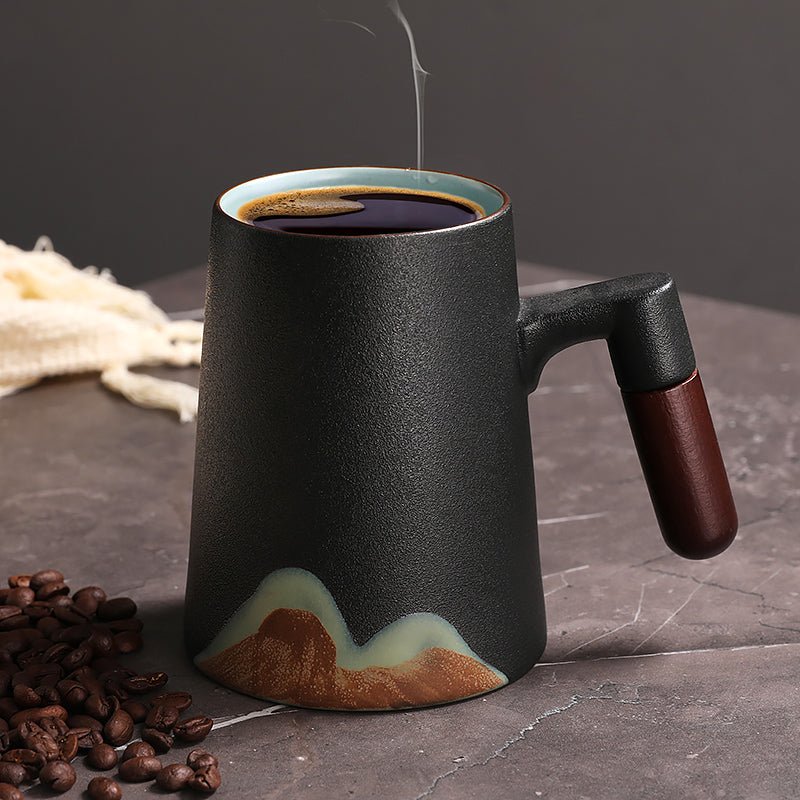
- The Flow — 400 ml listed capacity. Choose it when you want a taller profile without a big jump in volume. It suits a single-shot latte plus a modest jug of milk, or a filter-coffee drinker moving up from a standard mug.
- Morning and Night — 440 ml listed capacity. The middle ground, 40 ml more than The Flow. Worth shortlisting when your milk jug tends to run generous or when the mug doubles as a tea vessel through the afternoon.
- The Rock — 480 ml listed capacity. The largest of the three. Best for long desk sessions, iced drinks, or a large milk-heavy build where you want the mug to still look full after the foam settles.
Capacity is the number we can state without guesswork. Rim flare, taper, and how upright the body reads are visual calls, and a narrower body photographs taller than a wider one at the same volume. If none of these silhouettes is the one you pictured, start with the unique coffee mugs collection instead of forcing a fit. For a mug that will live beside a monitor, our notes on office desk stability and care cover footprint and tipping. For gift orders, the ceramic mug buying checklist covers the checks before a mug leaves the house.
Frequently asked questions
Is a 400 ml tall ceramic latte mug big enough for a latte?
For most home builds, a listed 400 ml capacity leaves workable headroom for a double shot plus a modest jug of steamed milk. If you routinely steam a large jug or drink iced coffee by the pint, step up to 440 or 480 ml, and confirm the actual fill line on the listing.
Will a tall mug fit under my single-serve brewer or espresso machine?
Measure first. Take the distance from the drip tray to the spout and subtract any scale you place underneath. Tall mugs are the first thing to fail this check, and height is rarely listed on product pages, so check the listing and then measure your own machine.
Are ceramic latte mugs microwave and dishwasher safe?
Only if the listing or base stamp says so. Ceramic formulations and glaze firing vary, and unmatched ware should be treated as unknown. Metallic decals and some print finishes are the most common reason a mug is labelled hand wash only, so read the care line for the exact piece.
Does a lead-free label mean the mug was actually tested?
Not necessarily. The FDA has documented pottery labelled lead free that still released extractable lead, sometimes above action levels. Ask what standard the glaze was tested against, and keep decorative-only pieces away from drinks entirely.
What is the real difference between 440 ml and 480 ml in practice?
About 40 ml, or roughly 1.3 fl oz of listed capacity. The bigger practical difference is usually height, handle opening, and how the mug feels when full, so choose on those rather than on the capacity gap alone.
More from our blog
Ready to pick your mug? Two ways to save on today's order:
Ordering 1–3 mugs? Get an extra 10% off your 1st order with code 10_OFF Apply 10% Off & Shop Wooden-Handle Mugs →
Gifting 4+ mugs? Buy 3, Get the 4th Free applies automatically at checkout (no code needed; offers do not stack) · Free standard shipping (Nov pre-Christmas delivery: 15–20 calendar days US) · Free replacement if chipped in transit.
Popular mug buying guides: Wooden-Handle Tea Infuser Mugs Compared · Christmas & Secret Santa Mugs 2026 · Espresso & Cortado Cups Guide · Cup & Saucer Gift Sets · All 25 Mugs Spec Table · Mug Size Guide · Shipping & Promo FAQ
FIRST ORDER 10% OFF (CODE: 10_OFF) · OR BUY 3, GET THE 4TH FREE


Read more
Best Gradient Ceramic Mug for Office: What Buyers Compare
A desk-level comparison of the best gradient ceramic mug for office use: handle and base fit, glaze wear under fluorescent light, capacity math, arrival inspection, and the buyers who should pick s...
Read more
Coffee and Tea Mug for Home Office Decor: What Buyers Compare
A desk mug has to do two jobs: drink well through a long call and look intentional in a home office. We compare capacity, materials, microwave and glaze safety, and desk fit, including the details ...
Read more
Leave a comment
This site is protected by hCaptcha and the hCaptcha Privacy Policy and Terms of Service apply.