
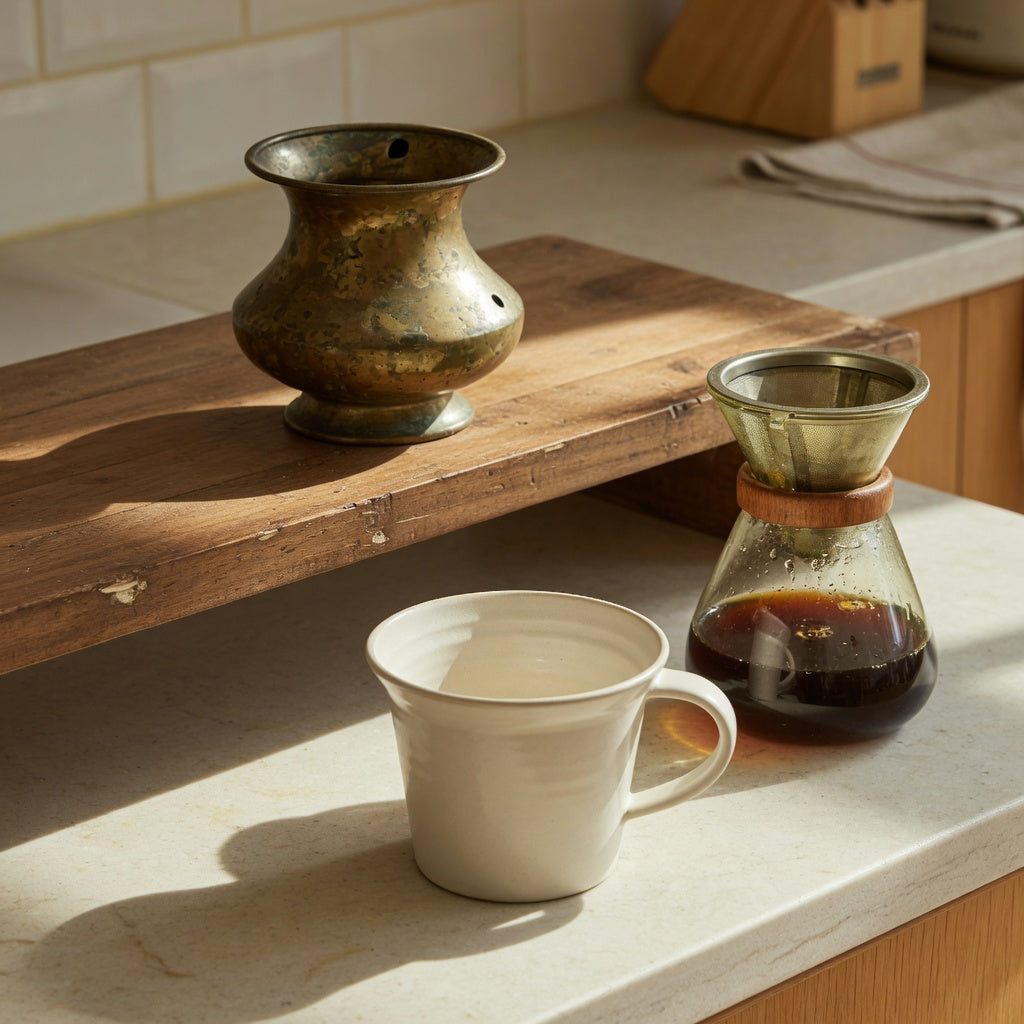
Spittoon Mug Home Decor: Cup or Vintage Display?
Reading time: about 11 minutes
Customers keep dropping two photos into the same message and calling both of them rustic coffee decor. One is a new cup with a wide flared rim, sometimes pictured with a small lid and a Chinese-style title. The other is a low brass bowl from a flea-market stall, dented, with a hole in the center of the top. Same search, two objects. If you are comparing spittoon mug home decor, settle that split first. The buying checks are not interchangeable.
We sell conversation-piece drinkware, not antique brass. The piece we recommend from our catalog is the spittoon coffee tea mug. It is grouped with the other odd, gift-ready shapes in our unique coffee mugs collection. We will not guess its material, capacity, lid, microwave line, or dishwasher line from a lookalike on another site. Those facts belong on the current product page, and pages change. Open it before you treat the cup as a daily driver.
Are you buying a new gag cup or an old spit vessel?
Four objects get mashed into one search. A new novelty mug shaped like a spittoon, a chamber pot, or a Chinese-style cuspidor. A standard mug that only prints the word spittoon on the outside. A vintage brass or enamel cuspidor kept for a bar cart, a western shelf, or a man-cave. An antique ceramic spittoon, sometimes in mottled Rockingham glaze, that once sat in a home or a public room.
In our experience, a prank gift for a coffee drinker is a different order from old brass on a sideboard. The first buyer cares about the joke, a comfortable grip, and whether the listing allows a hot drink. The second cares about patina, and about whether the form is an old cuspidor or a later vase wearing the same outline. Mix those up and you overpay for a reproduction, or you hand someone a toilet-shaped cup they did not want.
Wine-tasting spit cups are a fifth lookalike. They are tools for discarding a sip, not tobacco antiques and not kitchen mugs. Read the intended-use line before you assume coffee, tea, fruit, cosmetics, or soil.
What the old shape was built to catch
Before machine-made cigarettes were common, chewing tobacco was widely used through the nineteenth and early twentieth centuries. Spittoons and cuspidors caught the spit in private homes and in public rooms such as saloons, banks, offices, barber shops, and courtrooms. A handsome brass bowl can still make a guest pause. Its first job was not charming.
Late nineteenth-century catalogs did not treat the names as one shape. A spittoon was a low circular vessel with a top sloping toward a small central hole. A cuspidor stood taller, with a bowl-shaped base, a funnel-like opening, and a pinched neck. English took cuspidor from the Portuguese cuspidouro, a place for spitting. Sellers swap the words now. Trust the silhouette in the photo, not the title.
Rockingham, a mottled brown-and-yellow ceramic glaze, was popular on spittoons because the mottling helped hide spit. Some ceramic examples had a side opening used to empty them. A brown antique can look like farmhouse decor in a photo and still be a working vessel from another century. Read the glaze as a clue about the original job.
Chinese style on a new mug is a design cue, not a museum label. A flared rim and a borrowed phrase do not turn a current production cup into historic porcelain. Buy the joke on purpose, or leave it.
Spittoon mug home decor: which form belongs on your shelf?
Once the object is clear, placement is simpler. A novelty cup is a counter or desk accent that might also be drinkware. A brass cuspidor is sculpture. An old ceramic spittoon belongs with the brass, not with a new coffee mug, even when both are clay.
| What you are looking at | Sensible job | Do not assume |
|---|---|---|
| New spittoon-shaped or chamber-pot cup, sometimes lidded | Prank gift, shelf accent, or a hot drink only if the current listing says so | A lid, microwave use, dishwasher use, or a food-contact test |
| Printed mug that only says spittoon | Ordinary drinkware with a joke on the outside | That the body is a real cuspidor |
| Vintage brass or enamel cuspidor | Bar cart, western shelf, or dry display | That drinks are safe, or that soil and fertilizer belong on the metal |
| Antique ceramic with Rockingham glaze | Display, if you want the mottled surface and the history | Food use, especially if the glaze is worn, bright, or of unknown make |
A low, wide brass form belongs on a bar cart or a bottom shelf, not on a mug tree. A handled cup can sit by the kettle, but a flared body often misses a standard rack that a simple round cup would clear. Measure shelf depth and the cabinet opening before you trust the photo. If fit and a comfortable rim matter more than the gag, use the same proportion checks we walk through for round coffee mug shape, size, and care.
Food contact, old glaze, and the cup you should not drink from
A vessel built to catch tobacco spit is a poor coffee cup, even after a hard scrub. Soap does not rewrite that history, and it does not fix the glaze.
Lead may be present in the glaze or the decoration of some traditional pottery. If the piece was not made properly, that lead can leach into food or drink prepared, stored, or served in it. U.S. Food and Drug Administration guidance treats higher concern as warranted for pottery that is handmade or roughly made, antique, damaged or worn, of uncertain manufacture, or brightly decorated in orange, red, or yellow. Decorative-only pieces may be marked as not for food because they can poison what you serve. Washing, boiling, or a similar process will not pull lead out of a glaze. If a home test shows leachable lead, do not cook, serve, or store food or drinks in that piece.
Listings in this niche often call one cup both a daily drink and a holder for cosmetics or fruit, with no steady line on food contact, the microwave, or the dishwasher. We have not seen independent tests that cover every imported cup sold under a spittoon name. For anything in our store, the current listing is the only spec sheet we will stand behind. If care lines are missing, leave the answers blank. A photo of coffee in the cup is not a test.
This shape is a bad quiet office mug when the chamber-pot joke will embarrass someone in a meeting. It is not a stackable set for a crowded cabinet. Do not send it through a dishwasher cycle the page never mentions, and do not scrub an antique and drink from it. For a plain tea cup, use the material and care checks in our ceramic tea mug comparison instead of forcing a novelty silhouette into that job.
Brass on a bar cart, or a planter you should leave dry
Resale ads call brass and enamel cuspidors planters, vases, pencil cups, and bar props. That is shopper talk, not a care manual. The history we can stand behind does not cover drainage, liners, or fertilizer sitting against old metal. If the seller says display-only, keep it that way. A dry arrangement, or a nursery pot nested so water never touches the brass, is styling. Drilling the base is a change we will not recommend from a product photo.
Wipe loose dirt before an old cuspidor comes into the house. The original contents were spit, so a surface clean is reasonable. Stop when the grime is gone if you want the patina. Heavy polishing can erase the uneven color that shows age, and a too-even shine is a common look on reproductions. We are not authenticators. Unmarked brass, enamel, and ceramic sold as western or farmhouse decor is hard to date from a listing photo. A stamped mark belongs with a specialist. A funnel neck is not proof of age, and neither is a story in the description.
A side opening or a central hole is a feature, not damage. On historic ceramic, a side opening was used to empty the vessel. On the low catalog form, the top slopes to a small center hole. Either opening makes a poor watertight vase and a useless mug. If you see one, you are shopping for display, not for coffee.
Who should order the novelty mug, and who should skip it
Match the person, then the product.
- Prank or housewarming gift for someone who likes odd ceramics. The shape is the gift. Confirm material, size, lid, and care on the current product page before you wrap it. Humor is the same filter we use in our gift mug checks for coffee lovers. If you must explain the joke at the kitchen table, pick another shape.
- A daily cup you will microwave and rack-wash. Only when the listing says so in plain language. A wide flare, common on this silhouette, fights mug trees and tight cabinets more than a standard round cup does.
- Western bar or man-cave brass. That is a vintage cuspidor hunt, not a new order from our store. Expect uncertain age, and keep drinks out of it.
- Anyone who will read the silhouette as a toilet and hate it. Skip it. A chamber-pot outline is not subtle, and a Chinese-style phrase in the title does not make the gag polite.
On our packing bench, novelty cups get a simple pass before they leave: a foot that sits flat, a grip that feels secure, and a rim you could drink from if the listing allows food use. Crazing, a gritty unglazed lip, or a lid that rocks turns a funny unboxing into a return. Those are category checks, not a measured report on one product. Confirm them on the current page, and on the piece itself if you are buying secondhand.
A short compare list before you check out
Run these checks before you pay for spittoon mug home decor.
- Name the object: new novelty cup, printed joke mug, vintage brass or enamel, or antique ceramic.
- Pick one job: hot drink, dry display, or something else. Do not mix them.
- Read food-contact, microwave, and dishwasher lines on the current listing. Missing text is not a yes.
- Keep food and drink out of anything antique, worn, uncertain, or covered in bright orange, red, or yellow glaze.
- Check lid, grip, foot, and whether the width fits the shelf or the rack.
- If it is brass and you want plants, do not assume a drainage hole is safe. Display-only stays display-only.
- Picture the unboxing. If the joke needs a disclaimer, it is the wrong person.
If you want a new odd cup rather than an antique, start with the spittoon coffee tea mug listing and browse other odd mug shapes for a fit that suits the person better. Buy only after the care notes match how that cup will actually be used.
Frequently asked questions
Is spittoon mug home decor meant for drinking coffee or only for display?
It depends which object the listing is selling. A new novelty cup is sometimes marketed as coffee or tea and sometimes as a prop for fruit, cosmetics, or a shelf. A vintage brass cuspidor or an antique ceramic spittoon is display in our view, not a drink cup. Use only the food-contact language on the current page.
Is a Chinese-style spittoon mug the same as a chamber-pot gag cup, and does it include a lid?
Shoppers use those names for overlapping novelty shapes, so a Chinese-style title can still look like a toilet on the table. A new imported mug is not historic porcelain just because the title borrows the look. Lid or no lid is a listing fact. Check the current photos and the included-items line before you assume a cover is in the box.
Can I plant in a vintage brass spittoon or use it as a vase?
Many resale listings suggest planter or vase use. We do not have care guidance we trust on drainage, liners, or fertilizer against old brass, so we do not treat that as a proven use. If the seller says display-only, leave it on the shelf. A pot set inside, with no water on the metal, is safer than drilling the base.
How can I tell a spittoon from a cuspidor?
Late nineteenth-century catalogs drew a spittoon as a low circular vessel with a top sloping to a small central hole, and a cuspidor as a taller form with a bowl base, funnel opening, and pinched neck. Sellers mix the words now. Compare the photo to those two outlines. A center hole or a side emptying opening means you are looking at display, not a coffee mug.
Should I worry about lead glaze on an old spittoon or a novelty cup?
Take it seriously if the piece is antique, worn, handmade, of uncertain make, or brightly decorated in orange, red, or yellow. Lead in a poorly made glaze can leach into food or drink, and washing or boiling does not remove it. Decorative pottery may be marked not for food. For a new mug, do not invent a safety yes from the shape. Read the listing, and skip food use if that information is missing or a lead test shows leaching.
Read more
Affogato Coffee Mug Gift: Compare 170ml, 200ml & 270ml Cups
When searching for an affogato coffee mug gift, buyers often mix up novelty pun mugs with compact dessert cups. We compare the Retro, Pleated, and Emerald options by capacity and visible shape, the...
Read more
Coffee Cup for Espresso at Home: Size Before Style
The Retro is 170 ml, the Pleated cup is 200 ml, and the ball-handled mug is 250 ml — all larger than a traditional demitasse. We match those capacities to shot size, crema room, heat, and machine f...
Read more
Leave a comment
This site is protected by hCaptcha and the hCaptcha Privacy Policy and Terms of Service apply.