

Small Ceramic Coffee Cup Size Decision Guide: Smaller or Larger?
Reading time: about 9 minutes
A cup can look perfectly sized on a product page and still feel wrong after the first pour. Add milk and there is no room to stir. Set it beside a keyboard and the handle crowds the mouse. Choose a roomier mug, and part of the drink may still be sitting there when the next meeting starts.
This small ceramic coffee cup size decision guide starts with those everyday details. In our store, we handle ceramic cups at the packing table and talk with shoppers comparing them for kitchen counters, office desks, tea breaks, and gifts. The pattern is consistent: the best size is not the one with the most capacity. It is the one that holds a normal finished drink with comfortable headspace and still fits the space where it will be used, washed, and stored.
The live product pages are the source of truth for each current listed capacity and care detail. The guidance below explains how to use those facts without treating a particular milliliter or ounce figure as a universal coffee standard.
Small ceramic coffee cup size decision guide: what should you measure first?
Measure the drink you make, not the amount your brewer claims to dispense. Prepare coffee or tea exactly as usual, including added water, milk, or creamer, then pour the finished drink into a measuring jug. That result is your starting volume.
Do not match it to a cup that would be full to the rim. A practical cup needs headspace so you can carry it from the kitchen, stir without spilling, and set it down without coffee reaching the edge. The amount of headspace is a personal handling preference, so test it with a cup you already own rather than relying on a fixed formula.
- Finished pour: Include milk, added water, or anything else that goes into the cup.
- Refill pattern: Note whether you prefer one longer drink or several fresh, smaller pours.
- Physical clearance: Measure shelf height, brewer spout clearance, and the available area beside your keyboard or kettle.
- Handling room: Account for the handle, not just the cup body, when measuring storage and desk space.
- Care routine: Check the product page before assuming a ceramic cup is suitable for a dishwasher or microwave.
Product names such as cup and mug are useful descriptions, but they are not standardized measurements. Compare your measured drink with the capacity currently shown on each product page.
When does a smaller current ceramic cup make more sense?
A smaller cup is usually the practical choice when you finish a modest pour in one sitting, prefer a fresh refill to one long drink, or have limited space around your coffee setup. It can also suit tea tastings, a short coffee break, or a second cup later in the morning.
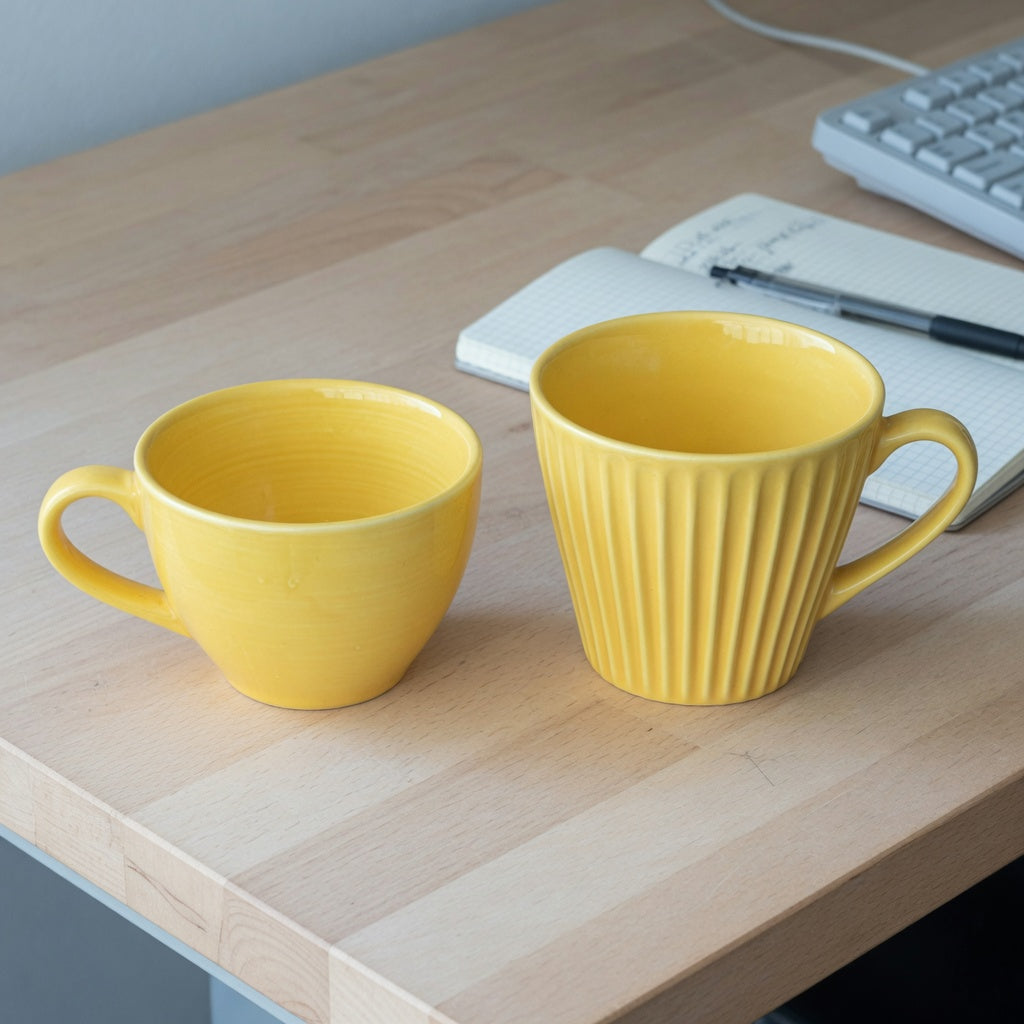
For that situation, start by comparing the listed capacity of the Pleated Coffee Tea Cup with your measured drink. The Retro Coffee Tea Cup is another compact-side comparison for shoppers who want a different visual style. In both cases, the fit depends on the live capacity and dimensions shown on the page, not on the product name alone.
The trade-off is straightforward. A smaller ceramic coffee cup can reduce unfinished coffee and occupy less space, but it also means more trips back to the pot if your normal drink is larger. It is not a strong fit for a drink that already reaches close to its listed capacity after milk is added. It can also feel restrictive for iced coffee because ice takes up part of the usable interior.
When does the roomier Emerald Coffee Tea Mug earn the extra space?
A roomier option makes sense when your measured drink needs extra headspace, you add milk after brewing, or you prefer one pour for a longer desk or reading session. In that case, compare your measurement with the current capacity shown for the Emerald Coffee Tea Mug.
The additional room is useful only if you use it. A larger cup takes up more surface and cupboard space, and the cup will be heavier once filled. That matters for anyone with reduced grip comfort or a habit of carrying coffee, a phone, and a notebook at the same time.
Extra capacity also does not guarantee better heat retention. Cup shape, wall construction, starting temperature, room conditions, and the length of the drinking session all affect temperature. Choose the Emerald option because its listed capacity fits the drink and routine, not because larger automatically means hotter for longer.
How do pour volume, desk space, and storage change the answer?
| Reader situation | Likely size direction | Practical next step |
|---|---|---|
| You regularly leave part of a drink unfinished | Smaller | Compare the Pleated and Retro cup capacities with the amount you actually finish. |
| Your finished drink reaches the rim after adding milk | Larger | Check whether the Emerald mug provides enough capacity for comfortable headspace. |
| Your cup sits beside a keyboard on a shared desk | Compact exterior dimensions | Check body width and handle projection instead of choosing by capacity alone. |
| Your brewer has limited spout clearance | Shorter profile | Measure from the drip tray to the spout and compare that space with the listed dimensions. |
| You make iced coffee with several ice cubes | Roomier or a different vessel | Allow for ice displacement and browse the unique coffee mugs collection if the small options are too restrictive. |
Capacity and exterior size are separate variables. Two cups can hold similar amounts while having different heights, body widths, or handle shapes. We notice this clearly while packing orders: a projecting handle can affect box and shelf fit more than a small change in the cup body's diameter.
Measure the location where the cup will actually live. On a kitchen counter, check clearance beneath cabinets and beside the kettle. At a desk, leave room for the handle without pushing the cup into a mouse pad, notebook, or charging cable. In a cupboard, measure the shelf opening rather than assuming a cup will fit because another one has a similar capacity.
What does ceramic care change about the size decision?
Ceramic size affects handling after the drink is finished. A roomier cup carries more filled weight and may require more control when rinsing it near a hard faucet or loading it beside other dishes. A smaller cup is lighter, but it is not immune to impact damage.
For glazed ceramic, the rim and handle attachment are two areas worth checking during regular use. A rim can chip if it repeatedly strikes a faucet, another cup, or a hard countertop. A handle can be stressed by tightly packing cups together or lifting a piece that already has a visible hairline crack near the join. Superficial rubbing on the base is different from a crack or sharp rim chip; inspect damage rather than treating every mark as the same issue.
- Follow the care instructions on the specific product page.
- Do not assume dishwasher or microwave suitability from the word ceramic alone.
- If dishwasher use is permitted, position cups so their rims and handles cannot knock against neighboring pieces.
- When hand washing, avoid striking the rim against the faucet and do not force cups into a tight stack.
- Do not expose a cup to abrupt temperature changes unless the product guidance specifically supports that use.
If your priority is a cup for a busy commercial sink, outdoor use, or a sealed commute, an open ceramic coffee cup may be the wrong category. A more durable service cup or purpose-built travel vessel would be a better match.
Which size is easier to give when you do not know the recipient's routine?
For gifts, look for evidence in the recipient's existing setup. A row of compact cups, a small apartment cupboard, or a crowded home-office desk points toward a smaller option. A large everyday mug beside a teapot or coffee carafe suggests that the recipient may appreciate more room.
Compact cups can work well as distinctive secondary pieces because they do not have to replace an established daily mug. A larger option makes more sense if the recipient routinely refills a small cup or prepares drinks with milk and added water. Neither is a universally safer gift choice.
Style still matters once the size direction is clear. Compare the Pleated, Retro, and Emerald pages first, then use the current unique coffee mug selection to find a design that fits the recipient's kitchen or desk.
Two-minute size check before ordering
- Make your normal drink and measure the finished volume.
- Open the three product pages and record each currently listed capacity.
- Remove any option that would not leave comfortable carrying and stirring room.
- Measure brewer clearance, shelf height, desk area, and handle space.
- Read the product-specific material and care details before deciding how the cup will be washed or heated.
Use this small ceramic coffee cup size decision guide as an elimination tool. If the measured drink does not fit comfortably, the cup is too small. If the exterior dimensions interfere with your desk, brewer, or cupboard, the cup is too large for that setting even if its capacity looks ideal.
Frequently asked questions
How do I use this small ceramic coffee cup size decision guide for coffee with milk?
Measure the complete drink after adding milk, not the black coffee alone. Compare that amount with the live listed capacity and leave headspace for stirring and carrying. If the finished drink sits close to the cup's maximum capacity, move to the roomier current option.
Is a smaller ceramic coffee cup only for espresso?
No. Cup size should follow your actual pour rather than a drink label. A smaller cup can suit coffee, tea, or another modest hot drink if the finished volume fits with enough room below the rim.
Can I assume every ceramic cup is dishwasher and microwave safe?
No. Ceramic pieces can differ in construction, finish, and care requirements. Check the instructions on the individual CoffeifyMug product page before using a dishwasher or microwave.
Which CoffeifyMug option should I compare for a larger pour?
Start with the Emerald Coffee Tea Mug as the roomier current comparison, then check its live listed capacity against your measured drink. Also verify its exterior dimensions for your brewer, desk, and cupboard. More capacity is useful only when the filled cup remains comfortable to handle.
What if I need one cup for quick coffee and a longer afternoon tea?
Choose the size that matches the drink you make most often. If the two pours differ substantially, one compromise cup may feel too large for one routine and too small for the other. In that case, a compact cup and a roomier mug serve clearer purposes.
For the next step, measure one normal drink and write down the maximum height and width your space can accept. Then open the CoffeifyMug unique coffee mugs collection and compare the live capacity, dimensions, and care details with those measurements. Remove any option that misses one of those practical requirements, and choose from the cups left on your shortlist.
More from our blog
Read more
Yellow ceramic coffee mug size decision guide: 170 ml or 200 ml
Compare CoffeifyMug's listed 170 ml Retro and 200 ml Pleated yellow ceramic options by capacity, visible form, refill habits, and gifting use. It also identifies which fit details and care claims s...
Read more
Geometric Coffee Mug Size Decision Guide: 11, 12, or 14 oz?
Compare the current 11, 12, and 14 oz ceramic mugs by measured pour habits, visible shape, desk and cabinet constraints, gifting needs, and care limits.
Read more
Leave a comment
This site is protected by hCaptcha and the hCaptcha Privacy Policy and Terms of Service apply.