
Geometric Coffee Mug Size Decision Guide: 11, 12, or 14 oz?
Reading time: about 9 minutes
At our packing table, 11 oz, 12 oz, and 14 oz labels can seem almost interchangeable until we compare them with the amount a shopper actually pours. One ounce may be irrelevant if a mug is usually half full. Three ounces can matter if milk, ice, or room for a tea infuser regularly pushes a drink close to the rim. This geometric coffee mug size decision guide treats capacity as a practical fit question, not as a rule about how much coffee or tea anyone should drink.
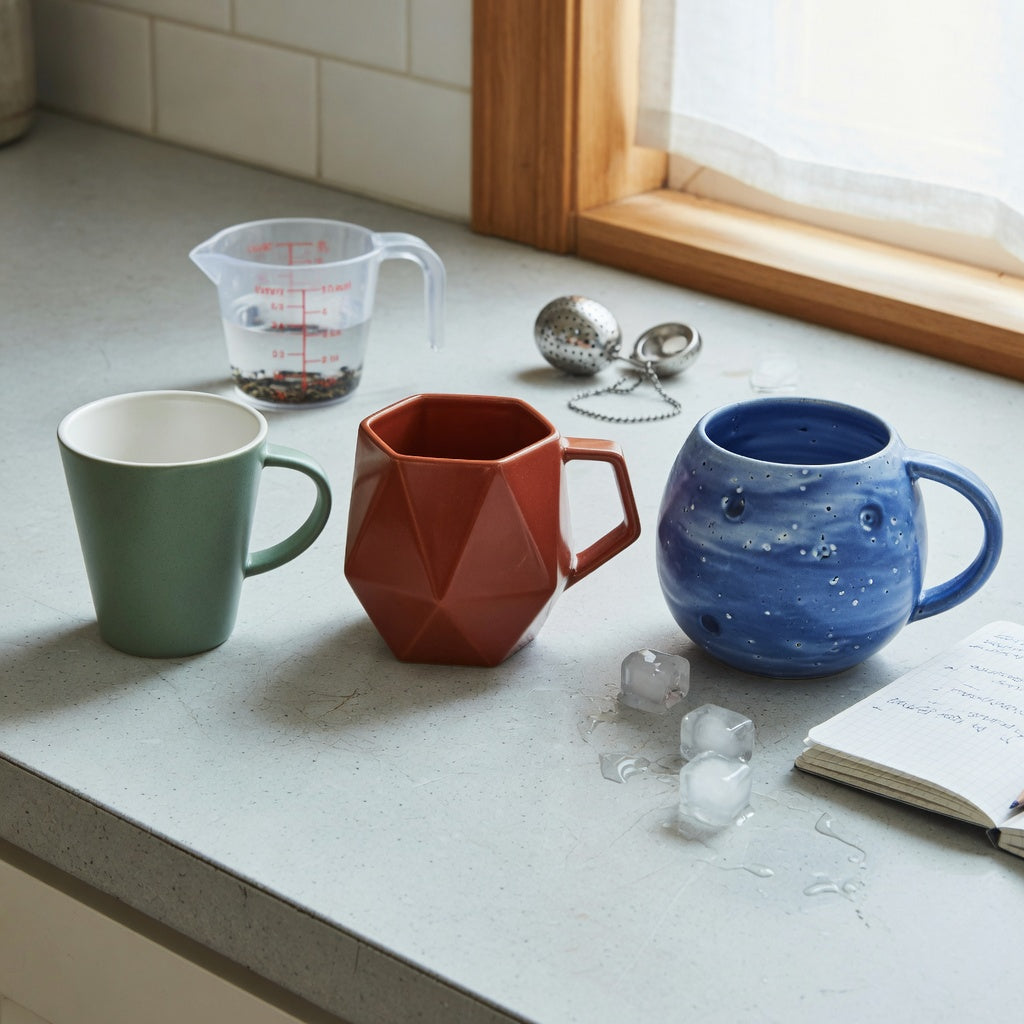
In our store, we compare three current ceramic options with visibly different forms: the tapered Gradient, the angular Rhombus, and the rounded Planet. We can use their listed capacities, ceramic material, and visible shapes to make a useful comparison. We do not use capacity to assume exterior dimensions, empty weight, insulation, dishwasher compatibility, microwave compatibility, or cup-holder fit. Those details require separate confirmation.
What does the difference between 11, 12, and 14 oz change?
The 11 oz Gradient is the smallest option in this group. The 12 oz Rhombus adds one ounce, while the 14 oz Planet adds two ounces over the Rhombus and three over the Gradient. That comparison is more useful than calling one mug small or large without context.
A listed capacity is also not necessarily the amount you will comfortably carry. Most people leave some room below the rim, and ice, milk, an infuser, or other additions change how much usable space remains. We recommend measuring your own routine instead of relying on a supposed standard serving.
- Fill your current mug with water to the level you normally use.
- Transfer that water to a marked measuring cup and note the volume.
- Account for any regular additions, including milk, ice, or a tea infuser.
- Decide whether you want the same working volume, more headroom, or a deliberately smaller pour.
- Compare that result with the listed 11, 12, and 14 oz capacities.
This quick test prevents a common buying mismatch: selecting the most striking shape, then discovering that the capacity does not suit the drink prepared at home or at work.
When is the 11 oz Gradient the more practical option?
The smallest current choice makes sense when your measured pour already fits within an 11 oz listed capacity and extra room would rarely be used. That can describe a short coffee break, a controlled tea pour, or a desk routine where a larger mug tends to remain partly full.
The 11 oz Gradient Coffee Tea Mug pairs that smaller capacity with a visibly tapered geometric form. It is the direct next step for a shopper who wants the lowest listed volume among these three and prefers the Gradient shape.
The trade-off is straightforward. It is not the practical choice if your finished drink regularly needs more than 11 oz of total room or if reducing refills is the main goal. Its lower capacity also does not prove that it has the smallest exterior footprint, so confirm physical clearance separately if a narrow cabinet or shelf is the deciding factor.
Who should choose the 12 oz Rhombus as the middle option?
The Rhombus fits a buyer who finds 11 oz slightly restrictive but does not expect to use the full 14 oz option. Its listed 12 oz capacity sits between the other two, and its visible angular, faceted form creates a different handling and display profile from the tapered Gradient and rounded Planet.
Choose the 12 oz Rhombus Coffee Tea Mug if your measured drink lands near the middle of this range and the faceted exterior is the form you actually want on a desk or kitchen shelf. The extra ounce over the Gradient is modest. If you are trying to make a noticeable jump in available capacity, moving directly to 14 oz may make more sense.
Faceted ceramic also deserves thoughtful handling. At our packing and washing surfaces, we avoid letting raised planes, edges, and rims knock against another hard item. Ceramic can chip at contact points, so the Rhombus is not ideal for a tightly packed sink or unstable stack where mugs regularly strike each other.
When does the 14 oz Planet justify the extra capacity?
The largest option earns its place when a measured finished drink does not fit comfortably within 11 or 12 oz, or when you want more room below the rim for additions. This is especially relevant for iced drinks because the ice occupies space, but there is no universal iced-coffee volume that makes 14 oz automatically correct.
The 14 oz Planet Coffee Tea Mug provides three more listed ounces than the Gradient and two more than the Rhombus. Its rounded visible form also offers a clear alternative to the other geometric profiles. It suits a kitchen or desk routine where the extra capacity will genuinely be used.
Using that added capacity means carrying more liquid weight, even though the product's empty weight cannot be inferred from ounces alone. A 14 oz label also says nothing about heat retention, insulation, lids, or vehicle cup holders. The Planet is not a substitute for an insulated travel mug if commuting, spill resistance, or all-day temperature control is the main requirement.
Geometric coffee mug size decision guide: capacity and form compared
This table keeps the decision within the facts available for the current products. The best fit depends on your measured pour and preferred visible form, not on an invented drink standard.
| Current option | Listed capacity | Material and visible form | Practical shopper fit | Main limitation |
|---|---|---|---|---|
| Gradient | 11 oz | Ceramic with a tapered form | Measured smaller pours and buyers who rarely use extra capacity | Least room for additions or longer no-refill sessions |
| Rhombus | 12 oz | Ceramic with an angular, faceted form | Middle-range pours and shoppers who prefer visible facets | Only one ounce more than the Gradient; edges need clearance from hard contact |
| Planet | 14 oz | Ceramic with a rounded form | Larger measured drinks or extra room below the rim | More liquid weight when the added capacity is used; no travel or insulation claims |
Capacity and exterior size are separate measurements. A 14 oz mug is not automatically a certain width or height, and an 11 oz mug is not guaranteed to fit a particular shelf. If clearance is critical, measure the available space and confirm current product dimensions with our store before ordering.
How should ceramic care and storage affect the size decision?
All three compared mugs are ceramic, so hard contact matters more than the one- or two-ounce differences between them. The rim and any raised geometric planes should not press against another mug during storage. We also avoid unstable stacking, especially where opening a cabinet door could cause pieces to shift.
- Before washing: Follow the care instructions supplied with the specific mug. Ceramic material alone does not confirm dishwasher or microwave compatibility.
- If dishwasher use is permitted: Leave enough clearance to prevent the rim or faceted surfaces from knocking against plates, racks, or other mugs during the cycle.
- For hand washing: Support the mug securely over the sink instead of holding it loosely by the handle while scrubbing.
- Before storage: Dry the contact surfaces and check that the mug sits steadily without resting on another piece's rim or raised edge.
A different product category will serve better if you need an unbreakable mug, a sealed lid, verified insulation, or a shape made for a vehicle cup holder. The current comparison supports ceramic desk and kitchen use; it does not establish travel performance.
Which size makes sense for a gift recipient?
At the gift-packing stage, we do not treat the largest mug as automatically more generous. A useful size reflects the recipient's routine. Someone who prepares a measured smaller drink may use the 11 oz Gradient more often, while a person whose finished drink regularly exceeds 12 oz has a clearer reason to receive the 14 oz Planet.
- Known smaller pour and preference for a tapered profile: Start with the 11 oz Gradient.
- Middle-range pour and interest in an angular, faceted exterior: Consider the 12 oz Rhombus.
- Measured drink above the smaller capacities or a need for more headroom: Move to the 14 oz Planet.
- Unknown habits: Do not assume 12 oz is universally safest. Check an existing favorite mug or ask about typical drinks and storage space.
For a broader visual comparison after deciding on capacity, open our unique coffee mugs collection. Compare the visible forms there, then return to the measured volume instead of choosing from the product photo alone.
Which current option matches your daily routine?
Use this geometric coffee mug size decision guide as a final filter before ordering. First choose the capacity, then the form. Reversing that order can leave you with an attractive mug that does not match the amount you prepare.
- Measure one normal finished drink.
- Select 11 oz, 12 oz, or 14 oz based on that volume and the headroom you prefer.
- Confirm that the tapered, faceted, or rounded form suits the recipient or setting.
- Check cabinet clearance rather than estimating exterior size from capacity.
- Verify the supplied care instructions against your washing and reheating routine.
Frequently asked questions
How do I use the geometric coffee mug size decision guide for milk or ice?
Measure the total drink as you actually prepare it, including milk, rather than measuring the coffee base alone. For an iced drink, account for the room occupied by ice and leave enough space to move the mug without spilling. No single capacity is correct for every recipe.
Is a 12 oz geometric mug the safest size for a gift?
Not automatically. The 12 oz Rhombus is the middle listed capacity, but the recipient may prefer a smaller pour, more headroom, or a rounded rather than faceted form. Checking a mug they already use gives you better evidence than choosing the midpoint by default.
Does ceramic mean these mugs are dishwasher and microwave safe?
No. Material alone does not establish dishwasher or microwave compatibility. Follow the current care instructions supplied with the chosen mug, and do not assume an appliance-use claim that is not explicitly provided.
Will the 14 oz Planet mug fit a car cup holder?
A 14 oz capacity does not reveal the mug's exterior width, base shape, or cup-holder compatibility. Confirm the relevant dimensions before buying for a vehicle. A dedicated travel mug is the better choice if a lid, spill resistance, or reliable cup-holder fit is essential.
Measure your usual pour, decide how much headroom you need, and compare that result with 11, 12, and 14 oz. Then review the current forms in the CoffeifyMug unique mug collection and choose the capacity you are most likely to use every day.
More from our blog
Read more

Small Ceramic Coffee Cup Size Decision Guide: Smaller or Larger?
Measure the drink you actually make, then compare it with the current listed capacities. This guide explains when a compact Pleated or Retro cup, a roomier Emerald mug, or another ceramic option be...
Read more
Ceramic Sculptural Mug Size Decision Guide: 250, 310 or 400 ml
Compare CoffeifyMug's 250 ml Ball Handle, 310 ml Handbag and 400 ml The Flow by actual pour size, refill habits, grip, storage, cleaning clearance and gifting fit. This guide also explains where ca...
Read more
Leave a comment
This site is protected by hCaptcha and the hCaptcha Privacy Policy and Terms of Service apply.