

Rustic Ceramic Coffee Mugs First Time Buyer Product Shortlist Guide
Reading time: about 10 minutes
Three rustic mugs can look equally convincing on a phone screen, then become very different purchases once one has to clear a crowded shelf, sit beside a keyboard, or cope with a shared sink. This rustic ceramic coffee mugs first time buyer product shortlist guide starts with those constraints. In our store, when our team handles a ceramic mug at the packing table, we look closely at the rim, the handle connection, and the foot ring because those areas affect everyday handling and are easy to miss in styled photography.
We also separate what a product page confirms from what a shopper might infer. The linked product names establish mountain-and-sea or elk-and-moon themes, and one title explicitly identifies a wooden handle. Capacity, external dimensions, care compatibility, construction details, and included accessories should remain unknown unless the live listing states them. That boundary matters more than a confident-sounding recommendation.
What should a rustic ceramic coffee mugs first time buyer product shortlist guide verify?
A useful shortlist records confirmed facts rather than assumptions pulled from photos. Before adding any rustic mug to the cart, write down these six listing fields:
- Published capacity: Record the exact ounce or milliliter figure. Brim capacity and a comfortable working fill are not necessarily the same, so do not create a second number if the listing provides only one.
- External dimensions: Look for height, rim diameter, base diameter, and maximum width including the handle. Overall width is especially relevant on narrow shelves and crowded office desks.
- Material breakdown: Confirm the body, handle, and any connecting hardware separately. The word ceramic does not establish the wood species, coating, fasteners, or handle construction on a mixed-material mug.
- Care instructions: Check for explicit dishwasher, microwave, and hand-washing language. Ceramic alone does not prove machine compatibility because glaze, decoration, attached wood, and hardware can change the answer.
- Finish and variation notes: Check whether the page describes handmade variation, reactive glaze, texture, or one-sided decoration. A rustic appearance does not automatically mean every mug will vary or that the motif wraps around the full body.
- Included components: Do not assume a lid, spoon, coaster, saucer, or gift box is included unless the listing says so. Styled photographs may contain props that are not part of the purchase.
An absent claim is not a negative claim. If dishwasher use is not stated, for example, we are not declaring the mug unsafe for a dishwasher; we are saying there is not enough published information to treat it as confirmed. Marking that field as unknown keeps general category advice separate from a product-specific promise.
Which mug should you open first for a kitchen, desk, or gift?
We do not rank one rustic mug as universally best. Instead, we match the first page you should inspect to the situation driving the purchase, then identify the fact that could disqualify it.
| Reader situation | First page to inspect | Why it fits the shortlist | Reason to skip or pause |
|---|---|---|---|
| A personal kitchen where landscape imagery is the main preference | Mountain Sea coffee and tea mug | The product identity gives you a clear mountain-and-sea design starting point. Choose it first if a landscape motif matters more than an animal theme. | Pause if exact shelf dimensions, capacity, handle construction, or machine-care instructions are non-negotiable and the live page does not confirm them. |
| A home-office desk or gift for someone who actively likes wildlife and moon imagery | Elk and Moon coffee and tea mug | The named elk-and-moon motif makes the visual decision specific. It is easier to shortlist for a known recipient than a vaguely rustic design. | Skip it for someone who avoids animal imagery or wants a plain matching set. Do not infer desk stability from the photographs alone. |
| A buyer who treats handle material as the deciding feature | Mountain Sea II mug with wooden handle | This is the only linked product whose title explicitly identifies a wooden handle. That makes it the logical first page when mixed-material construction is part of the appeal. | Pause if dishwasher use, microwave use, prolonged soaking, or one-material construction is required and the listing does not address it. |
| None of the three motifs or handle directions fits the room or recipient | Browse the unique coffee mugs collection | A broader comparison lets you change the design direction without forcing one of these three options into the wrong setting. | Skip the original shortlist rather than accepting a motif or care burden you already know will be inconvenient. |
The room still sets the rules. A crowded apartment kitchen makes overall width and shelf height more important than motif. An office desk puts base footprint and care convenience ahead of gift presentation. For a gift, the recipient's design taste and willingness to care for a wooden component can matter more than your own preference.
How do capacity, footprint, and shelf clearance narrow the list?
Capacity should match the drink that is actually poured, not an imagined oversized serving. Coffee with milk needs headroom above the liquid. Iced coffee needs space for ice, while tea drinkers who use an infuser may need enough rim opening and depth for their existing accessory. Use only the capacity stated on the product page, and do not treat a mug filled to the brim as a practical serving size unless the listing makes that distinction.
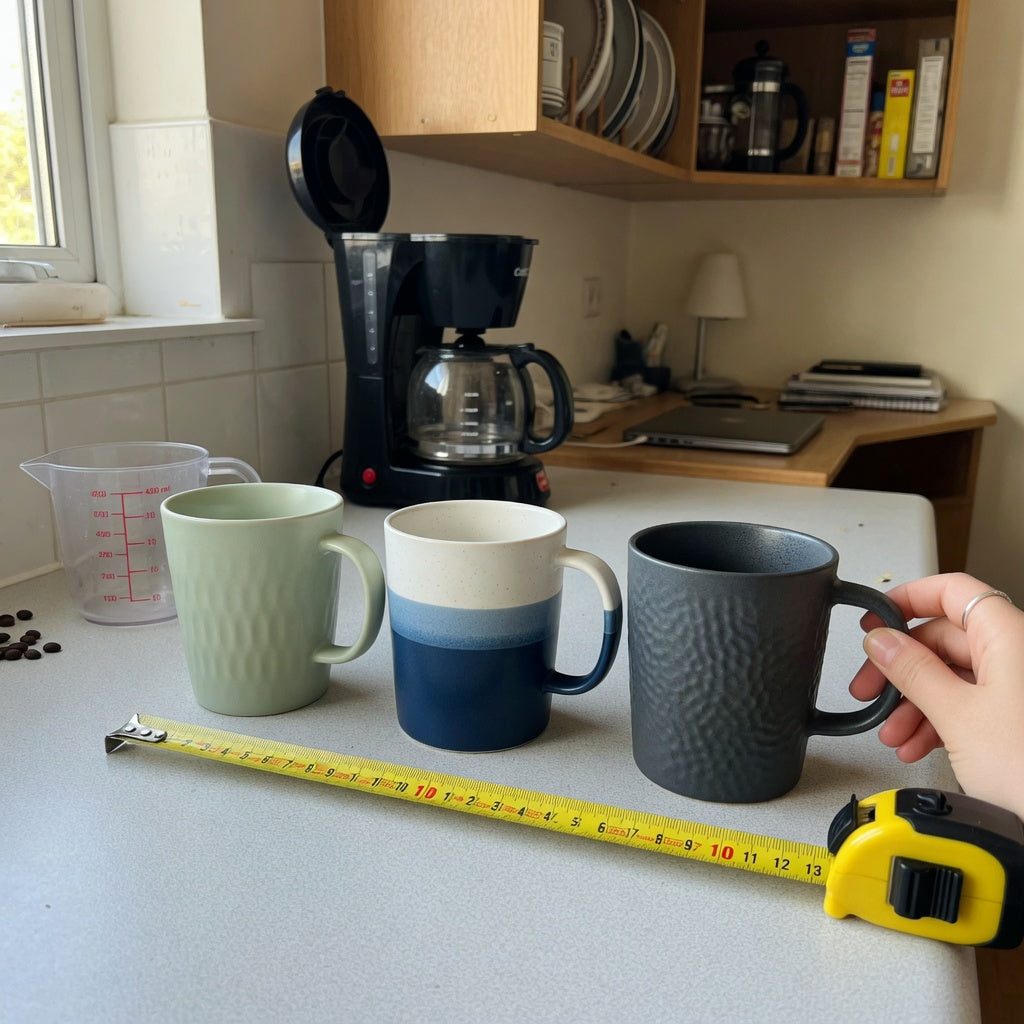
- For a cabinet shelf: Measure the available height and the maximum side-to-side space. Compare that space with the mug's full width including its handle, not just the ceramic body.
- For a desk: Look for base diameter and product weight if published. A photograph cannot confirm a flat foot, balanced weight distribution, or resistance to wobble.
- For a small counter: Check whether the handle projects far enough to interfere with a kettle, dish rack, or neighboring mug. Total footprint can rule out an otherwise appealing design.
- For gifting: Compare the dimensions with a mug the recipient already uses. If comparable measurements are not published, size remains an unknown rather than a reason to promise a familiar fit.
These measurements are concrete disqualifiers. If a mug must fit a specific shelf or workstation and the needed dimension is unavailable, the practical move is to pause rather than estimate scale from a lifestyle image.
What does the Mountain Sea II wooden handle change?
The wood-handled Mountain Sea II option gives first-time buyers one useful, product-specific difference before any deeper comparison. Its title confirms a wooden handle. It does not, by itself, establish the wood species, surface treatment, attachment method, insulation, grip comfort, or whether the handle can be removed.
Those unknowns affect care. From handling mixed-material drinkware, our conservative routine is to follow the published instructions first. If no care method is stated, hand-washing, avoiding prolonged soaking, and drying around attachment points are cautious habits, not manufacturer claims for this particular mug. Do not place it in a dishwasher or microwave based only on the presence of ceramic and wood.
The trade-off is straightforward: a wooden handle adds a distinct material and visual contrast, but it can create more care questions than a confirmed one-material construction. It is not the practical first choice for a communal office where every mug goes directly into a dishwasher unless the current product instructions explicitly support that routine.
Which details deserve a hands-on check after delivery?
Rustic styling can include deliberate texture or color variation, but functional surfaces still deserve a close inspection. When we unpack and handle mugs, these are the areas we check before the first drink or gift wrapping:
- Rim and drinking edge: Look and feel for chips, sharp spots, or cracks. A deliberately uneven glaze color is different from a damaged edge.
- Handle connections: Inspect where a ceramic handle joins the body. On a separately attached wooden handle, check for visible gaps, looseness, or movement without forcing the parts.
- Glazed surfaces: Look for sharp bare patches, concentrated pinholes, or crack lines. Small visual variations may be part of a rustic finish if the listing sets that expectation, but they should not be confused with structural damage.
- Foot ring and base: Set the empty mug on a dry, level counter to check for wobble. Run a finger carefully around an unglazed foot ring because a rough edge may mark a delicate desk or table.
- First wash: Use the care method published on the product page. Dry recessed bases and mixed-material joints rather than leaving standing water around them.
Do this inspection before filling the mug with coffee or tea. For a gift, check it before wrapping so the recipient's first unboxing is not also the first quality-control step. Rustic does not mean cracked, unstable, or sharp.
When are these rustic mugs the wrong first purchase?
A different mug style will serve you better if any of these needs controls the decision:
- You require confirmed dishwasher or microwave compatibility, but the selected page does not state it.
- You need stackable mugs for a short cabinet and no stackability or dimensions are published.
- You want a travel mug, sealed lid, or guaranteed vehicle cup-holder fit.
- You need a precise high-volume serving size and cannot verify the listed capacity.
- You are building a plain, uniform tableware set and do not want landscape, wildlife, or rustic visual variation.
- The recipient will not hand-wash a mixed-material mug if that care becomes necessary.
Those are reasons to skip, not objections to the designs themselves. The wider CoffeifyMug unique mug collection is the better next step when you need another motif or construction direction.
Your two-minute choose, pause, or skip checklist
- Name the main setting: kitchen shelf, office desk, or gift.
- Choose landscape, wildlife, or wooden-handle interest as the first visual filter.
- Record the published capacity and all available external dimensions.
- Confirm body, handle, and attachment materials separately.
- Read the dishwasher, microwave, and hand-washing language exactly as written.
- Mark every missing non-negotiable as unknown and pause the purchase.
- Write one reason to choose and one reason to skip each finalist before comparing again.
That is how we use the rustic ceramic coffee mugs first time buyer product shortlist guide in our store: start with the buyer's real setting, keep product facts narrow, and let an unresolved care or size requirement remove an option before checkout.
Frequently asked questions
How do I use a rustic ceramic coffee mugs first time buyer product shortlist guide?
Use it as a filter rather than a universal ranking. Match your kitchen, desk, or gift scenario to the three linked product pages, record only confirmed capacity, dimensions, materials, and care instructions, and mark missing fields as unknown. A mug earns a place only when it meets your non-negotiable requirements without inference.
Does the wooden handle mean the Mountain Sea II mug is dishwasher-safe or cooler to hold?
No. The product title confirms a wooden handle, but that fact alone does not prove dishwasher compatibility, insulation, temperature performance, or grip comfort. Follow the current care instructions on the product page and pause if machine washing is essential but not explicitly addressed.
Which rustic ceramic mug is best for a home-office desk?
There is no universal desk winner based on motif alone. The Elk and Moon mug is a sensible first page to inspect if that quieter wildlife theme suits the workspace, but base diameter, overall width, weight, and care instructions still need verification. Do not label any mug stable or keyboard-friendly from photography alone.
What capacity should I choose for coffee, tea, or iced coffee?
Start with the amount you normally pour and leave practical headroom for milk, movement, an infuser, or ice. Compare that need only with the capacity published on the listing. If capacity is absent, do not estimate it from the mug's appearance.
What should I do if a product page leaves my key requirement unknown?
Do not convert missing information into an assumed yes. Pause that option, compare another product page, or change the design direction entirely. Apply the same checklist while you compare more unique coffee mugs.
More from our blog
Read more
Cafe Au Lait Mug First Time Buyer Product Shortlist Guide
Compare The Flow 400 ml, Morning and Night 440 ml, and The Rock 480 ml against your actual pour, handle needs, and storage space. We identify what each listing confirms, what remains unknown, and c...
Read more
Matcha Latte Mug First Time Buyer Product Shortlist Guide: 3 Options
Compare the Ball Handle 250 ml, Round 390 ml, and Spittoon 400 ml using verified listing facts: capacity, the Ball Handle's listed 11.2 cm diameter, and visible opening shape. Each option has a pra...
Read more
Leave a comment
This site is protected by hCaptcha and the hCaptcha Privacy Policy and Terms of Service apply.