



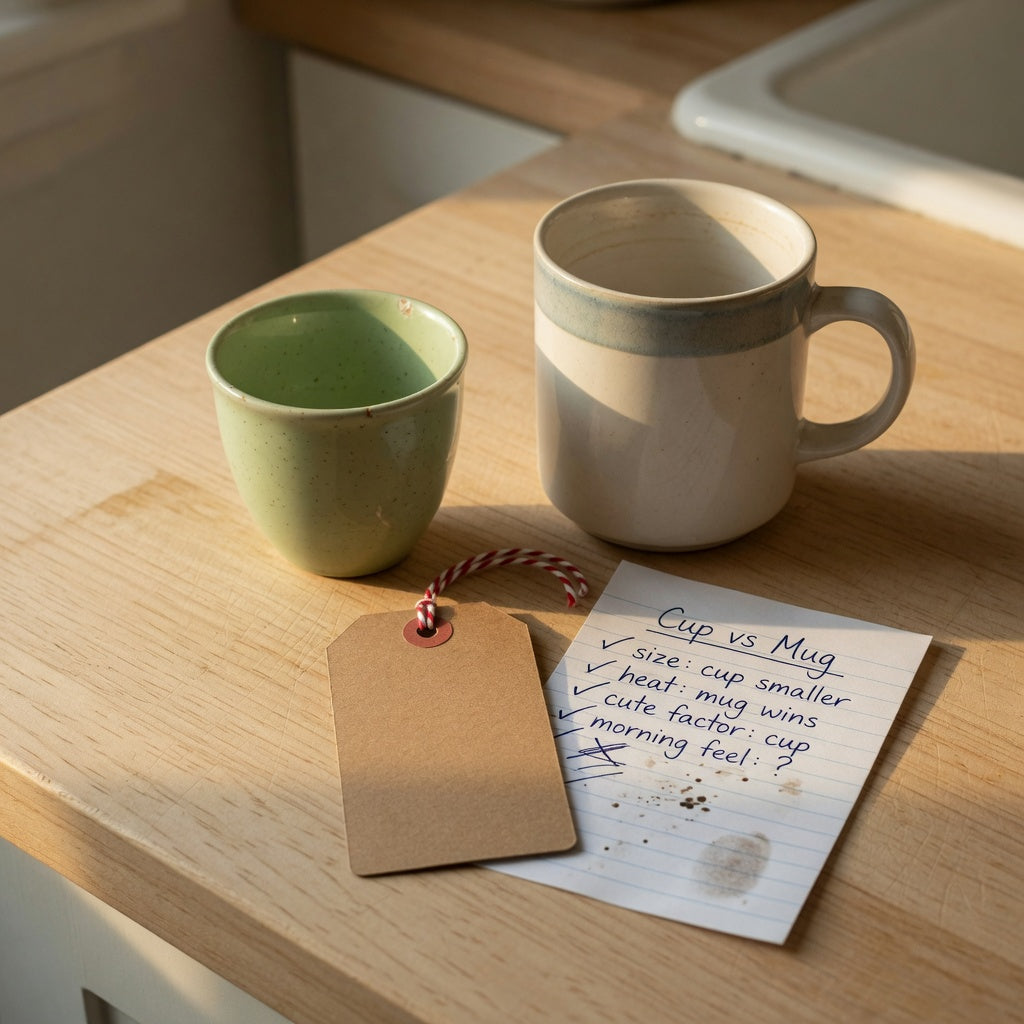
Retro Coffee Mug Gift Ideas: What Buyers Should Compare
Reading time: about 13 minutes
A customer stood at our packing table last week with two options for her dad's 60th. One was a glossy new mug printed with chrome-diner script. The other was a heavy earth-tone stoneware cup from a garage sale, with a hairline at the rim. Both looked retro. Only one was an easy yes for morning coffee. The other needed a harder conversation about chips, an unknown glaze, and whether it belonged on a shelf. That split is what we walk people through whenever they ask for retro coffee mug gift ideas.
Shoppers usually land in one of two piles. One pile is new drinkware printed or shaped to echo a 1950s diner, a 1970s kitchen, mid-century atomic lines, or 1980s-1990s nostalgia. The other is a true older piece: stoneware, a character mug, or a cup whose maker's mark is worn smooth. The right gift depends on whether the person will drink from it every weekday or enjoy looking at it. Those are not the same job.
Retro coffee mug gift ideas: new print or a true vintage piece?
Start with the job, not the artwork. If the recipient reheats coffee at a desk and runs everything through the dishwasher, a new commercial mug with care notes you can read is the kinder gift. FDA describes commercially made everyday pottery as much less likely to have a lead problem than antiques, worn pieces, and unknown flea-market ware. That is the split we use in our store. You still read the listing. You do not guess.
If the recipient collects, displays, or already keeps older cups in a cabinet, a true vintage piece can be the better story. Patina, a dated backstamp, and a shape you cannot reorder next month are the point. That mug may not be the one you hand someone for a 6 a.m. pour.
On our site, the Vintage Retro Small Coffee Cup is the listing we point people toward when they want a compact retro look rather than a big diner tankard. The catalog title calls it small, and that is the fact we will stand on. Capacity, body material, glaze, handle shape, and any microwave or dishwasher note live on the current page and can change, so confirm them before you promise a new daily driver. If the live listing confirms a modest size, it is a poor match for someone who fills a large mug and walks away from the pot. It can suit a short pour, a desk sipper, or a shelf that cannot take a heavy stoneware bucket. It is not a travel cup, and it will not replace an insulated commuter bottle.
If the retro look is close but the shape is wrong, browse our unique coffee mugs and compare handles, color, and scale side by side. A charming print can still be the wrong object in the hand.
| Gift path | Best when | Weak when |
|---|---|---|
| New retro-style mug | Daily coffee or tea, an office desk, care notes you can read | They want an actual older object, not a reprint of one |
| True vintage or thrifted mug | Display, a collector, a decade they actually lived through | Unknown maker, worn glaze, chips, or a microwave habit |
| Small retro coffee cup | A modest pour, a tight shelf, vintage look without a huge mug | Large latte habits, or size and care still unchecked on the listing |
Which decade belongs in their kitchen?
Buyers say retro and mean four different rooms. Matching the decade to the person beats buying the busiest graphic. In our experience, the miss is usually the giver's favorite era, not the recipient's.
- 1950s diner. Script, a thick lip, breakfast-counter color, sometimes a heavy foot. It reads as a costume in a quiet modern kitchen, and it can be exactly right for someone who still talks about the corner booth.
- 1960s-1970s earth-tone stoneware. Brown, mustard, avocado, speckled glaze, a chunky handle. It already looks like it lived in a wood cabinet. Collectors forgive a little wear. Daily users should not.
- Mid-century atomic and geometric. Stars, boomerangs, clean lines. Often a better fit for someone who likes design history more than slogans.
- 1980s-1990s nostalgia. Bold type, character art, louder color. Specific, and easy to overshoot if they did not like that decade the first time.
Milestone birthdays pull a lot of this search. A born-in-year line or a first name on a retro layout is language we hear for 40th, 50th, 60th, and 70th gifts. It is more personal than a generic joke mug, and less flexible. A misspelled name is a bad gift. A plain era-correct cup leaves room for their own coffee ritual. If you want a fuller box, pair the mug with cocoa or a small bag of beans only after the cup itself is the right size and safe to drink from. A packet of cocoa does not fix a chip or a wrong pour.
Parents, coworkers, and collectors are not the same recipient. A coworker gift should wash without a lecture and sit quietly in a shared kitchen. A collector will care about the mark on the bottom more than a modern large pour. Parent gifts go wrong when the decade is yours.
Does 11 oz or 15 oz matter more than the graphic?
Two sizes dominate the retro gift shelves we compare against: about 11 oz and about 15 oz. Neither is a rule, and neither is a spec we are pasting onto the cups in our catalog. An 11 oz mug is closer to a classic coffee pour and easier to lift if the walls are thick. A 15 oz mug suits people who hate refills and people who add a lot of milk. Thick stoneware can make a listed capacity feel larger in the hand and heavier on a weak wrist. Ask what they actually pour before you fall for the print.
The handle complaint shows up after the cute unboxing, not in the product photo. A narrow opening pinches fingers. A handle set too close to the body burns knuckles on a hot pour. Grip is what they will notice every morning, so compare that before the graphic.
Material changes the drink, and this is category guidance, not a claim about one listing. Ceramic holds heat in the liquid and can be hot at the rim. Glass shows the coffee and usually sheds heat faster. An insulated cup keeps temperature and drops the retro ceramic look. Do not buy a double-wall tumbler and call it a vintage mug. Lip shape matters too. A thick diner lip feels sturdy and can dribble. A thin lip drinks cleaner and chips easier on older pieces.
For the small retro cup on our product page, treat capacity, material, and handle shape as open questions until you read the current listing. Photos lie about scale. A mug beside a laptop is not a measurement. If they drink a large latte or reheat the same cup three times before lunch, look through the unique coffee mug collection for a different scale instead of forcing a small cup to do a big job.
When should a thrifted retro mug stay empty?
Most gift roundups skip this. We will not. Lead may be present in the glaze or the decoration on some traditional pottery. If the piece was not manufactured properly, that lead can leach into food or drink. Fired at the right temperature for the right time, essentially all the lead is bound into the glaze. Fired poorly, it may not fuse, and it may contaminate what you drink. Washing, boiling, and other kitchen tricks do not pull it out.
FDA treats higher-risk ceramicware as handmade pieces with a crude or irregular look, antiques, damaged or heavily worn items, ware from flea markets or unknown makers, and pieces brightly decorated in orange, red, or yellow. Commercially made everyday pottery is described as much less likely to have a lead problem. An unmarked garage-sale mug is not the same conversation as a new retro print from a seller who states how the cup is meant to be used. Less likely is not a certificate. Read the care line anyway.
FDA's lead action level for ceramic cups and mugs is 0.5 micrograms of lead per milliliter of leaching solution in any one of six units tested. For that limit, cups and mugs are described as small ceramic hollowware for hot drinks such as coffee or tea, normally about 8 fluid ounces (about 240 milliliters), usually with a handle. That is a regulatory category, not a shopping rule that every gift mug should be 8 oz. Some ceramic foodware has leached significant lead from food-contact surfaces. Extractable lead can cause a wide range of adverse effects, including chronic lead poisoning if the piece stays in food use.
FDA links lead poisoning in children to learning disabilities, developmental delays, and lower IQ scores. Infants, young children, and a developing fetus can be affected by chronic exposure that may not cause obvious symptoms. CDC has documented elevated blood lead levels in a family associated with traditional glazed ceramicware. Lead on a glaze or paint can transfer into foods or drinks, and it can cause serious health effects in children and adults. If a child or a pregnant person might use the mug, we would not gift an untested antique as a drinking cup.
A consumer lead test on the inside surface is a reasonable screen for a thrifted piece you hoped someone would drink from. If it finds leachable lead, do not cook, serve, or store food or drinks in it. Keep the mug as decor, or do not keep it. Some ornamental ceramicware is not for food at all. Pieces that look usable but are only decorative are supposed to carry a not-for-food warning or have a hole through the food-contact surface. A hole bored through the well is a stop sign, not a quirk.
Cadmium is the other metal worth naming when the palette is very bright. FDA has reported that imported and domestic ceramicware can contain significant extractable cadmium, that acid foods can pull it out, and that continued food use could cause chronic cadmium poisoning. The guideline cited for small hollowware is 0.5 micrograms per milliliter of leaching solution in any one of six units. There are no FDA regulations authorizing cadmium as a color additive or food additive, including as a component of foodware or a food-contact surface. Bright orange, red, or yellow is not proof of a problem. It is a reason to choose a labeled commercial mug when the gift is meant for drinking. Unknown old glaze stays on the shelf until there is a reason to trust the food-contact surface.
Chips, crazing, and a gold rim: drink from it or display it?
Condition decides use even when the era is perfect. We look at five spots before we would pack a secondhand mug as a drinking gift.
- Rim. A chip on the lip can cut and holds stains. A chipped rim is a display piece.
- Crazing. A fine crackle through the glaze can be part of an old look. It also gives stains and moisture a path. We do not call a crazed, worn cup good as new for everyday coffee.
- Handle joint. Hairline cracks where the handle meets the body fail in a sink of hot water, usually after the gift has been opened.
- Print and glaze wear. A faded diner logo can be charming on a collector shelf. On a daily mug it is already losing what you paid for, and worn decoration sits on the higher-risk list above.
- Metal trim. Gold and other metal rims look finished. They are a common reason to keep a mug out of the microwave. Do not assume a dishwasher will spare metallic paint. If the listing does not say microwave-safe and dishwasher-safe for that exact mug, do not promise either.
New retro mugs are not automatically rugged. A printed wrap can fade or scratch if the decoration sits on the surface and the owner treats it like plain diner china. Read the care line for the specific product. The small retro coffee cup in our catalog is not a blanket toss-it-in-with-the-pots recommendation. Check the current listing for appliance notes. If those notes are missing, write hand-wash on the gift card and skip the microwave until you know.
A retro mug is also the wrong gift when the person wanted a travel lid, a large insulated commuter cup, or something they can reheat three times a morning without thinking. Style will not fix that mismatch.
What a maker's mark proves before you wrap the gift
On a secondhand or character mug, flip it over in the light. A maker's mark, a country line, or a copyright date helps you separate a reproduction from an older piece. A mark is not a safety certificate. Reproductions are common in diner and character styles, and a fresh copyright line on a vintage graphic usually means a new print. If the bottom says nothing, gift it as retro style, not as a documented antique.
We use a short pass before a vintage-leaning gift leaves the counter:
- Food-contact surface: no hole, no decorative-only wording, no lead-test fail.
- Rim, handle joints, and foot: no chips that catch a finger.
- Inside glaze: no large bare patches, no sticky or powdery feel.
- Metal paint: written on the card so nobody microwaves it by habit.
- Scale: checked against how that person actually drinks, not against the photo.
Pairing is optional. Cocoa or a small bag of beans makes a fuller birthday box only after the mug itself is safe and the right size. A matching pair works when two people share a kitchen. One small cup is enough when the point is the shape on the shelf.
If you want the compact vintage look without a flea-market gamble, start with the current retro coffee cup listing and read the live details for size, material, and care. If you are still choosing among eras, colors, and handles, use the unique coffee mug collection as the comparison shelf instead of a random thumbnail.
Frequently asked questions
What should I compare first in retro coffee mug gift ideas?
Compare the job before the graphic. Decide whether the person will drink from the mug daily or keep it on a shelf, then match era, capacity, handle comfort, and care. A new labeled mug is the simpler daily gift. A true vintage piece needs a condition check, and often a lead check, before it holds coffee.
Do thrifted or vintage retro mugs contain lead?
Some can. Antiques, worn glaze, flea-market pieces, unknown makers, and bright orange, red, or yellow decoration deserve extra caution, because lead in a poorly made glaze or decoration can leach into drinks. A consumer lead test on the inside surface is a practical screen. If it shows leachable lead, do not use the mug for food or drink. Washing does not remove it.
Is a chipped, faded, or crazed mug still okay for everyday coffee?
We would not gift it as an everyday cup. A rim chip and a cracked handle joint are use problems, not just looks. Crazing and a faded print can be acceptable on a display piece. For daily coffee, choose an intact mug and follow the care marks for that exact item.
Should a retro gift mug be microwave-safe and dishwasher-safe?
Only if the person will actually microwave and machine-wash it. Gold or other metal rims are a reason to keep a mug out of the microwave, and metallic decoration may not survive a dishwasher. If the listing does not state those claims for the mug in your cart, assume neither, and say so on the gift note.
Is a born-in-year mug better than a plain retro cup?
It is better when you know the year matters to them and you can spell a name correctly. It is worse when you are guessing their taste or they already own a cabinet of slogan mugs. An era-matched cup without personalization is easier to use every day and easier to pass on.
Before you order, run those checks against the person, not against the prettiest photo. Then open the small retro cup listing or the unique mug collection and confirm size, material, and care on the page you are actually buying.
More from our blog
Ready to pick your mug? Two ways to save on today's order:
Ordering 1–3 mugs? Get an extra 10% off your 1st order with code 10_OFF Apply 10% Off & Shop Wooden-Handle Mugs →
Gifting 4+ mugs? Buy 3, Get the 4th Free applies automatically at checkout (no code needed; offers do not stack) · Free standard shipping (Nov pre-Christmas delivery: 15–20 calendar days US) · Free replacement if chipped in transit.
Popular mug buying guides: Ceramic Tea Cups & Infuser Mugs · Ceramic Mugs with Lids Compared · Wooden-Handle Tea Infuser Mugs Compared · Christmas & Secret Santa Mugs 2026 · Espresso & Cortado Cups Guide · Cup & Saucer Gift Sets · All 25 Mugs Spec Table · Mug Size Guide · Shipping & Promo FAQ
FIRST ORDER 10% OFF (CODE: 10_OFF) · OR BUY 3, GET THE 4TH FREE


Read more
Kio Mug Golden Waves Gift: What Buyers Should Compare
Shoppers searching for a kio mug golden waves gift often mix printed wave mugs, metal-trim porcelain, and sea-glass cups. We walk through material, care labels, capacity, and what actually ships be...
Read more
Round Coffee Mug Gift Ideas: Shape, Fill, and Care
Round coffee mug gift ideas only work when shape, real pour size, and care marks match how someone drinks. Here is what we check before a rounded mug leaves our store as a gift.
Read more
Leave a comment
This site is protected by hCaptcha and the hCaptcha Privacy Policy and Terms of Service apply.