



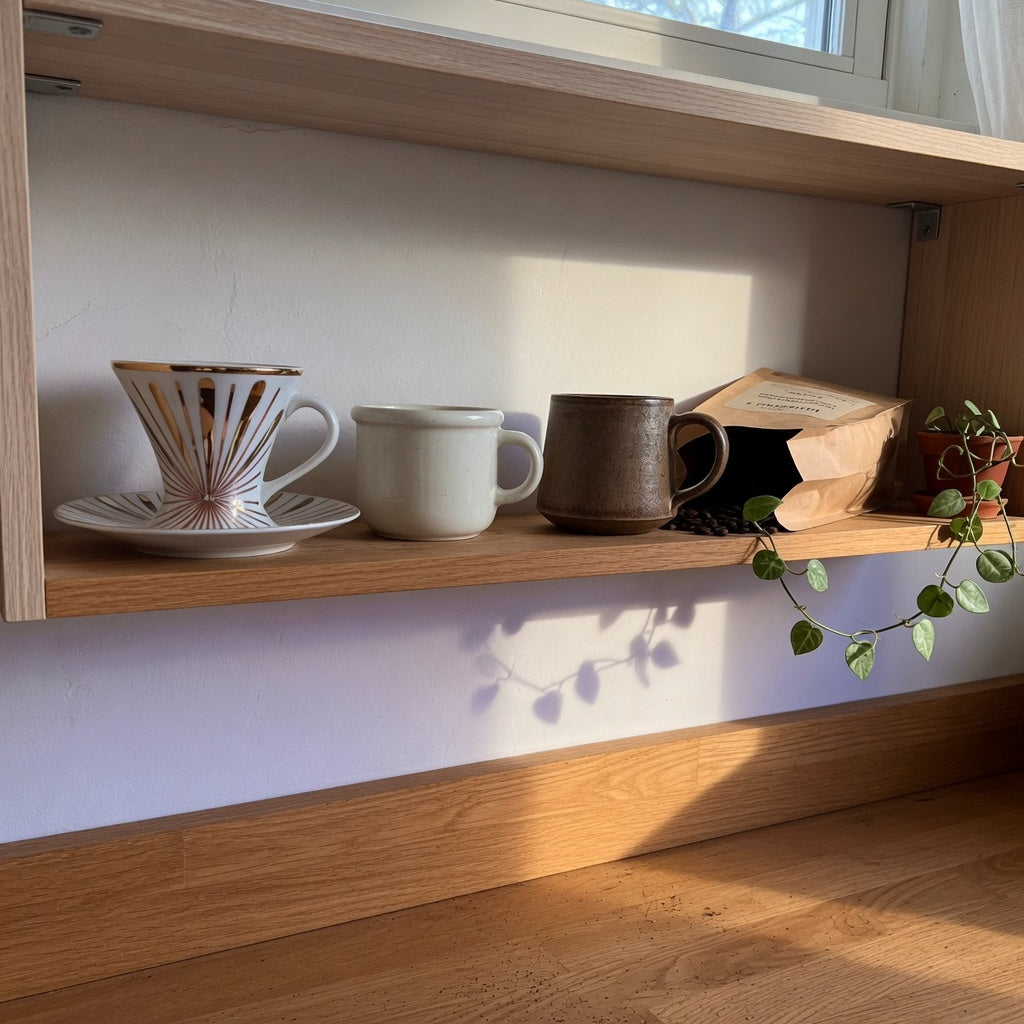
Retro Coffee Cup Gift for Home Decor Enthusiasts: What to Compare
Reading time: about 11 minutes
The box comes open, the cup gets flipped over to check the base, and someone at the table asks the question that decides the gift: can I actually drink coffee out of this, or is it for the shelf? We sell retro-style drinkware, and in our experience that one question matters more than the pattern. A retro coffee cup gift for home decor enthusiasts has to do two jobs at once — look right on an open shelf, mug rack, or home coffee bar, and survive a recipient who pours coffee into it every morning. Those jobs pull in opposite directions, and most of the comparison work is deciding which one your recipient cares about more.
Get that decision wrong and the cup ends up at the back of a cupboard, unused and slightly resented. Get it right and it becomes the mug they reach for while guests are still in the kitchen.
Daily drinker or shelf piece — settle this before you compare anything else
Split the category in half and the shopping gets simple:
- The daily drinker. It lives in the cupboard, goes through the dishwasher, gets reheated at 7 a.m., and needs a handle that fits a real hand. Food-contact status, care instructions, and capacity matter more than the era.
- The shelf piece. It sits on an open shelf or a bar cart and gets lifted down when someone asks about it. Silhouette, color, era signal, and condition matter more than whether it survives a hot cycle.
Most disappointing purchases in this category happen because the buyer shopped for the second and the recipient expected the first. If you genuinely cannot tell, buy the drinker. A cup that is safe and pleasant to use can still be displayed, but a decorative piece cannot be un-decorated.
Which retro look fits the room — atomic starburst, diner cup, or 1970s earth tones?
“Retro” covers at least four visually different families, and they do not style the same way. Match the era signal to where the cup will actually sit.
| Style family | What it signals | Where it looks strongest | What to watch |
|---|---|---|---|
| Atomic starburst / mid-century | 1950s–60s geometric motifs, often with thin metallic accents | Bright open shelving, white or walnut cabinets | Metallic trim usually means hand-wash only and never microwave |
| Diner-style cup | Thick-walled, straight-sided, colored band or logo | Countertop coffee station, breakfast bar, office desk | Heavy in the hand; check the handle opening before you commit |
| 1970s earth-tone stoneware | Browns, rusts, mustard glazes, chunky silhouettes | Wood-toned kitchens, cottagecore shelves, reading corners | Faded prints and crazing are common on genuinely old pieces |
| Cottage / farmhouse floral | Soft prints, pastel glazes, cup-and-saucer shapes | Shaker-style kitchens, tea trolleys, holiday tables | Smaller capacities; often espresso or tea size, not a mug |
Three buyer situations cover almost every gift we ship, and each points somewhere different:
- The recipient already has a styled coffee corner with a gap to fill. Buy one statement piece, not a set. Open the retro coffee tea cup listing first and read the base description, care line, stated capacity, and finish before you add it to the cart — those details decide whether the cup ends up on the shelf or in the sink.
- They are starting from zero and want to mix eras deliberately. Browse our unique coffee mugs collection by silhouette first, then finish. Comparing shapes side by side is faster than scrolling a single product page and guessing how it will look next to what they already own.
- They collect a specific era and will spot a reproduction instantly. Ask about the backstamp or maker’s mark before you buy anything, and be upfront that the piece is new retro styling rather than vintage. A collector who is told the truth will still love the gift; one who feels misled will not.
If the gift also needs to feel deliberate in presentation, our ceramic mug gift guide for coffee lovers covers packaging and pairing details that this comparison does not.
Is a retro coffee cup gift for home decor enthusiasts safe to drink from?
This is where gift buying in this category genuinely goes wrong. Retro styling is frequently applied to ceramic that was never intended to hold a hot drink, and the difference is often a line of text on the base.
Under 21 CFR 109.16, ornamental ceramicware whose glaze or decals can leach lead into food must carry a conspicuous warning — “Not for Food Use. May Poison Food” — plus a permanent version of that statement on the base, unless a hole is bored through the potential food-contact surface (21 CFR 109.16). Ware that looks suitable for food is treated as food-use ware by default. If a cup is sold as decor, the labeling usually says so.
The FDA’s position on lead is blunt: there is no known safe level of exposure, and lead used in pottery glazes can leach into food and drinks (FDA). Its guidance for ceramic cups and mugs sets an action level of 0.5 micrograms of lead per milliliter of leaching solution for any one of six units tested, and describes a cup or mug as small hollowware, normally about 240 mL (8 fl oz) and usually made with a handle (FDA guidance). That 8-ounce figure is also the most useful sizing anchor in this whole article.
The FDA names the categories that deserve extra caution: handmade crude ware, antiques, damaged or worn pieces, flea-market finds of unknown origin, and bright orange, red, or yellow decoration. Washing or boiling does not remove lead from a poorly fired glaze (FDA Q&A). New York City’s health department goes further, advising against using decorative, handmade, antique, damaged, or unclear-origin ceramics for preparing, serving, or storing drinks at all (NYC Health).
Translate that into three checks before checkout: does the base carry a food-use statement or a warning; does the listing describe the piece as drinkware rather than decor; and is there any chip, crack, or crazing in the food-contact area? If you cannot confirm all three, gift it as a display object and say so plainly when you hand it over. That honesty beats a cup that quietly sits unused because the recipient was never sure.
Will the print, gold rim, or glaze survive the dishwasher?
Retro looks fail in specific, predictable ways. The three we see most often:
- Metallic trim. Gold and platinum bands are thin metal films, which is why a good-looking cup becomes hand-wash-only. They should never go into a microwave — metal in a microwave arcs.
- Surface-printed graphics. Decoration applied over the glaze sits on top of the surface and abrades with scrubbing and repeated hot cycles. Decoration fired under the glaze is far more durable. Listing photos rarely tell you which one you are buying, so look for an explicit care line.
- Thermal shock. Sudden temperature swings stress any ceramic. Pouring boiling water into a cold cup, or dunking a hot cup into cold water, is the fastest way to crack a gift before it is ever used.
If the listing states dishwasher- and microwave-safe, that claim applies to that specific product — trust it there and nowhere else. If the listing is silent, assume hand-wash and no microwave. A five-second rinse costs the recipient far less than a faded 1970s graphic.
Capacity, handle opening, and saucer height: what decides whether it gets used
The FDA’s 8 fl oz benchmark is a good anchor because it matches what most people picture when they hear “cup.” Everything else is a deviation you need to check on the listing:
- Capacity. Espresso cups run a few ounces; diner-style cups often run larger than the 8-ounce standard; latte cups need width, not just depth. Anyone who drinks a 16 oz morning coffee will not adopt a 6 oz decorative cup as a daily driver.
- Handle opening. Eyeball the gap between handle and body. A two-finger handle is fine for tea; a three-finger handle is what makes a mug feel comfortable at breakfast. Photos with a hand in frame tell you more than a dimension.
- Height with the saucer. Cup-and-saucer sets are taller than they look once stacked. If the cup is going on a narrow shelf or under a cabinet, measure the total height, not just the cup.
- Set or single. One statement cup reads as a collectible; a matched pair or four-piece set reads as a coffee bar. Buy the set if the recipient hosts, the single if they curate.
Chips, crazing, and reproductions: judging condition before you gift it
Condition language matters more here than in almost any other gift purchase. A few terms worth knowing:
- Crazing is the fine web of cracks in the glaze itself, not the body. On a shelf piece it reads as character. On a cup someone drinks from, it is a place residue collects and a visible sign of age.
- A worn rim — where glaze has thinned to the clay — is the most common defect on a heavily used cup, and the first place a gift starts to look secondhand.
- Reproduction vs. new retro styling. A genuinely old piece usually carries a maker’s mark, backstamp, or country-of-origin mark on the base. A new cup made in a retro style may carry none of that, which is fine as long as the listing calls it retro-style rather than vintage.
- Faded prints and rubbed gold. Both are irreversible. If the pattern is the reason you are buying, examine the photos closely rather than trusting the word “excellent.”
When a different mug is the better gift
There are honest situations where a retro cup is the wrong choice, and we would rather say so than sell you one. Skip it if the recipient:
- Reheats their coffee two or three times a morning and owns nothing hand-wash-only;
- Drinks 16 oz or more per sitting and needs volume over silhouette;
- Has toddlers in the house and prefers unbreakable drinkware;
- Collects one specific era and will notice a reproduction immediately.
In those cases a plain, sturdy everyday mug serves them better, and our broader mug collection includes shapes that are decorative enough to display and practical enough to use daily. Pairing the cup with coffee beans, a small vase, or a shelf riser often lands better than upgrading the cup itself.
Sixty-second checklist before checkout
- Decide drinker or shelf piece, and buy accordingly.
- Read the base description for a food-use statement or a “not for food use” warning.
- Confirm the care line: dishwasher, microwave, or hand-wash only.
- Check stated capacity against how the recipient actually drinks coffee or tea.
- Check handle opening and total height, especially for a shelf or cabinet.
- Scan the photos for chips, crazing, worn rims, and rubbed metallic trim.
- Confirm the listing describes the piece as retro-style or vintage honestly, not both.
Still shortlisting? Compare shapes in the unique coffee mugs collection, or go straight to the retro coffee tea cup and run those seven checks against the current product page. If a detail is not stated there, message us before you buy — a two-line question saves a gift that ends up at the back of a cupboard.
Frequently asked questions
How can I tell if a retro coffee cup is decorative only?
Start with the base. Ornamental ceramicware that could leach lead into food must carry a conspicuous warning such as “Not for Food Use. May Poison Food,” plus a permanent version of that statement on the base. If the cup is sold as decor or the origin is unclear, treat it as a display piece and keep drinks out of it.
Can I microwave a retro cup with a gold rim?
No. Metallic bands and trim arc in a microwave. Even when a listing describes the body as microwave-safe, metallic decoration is a separate risk — keep any cup with a gold or platinum rim out of the microwave and wash it by hand.
What capacity should I look for in a retro coffee cup gift for home decor enthusiasts?
The FDA describes a standard cup or mug as roughly 240 mL (8 fl oz). Espresso-sized cups run much smaller and diner-style cups often run larger, so match the number on the listing to how the recipient actually drinks. A 6 oz decorative cup will not replace a 16 oz morning mug.
Is a genuine vintage cup a better gift than a new retro-style one?
It depends on the job. A true vintage piece carries character and a story, but antiques, damaged pieces, and unknown-origin finds are exactly the categories regulators flag for lead-leaching concern. A new retro-style cup with a verifiable care line and food-contact statement is the safer gift for someone who will actually drink from it.
How do I keep a 1970s-style printed graphic from fading?
Hand-wash in warm water with mild detergent, skip abrasive sponges, and avoid stacking other cups against the print. Surface-applied decoration abrades with scrubbing and repeated hot dishwasher cycles, and once the print fades there is no restoring it.
More from our blog
Ready to pick your mug? Two ways to save on today's order:
Ordering 1–3 mugs? Get an extra 10% off your 1st order with code 10_OFF Apply 10% Off & Shop Wooden-Handle Mugs →
Gifting 4+ mugs? Buy 3, Get the 4th Free applies automatically at checkout (no code needed; offers do not stack) · Free standard shipping (Nov pre-Christmas delivery: 15–20 calendar days US) · Free replacement if chipped in transit.
Popular mug buying guides: Ceramic Tea Cups & Infuser Mugs · Ceramic Mugs with Lids Compared · Wooden-Handle Tea Infuser Mugs Compared · Christmas & Secret Santa Mugs 2026 · Espresso & Cortado Cups Guide · Cup & Saucer Gift Sets · All 25 Mugs Spec Table · Mug Size Guide · Shipping & Promo FAQ
FIRST ORDER 10% OFF (CODE: 10_OFF) · OR BUY 3, GET THE 4TH FREE


Read more
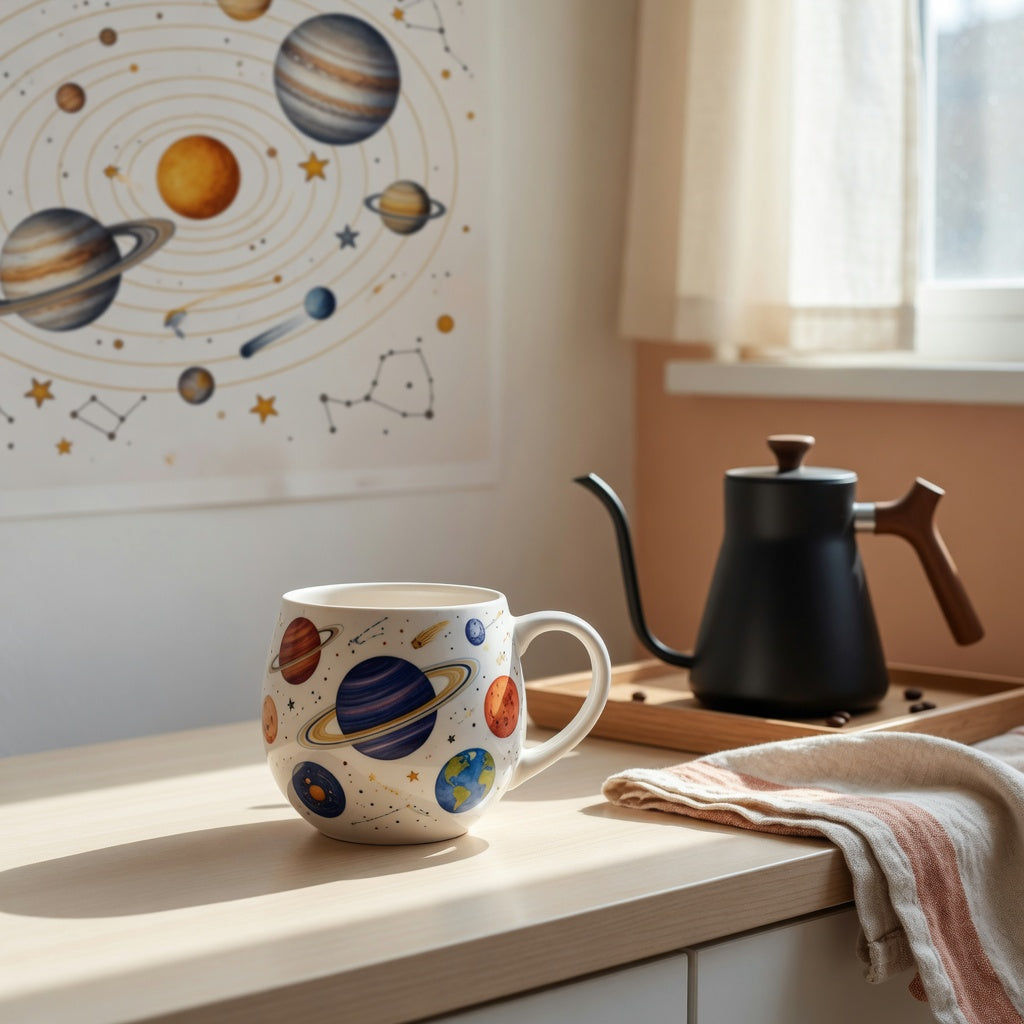
Planet Mug for Coffee Lovers Home Decor: A Buyer's Comparison
A planet mug has to survive coffee, a sink, and a shelf. We compare heat-reveal, printed ceramic, stoneware, and enamel, then walk through capacity, care lines, and the planet-accuracy checks worth...
Read more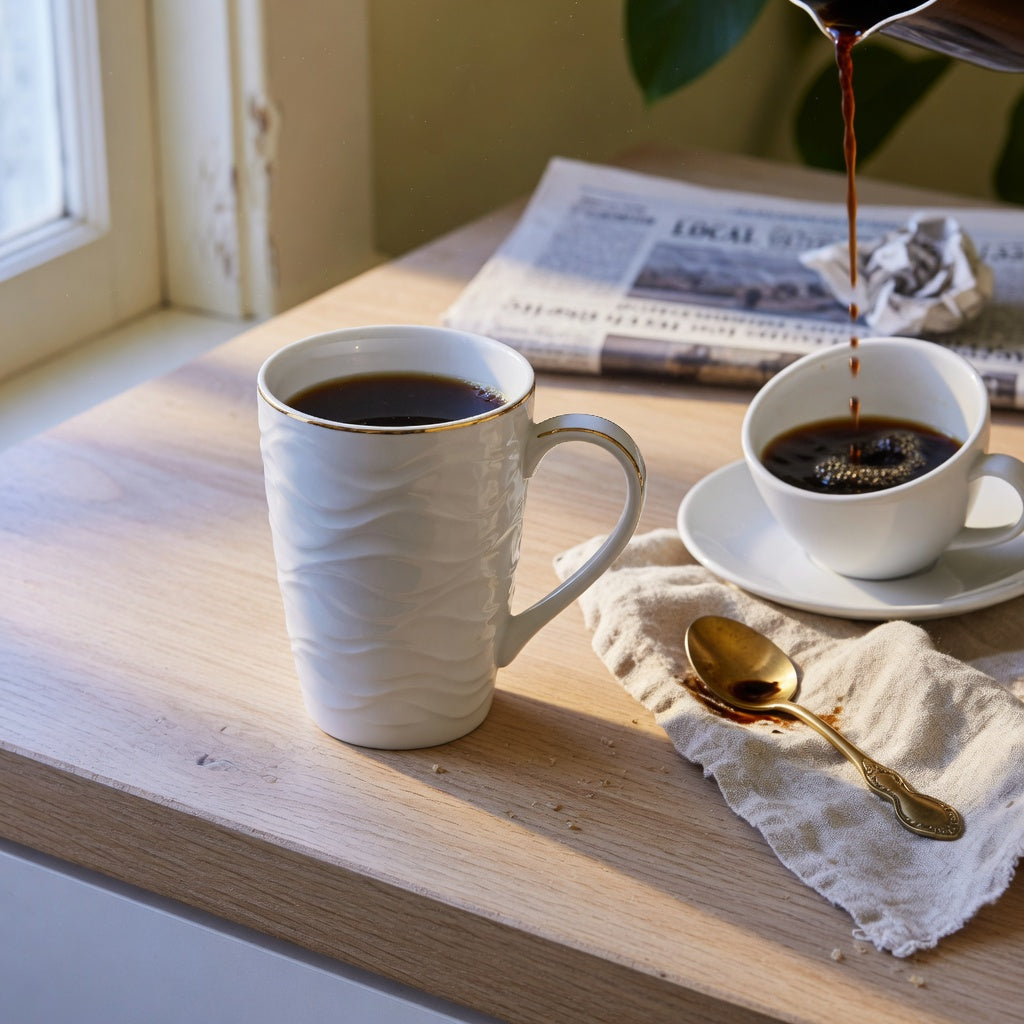
White Golden Waves Tall Coffee Tea Mug for Coffee Lovers Home Decor
A tall white mug with a gold wave line is easy to love in a photo and harder to live with if the trim is metallic. Here is what to verify on capacity, microwave use, rim decoration, and gifting bef...
Read more
Leave a comment
This site is protected by hCaptcha and the hCaptcha Privacy Policy and Terms of Service apply.