
Practical matcha latte mug shared household product shortlist guide
Reading time: about 8 minutes
At 7:15 a.m., one resident makes a compact matcha latte. Ten minutes later, another adds more milk and finds the same mug too small. Buying identical shapes would not fix the mismatch. A matcha latte mug shared household product shortlist guide should answer a narrower question: which individual mug fits each person's normal finished volume without filling the cupboard with options nobody needs?
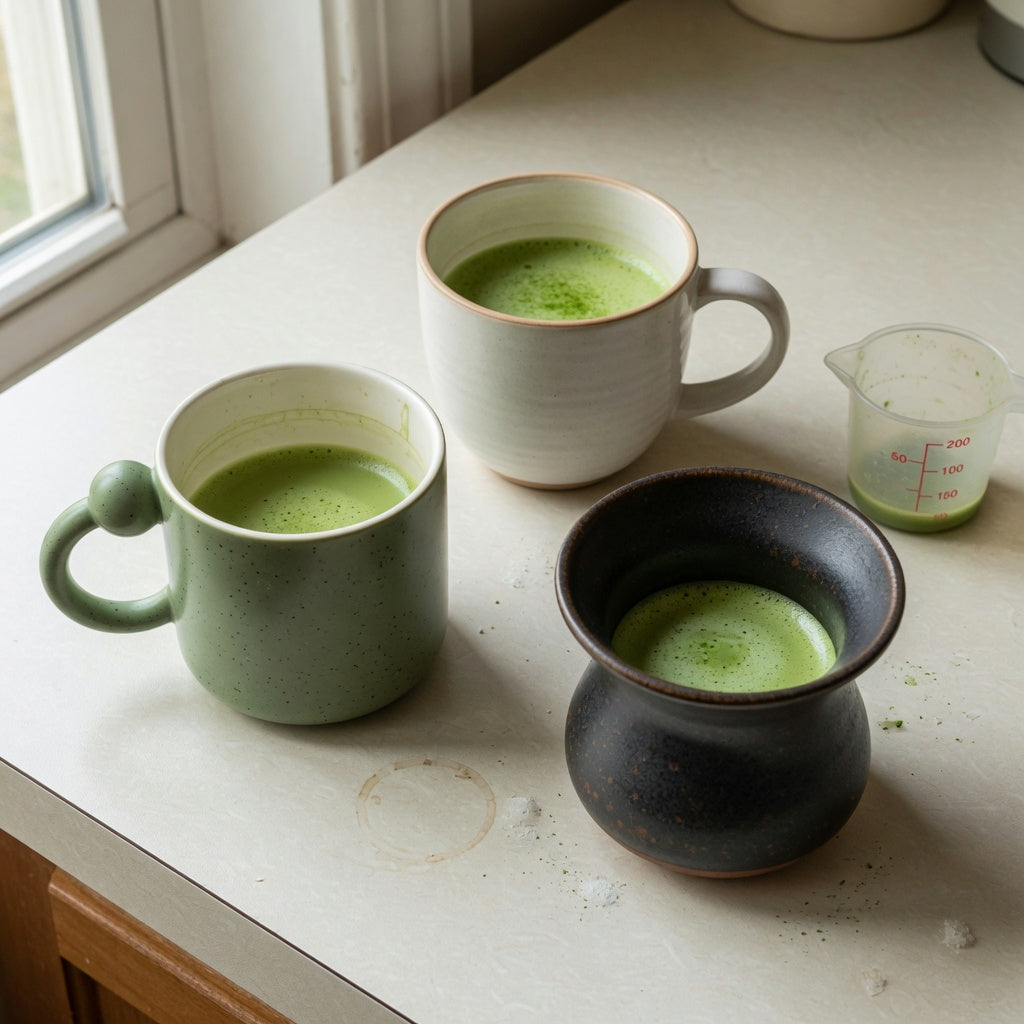
At CoffeifyMug, we keep the answer tied to catalog facts we can support: Ball Handle at 250 ml with a listed 11.2 cm diameter, Round at 390 ml, and Spittoon at 400 ml. We compare listed capacity and visible opening shape only. These are separate product listings, not a set recommendation, and we do not turn appearance into claims about whisking, care, or heat.
How does the matcha latte mug shared household product shortlist guide separate serving sizes?
Measure what each person actually drinks. Fill the current favorite mug with cool water to the level that person normally uses, then transfer the water to a suitable kitchen measuring jug and record the milliliters. This avoids vague labels such as small or large, and it does not require handling a hot drink during the check. It measures serving habit, not recipe quality.
Compare that result with the listed capacities below. Do not treat capacity as a promised everyday fill line. The product listing cannot know how much space each resident prefers to leave below the rim.
| Individual option | Verified catalog detail | Reason to choose | Reason to skip |
|---|---|---|---|
| Ball Handle | 250 ml; listed 11.2 cm diameter | Measured serving sits clearly below 250 ml and the smaller capacity is preferred | Normal serving reaches or approaches 250 ml |
| Round | 390 ml; round visible opening profile | More than 250 ml is needed and the round opening shape is preferred | Serving approaches 390 ml or a compact option is wanted |
| Spittoon | 400 ml; spittoon visible opening profile | Measured serving fits below 400 ml and the spittoon profile is preferred | The 390 ml option already leaves the desired margin or the profile is not preferred |
The 390 ml and 400 ml options differ by only 10 ml. If both leave enough room for a resident's normal drink, we would not present that small capacity gap as a major usability difference. Visible opening preference becomes the more honest tie-breaker within the facts available.
Who should choose or skip the 250 ml Ball Handle mug?
The Ball Handle 250 ml coffee and tea mug is the smallest listed capacity in this shortlist. It suits the resident whose measured fill falls clearly below 250 ml and who prefers its visible profile. Its listed 11.2 cm diameter is the only additional numeric dimension used here. That number is a useful reference beside a current mug, but it cannot establish height, weight, or complete cabinet fit.
- Choose it: One resident consistently makes the household's smallest matcha latte and does not need the flexibility of a 390 ml or 400 ml capacity.
- Skip it: That resident's usual drink approaches 250 ml, adds enough milk to exceed it, or changes serving size often.
- Consider a different style: Full exterior dimensions, stackability, material, or verified care compatibility matter more than listed capacity and visible opening shape.
On a shared counter, the Ball Handle mug should not become the default for everyone just because it is the most compact option. It is a targeted choice for the smallest consistent serving.
Round 390 ml or Spittoon 400 ml: does 10 ml settle it?
The Round 390 ml coffee and tea mug and the Spittoon 400 ml coffee and tea mug are close in listed capacity. Ten milliliters is the arithmetic difference, nothing more. The decision should come from the resident's measured serving and preference for the visible opening profile.
- Choose the Round 390 ml: The usual finished drink sits below 390 ml with the resident's preferred margin, and the round opening profile is the better visual fit. Skip it if the serving crowds that capacity or the spittoon profile is preferred.
- Choose the Spittoon 400 ml: The normal pour fits below 400 ml with the desired margin, and the resident specifically prefers the spittoon-style opening. Skip it if 390 ml already accommodates the drink or the round profile suits the cupboard better visually.
- Skip both larger options: The resident consistently drinks well below 250 ml and does not want extra unused capacity. The Ball Handle listing is the more focused place to start.
If two residents drink similar volumes but prefer different silhouettes, selecting one individual listing for each is a coherent shortlist. There is no need to claim that one opening shape performs better than the other.
How can housemates avoid buying every option?
Shortlist by resident, not by product count. In our store, that keeps the comparison tied to actual kitchen routines rather than the idea that a shared household needs a coordinated group of mugs.
- One compact pour and one larger pour: Inspect the Ball Handle for the compact drinker. Compare Round and Spittoon for the larger drinker using measured volume and visible shape preference.
- Two larger pours: Skip the 250 ml option unless another resident needs it. Decide between 390 ml and 400 ml separately for each person.
- One variable serving: Measure both common fill levels. If the larger one crowds 390 ml, remember that 400 ml adds only 10 ml; neither option should be forced if that is still insufficient.
- Everyone drinks a compact serving: Start with the Ball Handle listing. Larger capacities do not earn a place on the shortlist merely because more room is available.
If none of those mappings works, browse the unique coffee mugs collection for other individual shapes. A different style is a better next step than buying one of these three despite a poor capacity match.
What do capacity and visible opening shape not prove?
Opening profiles are easy to overinterpret in product photos. We keep our recommendations inside the limits of the verified details so shoppers know exactly what this comparison can and cannot establish.
- No whisking claim: A visible opening shape or listed diameter does not prove better whisking performance.
- No authenticity claim: Mug shape alone does not establish ceremonial authenticity.
- No accessory claim: Do not assume a whisk, spoon, stand, or other tool is included.
- No care or heat claim: This shortlist does not establish microwave safety, dishwasher safety, or heat retention.
- No material or full-size ranking: Material, weight, height, and complete exterior dimensions are not comparison factors in this article.
If care compatibility, exact shelf fit, stackability, or a particular material is the deciding requirement, pause at the product page and verify the current details. A different mug style with those specifications would suit that household better than an unsupported assumption.
What should housemates write down before opening the product pages?
Use the matcha latte mug shared household product shortlist guide as a five-minute filter at the kitchen counter. One note per resident is enough.
- Measure the normal fill level in milliliters using cool water and a suitable measuring jug.
- Record whether that person likes a noticeable margin below the rim.
- Cross out 250 ml if the measured level reaches or approaches that capacity.
- For larger servings, compare 390 ml with 400 ml and use visible opening shape to settle a close result.
- Open only the individual product pages that survive the comparison.
A useful result may contain one option, two options, or none of these three. The goal is a defensible shortlist, not a full cupboard.
Frequently asked questions
Is the 250 ml Ball Handle mug large enough for a matcha latte?
It can be if the resident's usual measured fill sits clearly below 250 ml. If the drink reaches or approaches that amount, a larger listed capacity is the more practical shortlist choice. The 11.2 cm diameter does not add capacity.
What is the practical difference between the 390 ml Round and 400 ml Spittoon mugs?
The listed capacity difference is 10 ml. If both leave the preferred space below the rim, compare the round and spittoon visible opening profiles. This guide does not claim that either shape changes drink preparation or performance.
How do I use a matcha latte mug shared household product shortlist guide for two different serving sizes?
Measure each resident's normal fill level separately. Match the smaller serving to 250 ml only if it fits with the person's preferred margin, then compare 390 ml and 400 ml for the larger serving. Select individual listings rather than treating the shortlist as a required set.
Are the Ball Handle, Round, and Spittoon mugs a matching set?
No set is implied by this guide. The three options are compared through separate product listings, and shoppers should select only the individual mug or mugs that fit their household serving habits.
Can I assume these mugs are dishwasher safe or microwave safe?
This comparison cannot support that assumption. Its verified factors are listed capacity, visible opening shape, and the Ball Handle mug's listed diameter. Check the current product page before making any microwave, dishwasher, or other care decision.
Write each resident's measured fill beside 250 ml, 390 ml, and 400 ml. Cross out any capacity that does not leave the margin that person wants, then use visible opening shape to break a 390 ml versus 400 ml tie. That leaves a practical one- or two-product shortlist without treating three individual mugs as a required purchase.
More from our blog
Read more
Ceramic vs Porcelain Coffee Mugs Weekend Coffee Product Shortlist Guide
Compare ceramic and porcelain for slower Saturday coffee using hand feel, shape, care, and table setting as practical filters. Three CoffeifyMug designs are matched to clear choose-or-skip scenario...
Read more
Unique Pottery Coffee Mugs Shared Household Product Shortlist Guide
Shared kitchens need mugs that are easy to identify, but a black-coffee drinker, a slower tea sipper, and a finish-focused recipient may want different designs. This unique pottery coffee mugs shar...
Read more
Leave a comment
This site is protected by hCaptcha and the hCaptcha Privacy Policy and Terms of Service apply.