



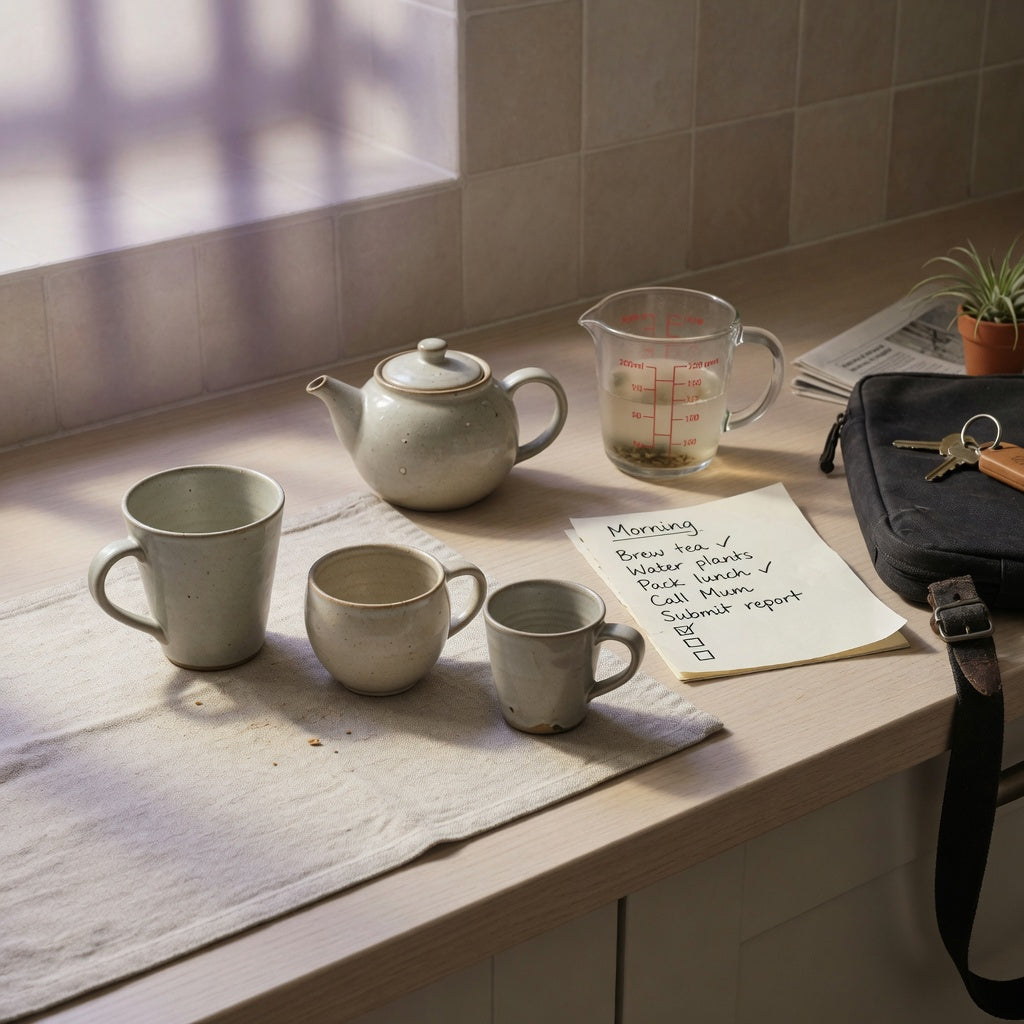
Pottery Tea Cups Morning Routine Practical Purchase Checklist
Reading time: about 9 minutes
The kettle clicks off, you pour, and the cup is empty before the toast is down. That small friction is what our pottery tea cups morning routine practical purchase checklist is built to catch: not how the cup looks on a shelf, but whether it carries you from first pour to front door without an extra trip.
In our store, we start with the boring number. The ceramic Retro Coffee & Tea Cup is listed at 170 ml, which makes it a small-serving cup, not a stand-in for a large morning mug. If you want to see the wider range before narrowing down, browse the unique coffee mugs collection and compare each listing’s current details.
Your pottery tea cups morning routine practical purchase checklist starts with one measurement
Before you compare shapes, measure the drink you actually pour on a workday. Use a jug, include milk or anything else you add, and note whether you go back for a second pour. A cup can be right for your tea and wrong for your habit.
- One small serving: Start around 170 ml if your measured drink is smaller than that and you like a compact cup with the pot nearby.
- A moderate serving: Compare 200 ml and 250 ml if you want more room but do not need a large mug.
- A larger drink with no interruptions: Measure carefully. Even 250 ml may be too small, and a larger mug may suit you better than any of these three.
Listed capacity is not the same as comfortable fill. Most people leave some room below the rim for carrying, milk, or a steady hand. That is why a cup whose listed capacity matches your measured drink can still feel tight in practice. If that margin will decide your choice, ask us about usable fill volume for the exact cup.
170 ml, 200 ml, or 250 ml: which listed capacity matches your refill tolerance?
The three CoffeifyMug cups below share a ceramic body, but their listed capacities and named forms give them different morning jobs. We keep the comparison to what the catalog verifies: listed capacity, ceramic body, and visible form. Check the live listing for anything else.
| Cup | Listed capacity | Morning fit | Check before ordering |
|---|---|---|---|
| Retro Coffee & Tea Cup | 170 ml | Best for a short first pour or a routine where the pot stays within reach; least suited to no-refill mornings. | Usable fill, rim feel, and current care details. |
| Pleated Coffee & Tea Cup | 200 ml | A middle size for a moderate pour when you can accept one refill on a longer morning. | Whether your usual pour fits below the rim with room to spare. |
| Ball Handled Coffee & Tea Mug | 250 ml | The largest listed capacity of the three; start here if you want more tea in the first pour. | Handle opening, empty weight, and current appliance guidance. |
Refill math is simple. A 400 ml morning would need at least three fills of the 170 ml cup or two fills of either the 200 ml or 250 ml cup, assuming each is filled to its listed capacity. In practice, leaving room below the rim can add another fill. If 400 ml with no refills is your normal, none of these should be your primary cup; look for a larger vessel.
For context, FDA’s cup-and-mug guidance describes small ceramic hollowware as commonly holding about 240 mL with a handle. That is a regulatory category, not a rule that every tea cup should be 240 ml, but it explains why 170 ml feels small against a standard mug. If you want a larger-serving comparison, our black tea mug checklist for 390–400 ml routines and ceramic tea mug morning checklist cover that lane.
Will the cup still fit your counter, desk, and grip at 7:30 a.m.?
Capacity solves only half the problem. Picture the route: kettle to counter, counter to table, table to desk. A 250 ml cup is heavier when full than a 170 ml cup, and a cup you carry while walking needs a grip that feels secure before the tea goes in.
For a handled cup such as the Ball Handled Coffee & Tea Mug, ask about the handle opening if you need room for more than one finger. For any cup without a handle, think about how you hold it when full and hot; we cannot confirm heat feel from listed capacity alone. Rim shape matters too. A thin, smooth lip feels different from a thick rounded one, especially if you drink slowly. Online, use the listing images and ask the seller about rim and base if you are particular.
Trade-off: a small cup is lighter and easier to carry, but it may mean more refills. A larger cup reduces trips but takes more counter space and may not fit a tight desk corner. Measure your cupboard shelf and your usual spot before you fall for a shape.
What should you verify about glaze and food contact before the first pour?
Pottery is a broad word. Earthenware, stoneware, and porcelain are different ceramic categories, and a cup’s name or surface does not tell you how porous the body is, how it was fired, or whether the finished piece is intended for hot drinks. For the three linked cups, our verified details cover ceramic body, listed capacity, and visible form; they do not establish glaze composition, food-contact status, test results, or firing method.
The FDA explains that lead can be present in glazes or decorations on some traditional pottery, and that lead can leach if a piece is not manufactured and fired properly. Proper firing at the right temperature and time binds essentially all the lead into the glaze. FDA flags higher concern for handmade ware with a crude or irregular look, antiques, damaged or heavily worn pieces, flea-market or street-vendor buys, unidentified makers, and bright orange, red, or yellow decoration. Washing or boiling does not remove lead from pottery.
Ask about the finished piece, not just an ingredient. Which surfaces touch the tea and your lips? Is there a test report, and does it cover the finished cup or batch you will receive? A lead free label has a specific meaning: FDA says ware that contains extractable lead under its test method should not be labeled that way. That still does not answer every question about a handmade one-off, so ask how the report relates to the cup in your hand. Cadmium has separate FDA guidance for small hollowware, which is another reason to ask what was tested rather than assume from a glossy finish.
Do not put a piece marked decorative-only or Not for Food Use. May Poison Food into your breakfast rotation. If the seller cannot answer the food-contact question, wait. Appearance is not proof.
Which visible flaws are a stop sign when the cup arrives?
Unbox in good light before the first pot. These checks spot visible problems; they cannot prove a glaze passes a leach test.
- Chips and cracks. Check the drinking edge, handle attachment if present, and inside. Take a chipped or cracked drinking surface out of service while you ask about replacement.
- Glaze on contact surfaces. Pinholes, rough patches, bare clay, or unexpected decoration where tea or lips touch deserve a question to the maker before use.
- Crazing versus a crack. Crazing is a network of fine lines in the glaze; a structural crack involves the ceramic body. A photo may not settle which you have, so ask if you are unsure.
- Base and foot. Set the empty cup on a level counter. A wobble or a rough foot that marks a desk is a practical annoyance, even if the cup looks fine.
Later damage counts too. A cup that develops a crack or chip leaves drink service. Keep it for display or ask the maker about next steps.
Can your morning cup go in the dishwasher or microwave?
That depends on the individual cup. Ceramic construction alone does not confirm dishwasher or microwave compatibility, and the verified details for the Retro, Pleated, and Ball Handled cups do not establish either. Check the current listing or ask us before buying if an appliance-safe cup is essential.
Ask about the dishwasher and microwave separately; an answer for one does not establish the other. Metallic decoration should stay out of the microwave. Follow the maker’s washing instructions, and avoid sudden temperature changes unless the maker says the piece is made for them. If your mornings end with everything going straight into the dishwasher, an unconfirmed care instruction is a real trade-off. If you are happy to hand-wash a favorite cup, the extra step may be worth it.
When is a pottery tea cup the wrong purchase for your morning?
Skip a small pottery cup if you routinely drink 400 ml or more and dislike refills. None of the three capacities here solves that in one pour. Skip it if you need a documented appliance rating and the listing does not provide one, or if you want a tested food-contact report for the exact piece before you buy. Also skip the guess if you are buying a gift for someone particular about rim feel or handle fit; a return policy or a different style may serve you better.
If you want a larger vessel or a different form, start with the unique coffee mugs collection rather than forcing a small tea cup into a job it was not sized for. Our black tea mug morning checklist and ceramic tea mug buying guide are useful if your usual pour is closer to 390–400 ml.
Frequently asked questions
Which listed capacity should I pick if I drink about 400 ml before work?
Among these three, 250 ml is the largest, but it still cannot hold 400 ml in one pour. Pick it only if a refill is acceptable; otherwise look for a larger mug and leave room below the rim.
Are all ceramic pottery tea cups safe for hot tea?
No. Ceramic appearance does not establish that a finished piece is intended for hot drinks or that its glaze and decoration are suitable for food contact. Ask about the exact cup, and keep decorative-only pieces out of drink service.
How do I use the pottery tea cups morning routine practical purchase checklist if I am buying a gift?
Start with the recipient’s usual pour and whether they mind refilling, then check rim feel, handle fit, care instructions, and food-use labeling before ordering. If you do not know their preferences, a return policy is more useful than guessing at the perfect size.
Does a lead-free glaze guarantee the finished cup is safe?
A glaze-ingredient claim is not the same as documentation for the finished cup. Ask which surfaces touch tea and lips, and whether any test covers the finished piece or batch you will receive.
Is a crazed glaze automatically unsafe?
Crazing is not a simple yes-or-no from a photo. Fine lines in the glaze differ from a structural crack, and the maker is the right person to assess the piece. If you see a crack or cannot get a clear answer, stop using it for drinks.
Next step: Tomorrow, measure your first pour, decide how many refills you will tolerate, and match that number to 170 ml, 200 ml, or 250 ml. Before checkout, confirm food-contact labeling, appliance care, and rim or handle questions on the exact listing you are buying.
More from our blog
Ready to pick your mug? Two ways to save on today's order:
Ordering 1–3 mugs? Get an extra 10% off your 1st order with code 10_OFF Apply 10% Off & Shop Wooden-Handle Mugs →
Gifting 4+ mugs? Buy 3, Get the 4th Free applies automatically at checkout (no code needed; offers do not stack) · Free standard shipping (Nov pre-Christmas delivery: 15–20 calendar days US) · Free replacement if chipped in transit.
Popular mug buying guides: Wooden-Handle Tea Infuser Mugs Compared · Christmas & Secret Santa Mugs 2026 · Espresso & Cortado Cups Guide · Cup & Saucer Gift Sets · All 25 Mugs Spec Table · Mug Size Guide · Shipping & Promo FAQ
FIRST ORDER 10% OFF (CODE: 10_OFF) · OR BUY 3, GET THE 4TH FREE


Read more
15 Oz Ceramic Coffee Mugs Daily Use Guide: What Actually Fits
A 15 oz mug never pours 15 oz of coffee once you leave headroom for cream or foam. This daily use guide covers real capacities, usable pour by drink, handle fit, full-mug weight, and the glaze chec...
Read more
Coffee Mug Gifts Ideas Morning Routine Product Shortlist Guide
A practical filter for gifting a mug: match the listed capacity to the recipient's real pour, check refill tolerance, and confirm the ceramic finish suits how they wash dishes. Three scenarios, wit...
Read more
Leave a comment
This site is protected by hCaptcha and the hCaptcha Privacy Policy and Terms of Service apply.