



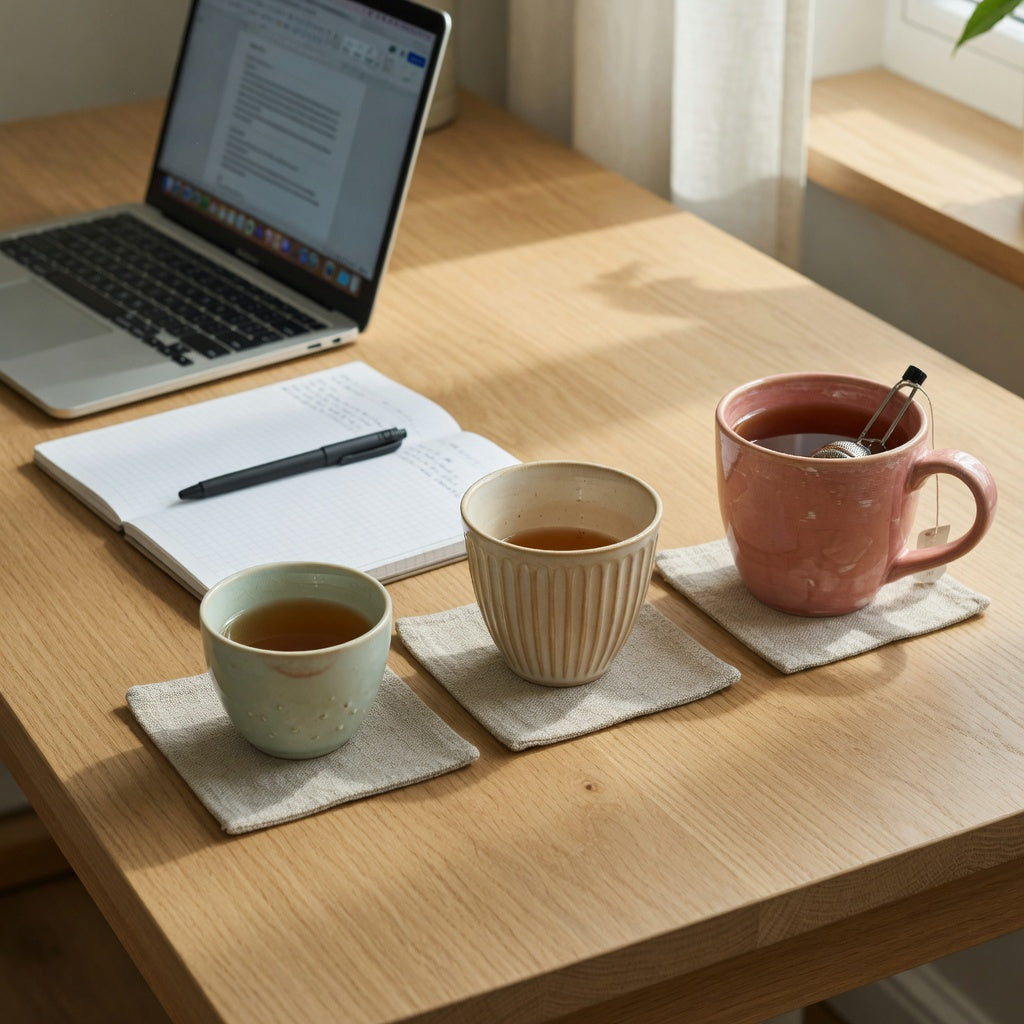
Pottery Tea Cups Home Office Product Shortlist Guide: 3 Desks
Reading time: about 9 minutes
A home-office tea cup gets moved twice before 10 a.m. Once to clear space for a notebook, once back within elbow reach. That shuffle is the real test — not how it photographs, but whether it survives a normal Tuesday of calls, typing, and tea that goes lukewarm at the worst moment.
We pack and ship these cups, and we answer the emails that follow: is 170 ml too small by mid-morning, does the handle clear a hot knuckle, does the glaze look as even in person as it does on screen. That is why we built this pottery tea cups home office product shortlist guide around routines, not patterns.
What breaks a pottery cup's case for the desk in week one?
Rarely the looks. Four physical details decide whether a cup keeps its place next to the keyboard, and our team sees them come up in returns and exchanges more often than color or pattern:
- The lip. A thick rounded rim and a thin one drink differently. A rim that flares outward spreads tea across the lower lip; a narrower rim puts the liquid where you expect it.
- Wall thickness. Thick walls hold heat longer and feel heavier at the end of a long call. Thin walls respond faster to the first pour and give that heat back faster too.
- The foot ring. A cup that rocks, even a little, gets moved away from the keyboard quickly. A flat, cleanly cut foot sits still on a desk mat.
- Handle clearance. Room for two fingers is plenty on a 170 ml cup and cramped on a 250 ml one if your grip runs large.
Pattern, glaze color, and whether the cup matches the desk are not on that list. They matter — they just are not what sends a cup to the back of the cabinet.
Which desk routine fits which cup? A pottery tea cups home office product shortlist guide
Capacities below are the listed capacities on each product page; the ceramic body and visible form are as shown there. Everything else — glaze testing, firing, appliance care — is a question to put to us or to the listing before you order.
| Cup | Listed capacity | Desk routine it suits | Choose it if | Skip it if |
|---|---|---|---|---|
| Retro coffee and tea cup | 170 ml | Short sips between calls | You like a fresh steep in ten-minute gaps | You expect one cup to last a full meeting |
| Pleated coffee and tea cup | 200 ml | The all-day middle ground | You want one standard serving in one hand | A handle is non-negotiable — check the listing photos first |
| Ball handled coffee and tea mug | 250 ml | Long meetings, one refill | You want a place to grip away from the wall | You mostly drink small repeated steeps |
All three sit in our unique coffee mugs collection, which is the better place to browse if you would rather compare forms side by side than commit to a capacity jump on faith.
Short sips between calls: the Retro at 170 ml
170 ml is a small pour, closer to a teahouse serving than a mug. Choose it if your day runs in ten-minute gaps and you like a fresh steep each time, especially with green tea or a light oolong where a small volume is the point. Skip it if you already know you refill a standard mug twice before lunch — you will be walking to the kettle constantly. If that is your pattern, size up rather than forcing a small cup into a long-call job.
See the Retro cup if the small-pour routine matches your desk.
The all-day middle: the Pleated at 200 ml
200 ml is where most desks land. It takes a standard tea bag without looking half empty and stays comfortably in one hand while you scroll. The pleated wall is a grip question as much as a looks question — check the product photos and think about where your fingers actually land, because a faceted body changes the hold more than a smooth one does. If a handle is non-negotiable for you, look at the Ball Handle instead of hoping the Pleated will feel handled.
See the Pleated cup if you want the middle ground.
Long meetings: the Ball Handle at 250 ml
250 ml lands close to the size most people picture when they hear the word mug, and the handle gives you a place to grip away from the wall. Choose it for back-to-back calls, cold rooms, or anyone who visits the kettle once and expects the drink to still be there twenty minutes later. Skip it if you mostly drink tea in small repeated steeps, because the last third will cool before you reach it.
See the Ball Handle mug if long blocks are your normal.
How much does capacity really change a desk cup?
More than buyers expect. Capacity decides how often you leave the chair, how heavy the cup feels when it is full, and how quickly the drink cools. The three sizes here look similar in photos and behave very differently:
- 170 ml — a two-or-three-sip cycle. Good for a fresh steep each time, poor for a 45-minute call.
- 200 ml — one standard serving in one hand. The size most desks settle on.
- 250 ml — a mug-sized pour with a handle to match. One refill covers a long block.
For scale, the FDA's cup-and-mug guidance describes small ceramic hollowware that normally holds about 240 ml and is manufactured with a handle. Treat that as an anchor, not a rule for pottery: a 250 ml handled cup sits close to that familiar mug size, while a 170 ml cup sits well below it, so you are choosing on feel rather than on a size you already know by heart.
What should you confirm about glaze and food contact before buying?
This is where we get careful, and you should too. Glaze on pottery can contain lead, and if a piece is not manufactured and fired properly, that lead can leach into what you drink. Fired at the right temperature for the right time, essentially all of the lead binds into the glaze. You cannot tell which case you are holding by looking at it, and no amount of washing or boiling removes lead from pottery once it is there.
Some context that helps. FDA guidance for ceramicware holds cups and mugs to a lead leaching guideline of 0.5 micrograms per ml in any one of six test units, and small hollowware to the same figure for cadmium. Ceramicware that contains lead can legally be sold in the United States if it is properly made, so the existence of a guideline tells you nothing either way about one specific cup. FDA also states that ware showing extractable lead under its method should not be labeled Lead Free, and that decorative ceramics resembling foodware are treated as foodware unless permanently marked as not for food use.
Two things we will not do here: certify a leach test we have not run, or claim a firing temperature we cannot document. What we can give you is the listed capacity and ceramic body on each page. For the rest, ask before you order:
- Which surfaces touch the tea and your lips — is the interior fully glazed, and is there bare clay anywhere near the rim?
- Was the piece fired to maturity, and is there a finished-piece test that matches this cup rather than a clay batch in general?
- Is there metallic, gold, or overglaze decoration near the lip, and what does the maker say about heating it?
- Does the maker state dishwasher or microwave status for this exact form? If the page is silent, assume nothing and hand wash until you know.
If certainty on all four points matters more to you than the look of a glazed handmade cup, factory porcelain is the lower-drama choice. We would rather say that plainly than nudge you toward pottery for a job it is not built for.
What should you check the day the cup arrives?
Open the box at the counter, not at the desk. Five things are worth a minute of your time:
- Pinholes and bare spots in the interior glaze — small craters or matte patches where clay is exposed.
- Crazing versus a crack. A fine web of surface lines is crazing; a line you can catch with a fingernail, or one that runs through the wall, is a crack. Either is a question for the seller, not something to shrug at.
- Wobble. Set it on a flat counter and press one edge down. Any rock shows up immediately.
- Rim and lip finish. Run a fingertip around the drinking edge and feel for rough glaze or a decal edge.
- Handle join. Look for a hairline where the handle meets the body, especially on the 250 ml cup where the handle carries more weight.
And be clear about what these cups are not. They are not travel cups, not insulated, and not something we would suggest carrying in a bag — no portability or spill claims here. They are desk ware: a cup that lives within arm's reach of a chair, gets rinsed between steeps, and stays put. If your day means carrying tea from room to room, a different form will serve you better, and we would rather you buy that one.
Frequently asked questions
How do I build a pottery tea cups home office product shortlist guide without overbuying?
Start with how long your typical call block runs, not with the pattern. If you drink in short gaps, the 170 ml Retro is enough; if you want one pour to survive a long meeting, the 250 ml Ball Handle is the fit; the 200 ml Pleated sits between them. Then cut any cup whose handle or capacity you already know frustrates you.
Is a 170 ml pottery tea cup too small for a home office?
It is small, not too small. It works for green tea, light oolong, or anyone who likes a fresh steep between tasks. It is the wrong pick if you expect a single cup to carry you through a 45-minute call without a refill.
Can I put a pottery tea cup in the dishwasher or microwave?
That answer is maker-specific, not a universal pottery rule. We do not state appliance compatibility here, so check the product page or ask us about the exact cup before you heat or machine wash it. If a piece has metallic or overglaze decoration near the lip, keep it out of the microwave regardless.
Will a cup without a handle be too hot to hold?
It depends on wall thickness and how full you pour. A thick-walled cup with a partial fill is usually comfortable; a thin one filled to the rim is not. The 250 ml Ball Handle gives you a handle to grip, which is why it is our pick for anyone who does not want to think about the hot wall.
Does the inside glaze matter more than the outside finish?
Yes, because the interior and the rim are what contact the tea and your lips. Look at the interior in the product photos first, then the lip area, and only then the decorative exterior. A handsome outside does nothing for a rough drinking edge.
More from our blog
Ready to pick your mug? Two ways to save on today's order:
Ordering 1–3 mugs? Get an extra 10% off your 1st order with code 10_OFF Apply 10% Off & Shop Wooden-Handle Mugs →
Gifting 4+ mugs? Buy 3, Get the 4th Free applies automatically at checkout (no code needed; offers do not stack) · Free standard shipping (Nov pre-Christmas delivery: 15–20 calendar days US) · Free replacement if chipped in transit.
Popular mug buying guides: Ceramic Tea Cups & Infuser Mugs · Ceramic Mugs with Lids Compared · Wooden-Handle Tea Infuser Mugs Compared · Christmas & Secret Santa Mugs 2026 · Espresso & Cortado Cups Guide · Cup & Saucer Gift Sets · All 25 Mugs Spec Table · Mug Size Guide · Shipping & Promo FAQ
FIRST ORDER 10% OFF (CODE: 10_OFF) · OR BUY 3, GET THE 4TH FREE


Read more

Latte Mugs Tall Home Office Product Shortlist Guide
A scenario-based shortlist of three listed capacities—400 ml, 440 ml, and 480 ml—with explicit reasons to choose or skip each mug, plus the clearance and care questions capacity alone cannot answer.
Read more
15 oz Ceramic Coffee Mugs Home Office Product Shortlist Guide
A short, scenario-based shortlist of the three ceramic mug sizes we sell around the 15 oz mark, with exact capacities, usable fill math, and a plain reason to choose or skip each one for desk work.
Read more
Leave a comment
This site is protected by hCaptcha and the hCaptcha Privacy Policy and Terms of Service apply.