



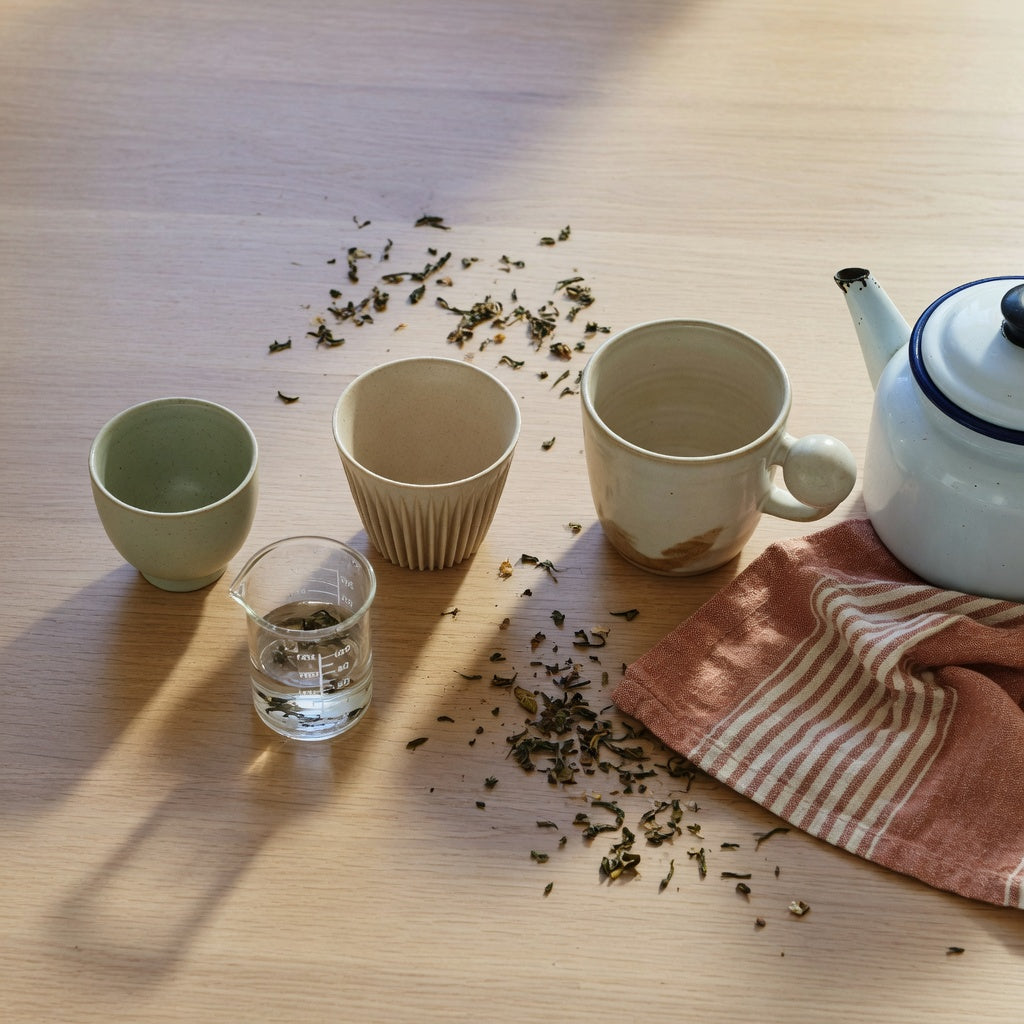
Pottery Tea Cups Gift Choice Practical Purchase Checklist
Reading time: about 10 minutes
A customer once ordered our smallest cup for a friend who, it turned out, drinks one large builder's tea every morning. The cup ended up holding pens. Nothing was wrong with it — 170 ml simply could not carry the pour. We keep that story close because it explains why this pottery tea cups gift choice practical purchase checklist runs in use order: capacity first, then glaze condition, then lip and foot finish, then grip, then what the cup will realistically survive in someone else's kitchen.
What does your recipient actually pour in a day?
Answer that before you open a single product page. In our experience behind the counter, gift misses come from this step far more often than from glaze or colour.
- Short, repeated steeps. Gongfu sessions, sencha, oolong, pu-erh — small pours emptied within a minute or two. These drinkers refill constantly and rarely want a large vessel.
- One long morning cup. A tea bag or basket infuser, sometimes milk, sitting beside a laptop for twenty minutes.
- Desk and sofa use. The cup travels, gets set down on wood, gets nudged. Foot finish and grip matter more here than decoration.
- Guests and display. The cup comes out when someone visits. Appearance legitimately outranks dishwasher tolerance — and that is a valid reason to buy.
Write the sentence down in plain words. "She drinks two small green teas at her desk." "He drinks one big milky tea at six in the morning." Those two people need different cups, and neither is wrong.
170 ml, 200 ml, or 250 ml — which capacity fits their routine?
Our three ceramic cups are separated mainly by this one variable, and the practical gap is wider than the numbers suggest. A 170 ml cup and a 250 ml mug are not the same object at different scales; they belong to different drinking habits.
- 170 ml — the small pour. The retro ceramic tea cup at 170 ml suits short, repeated infusions, concentrated servings, or anyone who likes the cup emptied before it cools. It is the wrong gift for a large milky breakfast tea — it will overfill, and we would rather say so plainly than let your recipient discover it.
- 200 ml — the middle ground. The pleated 200 ml ceramic tea cup lands closest to a standard tea-bag serving, which makes it the safest single pick when you genuinely do not know how someone brews. Its name points to the pleated exterior; confirm the surface texture on the current product page if that detail matters to you.
- 250 ml — the mug-sized serving. The ball-handled 250 ml ceramic mug sits closest to the FDA's description of a typical cup or mug: small ceramic hollowware used for hot beverages, normally holding about 240 ml, usually made with a handle. The name signals a defined side grip — check the current listing photos for the exact handle shape, since grip preference is personal.
One honest caveat: cup size is also a temperature tool. A small cup cools fast, which is good for delicate green tea and bad for someone who wants a drink that stays hot through a whole meeting.
The pottery tea cups gift choice practical purchase checklist
Run this against any ceramic cup — ours, a craft-fair find, or a thrifted piece — before money changes hands.
| Check | What good looks like | Walk away if |
|---|---|---|
| Capacity vs. routine | Listed millilitres match the recipient's usual pour, with a little headroom | You are guessing, or sizing up to "make it more useful" |
| Interior glaze | Continuous, smooth finish across the whole liquid area | Rough patches, pinholes, or chalky bare clay inside |
| Lip rim | Even profile, smooth glaze, no sharp edges or heavy drips | Coarse unglazed rim, chipped edge, or metal decoration on the lip |
| Foot ring | Sits flat, no wobble, smoothed where it meets the table | Gritty or burred base that scratches desks and wood |
| Grip and weight | Handle or textured wall gives fingers real purchase when full | You cannot picture holding it with a hot drink in it |
| Care labeling | The listing states microwave and dishwasher status for that exact cup | Care is silent, or the answer lives only in marketing copy |
What "food safe" and "lead free" actually tell you
Glaze is the part of a pottery tea cup that touches tea and lips, so it carries the safety question. The FDA's position is narrow and useful: lead may be present in glazes or decoration on some traditional pottery, and if a piece is not manufactured and fired properly, lead can leach into food and drink — but when pottery is fired at the right temperature for the right time, essentially all the lead is bound into the glaze. For cups and mugs, FDA compliance guidance sets a lead guideline of 0.5 micrograms per millilitre of leaching solution under standard test methods, with a matching 0.5 micrograms per millilitre cadmium guideline for small hollowware under 1.1 litres.
The FDA also names the categories it treats with more concern: handmade ware with a crude appearance or irregular shape, antiques, damaged or heavily worn pieces, flea-market and street-vendor finds from unidentifiable makers, and bright orange, red, or yellow decoration. Everyday factory-made pottery is described as far less likely to have a lead problem. No amount of washing, boiling, or scrubbing removes lead from a piece that contains it. The CDC has also documented a household whose elevated blood lead levels were tied to traditional glazed ceramic ware used for cooking, storing meals, and making coffee; levels declined after the family stopped using it.
For a gift, that translates into three questions worth asking any seller of handmade pottery tea cups:
- Which surfaces actually contact tea and lips — and are all of them glazed?
- Was this specific cup fired to maturity, and is the glaze formulated for food contact?
- Does any test document refer to this finished piece, or to a different sample from the same batch?
Two labelling details matter. Decorative ceramicware that looks like drinkware is treated as foodware unless it is permanently identified as not for food use. And ware with extractable lead should not carry a "lead free" claim. If a listing cannot answer basic food-contact questions, treat the cup as display-only and gift accordingly.
Crazing, chips, and bare clay — which defects change the answer?
Most of what looks like damage on a glazed pottery tea cup is glaze behaviour, not structural failure. Knowing which is which keeps you from gifting something fragile — or rejecting a perfectly sound cup.
- Crazing is a fine web of lines inside the glaze layer, caused by a mismatch in how the clay body and glaze expand and contract. Intentional crackle is a decorative choice; delayed crazing on a working cup is mainly a cleaning concern, since those lines can trap tea oils and residue.
- A crack through the wall is different. If a line reaches the outside or catches a fingernail, the piece is compromised and should leave drink duty.
- Bare clay on the drinking rim or interior floor deserves a direct question to the seller, not an assumption. Unglazed clay can absorb what it meets.
- Metal luster, gold banding, or overglaze decals near the lip are a care flag: keep them out of the microwave and ask how durable the decoration is.
Handle, no handle, and the hot-drink handoff
Ceramic transmits heat, and how much reaches your fingers depends on wall thickness, fill level, and whether there is a handle. Pour boiling water into a thin-walled cup and the outside gets hot fast; pour warm green tea into the same cup and it is comfortable in the palm.
That logic sorts the three cups cleanly. For boiling-water black tea or herbal infusions, a defined handle keeps fingers off the hot wall — which is the case for the 250 ml mug with the ball-style side handle. For moderate-temperature steeps where the cup is cradled, a textured wall helps: the pleated 200 ml cup gives fingers something to hold against a slick glaze. The small 170 ml retro cup suits the short pour, where the cup is emptied before heat has time to build.
The trade-off is real in both directions. Handles add bulk on a cabinet shelf and are often the first thing to chip. Handleless forms make you feel the drink's temperature through the wall, which some tea drinkers genuinely prefer and others find annoying by the second cup.
Dishwasher, microwave, and thermal shock — what we will not promise
We will not slap a blanket "dishwasher safe" or "microwave safe" claim across ceramics as a category, and you should be sceptical of anyone who does. Clay bodies, wall thickness, and glaze recipes differ enough that appliance tolerance is piece-specific. Check the care section on the exact listing you are buying from — including ours.
What holds regardless of maker:
- Thermal shock is the usual killer. Boiling water into a cold cup, or cold tap water into a just-emptied hot cup, stresses the body unevenly. Warm the cup first with a splash of hot water.
- Metal decoration never goes in the microwave. Luster, gold, and silver banding reflect microwave energy and can arc.
- Skip the soaking basin. A cup left standing in a wet sink keeps moisture against the foot ring; dry it upside down on a rack instead.
- When care guidance is missing, hand wash. That is the conservative default, not a failure of the product.
Frequently asked questions
Does this pottery tea cups gift choice practical purchase checklist apply to antique or thrifted cups?
Apply it more strictly. Antique, worn, or unidentifiable handmade pieces sit in the FDA's higher-concern group, and older glazes may predate current limits. A cup marked as not for food use, heavily crazed, chipped at the lip, or finished in bright orange or red glaze should be gifted as a display object rather than a daily drinker.
What size should I choose if I do not know how the recipient brews?
Go with the 200 ml option — the pleated ceramic cup — because 200 ml sits closest to a standard mug serving without overcommitting. If you know they drink large milky teas, move up to the 250 ml mug instead; the 170 ml cup is for short, repeated pours.
Do these cups arrive with gift packaging or personalization?
We do not claim gift wrapping, gift boxes, or engraving on these listings, so plan your own presentation if that matters. The straightforward move is to buy the cup that fits the routine and skip assuming extras that are not documented.
How do I tell crazing apart from a real crack on a ceramic tea cup?
Crazing is a shallow web confined to the glaze and does not catch a fingernail when you drag it across. A structural crack reaches through the wall, often shows on the outside, and usually follows one line. Crazed cups can still be used if the glaze is otherwise intact; cracked cups should be retired from drinking.
Will a glazed ceramic cup change how the tea tastes?
An intact glaze is a non-porous surface, so it behaves much closer to porcelain than to raw clay. We did not find a food-science or standards source that settles the flavour question for unglazed interiors, so treat claims about clay "seasoning" your tea as maker opinion rather than documented fact.
Pick the cup that fits their counter, not the shelf
- How many millilitres does the recipient pour in one sitting?
- Is the interior fully glazed, with a clean lip and a flat foot?
- Will they be holding a boiling-hot drink, or a warm one?
- Does the listing tell them how to wash and heat this exact cup?
Answer those four and the shape decision usually makes itself. If you are still weighing silhouettes, browse our unique coffee mugs collection to compare the 170 ml, 200 ml, and 250 ml forms side by side on one page. Buy the cup that fits a Tuesday morning, not the one that photographs best.
More from our blog
Ready to pick your mug? Two ways to save on today's order:
Ordering 1–3 mugs? Get an extra 10% off your 1st order with code 10_OFF Apply 10% Off & Shop Wooden-Handle Mugs →
Gifting 4+ mugs? Buy 3, Get the 4th Free applies automatically at checkout (no code needed; offers do not stack) · Free standard shipping (Nov pre-Christmas delivery: 15–20 calendar days US) · Free replacement if chipped in transit.
Popular mug buying guides: Ceramic Tea Cups & Infuser Mugs · Ceramic Mugs with Lids Compared · Wooden-Handle Tea Infuser Mugs Compared · Christmas & Secret Santa Mugs 2026 · Espresso & Cortado Cups Guide · Cup & Saucer Gift Sets · All 25 Mugs Spec Table · Mug Size Guide · Shipping & Promo FAQ
FIRST ORDER 10% OFF (CODE: 10_OFF) · OR BUY 3, GET THE 4TH FREE


Read more
Coffee Mugs With Big Handles Gift Choice Practical Purchase Checklist
A ten-minute checklist for buying coffee mugs with big handles as a gift: which hand problem you are actually solving, how many fingers should clear the loop, why a full 480 ml mug feels heavier th...
Read more
Large Round Coffee Mugs Gift Choice Practical Purchase Checklist
A working checklist for gifting a wide, rounded mug: the four measurements to take first, what 400, 440 and 480 ml actually hold, and the fit, heat and food-contact questions worth confirming befor...
Read more
Leave a comment
This site is protected by hCaptcha and the hCaptcha Privacy Policy and Terms of Service apply.