
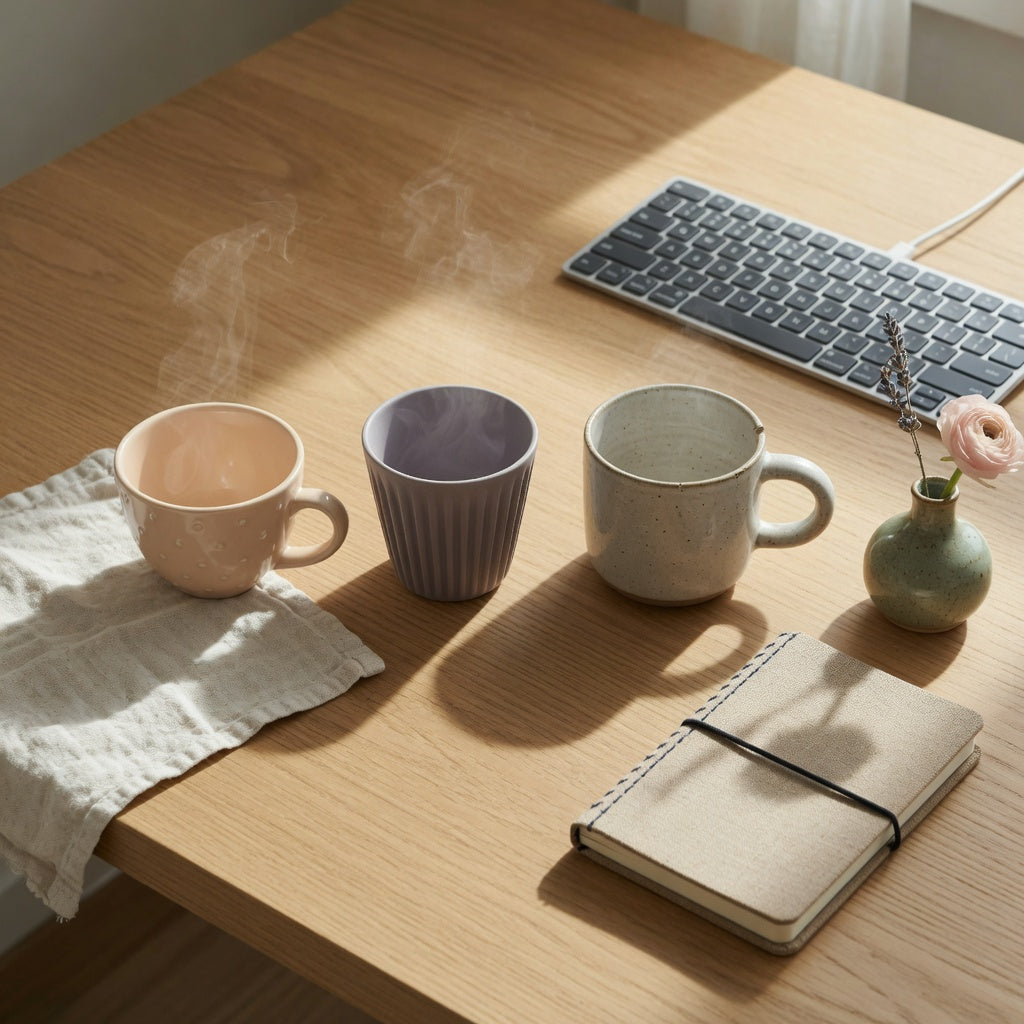
Pottery Tea Cups for Desk Use: Capacity, Handle Clearance, Footprint
Reading time: about 9 minutes
Somewhere around the second refill, a desk cup stops being decoration and starts being equipment. Our team packs and photographs these cups every week, and the questions that come back to us are almost never about glaze names — they are about how much tea a cup really holds, how far a handle reaches toward a mouse, and whether a small pour survives a 40-minute call. If you are comparing pottery tea cups for desk use, three numbers do most of the work: listed capacity, base diameter, and handle projection.
How much desk time does a 170 ml, 200 ml, or 250 ml pour actually buy?
Capacity is the easiest spec to read and the hardest to translate into a workday. For scale, FDA guidance describes a typical handled cup or mug as holding about 240 ml (8 fl oz). That puts two of our three cups below the standard mug and one slightly above it.
- Retro Coffee & Tea Cup — 170 ml. About two-thirds of a standard mug. This is a tea-break cup: one focused pour, a short tasting round, a deliberate pause between tasks. At roughly 70% of the FDA reference, it is the wrong pick if you want a single drink to carry you through a long call, and we would rather say that plainly than oversell it.
- Pleated Coffee & Tea Cup — 200 ml. The middle pour. Enough for a normal desk tea, short of full-mug territory, and the easiest size to justify if you have never tracked how fast you drink while working.
- Ball Handled Coffee & Tea Mug — 250 ml. Just above the 240 ml reference. Fewest refills of the three, closest to mug behavior, and the one that assumes you have room to park it.
Do the refill math before you commit. Two focused hours of steady sipping will empty a 170 ml cup more than once and a 250 ml cup about once. If tea is a reset between tasks, the small cup ends the session for you. If it is fuel for back-to-back calls, buy the larger pour. All three sit side by side in our unique coffee mugs collection.
Which pottery tea cups for desk use clear a tight keyboard zone?
Footprint is three measurements, not one: base diameter, the widest point of the body, and handle projection past the wall. A 200 ml cup with a wide handle can occupy more usable desk than a 250 ml cup with a tucked one. That is why capacity alone is a bad proxy for desk fit.
Two placement rules cover most tight desks. Keep the cup behind the keyboard line instead of beside the mouse, and park it on your non-dominant side so reaching for it never crosses your typing hands. A cup can be perfectly sized and still be in the wrong spot.
The 170 ml Retro is the sensible first look when space is genuinely tight and you accept more refills. The 200 ml Pleated is the middle option — a little more tea than the Retro, without committing to the largest body in the group. The 250 ml Ball Handled mug is the one that needs the most deliberate placement, which is a fair trade for the fewest trips to the kettle.
We deliberately do not put base and handle measurements in this article. Those figures belong on the current product page, where they can be kept accurate for the run you are actually buying. Pull the base diameter and handle projection from the live listing before you order, and if either is missing, ask us before checkout — that answer tells you more than any photo about whether the cup clears a raised monitor shelf or a narrow keyboard tray.
Why does handle clearance matter more at a desk than on a kitchen table?
At a kitchen table a handle has empty air around it. At a desk, the space beside your cup is already full: a mouse, a cable, the edge of a notebook, a sleeve. The Ball Handled Coffee & Tea Mug uses the ball-style handle its name describes — a visible loop your finger can hook. Whether that loop clears your setup is a measurement question, not a style question, and no product photo settles it.
Our test is simple. Pick the cup up without looking, then set it back down without moving your keyboard. If either step fails, the cup belongs farther back on the desk or on a tray, not beside your mouse hand.
Heat is the second half of grip. Ceramic takes up heat and passes it to your fingers, so a handled cup keeps the hot wall away from skin while a handleless cup asks you to hold the body or the rim. If you sip slowly and set the cup down often, a handle is comfort, not ornament. If you drink fast in small rounds, a smaller pour is easier to manage than a large one.
What should you check on a product page before a cup earns desk space?
- The interior glaze. The surface that touches tea and your lips should be intact and evenly finished. Pinholes, bare clay patches, or rough spots on the drinking surface are worth a question before you buy, not after.
- What the food-contact claim actually covers. FDA guidance notes that lead can leach from glazes on improperly fired pottery, and that washing or boiling does not remove it. The same guidance says ceramicware with extractable lead should not be labeled "Lead Free." If a listing uses that phrase, ask whether the claim applies to the finished piece and whether a test report matches that specific cup.
- Cadmium, if the decoration is bright. FDA's parallel cadmium guidance sets extractable limits for small hollowware, and decorated ware in warm reds, oranges, and yellows is the usual worry. It is a question to put to the seller, not an assumption either way.
- Crazing versus a crack. Fine crackle across a glaze is a decorative look. A line you can catch with a fingernail is damage, and a damaged cup should leave daily drink duty.
- Appliance status. Dishwasher and microwave compatibility is product-specific. We confirm listed capacity and ceramic body for the cups in this comparison and nothing beyond that — do not assume appliance safety from a similarly named cup or from general pottery advice.
- Base and handle numbers. The desk-fit specs. Get them from the current page for the exact cup you are buying.
What are the realistic ways a desk cup fails?
Most desk cup disasters are placement and temperature problems, not clumsiness.
- Use a coaster or a lipped tray. It defines the cup zone and catches condensation before it reaches paper.
- Fill a small cup less than full when you are on a call and likely to gesture. A 170 ml cup at two-thirds is easier to manage than a brimmed mug.
- Avoid sudden temperature swings. Pouring boiling water into a cold ceramic cup, or setting a hot cup into a cold sink, is the classic thermal-shock setup. Warm the cup first with a splash of hot water and let it stand a few seconds.
- Retire chipped or visibly cracked cups from drinking. A shelf life is fine; a daily drinking life is not.
- Empty the cup before you walk away for a long stretch. Tea left standing in pottery is a stain waiting to happen.
We would rather tell you a cup is not a desk cup than hear later that it became a keyboard story.
Which desk setup matches which cup?
| Cup | Listed capacity | Refill load | Desk-fit watch-out | Best for |
|---|---|---|---|---|
| Retro Coffee & Tea Cup | 170 ml | Highest — expect multiple pours in a long block | Smallest body here, but still check base diameter | Short tea breaks, tasting rounds, very small desks |
| Pleated Coffee & Tea Cup | 200 ml | Moderate | Confirm handle projection for your tray | Everyday desk tea, gifts when you don't know the setup |
| Ball Handled Coffee & Tea Mug | 250 ml | Lowest — closest to a standard mug | Largest footprint question; measure the handle loop | Back-to-back calls, slow sippers, long sessions |
For a gift where you do not know the recipient's desk, the 200 ml Pleated is the safe middle choice. For your own desk, pick by session length: short breaks point to the 170 ml, steady sipping points to the 250 ml, and the 200 ml sits between them. If you want to compare forms rather than numbers, browse the full range of unique coffee mugs and check each listing's base and handle figures before you commit.
Frequently asked questions
How do I choose pottery tea cups for desk use when my desk is small?
Start with base diameter and handle projection, not capacity. The 170 ml Retro is the smallest pour in this group, but a small cup with a wide handle can still feel large beside a keyboard. Measure the clear zone on your non-dominant side and compare it to the figures on the current product page.
Is 170 ml too small for a full workday?
It is small for long, uninterrupted stretches — expect several refills. A 170 ml cup suits a deliberate tea break or a short task. If you want to sit through back-to-back calls, the 250 ml Ball Handled mug is closer to a standard 240 ml cup.
Are these ceramic cups dishwasher and microwave safe?
We confirm listed capacity and ceramic body for these cups, not appliance compatibility. Check the current product listing or ask us before dishwashing or microwaving. Care rules vary by glaze and decoration, and we will not have you assume a status that is not stated for that specific cup.
What does "Lead Free" mean on a pottery tea cup?
FDA guidance says ceramicware with extractable lead should not carry that label, and proper firing binds lead into the glaze. If a listing uses the phrase, ask whether it applies to the finished piece and whether a test report matches that cup. This matters most for brightly decorated, antique-style, or irregular handmade ware.
Will the 250 ml ball handle fit beside my keyboard?
That depends on handle projection and where you park the cup, not on capacity. The ball handle is the feature to measure. Compare its projection and the base diameter from the product page against the free gap on the non-mouse side of your keyboard.
More from our blog
Read more
Large Round Coffee Mugs for Desk Use: Capacity and Footprint Fit
A 480 ml mug and a 400 ml mug are not the same desk object. We walk through brim-full versus usable capacity, base footprint, handle clearance, and how the extra 80 ml changes your refill routine.
Read more
Coffee Mug Gifts Ideas for Small Coffee Setup: What Fits
A gift mug has to earn its counter space. We compare our three ceramic capacities, explain usable fill and brewer clearance, and show when one mug beats a set in a small kitchen.
Read more
Leave a comment
This site is protected by hCaptcha and the hCaptcha Privacy Policy and Terms of Service apply.