
Plain White Ceramic Coffee Mugs Shape and Handle Guide: Current Options
Reading time: about 10 minutes
Put three white mugs beside a keyboard and their differences become clearer than they were in a product grid. A tall body affects cabinet clearance, a pleated surface changes the visual texture, and a decorative motif can make the mug feel less like basic drinkware and more like a gift. Our plain white ceramic coffee mugs shape and handle guide focuses on those practical distinctions without treating appearance as proof of capacity, durability, or heat retention.
The current choices cover three different directions: the White Golden Waves Tall Coffee Tea Mug, the Pleated Coffee Tea Cup, and The Crane Coffee Tea Mug. Shoppers who do not see the right silhouette among those three can compare more designs in our unique coffee mugs collection.
Plain white ceramic coffee mugs shape and handle guide: what changes in use?
Shape affects where a mug fits and how the handle meets the hand. It does not, by itself, establish how much the mug holds. A tall, narrow-looking vessel can have less internal volume than a shorter, wider cup, while two mugs with similar listed capacities can occupy very different amounts of shelf space.
In our store, we separate facts stated on the product page from impressions created by photography. We use the listed material, dimensions, capacity, and care directions as the product-specific facts. We then use the photographs to examine visible variables such as body taper, rim shape, surface relief, foot profile, and the position of the handle.
- Body height: Compare it with the usable opening beneath a cabinet shelf or coffee machine, including enough room to lift the mug out.
- Maximum width: Check whether the listing measures the ceramic body alone or includes the handle. Overall width is the more useful number for a crowded desk or cupboard.
- Handle opening: Look at the clear space inside the loop, not merely the outside shape. A large-looking handle can still have limited finger clearance.
- Capacity: Treat the listed volume as separate from the silhouette. Do not estimate ounces from a photograph.
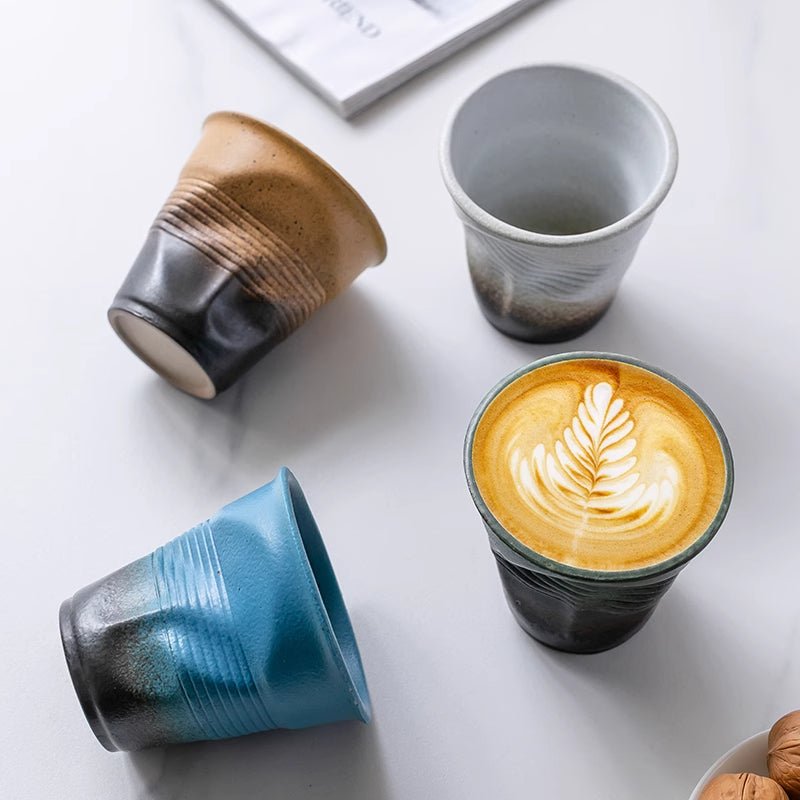
- Surface profile: Smooth, pleated, printed, and raised treatments create different visual and cleaning considerations even when the base color is white.
Tall, pleated, or crane-themed: which design suits the space?
| Current option | Visible design cue | Handle and size check | Best matched situation |
|---|---|---|---|
| White Golden Waves Tall Coffee Tea Mug | A tall white profile with golden-wave decoration | Confirm the live height, overall width, listed capacity, and finger space shown on the page; tall does not automatically mean larger capacity | A shopper who wants a vertical silhouette and visible decorative detail rather than a completely undecorated mug |
| Pleated Coffee Tea Cup | A pleated surface rather than a plain, smooth wall | Check how the handle sits beside the relief and whether the pleated area reaches the normal gripping points | A white-dominant setting where texture is welcome but a colorful graphic would be distracting |
| The Crane Coffee Tea Mug | A crane-themed design that gives the mug a distinct identity | Use the side photographs to see how the decorative treatment relates to the handle, then compare the current listed dimensions and capacity | A gift or personal mug chosen for an identifiable motif rather than blank utility |
A taller silhouette for a counter or dedicated mug shelf
The White Golden Waves option makes sense when the buyer specifically wants a tall form and gold-colored visual detail. Its limitation is equally clear: it is not a strictly plain, undecorated white mug. Measure the vertical opening where it will be stored, and read the current capacity instead of assuming that extra height provides extra volume.
Pleated texture for a quieter white setting
The Pleated Coffee Tea Cup is the more relevant next step for someone who likes a white surface but finds a completely smooth cylinder too basic. Pleating adds shadow and texture without requiring a large printed scene. It is not the right choice for a shopper seeking a smooth blank for decals, vinyl, or custom printing; the listing also should not be treated as a sublimation-ready blank unless it explicitly says so.
A crane motif for a more personal gift
The Crane Coffee Tea Mug fits the buyer who is choosing with the recipient's taste in mind. The crane identity makes the choice more specific than a generic office mug, but that also narrows its appeal. For an unknown recipient or a matching open-plan office set, a simpler form from the collection may be easier to coordinate.
How should listed dimensions and capacity be compared?
Start by putting every capacity in the same unit. Twelve US fluid ounces is approximately 355 ml, so an ounce label and a millilitre label should not be compared as raw numbers. The listed capacity is also not necessarily the amount a person will pour during normal use; most people leave some room below the rim. For a useful personal benchmark, fill a mug you already like to your usual level and pour that water into a measuring jug.
Next, record three measurements from each live listing: height, body diameter, and maximum width with the handle. If a page provides only one width, examine its diagram or wording to determine what it covers. A handle can be the difference between fitting two mugs across a shelf and fitting only one.
- Measure the height of a mug that already fits beneath the intended shelf or brewer.
- Measure its maximum width from the outside edge of the handle to the opposite wall.
- Record its comfortable fill volume with water and a measuring jug.
- Compare those figures with the currently displayed dimensions and capacity on each product page.
- Check the photographs for taper and foot width, but do not turn those visual cues into an unsupported stability claim.
Buyers comparing a specific volume can also use our 12 oz ceramic coffee mugs shape and handle guide. If wall profile and a more substantial-looking rim are the priority, the thick ceramic coffee mugs comparison covers that separate buying variable.
Which handle form works for one finger, two fingers, or a full grip?
Handle comfort depends on the usable opening, the thickness of the ceramic at the contact points, and how close the loop sits to the body. Hand size matters. So does habit: some customers hook one finger through a mug and support the base, while others expect room for three or four fingers.
Product photography can show handle form, but it rarely establishes exact finger clearance unless a measurement is supplied. A practical comparison is to look at where the top and bottom handle joins meet the body. Closely spaced joins generally create a different grip area from a long loop, while decorative relief near the joins may affect where the fingers rest. These are fit questions, not quality judgments.
- For a keyboard desk: Prioritize a grip that lets you lift the mug without sliding fingers against the hot body, then verify that the overall width leaves room beside the mouse or notebook.
- For tea held in both hands: A large loop may matter less if the drinker commonly supports the ceramic body, but the surface treatment still affects where the hands make contact.
- For reduced hand mobility: Do not rely on a styled photograph. Use a listing with clear dimensions, or choose a familiar handle form with enough visible clearance.
- For gifting: Handle appearance can be part of the design, but it should still suit the recipient's likely grip and storage space.
Does white ceramic mean plain, blank, or easy to customize?
No. These terms describe different things. A mug may have a white ceramic base while also carrying golden-wave decoration, pleated relief, or a crane motif. A truly blank mug has no decorative treatment, and a mug intended for sublimation needs a suitable coating stated by its seller. White color alone does not establish that coating.
This distinction matters for buyers planning vinyl, decals, paint, or commercial printing. Texture can interrupt adhesion, decoration can compete with a new design, and an unspecified glaze should not be assumed to accept a particular process. For a minimalist kitchen, the Pleated option may still read as visually quiet. For restaurant-style uniformity or a custom-logo project, a smoother and more strictly undecorated product may be the better route.
What care checks apply to gold-colored details and textured ceramic?
Care instructions on the current product page control. The word golden describes appearance, but it does not by itself prove what the decoration contains. That means we should not label a mug microwave-safe, microwave-unsafe, dishwasher-safe, or dishwasher-unsafe solely from its color. Look for explicit care wording on the selected product and variant.
For routine handling, our unboxing and cleaning check is straightforward:
- Inspect the rim and foot under direct light for chips, hairline cracks, or sharp points before first use.
- Examine both handle joins. A visible crack at either join is a reason to stop using the mug.
- Wash according to the listing directions before the first drink. Use a non-abrasive sponge around decorative finishes unless the page says another method is suitable.
- Check pleated grooves or raised details for residue during hand washing rather than wiping only the broad surfaces.
- Avoid sudden temperature changes, such as moving cold ceramic directly into very hot water, unless the product instructions specifically address that use.
Glaze pinholes, rough contact surfaces, crazing, rim chips, and cracks around a handle join are different from normal variations in an applied decorative pattern. If a mug arrives with a structural or food-contact concern, photograph it before use and contact the store rather than testing it through repeated dishwasher cycles.
Which current mug fits the buyer's actual situation?
- For a tall, decorative desk mug: Choose the White Golden Waves Tall Coffee Tea Mug because its named profile and wave treatment match that visual brief. Skip it if strict all-white minimalism or uncertain cabinet height is the concern.
- For white texture without a large illustrated motif: Start with the Pleated Coffee Tea Cup because the relief supplies the visual interest. Choose another style if the buyer needs a smooth customization surface.
- For a recipient who likes crane imagery: The Crane Coffee Tea Mug is the direct, specific match. It is less suitable when the recipient's decorative taste is unknown.
- For a uniform office set: Compare body height, maximum width, and handle clearance across the unique mug collection before ordering multiples. A dramatic decorative design may be less useful than repeatable shelf fit.
Gift shoppers can make the recipient check more systematic with our coffee mug gift shape and handle guide. The useful questions are where the recipient will store it, how much they usually drink, and whether they prefer a restrained texture or a recognizable motif.
Frequently asked questions
Is a tall white ceramic mug automatically the largest capacity?
No. Height is only one part of internal volume; diameter, taper, wall thickness, and the interior base also matter. This plain white ceramic coffee mugs shape and handle guide recommends comparing the capacity stated on each live page rather than estimating from the silhouette.
Can a white mug with gold-colored details go in the microwave?
Do not decide from color alone. Gold-colored decoration may use different materials or finishes, so follow the explicit care statement for the exact product and selected variant. If microwave suitability is not stated, ask before using it that way.
How can I tell if a coffee mug handle will fit my fingers?
Look for the internal height and width of the handle opening, not just the mug's overall dimensions. If those measurements are not listed, compare the side photograph with the body dimensions and use a mug you already find comfortable as a reference. Shoppers who need a precise full-hand grip should not rely on appearance alone.
Are these plain white mugs suitable for custom printing?
Do not assume that they are. Golden waves, pleated relief, and crane decoration mean these options are not all blank, smooth printing stock, and white ceramic does not automatically have a sublimation coating. Use a product that explicitly states compatibility with the customization method you plan to use.
Which design is the most practical gift?
The practical choice depends on what is known about the recipient. Pleated texture suits someone who prefers restrained white drinkware, the tall golden-wave design fits a more decorative setting, and the crane design is most relevant when the motif has personal appeal. If those preferences are unknown, prioritize familiar capacity, cabinet fit, and handle clearance.
A 60-second comparison before ordering
- Open the three product pages and record each currently listed capacity in the same unit.
- Compare height and maximum width with a mug that fits the intended cabinet, desk, or coffee station.
- Inspect the handle opening and join positions in the side photographs.
- Decide whether plain means white-dominant, completely undecorated, or suitable for customization.
- Read the exact microwave, dishwasher, and washing directions shown for the chosen product.
- Choose the design only after those functional checks match the buyer's routine.
Use those six checks while browsing the current unique coffee mugs collection. They will narrow the choice faster than color alone and keep the final decision tied to the live dimensions, capacity, handle form, care information, and decoration the product page actually shows.
Read more
Matcha Latte Mug Shape and Handle Guide: 250, 390 or 400 ml
Compare three current matcha latte mug options by listed capacity, visible opening profile, handle form, and known dimensions. See where the 250 ml Ball Handle, 390 ml Round, and 400 ml Spittoon mu...
Read more
Chai Tea Mug Shape and Handle Guide: 400-480 ml Options
Compare The Flow 400 ml, Morning and Night 440 ml, and The Rock 480 ml by listed capacity, visible silhouette, handle clearance, shelf fit, and realistic trade-offs. Includes a practical pre-purcha...
Read more
Leave a comment
This site is protected by hCaptcha and the hCaptcha Privacy Policy and Terms of Service apply.