
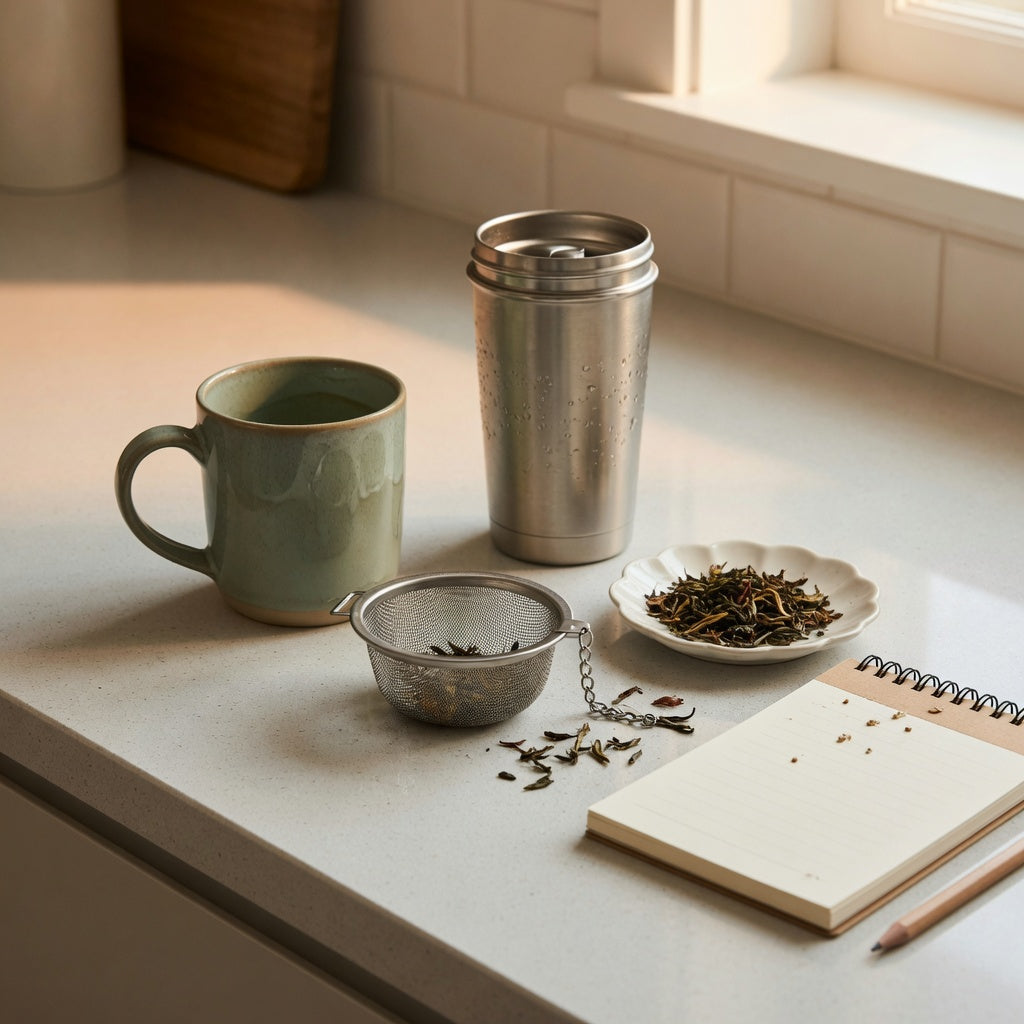
Mountain Tea Mug What to Compare Before You Buy
Reading time: about 11 minutes
A customer set a glazed mug box and a steel bottle on our counter and asked for the mountain tea mug what to compare list, as if the artwork was the only difference. One was a ceramic piece with a mountain motif. The other was sold as a mountain tea tumbler. Same search, three different jobs. In our store we split that search before we talk color, because the interior, the lid, and how you stop a steep decide whether the tea is drinkable.
If the job is a ceramic mug you can hold at a desk or hand over as a gift, start with the Mountain Ceramic Coffee Mug. That is the catalog name on our shelf. Ounces, care, and whether an infuser or lid is in the box have to come from the current listing, not from a lifestyle photo. If you are still choosing a shape for coffee at home, the unique coffee mugs collection is the wider shelf.
Which product is hiding behind the mountain name?
The phrase gets used for at least three tools, and they fail in different rooms of the house.
- A ceramic mug with a mountain motif, sometimes sold with an infuser and lid, meant for a kitchen counter, an office desk, or a gift shelf.
- An outdoor insulated mug with mountain in the name, built to hold temperature on a hike or a commute rather than to ride in a microwave.
- A loose-leaf tea tumbler. The Tea Spot's Mountain Tea Tumbler is one bottle shoppers drop into this search. On that style, the basket and the seal matter more than the print.
Compare like with like. Decorative ceramic will lose to vacuum steel on a cold trail. A trail tumbler looks clumsy if what you wanted was a glazed mug for the mantel. We have not run one shared heat test across ceramic mountain mugs, insulated outdoor mugs, and loose-leaf tumblers. Maker hold times are not scores you can line up.
Interior surface and whether the tea tastes like metal
Taste complaints follow travel mugs: a metallic or funny note, especially on green, white, and lighter herbals. Treat that as a criterion, not as a result we can stamp on every steel cup. Bare stainless, electropolished stainless, a ceramic or glass lining, and a plastic lid each change what the liquid touches.
Many tea drinkers ask for ceramic or glass when they want the cup to stay quiet. A ceramic coating inside steel is not the same object as a solid ceramic mug. Coatings can be thin. Listings often skip how they hold up near boiling, and whether a dishwasher is allowed. If the page does not say the lining is dishwasher-safe, plan on hand washing until the maker says otherwise.
On a solid ceramic mountain mug, the drink touches glaze. That is the food-contact surface. Read the interior line on the Mountain Ceramic Coffee Mug listing instead of guessing from the photo. A colored rim can be glaze, or it can be decoration sitting at the lip, which is the part your mouth meets. We will not call a printed steel wall ceramic just because the outside looks like pottery.
Infuser basket, mesh, and when the steep should stop
Loose leaf needs room. A small ball crushes large leaves and lets fines through if the holes are coarse. A deep basket that sits in the liquid gives oolong, pu-erh, and chunky herbals space to open. For fine leaf such as rooibos, mesh opening matters as much as basket volume. Most pages skip the three facts buyers use: basket volume, mesh size, and whether the basket reaches the tea or hangs in an air gap.
Run through this before a lidded infuser mug hits the cart:
- Does the basket come out in one piece, or is it trapped under a lid you cannot open with hot hands?
- Can you cover the mug during the steep so aroma and heat stay in, then lift that cover off?
- Can you remove the leaves when the timer ends, or do they keep extracting for the whole commute?
- Are you brewing bags? If yes, the infuser is extra hardware to clean, not a feature you will use.
Leaves left in the mug keep steeping. That is how a good cup turns bitter. It is also why some people pour a second, cooler round on the same leaves. The mug only helps if the infuser lifts out and has somewhere to sit. We tell shoppers to heat water in the kettle and steep in the mug, so time and temperature stay in their hands. A kettle basket is a different workflow. Do not buy a mug infuser to fix a kettle habit.
Stated capacity is not the drink in the cup. Basket and lid displace liquid. Shoppers often ask whether a cup in the roughly 12 to 16 ounce range is enough for one herbal mug, and whether the base will drop into a car holder. Fair questions. A single diameter, with no vehicle and no note about volume lost to the infuser, does not answer them. We do not publish a guessed ounce count for our ceramic mug here. If the listing states one, use that number, then subtract the hardware you will actually leave inside.
Lid wording, stated heat, and a real cup holder
Leakproof, spillproof, and splash-resistant are not the same promise. The failure we see with gift drinkware is a mug that is calm on a desk and wet in a tote once it tips. A gasket can behave while upright and still weep when a pack shakes. If the listing never mentions a tip, shake, or bag check, carry it upright. Then look for a replacement gasket or lid. A seal you cannot replace turns the mug into a short-lived gadget.
Heat copy needs the same reading. Write down the stated hot hold and the stated cold hold. Write down whether the maker means double-wall or vacuum. Double-wall slows heat loss. Vacuum usually slows it further. Neither phrase tells you when the tea becomes sippable. Strong insulation can leave a drink too hot for a short commute or the first mile of a hike. Ceramic on a desk sheds heat faster. That is often what you want between meetings, and a poor match for a winter trail.
Our ceramic piece is the wrong tool if you need a sealed commute and the listing never claims one. A wide foot, a handle, and an open rim are desk features. They are not a cup-holder strategy. Measure the base against your car only if the listing gives a diameter. If it does not, the fit is unknown.
Glaze, lead, cadmium, and the dishwasher cycle
Some traditional pottery has lead in the glaze or the decoration. If the piece is not made properly, that lead can move into food or drink prepared, stored, or served in it. Guidance on firing is specific: when pottery is fired at the proper temperature for the proper time, essentially all the lead is bound into the glaze. If it is not fired properly, the lead may not fuse, and then it can contaminate what you serve. A lead-free label is not a published leach test. Imported mountain mugs often skip lip-and-rim results and any note on how the piece was fired. No test on the page means the safety data is unpublished. It does not mean the mug passed, and it does not mean ours failed. It means you cannot check from the slogan alone.
Cadmium is a separate line. FDA guidance on extractable cadmium from ceramicware sets, for small hollowware, 0.5 micrograms of cadmium per milliliter of leaching solution for any one of six units. The agency notes that acid foods can extract cadmium. A mug is hollowware. A test written for a decorative plate is the wrong reassurance. Ask whether the cup itself was tested.
- Microwave-safe and dishwasher-safe are different sentences. A metallic rim can block the microwave even when the body is ceramic.
- Hand wash is the safer assumption once a wooden lid, a silicone gasket, or a coated steel wall enters the picture. Dishwasher heat and detergent are how coatings dull and gaskets crack.
- Plastic lids are not one material. FDA describes BPA as a component of polycarbonate used in certain beverage containers and says very small amounts may migrate into foods or beverages. Its review continues to support currently approved food-contact uses. Regulations no longer provide for certain BPA-based materials in baby bottles, sippy cups, and infant formula packaging because those uses were abandoned. That is not a verdict on a commuter lid. Read the polymer the maker names.
The Mountain Ceramic Coffee Mug is not automatically right if you need a microwave claim, a leach report, or a sealed commute. Those have to be on the current page. If they are missing, choose another tool or accept the blank on purpose.
Desk, commute, or trail: where ceramic is the wrong tool
Pick the failure you refuse to own. Then buy the object that avoids it.
| Situation | What usually fits | What it is not good for |
|---|---|---|
| Kitchen counter or gift shelf | Solid ceramic with a mountain motif, cared for the way the listing states | Sideways in a backpack, an open flame, or an all-day vacuum hold |
| Car holder and loose leaf | A tumbler with a neutral interior, a basket you can pull, and lid wording you have read | A wide ceramic foot, or leaves trapped for the whole drive |
| Day hike | A light camp mug, sometimes stove-safe single-wall metal, plus a plan to pack wet leaves out | Heavy ceramic, and any insulated bottle the maker says must stay off the stove |
Trail tea adds chores a desk mug never sees. You still have to stop the steep. Spent leaves get packed out, not tossed at the trail edge. A light cup plus a separate infuser can beat an all-in-one tumbler once weight in the pack matters. Single-wall metal heats fast on a stove and can burn a lip. The insulated bottle that saves the drink is the one you ruin on a flame. Stove safety is a yes or no on the listing, not a vibe.
At home the choice is plainer. If you want ceramic in the hand, use the Mountain Ceramic Coffee Mug page as the checkpoint. Scan unique coffee mugs if you want another shape for coffee and you do not need a travel seal. Do not buy a ceramic body because a tumbler ad borrowed the word mountain.
A mountain tea mug what to compare pass on the listing
The product page has to beat the artwork. This is the pass we use before we recommend a mug from our own shelf or from anyone else's:
- Body material and interior surface, named apart from each other.
- Capacity, and whether that number ignores the infuser.
- Infuser type, whether it is removable, and any note on depth or mesh.
- The maker's exact lid words, plus a replacement gasket if a seal is claimed.
- Insulation, if any: none, double-wall, or vacuum, with the hold time marked as the maker's claim.
- Base diameter or a cup-holder note you can measure against your car.
- Listed weight, if the mug will be carried.
- Microwave, dishwasher, and stove limits, each in its own words.
- For ceramic, leach information on lead and cadmium, not only a lead-free slogan.
If a line is missing, leave it blank. Blank means unknown. Unknown is how a hand-wash mug lands in a dishwasher house, and how a splash-resistant lid ends up in a bike bag.
Frequently asked questions
Does tea taste metallic in a stainless mountain-style travel mug?
Some drinkers report a metallic or off note, especially with lighter teas. Others never notice it. Compare the interior you will actually sip from: bare stainless, electropolished steel, or a ceramic or glass lining, plus the lid material. A solid ceramic mug avoids a steel wall only when the listing confirms ceramic, not a print on steel.
Is leakproof the same as spill-resistant on a lidded tea mug?
No. Spill-resistant usually describes a mug that behaves while upright. Leakproof should mean a tip or a shake, and many pages never name the test. If the mug rides in a pack, treat it as upright-only until the listing describes a seal, and check that the gasket can be replaced.
Mountain tea mug what to compare if the page only says lead-free?
Compare the slogan to a test. Proper firing binds lead into a glaze; poor firing may leave lead able to move into a drink. Cadmium has its own small-hollowware figure in FDA guidance: 0.5 micrograms per milliliter for any one of six units, and acid foods are called out as a way cadmium can be extracted. A lead-free line without a leach result is unfinished. Read the current Mountain Ceramic Coffee Mug listing and do not fill blanks from the photo.
Will loose leaf turn bitter if it stays in the mug all morning?
It can. Extraction does not stop because a lid is on. Pull the infuser when the steep is done if you want to avoid bitterness, or leave the leaves only when you want a stronger second pour. A basket you cannot remove with hot hands is the wrong tool for a timed steep.
Should I buy a ceramic mountain mug for backpacking?
Usually no. Ceramic weight and break risk fight a day pack, and a glazed mug is not a stove by default. Choose a light camp mug, confirm it is stove-safe before it meets a flame, and pack wet leaves out. Keep the ceramic mountain mug for the counter, the office, or a gift where a drop is unlikely.
Take that blank list to the Mountain Ceramic Coffee Mug page and to any tumbler you are cross-shopping. Fill in only what the listing states. If the ceramic piece matches a desk or gift job and the blanks you care about are filled, buy from the facts on that page. If you still want a different coffee silhouette for the house, walk the unique coffee mugs collection with the same questions.
More from our blog
Read more
The Rock Office Tea Cup Gift: What Buyers Should Compare
Shoppers typing the rock office tea cup gift often meet three unrelated cups. We compare 480 ml ceramic desk use, licensing language, print care, and food-contact checks before you wrap one.
Read more
Green Waves Coffee Tea Mug Gift: What to Compare First
Shoppers searching for a green waves coffee tea mug gift often mix coastal ceramics, lidded tea cups, and team merch. We compare material, capacity, appliance marks, food-contact wording, and boxin...
Read more
Leave a comment
This site is protected by hCaptcha and the hCaptcha Privacy Policy and Terms of Service apply.