



Moon Ceramic Coffee Mug Comparison: 4 Types Buyers Compare
Reading time: about 9 minutes
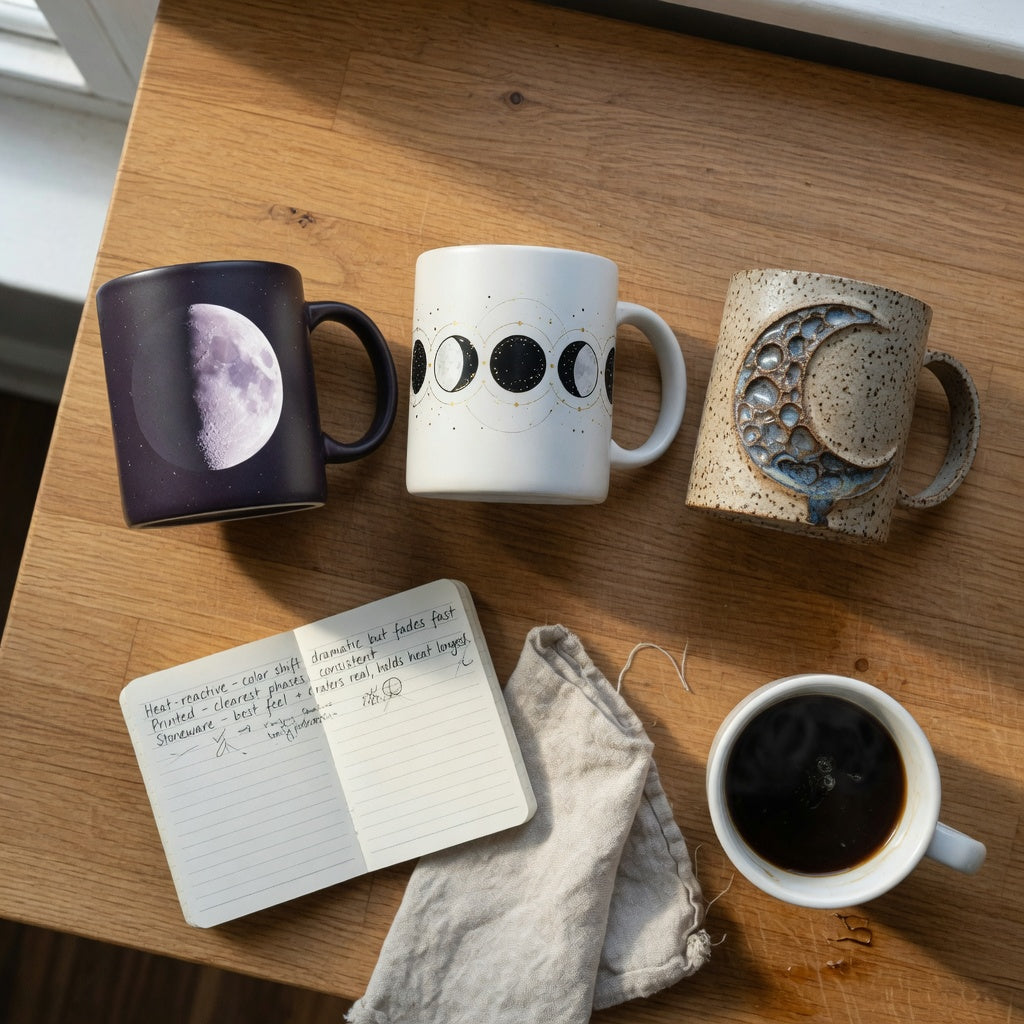
On a kitchen counter, three moon mugs can look like the same purchase: a dark vessel, a pale graphic, a handle. Then the coffee goes in. One mug reveals a moon only while the drink is hot. One shows the same printed phases whether it is full or empty. One has a crater glaze that will not match the next piece off the wheel. A moon ceramic coffee mug comparison is really a comparison of those behaviors, not the artwork.
We sell this category, and the questions that come back to us are rarely about whether the moon is pretty. They are about a mug that stopped changing color after a few dishwasher cycles, a base that leaves a wet ring on a desk, or a gold rim that made someone hesitate before microwaving. This guide separates the four types shoppers actually compare and shows which details to verify before you buy.
Why does a moon ceramic coffee mug comparison start with the ceramic?
Almost every listing you open falls into one of four buckets, and the care rules do not carry across them:
- Heat-reactive ceramic. A dark outer surface hides a moon, eclipse, or moon-phase graphic that appears when hot liquid warms the glaze. The reveal is the product.
- Printed or sublimated ceramic. A fixed moon image fired onto the surface. More consistent, and the design is there whether the mug is hot, cold, or empty.
- Engraved or carved stoneware. The moon is cut into the clay body or a slip layer. Durable, but the carved lines collect coffee oils and need a brush, not a rinse.
- glazed studio ceramics. Crater-like glazes, carved crescents, metallic gold or platinum luster, and a shape that will not match the next one off the wheel.
Two of those four are closer to commodities. Two are small-batch goods with real variability. Treating them as one category is how buyers end up disappointed by a mug that was never meant for a dishwasher or a microwave.
Is the moon permanent, or only there while the drink is hot?
Heat-change mugs use leuco-dye thermochromic inks — an encapsulated system of color-changing dye, developer, and solvent. Below the activation temperature the solvent is solid and the print reads dark; above it the solvent liquefies and the print can go transparent or translucent, exposing the moon underneath. Published polymer research describes these inks as sensitive to UV light, repeated heat cycling, and chemical exposure, and notes that ruptured microcapsules can stop the color change from reversing.
One honest caveat most listings skip: that research was done on printed packaging, not on finished, fired, repeatedly washed mugs. There is no clean published number for how many dishwasher cycles a thermochromic moon survives. What we can tell you from handling them is practical:
- Ask the maker for the activation temperature. Listings often omit it, and a lukewarm drink may show nothing.
- The moon typically fades as the drink cools and as the level drops, so a tall mug may only show its full graphic when nearly full and hot.
- Hand washing in warm water with a soft sponge is the conservative choice for any heat-change mug, whatever the listing claims.
If a design claims to be educational, count the phases. NASA lists eight in order: new moon, waxing crescent, first quarter, waxing gibbous, full moon, waning gibbous, third quarter, and waning crescent. The phase cycle runs about 29.5 days, while the Moon’s orbit is about 27.3 days. Plenty of decorative moon graphics are not astronomically sequenced, which is fine if you only want the look.
Which capacity and opening width fit black coffee versus a latte?
This is where moon mugs diverge most in daily use, and it has nothing to do with the design. Consumer Reports’ testing commentary makes two points worth internalizing: a narrower mug exposes less liquid surface, which cuts evaporative cooling, and a cover helps more than most people expect. The same source notes a wrinkle — if you do not preheat the mug, a lighter vessel actually cools your coffee less, because it absorbs less heat from the drink. Thick ceramic has more mass, so it pulls more heat at first, but that mass then holds warmth longer.
Listings we see often cluster around 11 to 20 oz for printed moon mugs, while studio-made moon mugs often land near 400 to 500 ml. Those are not the same drink. A wide 16 oz bowl is lovely for a latte and terrible for keeping a small black coffee hot. A narrow 11 oz mug is the opposite.
| What to compare | Heat-reactive moon mug | Printed or engraved ceramic | glazed studio mug |
|---|---|---|---|
| Design permanence | Appears above an activation temperature | Permanent print or carving | Permanent glaze, unique per piece |
| Microwave | Ask the maker — safest to avoid | Often stated safe; verify | Never if it has metallic luster |
| Dishwasher | Hand wash extends the reveal | Frequently stated safe | Usually hand wash |
| Piece-to-piece consistency | High | High | Low by design |
| Heat retention logic | Depends on wall mass and opening | Depends on wall mass and opening | Usually thicker, slower to warm, slower to cool |
Do the dishwasher and microwave claims cover the decoration or just the body?
Read the wording closely, because the claim is often narrower than it looks. A listing that says microwave safe may mean the unglazed clay body, not the printed band, the gold rim, or the thermochromic coating. Metallic decorations — 24k gold luster, platinum accents, metallic moon rims — are the classic microwave hazard, and no amount of attractive photography changes that.
When a listing is ambiguous, ask directly: does the safe claim apply to the whole mug, the ceramic body only, or the decoration too? A seller who cannot answer is telling you something. We would rather you ask that question before checkout than discover the answer when a metallic rim sparks.
What do FDA lead and cadmium limits mean for a mug you use daily?
The FDA sets an action level of 0.5 micrograms of lead per milliliter of leaching solution for small ceramic hollowware — cups and mugs around 240 mL with a handle — applied to any one of six units tested. Cadmium action levels are 0.5 micrograms per milliliter for small hollowware and 0.25 for large hollowware. Testing is typically done by acetic acid extraction under ASTM C738, which is deliberately harsher than normal use.
Two things follow for moon mugs specifically. First, microwave safe does not prove lead free; they are different questions. Second, decoration at the rim and lip deserves the most scrutiny, because that is where food contact is constant. The FDA is blunt that lead can leach from ceramic food-contact surfaces and that pieces flagged by a home test should not be used for food or drink. If a glazed mug leaves a wet ring under the base, ask the maker about firing temperature and vitrification before you assume it is fine — an underfired, porous body is a separate problem from glaze chemistry, but both are worth a direct question.
glazed or printed: which survives a desk, a sink, and a gift box?
Picture the actual routine: mug filled at 7am, sitting next to a keyboard, refilled at 11, rinsed at 2, tossed in the dishwasher whenever the load runs. A printed ceramic mug handles that cycle with little drama, and the trade-off is that the print can dull at the rim over years of scrubbing. A glazed stoneware mug gives you a thicker wall, a heavier hand-feel, and a glaze no one else owns — and asks for hand washing, careful stacking, and acceptance that the crater pattern on yours will not match the website photo.
- Choose printed if the mug will live in a shared office kitchen and go through a dishwasher most days.
- Choose heat-reactive if the reveal is the point and you will treat it gently — hand wash, no microwave, no abrasive sponge.
- Choose glazed if you want a piece you reach for deliberately, wash by hand, and expect to show variation in glaze and shape.
If you want one mug for morning coffee and afternoon tea, and the elk-and-moon motif is what caught your eye, our Elk and Moon Coffee & Tea Mug is the piece to check first. It suits a desk or kitchen counter where the mug stays out. It is not the right pick if you want a heat-reveal gimmick or a very large black-coffee mug; for those, compare thermochromic or high-capacity options. Confirm capacity, dishwasher and microwave wording, and whether any metallic decoration is present on the current listing.
If you are still comparing shapes, browse the unique coffee mugs collection to see this piece beside the rest of the range.
What should a moon ceramic coffee mug comparison cover beyond the design?
- Design type. Permanent print, carved stoneware, or temperature-activated? That single answer sets your care routine.
- Capacity in the unit you think in. Convert ounces to milliliters if the listing uses one and your mental model uses the other.
- Care claim scope. Body only, or body plus decoration? Ask if it is unclear.
- Metallic accents. Any gold or platinum means no microwave, full stop.
- Wall thickness and opening width. Narrow and thick holds heat; wide and thin is a latte mug, not a sipping mug.
- Variation disclosure. On glazed pieces, look for an explicit statement that glaze and shape vary.
- Glaze safety questions. Ask whether the maker publishes lead and cadmium extraction results for the food-contact surface and rim.
Frequently asked questions
Are heat-changing moon mugs dishwasher safe?
Treat it as maker-specific. Listings disagree with each other, and the thermochromic layer is a separate material from the ceramic body — a claim about the mug may not cover the coating. Hand washing in warm water with a soft sponge is the safest habit if you want the reveal to keep working.
What should a moon ceramic coffee mug comparison include beyond the artwork?
Capacity, wall thickness, opening width, the exact dishwasher and microwave wording, whether any metallic decoration is present, and whether the piece is identical to the photo or one of a variable glazed run. Design is the first filter, not the deciding one.
How hot does the drink need to be for the moon to appear?
It varies by manufacturer and is rarely published as a number. Freshly poured hot coffee or tea triggers the change and a cooling drink fades it back. If you drink lukewarm coffee, a color-change mug will mostly stay dark.
Does a thicker ceramic mug really keep coffee warmer?
Partly. More mass absorbs more heat at the start, then releases it more slowly, and a narrower opening reduces evaporative loss. Preheating the mug with hot water and using a cover will do more for your coffee temperature than swapping between two similar ceramics.
What should I verify on the listing before checkout?
Check stated capacity, the exact dishwasher and microwave wording, and whether the decoration includes metallic luster. If those details are missing, ask before ordering. You can start with our Elk and Moon Coffee & Tea Mug listing and compare it against the rest of our unique coffee mugs.
Ready to pick your mug? Two ways to save on today's order:
Ordering 1–3 mugs? Get an extra 10% off your 1st order with code 10_OFF Apply 10% Off & Shop Wooden-Handle Mugs →
Gifting 4+ mugs? Buy 3, Get the 4th Free applies automatically at checkout (no code needed; offers do not stack) · Free standard shipping (Nov pre-Christmas delivery: 15–20 calendar days US) · Free replacement if chipped in transit.
Popular mug buying guides: Ceramic Tea Cups & Infuser Mugs · Ceramic Mugs with Lids Compared · Wooden-Handle Tea Infuser Mugs Compared · Christmas & Secret Santa Mugs 2026 · Espresso & Cortado Cups Guide · Cup & Saucer Gift Sets · All 25 Mugs Spec Table · Mug Size Guide · Shipping & Promo FAQ
FIRST ORDER 10% OFF (CODE: 10_OFF) · OR BUY 3, GET THE 4TH FREE


Read more

Tall Coffee Mug for Home Office Desk: What Buyers Should Compare
Most tall mug regrets surface after delivery: the cup clears the brewer but not the shelf, or it holds 20 ounces on a base barely wider than a coaster. Here is the comparison order our team walks b...
Read more
Mountain Sea II Mug Buying Checklist: What to Compare First
A working Mountain Sea II mug buying checklist for shoppers comparing the 450 ml ceramic body, wooden handle comfort, care wording, and gift fit — including the questions the current listing leaves...
Read more
Leave a comment
This site is protected by hCaptcha and the hCaptcha Privacy Policy and Terms of Service apply.