
Minimalist Ceramic Mug for Small Coffee Setup: Footprint, Capacity, Fit
Reading time: about 10 minutes
On a narrow coffee counter, the mug is rarely the only object competing for space. A handle can catch the grinder, a tall body can meet the underside of an open shelf, and extra capacity can turn the only clear landing spot into a permanent obstacle. That is the fit problem behind choosing a minimalist ceramic mug for small coffee setup: it must clear the shelf, leave room beside the kettle, and hold the amount you actually pour. At CoffeifyMug, we handle these forms during packing and gift unboxings, so we compare the practical footprint before the visual finish. Here, minimalist is a shopper-facing lens for the simple visible forms in this group, not a formal design classification.
Will a minimalist ceramic mug for small coffee setup clear your shelf?
Start with the space where the mug will live, not the room's total counter length. A small station may share one strip with a grinder, kettle, scale, spoon rest, and laptop. Measure the usable opening with that equipment in place. We record vertical clearance from the surface to the shelf underside, the mug body's widest width and depth, and the handle's farthest reach. Then leave enough access to lift it without twisting around the wall or an appliance.
Product photos are poor rulers. Use the dimensions shown on the individual listing when they are provided, and compare them with your measurements in the same unit. Check the body and handle separately: a base can fit neatly while the handle projects into the next work zone.
- Height: measure from the surface where the mug will sit to the lowest part of the shelf above it.
- Base footprint: record the widest body width and depth, not only the diameter of the foot ring.
- Handle reach: include the outside edge of the handle and the finger space needed to lift it.
- Landing space: leave room to set the mug down without touching the kettle, dripper, wall, or laptop.
A clean round body can be a useful reference point for a one-mug apartment station, but the product page's listed dimensions still decide the fit. A simple silhouette does not eliminate the need to measure.
What does your actual pour require from the listed capacity?
Listed capacity tells you how much the mug is designed to hold, but it does not tell you how much counter space the body occupies. The words mug and cup in a product name are not a capacity measurement. A wider body can spread across a dripper's landing area; a taller body can preserve floor space but lose clearance beneath a shelf. Compare listed capacity with exterior dimensions as a pair.
Use your normal drink as the reference. For three mornings, pour your usual coffee or tea into a measuring cup and record the amount you actually serve. That quick check is more useful than choosing the largest listed number. Leave room for carrying and stirring, especially on a desk where the mug sits beside electronics.
- Short coffee or espresso-based drinks: prioritize a compact base and a listed capacity close to the serving you make.
- Filter coffee: check that the listed capacity covers your pour without forcing a broad bowl into the only clear spot.
- Tea or shared use: a larger serving may be worthwhile, but verify height and handle reach before accepting the extra volume.
Iced coffee deserves a separate decision. Ice occupies volume, and a ceramic mug without a lid is not automatically a good carry option. If cold drinks or commuting are central to your routine, compare a vessel designed for that job rather than stretching a compact coffee mug past its practical use.
How much shape and handle projection can your counter tolerate?
Two ceramic mugs can have similar listed capacity and still behave differently on a crowded station. The widest point may sit near the base, shoulder, or rim. Handle opening affects knuckle clearance; the handle's outside edge determines the sideways footprint. These are the shape questions we check when a customer is fitting a mug next to a kettle or laptop.
| Visible form | Useful starting situation | Space question to answer |
|---|---|---|
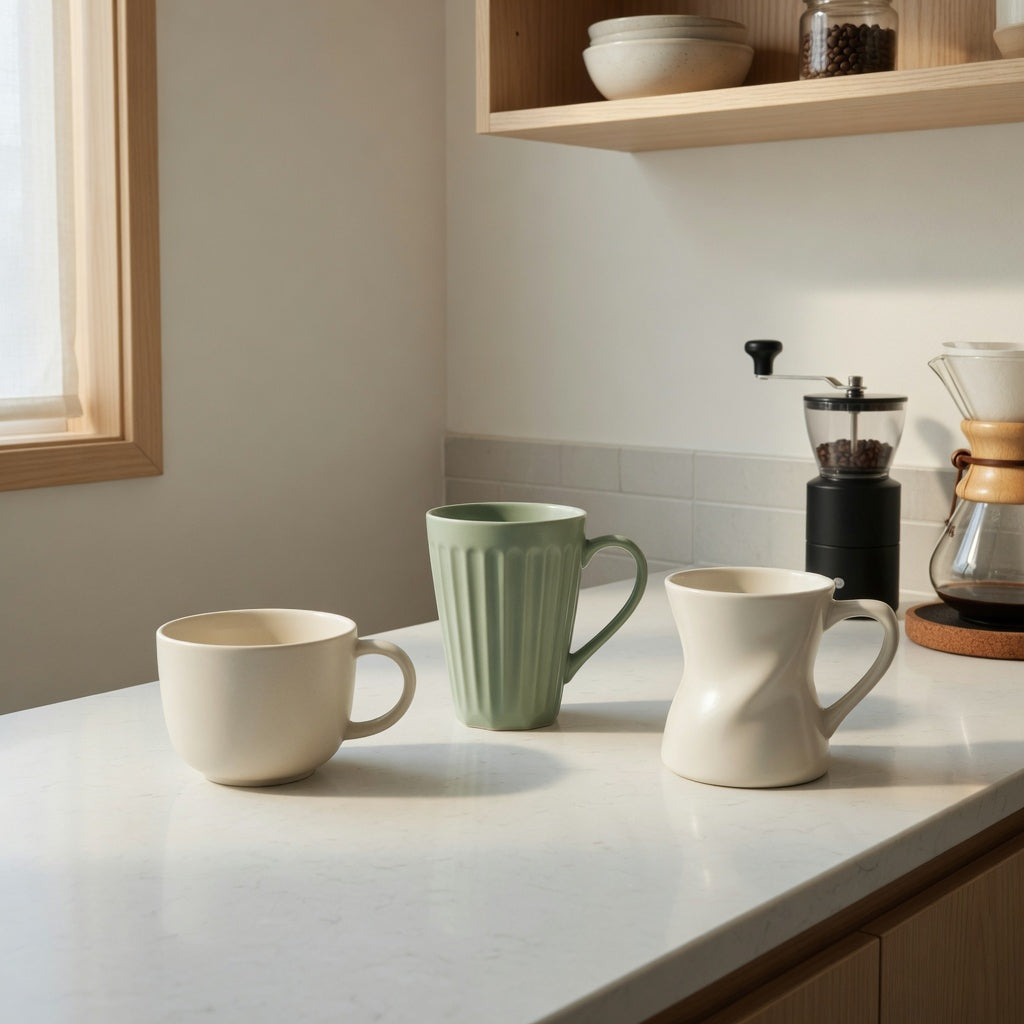
| Round body | One-cup apartment counter or uncluttered office setup | Do the base and handle leave room for the next tool? |
| Pleated surface | Desk or shelf where the buyer wants visible texture | Do the ridges and handle fit the wipe-down and storage routine? |
| Retro profile | Shared kitchen or gift display with a more collected look | Does the curved outline need extra shelf or counter clearance? |
A smooth round body gives fewer external contours to measure and wipe than a pleated body. Pleats add visible texture, but the ridges can require more attention if coffee residue dries on the outer wall. A retro curve can suit a collected kitchen or gift presentation, while its outline may need more clearance than a straighter form. These are visual and spatial observations, not a formal design grade or a promise about performance.
For larger hands, test the handle opening rather than judging it from the silhouette. For a desk, test whether your fingers can enter and exit without bumping the monitor stand or notebook edge. Comfort and footprint are linked, but neither should be assumed from capacity alone.
What should you inspect on the ceramic body at unboxing?
The three product options discussed here are presented as ceramic forms. That gives you a consistent material lens for this comparison, but ceramic by itself does not establish a durability rating, thermal-retention figure, microwave approval, or dishwasher approval. We keep those claims tied to the individual product listing.
When our team handles a piece for packing or a gift unboxing, we check details that a thumbnail hides:
- Rim: look for a chip, sharp spot, or rough edge before filling the mug.
- Handle join: inspect the attachment area for a crack or sharp projection. A visible transition where handle meets body is not automatically a defect.
- Glaze: look for pinholes, crawling, or a patch of bare clay rather than assuming every surface difference is damage.
- Foot ring: set the empty mug on a flat surface and check for rocking or a rough base that could mark a shelf.
Care is equally specific. Read the care instructions on the product page before the first dishwasher cycle or microwave use; the word ceramic is not a blanket guarantee. If dishwasher use is expressly listed, position the mug so the rim and handle do not strike other pieces. For hand washing, a non-abrasive sponge and a deliberate set-down at the sink help reduce contact with the rim and base. Unbox a gift before wrapping it so you can make the same checks and confirm the shape suits the recipient's shelf or desk.
Which CoffeifyMug form fits an apartment shelf, office desk, or gift?
The right choice depends on what the small setup asks the mug to do. We use this situation-first comparison in our store:
- Apartment kitchen with one open shelf: Start with the round coffee tea mug if you want the simplest visible outline to measure beside the grinder and kettle. Its role here is a baseline, not a promise that it fits every shelf. Compare the listing's capacity, body dimensions, height, and handle reach with your recorded clearance.
- Office desk with a laptop and notebook: Inspect the pleated coffee tea cup if surface texture is part of the appeal and you want the mug to serve as the one visible accent. Check the handle's outer edge against the laptop zone, and consider whether the ridges make your wipe-down and storage routine less convenient.
- Shared kitchen or gift unboxing: Consider the retro coffee tea cup if a more curved, display-oriented form suits the room or recipient. Accept the trade-off of potentially needing more visual and physical clearance, then verify the listed capacity and dimensions before purchase.
After those three comparisons, use the unique coffee mugs collection to see the current forms together. That is useful when the measurements work but none of the three silhouettes fits the kitchen's existing handles, shelves, or serving habits.
When should a different vessel replace ceramic?
A minimalist ceramic mug is a poor fit if your priority is a sealed lid, spill resistance, insulation for a commute, or a very large cold drink. It is also a weak choice for a cabinet that requires confirmed stacking geometry; do not assume similarly shaped cups nest safely. A travel tumbler, insulated mug, larger iced-drink vessel, or explicitly stackable set may serve those jobs better.
Small counters can expose another limitation: a mug that fits while empty may become awkward when the handle collides with the kettle or the filled weight makes a lightweight cart feel unstable. If the available landing area is too tight for the body plus a hand's access path, choose a smaller cup or reorganize storage before buying. We would rather point you to a different style than suggest a ceramic form for a task it does not cover.
Which five measurements belong on your order checklist?
Before clicking order, write down these five facts:
- Vertical shelf clearance, measured from the actual counter or shelf surface.
- Free body width and depth after the grinder, kettle, or laptop is in place.
- Maximum handle reach and the space needed for your fingers.
- Your usual coffee or tea volume in ounces or milliliters, compared with the listed capacity.
- Required care and storage rules, including whether the listing explicitly addresses dishwasher, microwave, or stacking use.
If a product page leaves a key measurement or care detail unanswered, treat that as an open question rather than filling the gap with assumptions.
Frequently asked questions
What listed capacity works best for a minimalist ceramic mug for small coffee setup?
Choose a listed capacity that covers your normal serving, then check the body's width, height, and handle reach. A larger capacity can help with tea or a generous pour, but it may claim more shelf or counter space. Measure the drink you actually make instead of choosing by the largest number.
How do I measure a ceramic mug's footprint under an open shelf?
Measure the widest body width and depth, then measure from the center of the mug to the outside edge of the handle. Compare those dimensions with the free counter area and add vertical shelf clearance. Also leave a hand-access path so the mug can be lifted without hitting the wall, kettle, or laptop.
Are the round, pleated, and retro CoffeifyMug cups the same size?
Do not assume they are. Compare each product page's listed capacity and dimensions, then inspect the visible body shape and handle reach; similar serving volume can occupy a different footprint. Use the round, pleated, and retro pages as separate comparisons rather than treating the names as a size system.
Is ceramic a good choice for a small office desk or iced coffee?
It can work for a stationary hot drink if the body and handle clear the desk equipment. It is not automatically spill-resistant, insulated, or sized for a large iced drink, and ceramic alone does not establish those features. For commuting or ice-heavy drinks, choose a vessel whose listing explicitly supports that use.
How should I check a ceramic mug before its first dishwasher cycle?
Read the individual listing's care instructions first; ceramic material alone does not confirm dishwasher suitability. If dishwasher use is stated, keep the rim and handle from striking other items and inspect the mug after the cycle for chips, rough spots, or changes that need attention. If care information is not listed, ask before relying on a dishwasher routine.
Next step: Measure the shelf, free counter rectangle, handle reach, and usual drink volume today. Then compare those notes with the listed details on the three product pages above, and use the unique coffee mugs collection for another current shape if the fit is still uncertain.
More from our blog
Read more
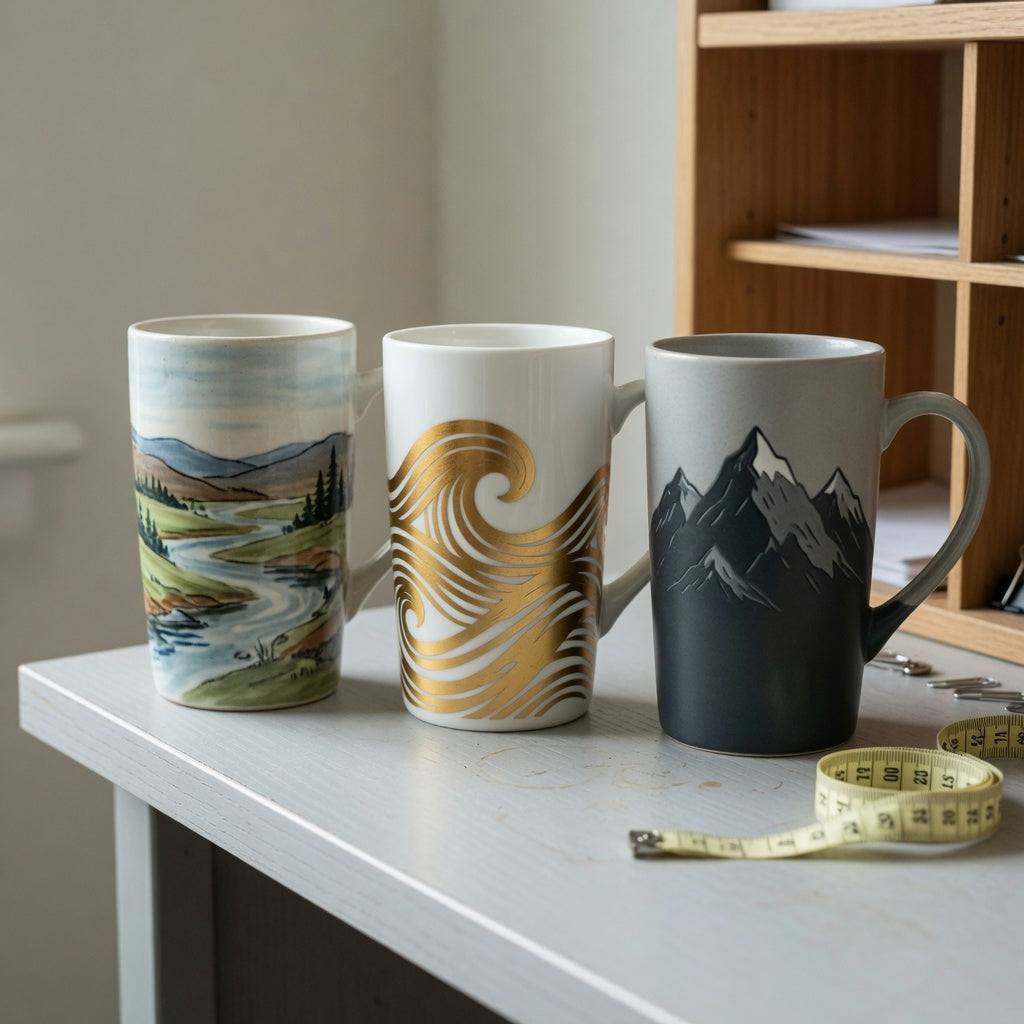
Tall Ceramic Coffee Mugs Shape and Handle Guide: Compare 3 Options
Compare the visible silhouettes, handle openings, listed dimensions, and capacity notes of CoffeifyMug's three tall ceramic mug designs. Use practical desk, shelf, grip, care, and gifting checks to...
Read more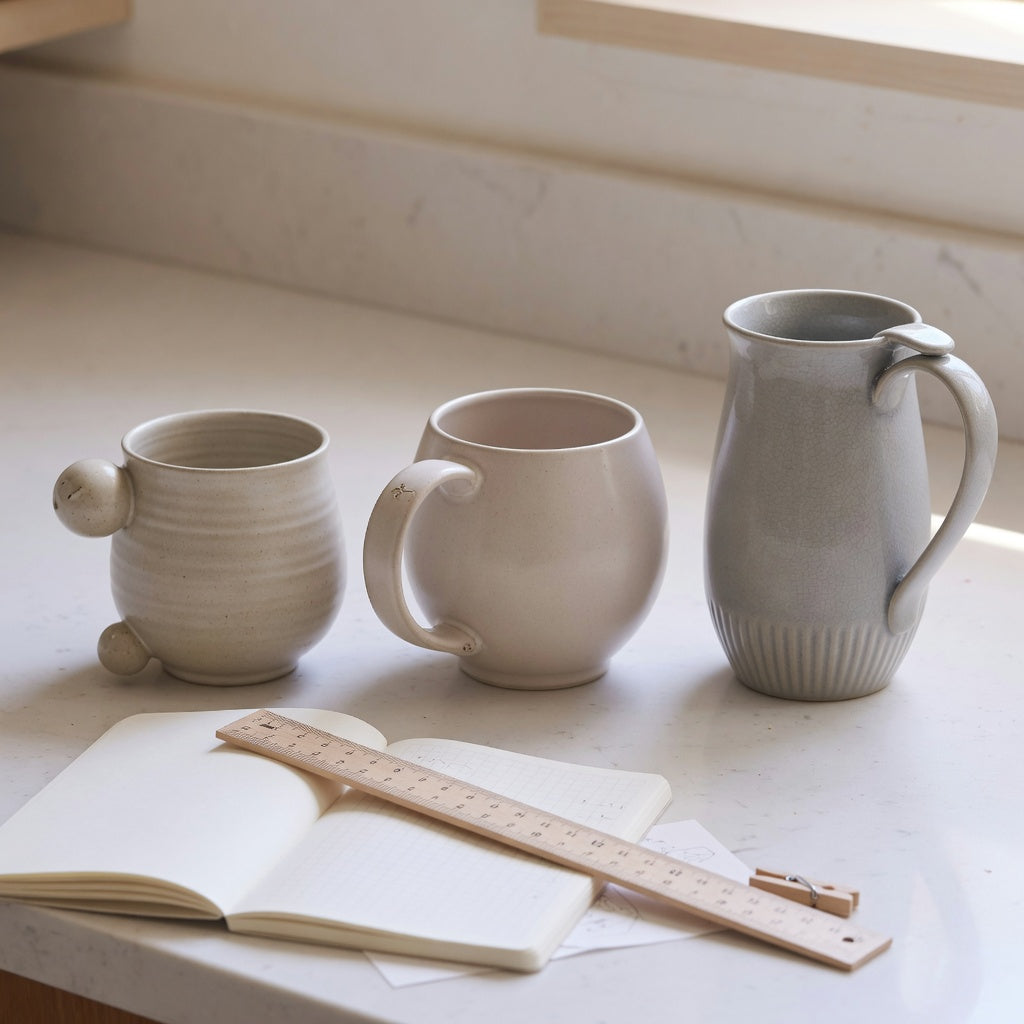
Ceramic coffee mug with handle shape and handle guide: 3 options
Compare the ball-handled, round, and Flow ceramic coffee tea mugs by visible vessel shape, handle form, listed capacity, and approximate dimensions. Use the trade-offs to choose a desk, kitchen, or...
Read more
Leave a comment
This site is protected by hCaptcha and the hCaptcha Privacy Policy and Terms of Service apply.