
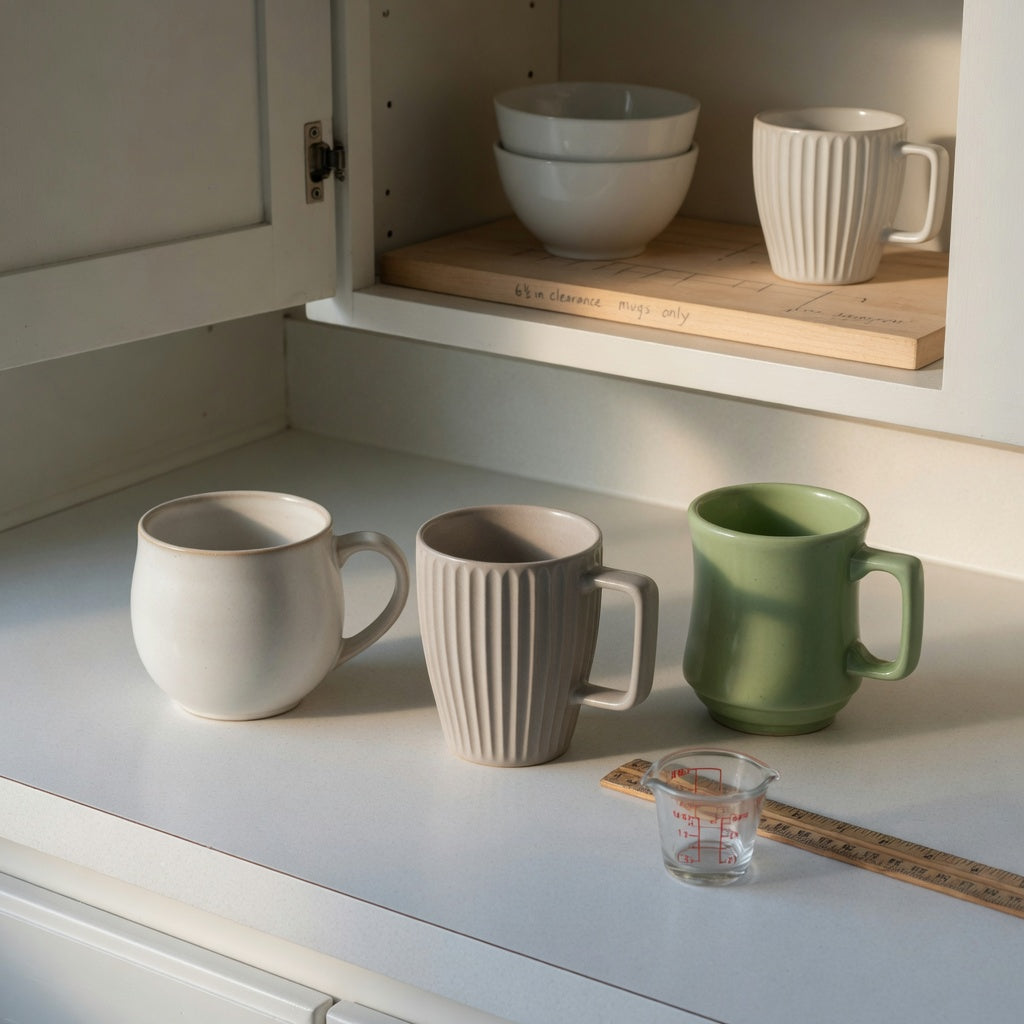
Minimalist Ceramic Mug Everyday Rotation: Practical Purchase Checklist
Reading time: about 9 minutes
At 7:30 a.m., the mug at the front of the cabinet usually gets picked. A new cup may look right online and still fall out of use because its listed capacity misses your normal pour, the handle fit is uncertain, or the body occupies the only open shelf space. That is why our minimalist ceramic mug everyday mug rotation practical purchase checklist starts with the cabinet and the drink, not a style label.
We sell and handle these ceramic forms for product presentation and fulfillment, and the useful questions are concrete: How much do you pour? Where does the mug dry? Can you follow the disclosed care instructions? Here, minimalist is a shopper-facing description of restrained visible forms. It is not a formal design classification, a durability rating, or a claim of premium quality.
Why does one mug get used while another stays on the shelf?
An everyday rotation is the group of mugs that moves repeatedly from storage to counter, desk, sink, or dishwasher. There is no universal number that makes a rotation work. Frequency matters more: a two-mug office setup can be practical, while a large kitchen collection can still depend on the same three cups.
Before adding another piece, audit the mugs you already reach for:
- Record the amount of coffee or tea you normally pour, including milk and carrying headspace.
- Measure the height, base width, and handle-to-rim width of your most-used mug.
- Check the shelf depth, cabinet-door clearance, drying-rack space, and coaster size it uses.
- Note whether your routine depends on a dishwasher, microwave, or quick hand wash.
In our experience, this simple audit exposes the real buying criteria. A shopper may think the goal is a cleaner-looking mug, then discover that the non-negotiable detail is a handle that does not collide with the mug beside it. Another may need enough listed capacity for tea plus milk but no extra width beside a laptop.
Minimalist ceramic mug everyday mug rotation practical purchase checklist
Use the current product page for every check because listed details can change. An attractive photograph should start the comparison, not settle it.
- Match listed capacity to an actual pour. Fill your current mug from a kitchen measuring cup and record the amount you genuinely drink. For iced coffee, add your normal ice first and allow space to carry the mug without spilling. Do not treat total listed capacity as guaranteed comfortable fill volume.
- Confirm the stated material. The options compared here are ceramic forms. Material alone does not establish wall thickness, weight, heat retention, resistance to breakage, or suitability for a particular appliance.
- Read the visible shape literally. Round, pleated, and retro describe the forms shown and named in our store. They help you compare appearance, but they do not prove stackability, stability, comfort, or any formal school of design.
- Check the handle against your grip. A product image can confirm that a handle is present, but it may not establish finger clearance or balance in your hand. Compare any listed dimensions with a handle you already use comfortably. Treat an unlisted measurement as an unknown.
- Measure the storage envelope. Include the handle when measuring total width. Check shelf height and depth, cabinet-door swing, drying-rack clearance, and the space needed to lift the mug out without moving every neighboring cup.
- Read the disclosed care information. If daily dishwasher cycles or microwave reheating are essential, look for an explicit statement on the individual product page. Do not infer appliance compatibility from ceramic material or appearance.
- Assign the mug a role. Decide whether it will be a high-frequency core mug, an office-only cup, a tea mug, or one visually distinct accent. A purchase without a clear role is more likely to compete with something you already prefer.
An unknown does not automatically disqualify a mug, but it is not a verified benefit. If handle clearance, appliance care, or capacity is essential and the listing does not answer the question, keep comparing rather than filling the gap with an assumption.
Capacity, handle, and shelf measurements for real routines
| Use scenario | Measure or verify | Reason to keep comparing |
|---|---|---|
| Morning coffee or tea | Usual liquid volume plus milk and headspace | The listed capacity does not suit your normal prepared drink |
| Iced coffee | Ice, liquid, and safe carrying space together | Your preferred recipe would require filling close to the rim |
| Office desk | Base area, handle direction, coaster size, and keyboard clearance | The listing lacks a dimension that your tight workspace requires |
| Kitchen cabinet | Total width with handle, body height, shelf depth, and door clearance | The mug only fits after frequently used items are moved |
Do not assume that similar-looking ceramic mugs will nest or stack. Rim shape, foot ring, wall angle, and handle position all affect how two pieces meet. If a product page does not explicitly state stackability, plan to store it as a single mug and confirm that your shelf can accommodate that footprint.
Round, pleated, or retro: which visible form suits your rotation?
There is no universal winner among these three ceramic options. The useful choice depends on the role you identified and the amount of visual detail you want to add.
A quiet core mug for a visually busy shelf
If your cabinet already contains printed or sculptural pieces, start with the round coffee tea mug. Its visible rounded form is the reason to shortlist it: the silhouette adds less surface detail than a pleated exterior. Compare its current listed capacity, material details, handle, and care information with your most-used mug before assigning it a daily role. The round form alone does not establish that it will stack.
Surface detail without a printed graphic
If completely smooth cups feel too plain but a bold motif would disrupt your kitchen or desk, consider the pleated coffee tea cup. The visible pleating gives the exterior a more defined surface treatment while keeping the comparison focused on form. Choose it for that appearance, not an assumed improvement in grip, insulation, or durability. Verify the current capacity and handle proportions for your routine.
One distinct accent inside a restrained set
If most of your rotation already consists of simple rounded forms, the retro coffee tea cup can fill the accent role. Its retro-influenced visible profile provides more identity without relying on a graphic print. It is still necessary to compare the listed capacity and material, examine the handle shown, and check disclosed care rather than assuming that the distinctive silhouette changes performance.
If none of those situations matches your cabinet, browse our collection of unique coffee mugs. Use the collection to compare forms, then return to the same capacity, handle, storage, and care checks. The broader collection is the better next step when a specific grip, larger drink, or different visual role matters more than choosing among these three shapes.
Care labels and unboxing checks before the first drink
A mug that conflicts with your normal cleaning routine will not stay convenient. A household that runs one dishwasher cycle each evening needs clear dishwasher guidance. An office with only a shared sink may make easy hand washing more relevant. In either case, rely on the care instructions stated for the individual product.
- Check for explicit dishwasher and microwave language before using either appliance.
- During unboxing, inspect the rim and both handle-to-body joins for chips or visible cracks from transit.
- Set the mug on a level counter and confirm that the foot sits as expected without pronounced rocking.
- Compare the received shape and surface with the product images before the first wash, especially for a gift unboxing.
These are receipt checks, not durability predictions. We do not treat a thicker-looking body, a rounder profile, or a textured surface as proof that one ceramic mug will last longer than another.
Who should skip these minimalist ceramic forms?
- Commuters needing a sealed lid: An open ceramic mug is not a substitute for a lidded travel vessel. Choose a category designed for transport and spill control.
- Drinkers making large iced recipes: If the listed capacity cannot hold your normal ice, liquid, and headspace, choose a larger format instead of overfilling the mug.
- Shoppers who require verified stacking: A round or tapered appearance is not enough. Select a product that explicitly addresses stacking or measure for single-piece storage.
- Anyone needing exact grip accommodation: If handle clearance is critical for comfort or dexterity, unlisted handle dimensions leave a meaningful gap. A product with exact measurements or an in-person fit check may suit you better.
Minimal visual styling is also not the right answer for every room. A shopper building a colorful matched set or looking for a strongly sculptural centerpiece may be better served by a more decorative mug, even if the three forms above fit the basic material and capacity requirements.
A two-minute cabinet check before ordering
- Place your most-used mug on the counter.
- Measure its normal pour, total width with handle, base, and height.
- Check the available shelf, desk, coaster, and drying space.
- Choose one role for the new mug: core, office, tea, iced drink, or accent.
- Reject any candidate whose essential capacity, handle, storage, or care requirement remains unresolved.
This short comparison keeps the minimalist ceramic mug everyday mug rotation practical purchase checklist tied to daily use. It also prevents visible style from standing in for measurements or product facts.
Frequently asked questions
What belongs in a minimalist ceramic mug everyday mug rotation practical purchase checklist?
Compare the listed capacity with your measured pour, confirm the stated ceramic material, review the visible shape and handle, measure the storage footprint, and read all disclosed care instructions. Also decide what role the mug will have so it does not duplicate a cup you already use more often.
How can I tell if a mug's listed capacity fits my daily drink?
Measure the finished drink in your current mug, including milk or other additions. For iced coffee, measure after adding your usual ice and leave carrying headspace. Compare that amount with the product's current listed capacity rather than estimating from photos.
Can I assume the round, pleated, or retro mug will stack?
No. A visible shape does not prove that rims, foot rings, walls, and handles will align safely. Unless the product listing explicitly addresses stacking, plan for individual shelf storage.
Are CoffeifyMug ceramic mugs dishwasher or microwave safe?
Check the care statement on the individual product page before using a dishwasher or microwave. This checklist does not infer appliance compatibility from ceramic material, product name, or appearance.
Which form should I choose for a quiet everyday rotation?
Choose the round form if you want a restrained core silhouette, the pleated form if you want visible surface detail without a printed graphic, or the retro form if you want one distinct accent. In every case, confirm the current capacity, handle information, and disclosed care before ordering.
Start with the mug you already use most, complete the measurements, and compare one candidate at a time. Open the round, pleated, or retro product page for a focused choice, or use the unique coffee mugs collection when your capacity, grip, care, or storage requirements point to a different form.
More from our blog
Read more
Ceramic Coffee Mug With Handle: Everyday Mug Rotation Product Shortlist
Build a practical three-mug rotation around pour size, use frequency, and storage. We compare ceramic options in listed 11, 12, and 14 oz capacities, with clear reasons to choose or skip each handl...
Read more
Tall Ceramic Coffee Mugs: Everyday Mug Rotation Purchase Checklist
Use shelf clearance, listed capacity, handle form, wash routine, and placement to decide which tall ceramic mug belongs in your daily rotation. We also flag cases where a shorter, lidded, or insula...
Read more
Leave a comment
This site is protected by hCaptcha and the hCaptcha Privacy Policy and Terms of Service apply.